Browse by Category
Fiction
- Action & Adventure
- African American
- Anthologies
- Children's Fiction
- Classics
- Comics & Graphic Novels
- Coming of Age
- Contemporary
- Cultural & Regional
- Drama
- Erotica
- Fantasy
- General
- Historical Fiction
- Horror
- Humor & Satire
- Literary Fiction
- Mystery, Thriller & Suspense
- Poetry
- Religious & Inspirational
- Romance
- Science Fiction
- Short Stories
- War & Military
- Westerns
- Women's Fiction
- Young Adult
Non-Fiction
- Antiques & Collectibles
- Arts & Photography
- Biographies & Memoirs
- Business & Money
- Children's Non-Fiction
-
Computers & Technology
- Artificial Intelligence
- Computer Science
- Cybersecurity & Cryptography
- Data Science & Analytics
- Databases & Big Data
- Game Development & Design
- General
- Hardware & DIY
- Mobile App Development
- Networking & Cloud Computing
- Operating Systems
- Programming
- Robotics
- Software
- Software Engineering
- User Experience (UX) & Design
- Web Development & Design
- Cooking, Food & Wine
- Crafts, Hobbies & Home
- Education & Teaching
- Engineering
- General
- Health, Fitness & Dieting
-
History
- African History
- African History - North Africa
- African History - Sub-Saharan Africa
- American History
- American History - 20th Century
- American History - Civil War
- American History - Colonial Period
- Ancient History
- Asian History
- Asian History - China
- Asian History - India
- Asian History - Japan
- Asian History - Southeast Asia
- European History
- European History - Ancient Greece
- European History - Ancient Rome
- European History - Medieval
- European History - Modern
- European History - Renaissance
- General
- Middle Eastern History
- Military History
- Military History - Aviation
- Military History - Naval
- Social & Cultural History
- World History
- Humor & Entertainment
- Industrial Technology
- Language Learning
- Law
- LGBTQ+ Non-Fiction
- Literary Criticism
- Medical Books
- Parenting & Relationships
- Philosophy
- Politics & Social Sciences
- Reference
- Religion & Spirituality
-
Science & Math
- Agricultural Sciences
- Astronomy & Space Science
- Behavioral Sciences
- Biological Sciences
- Botany & Plant Science
- Chemistry
- Earth Sciences
- Engineering - Chemical
- Engineering - Civil
- Engineering - Electrical
- Engineering - Mechanical
- Environment
- General
- Geology
- Mathematics
- Nature & Ecology
- Oceanography
- Paleontology
- Physics
- Statistics
- Self-Help
- Sports & Outdoors
- Study Aids
- Sustainability & Green Living
- Textbooks
- Transportation
- Travel
- True Crime
- Urban Planning & Development
- Veterinary Medicine
- Writing & Publishing
Jump to Section

Want unlimited access to all books published by MixCache.com (plus their audiobooks)? Try MixCache.com Total Access. Look for the MTA badge on book covers to identify included titles.
Access to infinite ebooks: Don't see the book you want? Suggest it and we'll create it (free!) for you from scratch with our powerful AI book writer. Then read it with MTA - besides profiting from any sales it makes!
Education In Germany
MTA
A Comprehensive Overview from Early Childhood to Higher Education
About this book:
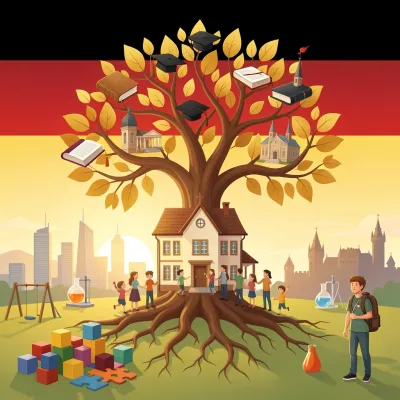
Germany's education system is characterized by its federal structure, with responsibility primarily held by the sixteen *Länder*, leading to regional variations while maintaining core national principles. Compulsory schooling typically begins at age six with *Grundschule* (primary school), lasting four years (six in Berlin and Brandenburg), where students learn together in mixed-ability classes focusing on foundational skills in German, mathematics, *Sachunterricht* (integrated studies), and social development. The pivotal transition after primary school involves the "track system," where students, around age ten (or twelve in some states), are guided into different secondary pathways based on teacher recommendations and parental consultation: the vocationally oriented *Hauptschule* (leading to *Hauptschulabschluss*), the intermediate *Realschule* (leading to *Mittlere Reife*), and the academically rigorous *Gymnasium* (preparing for the *Abitur* and university entrance). Comprehensive schools (*Gesamtschulen*) offer an alternative, integrating tracks and delaying early differentiation through internal differentiation and shared learning.
Central to Germany's strength is its internationally acclaimed Dual System of Vocational Education and Training, which seamlessly combines theoretical instruction at vocational schools (*Berufsschule*) with practical, on-the-job apprenticeships in companies. This system, accessible after lower secondary qualifications like *Hauptschulabschluss* or *Mittlere Reife*, trains students in over 300 recognized occupations, from traditional crafts to high-tech fields, and is financed through public vocational schools and private company investment. Higher education features two main pillars: research-oriented traditional universities (*Universitäten*), requiring the general *Abitur* for admission and emphasizing the unity of teaching and research, and practice-oriented Universities of Applied Sciences (*Fachhochschulen*), typically requiring the subject-specific *Fachhochschulreife* (from *Fachoberschule* or *Berufliches Gymnasium*) and focusing on applied sciences, engineering, business, and social work with strong industry ties and mandatory internships. Both sectors participate in the Bologna Process, offering Bachelor's and Master's degrees, with minimal tuition fees at public institutions enhancing accessibility.
The system faces ongoing challenges and reforms, including efforts to increase equity and permeability in the tracked system (e.g., expanding *Gesamtschulen* and bridging programs), integrating students with diverse needs through inclusive education (*Inklusion*) following the UN CRPD, addressing teacher shortages in STEM fields, modernizing infrastructure and pedagogy via initiatives like the *DigitalPakt Schule*, and responding to demographic shifts from immigration and declining birth rates. Internationalization significantly impacts higher education, with growing numbers of international students attracted by tuition-free access and English-taught programs, while German institutions engage globally through research collaborations and exchange programs. Future perspectives emphasize digitalization (AI, VR, coding), personalized learning, intensified focus on 21st-century skills (critical thinking, creativity, collaboration), sustained commitment to vocational excellence and permeability, and ongoing debates balancing state autonomy with national coherence in an evolving global landscape.
What You'll Find Inside:
- The German education system is structured into five main stages: early childhood, primary, secondary, tertiary, and continuing education, reflecting a commitment to both academic rigor and vocational training.
- A defining feature of German secondary education is its tracked system, comprising Hauptschule (vocational focus), Realschule (intermediate), and Gymnasium (academic/university preparation), alongside comprehensive schools (Gesamtschulen) that promote equity and flexibility.
- Germany’s Dual System of Vocational Education and Training (VET) integrates classroom learning with hands-on apprenticeships, combining theory and practice to prepare students for skilled professions.
- The country has a strong commitment to inclusive education, shifting from segregated special schools (Sonderschulen) toward integrating students with disabilities into mainstream classrooms with targeted support.
- Higher education in Germany features a binary system: research-oriented universities and practice-focused Fachhochschulen (Universities of Applied Sciences), both offering Bachelor’s and Master’s degrees, with most public institutions charging minimal or no tuition fees.
Who's It For:
This book is ideal for educators, policymakers, researchers, and students interested in comparative education or the German model of schooling. It also serves international readers seeking to understand the structure, history, and ongoing reforms of Germany’s decentralized education system—from early childhood through higher education—with particular relevance for those studying vocational training, inclusion, and educational governance.
Author:
Published By:
Date Published:
June 24, 2026
Type:
Nonfiction
Language:
English
Word Count:
40,816 words
Reading Time:
2 hours 51 minutes
Sample:
Order:
Order Education In Germany (Paperback) on MixCache.com:
Buy NowPrint copy is made to order and ships worldwide. Includes the ebook free, ready to read instantly.
$5 account credit for all new MixCache.com accounts, usable toward any ebook purchase!*