
Browse by Category
Fiction
- Action & Adventure
- African American
- Anthologies
- Children's Fiction
- Classics
- Comics & Graphic Novels
- Coming of Age
- Contemporary
- Cultural & Regional
- Drama
- Erotica
- Fantasy
- General
- Historical Fiction
- Horror
- Humor & Satire
- Literary Fiction
- Mystery, Thriller & Suspense
- Poetry
- Religious & Inspirational
- Romance
- Science Fiction
- Short Stories
- War & Military
- Westerns
- Women's Fiction
- Young Adult
Non-Fiction
- Antiques & Collectibles
- Arts & Photography
- Biographies & Memoirs
- Business & Money
- Children's Non-Fiction
-
Computers & Technology
- Artificial Intelligence
- Computer Science
- Cybersecurity & Cryptography
- Data Science & Analytics
- Databases & Big Data
- Game Development & Design
- General
- Hardware & DIY
- Mobile App Development
- Networking & Cloud Computing
- Operating Systems
- Programming
- Robotics
- Software
- Software Engineering
- User Experience (UX) & Design
- Web Development & Design
- Cooking, Food & Wine
- Crafts, Hobbies & Home
- Education & Teaching
- Engineering
- General
- Health, Fitness & Dieting
-
History
- African History
- African History - North Africa
- African History - Sub-Saharan Africa
- American History
- American History - 20th Century
- American History - Civil War
- American History - Colonial Period
- Ancient History
- Asian History
- Asian History - China
- Asian History - India
- Asian History - Japan
- Asian History - Southeast Asia
- European History
- European History - Ancient Greece
- European History - Ancient Rome
- European History - Medieval
- European History - Modern
- European History - Renaissance
- General
- Middle Eastern History
- Military History
- Military History - Aviation
- Military History - Naval
- Social & Cultural History
- World History
- Humor & Entertainment
- Industrial Technology
- Language Learning
- Law
- LGBTQ+ Non-Fiction
- Literary Criticism
- Medical Books
- Parenting & Relationships
- Philosophy
- Politics & Social Sciences
- Reference
- Religion & Spirituality
-
Science & Math
- Agricultural Sciences
- Astronomy & Space Science
- Behavioral Sciences
- Biological Sciences
- Botany & Plant Science
- Chemistry
- Earth Sciences
- Engineering - Chemical
- Engineering - Civil
- Engineering - Electrical
- Engineering - Mechanical
- Environment
- General
- Geology
- Mathematics
- Nature & Ecology
- Oceanography
- Paleontology
- Physics
- Statistics
- Self-Help
- Sports & Outdoors
- Study Aids
- Sustainability & Green Living
- Textbooks
- Transportation
- Travel
- True Crime
- Urban Planning & Development
- Veterinary Medicine
- Writing & Publishing
Jump to Section
MixCache.com Total Access
Unlimited reading and audiobooks for every book published by MixCache.com.
Included titles carry the MTA badge.
Learn more →A History of Public Transportation
About this book:

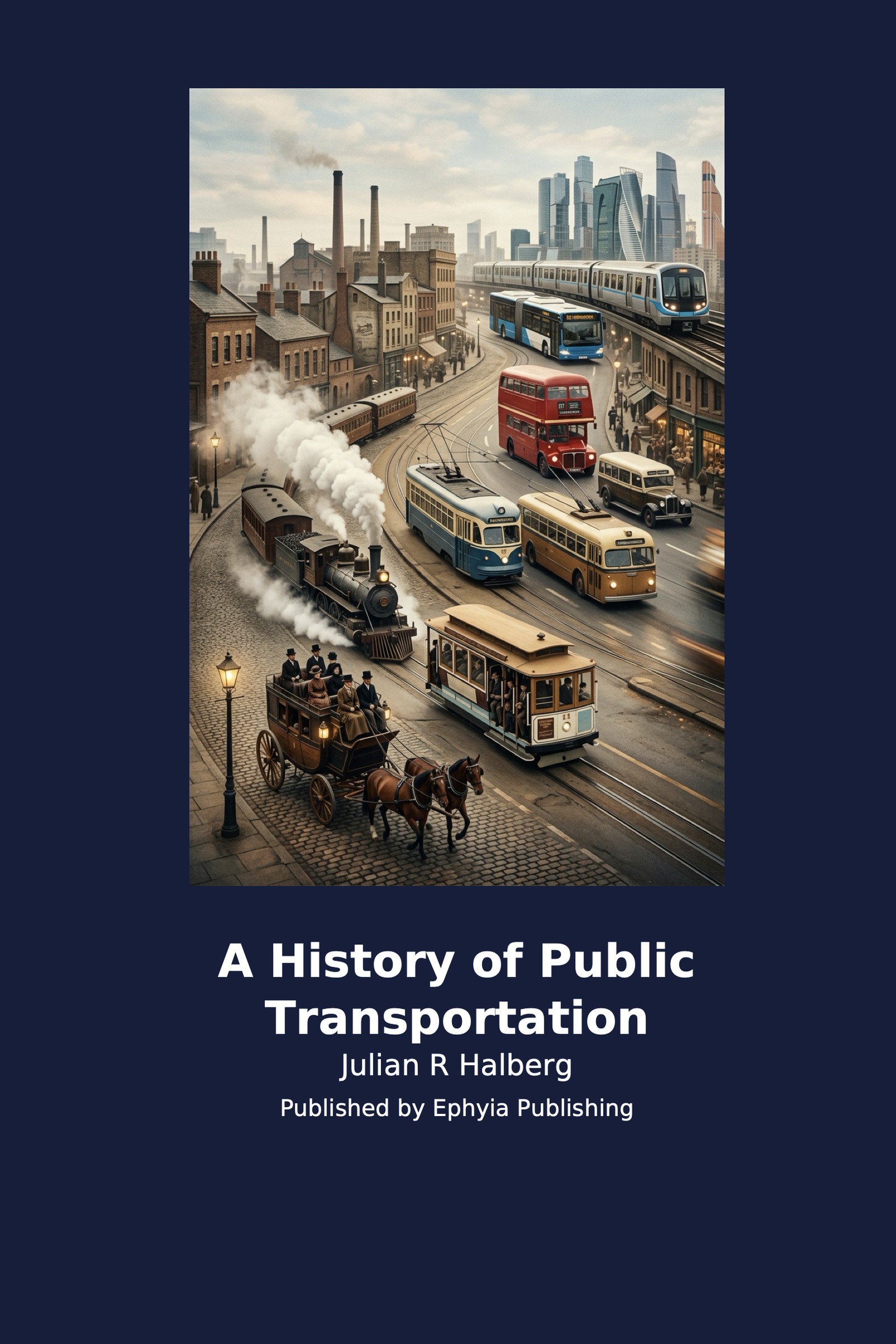
"A History of Public Transportation" invites readers on a sweeping journey through the ways humanity has moved together, from rudimentary ferries and stagecoaches to the sleek electric buses and high‑speed trains of today. Each chapter reveals how a new technology—whether steam, electricity, cable, or internal combustion—reshaped cities, altered social habits, and sparked fierce debates over cost, accessibility, and urban form. Readers will see how early innovations like the omnibus and horsecar laid the groundwork for mass mobility, and how later breakthroughs such as subways, elevated railways, and interurban lines expanded the reach of public transit beyond city limits.
The book explores the profound societal impact of transit, showing how shared travel influenced everything from work commutes and leisure trips to patterns of segregation, labor struggles, and the rise of suburbs. It examines the economic forces that drove private operators to innovate, consolidate, or collapse, and the political decisions—franchises, subsidies, public takeovers—that determined who paid for and who benefited from these systems. Through vivid anecdotes and detailed analysis, the text highlights the tension between the promise of efficient, egalitarian transport and the realities of congestion, pollution, and inequity that have accompanied every era of development.
Readers will also trace the global spread of rapid transit, from London’s pioneering underground to the expansive networks of Tokyo, Paris, and emerging megacities in Asia and Latin America, and discover how light rail renaissances and bus rapid transit experiments sought to blend rail’s capacity with road‑based flexibility. The narrative follows the evolution of the bus from noisy, unreliable beginnings to modern articulated, low‑floor, and electric models, while also shedding light on niche modes like trolleybuses and cable cars that offered unique solutions to specific urban challenges.
Finally, the book looks ahead to the future of public transportation, detailing how technology is transforming ticketing, real‑time information, and fleet management, and how green innovations—battery‑electric buses, hydrogen fuel cells, renewable‑powered rail, and integrated Mobility‑as‑a‑Service platforms—are shaping a more sustainable and equitable mobility landscape. By the end, readers will not only understand the historical trajectory of public transit but also grasp the lessons it offers for tackling today’s pressing issues of climate change, urban congestion, and social justice.
What You'll Find Inside:
- The book traces public transportation's evolution from basic shared modes like ferries and stagecoaches to complex modern systems including subways, light rail, and bus rapid transit.
- It examines how technological innovations (steam power, electrification, internal combustion engines) repeatedly transformed urban mobility while creating new challenges.
- The text explores the symbiotic relationship between public transportation and urban growth, showing how transit enabled city expansion while dense urban areas drove demand for better transit.
- It analyzes persistent social issues including accessibility, equity, and segregation, from historical discrimination to modern accessibility efforts.
- The book details the ongoing debate over public vs. private operation, funding models, and government involvement in transit systems.
Who's It For:
Urban planners, transportation professionals, and students of history or civil engineering will find this book invaluable for understanding how past innovations and challenges shape today's transit systems. It also appeals to policymakers and advocates seeking historical context for contemporary debates about funding, accessibility, and sustainable mobility. General readers interested in how transportation influences urban development and social equity will appreciate its comprehensive yet accessible approach.
Table of Contents:
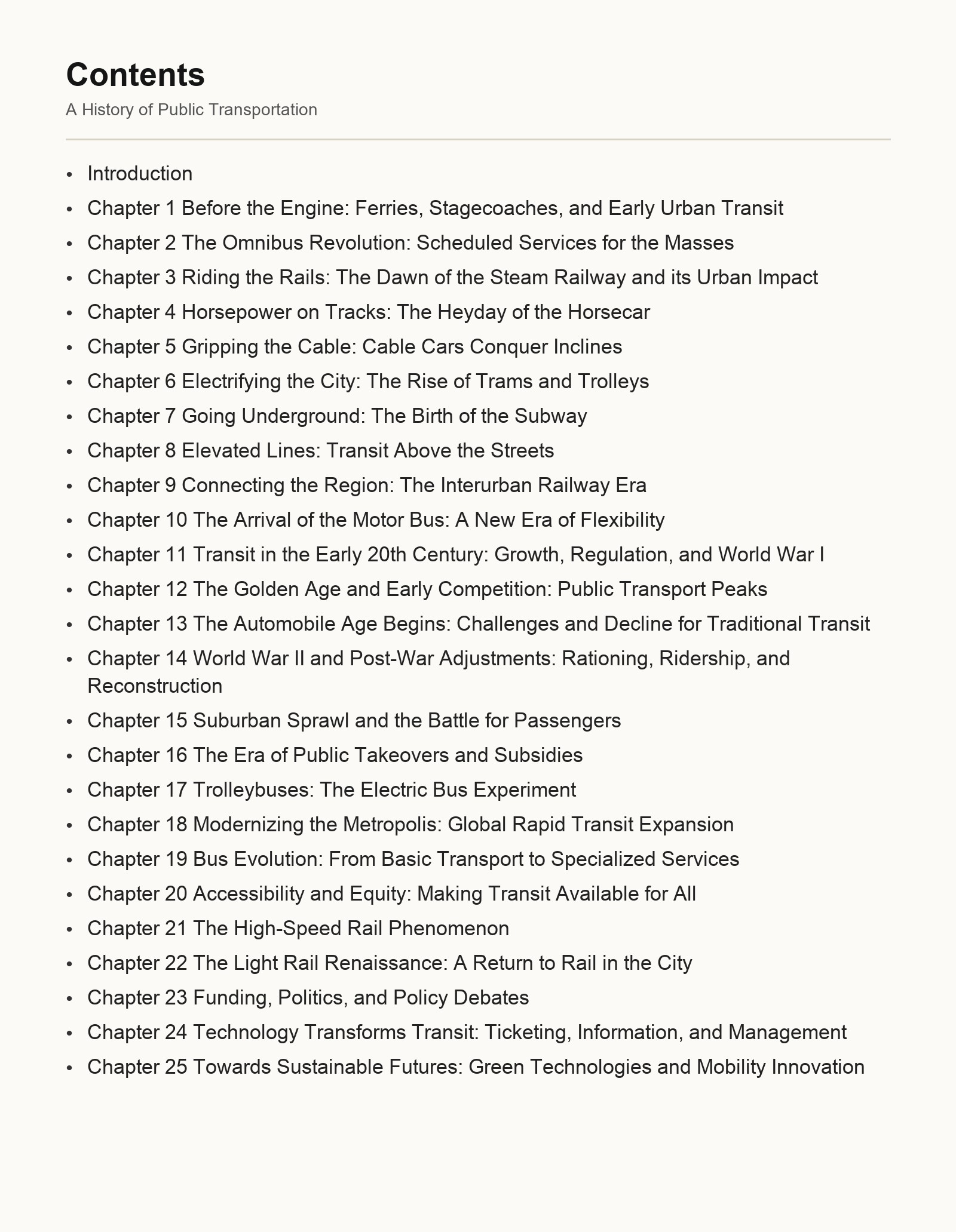
- Introduction
- Chapter 1 Before the Engine: Ferries, Stagecoaches, and Early Urban Transit
- Chapter 2 The Omnibus Revolution: Scheduled Services for the Masses
- Chapter 3 Riding the Rails: The Dawn of the Steam Railway and its Urban Impact
- Chapter 4 Horsepower on Tracks: The Heyday of the Horsecar
- Chapter 5 Gripping the Cable: Cable Cars Conquer Inclines
- Chapter 6 Electrifying the City: The Rise of Trams and Trolleys
- Chapter 7 Going Underground: The Birth of the Subway
- Chapter 8 Elevated Lines: Transit Above the Streets
- Chapter 9 Connecting the Region: The Interurban Railway Era
- Chapter 10 The Arrival of the Motor Bus: A New Era of Flexibility
- Chapter 11 Transit in the Early 20th Century: Growth, Regulation, and World War I
- Chapter 12 The Golden Age and Early Competition: Public Transport Peaks
- Chapter 13 The Automobile Age Begins: Challenges and Decline for Traditional Transit
- Chapter 14 World War II and Post-War Adjustments: Rationing, Ridership, and Reconstruction
- Chapter 15 Suburban Sprawl and the Battle for Passengers
- Chapter 16 The Era of Public Takeovers and Subsidies
- Chapter 17 Trolleybuses: The Electric Bus Experiment
- Chapter 18 Modernizing the Metropolis: Global Rapid Transit Expansion
- Chapter 19 Bus Evolution: From Basic Transport to Specialized Services
- Chapter 20 Accessibility and Equity: Making Transit Available for All
- Chapter 21 The High-Speed Rail Phenomenon
- Chapter 22 The Light Rail Renaissance: A Return to Rail in the City
- Chapter 23 Funding, Politics, and Policy Debates
- Chapter 24 Technology Transforms Transit: Ticketing, Information, and Management
- Chapter 25 Towards Sustainable Futures: Green Technologies and Mobility Innovation
Author:
Published By:
Date Published:
May 18, 2026
Type:
Nonfiction
Language:
English
Word Count:
53,548 words
Reading Time:
3 hours 45 minutes
Sample:
Order:
Buy the A History of Public Transportation ebook on MixCache.com:
Buy NowThe full ebook will be available immediately to read instantly on any device.
$5 account credit for all new MixCache.com accounts, usable toward any ebook purchase!*





Ratings & Reviews
Ask Questions About This Book
Have a question about the content? Ask our AI assistant!
Start by asking a question about "A History of Public Transportation"
Example: "Does this book mention William Shakespeare?"
Thinking...