
Browse by Category
Fiction
- Action & Adventure
- African American
- Anthologies
- Children's Fiction
- Classics
- Comics & Graphic Novels
- Coming of Age
- Contemporary
- Cultural & Regional
- Drama
- Erotica
- Fantasy
- General
- Historical Fiction
- Horror
- Humor & Satire
- Literary Fiction
- Mystery, Thriller & Suspense
- Poetry
- Religious & Inspirational
- Romance
- Science Fiction
- Short Stories
- War & Military
- Westerns
- Women's Fiction
- Young Adult
Non-Fiction
- Antiques & Collectibles
- Arts & Photography
- Biographies & Memoirs
- Business & Money
- Children's Non-Fiction
-
Computers & Technology
- Artificial Intelligence
- Computer Science
- Cybersecurity & Cryptography
- Data Science & Analytics
- Databases & Big Data
- Game Development & Design
- General
- Hardware & DIY
- Mobile App Development
- Networking & Cloud Computing
- Operating Systems
- Programming
- Robotics
- Software
- Software Engineering
- User Experience (UX) & Design
- Web Development & Design
- Cooking, Food & Wine
- Crafts, Hobbies & Home
- Education & Teaching
- Engineering
- General
- Health, Fitness & Dieting
-
History
- African History
- African History - North Africa
- African History - Sub-Saharan Africa
- American History
- American History - 20th Century
- American History - Civil War
- American History - Colonial Period
- Ancient History
- Asian History
- Asian History - China
- Asian History - India
- Asian History - Japan
- Asian History - Southeast Asia
- European History
- European History - Ancient Greece
- European History - Ancient Rome
- European History - Medieval
- European History - Modern
- European History - Renaissance
- General
- Middle Eastern History
- Military History
- Military History - Aviation
- Military History - Naval
- Social & Cultural History
- World History
- Humor & Entertainment
- Industrial Technology
- Language Learning
- Law
- LGBTQ+ Non-Fiction
- Literary Criticism
- Medical Books
- Parenting & Relationships
- Philosophy
- Politics & Social Sciences
- Reference
- Religion & Spirituality
-
Science & Math
- Agricultural Sciences
- Astronomy & Space Science
- Behavioral Sciences
- Biological Sciences
- Botany & Plant Science
- Chemistry
- Earth Sciences
- Engineering - Chemical
- Engineering - Civil
- Engineering - Electrical
- Engineering - Mechanical
- Environment
- General
- Geology
- Mathematics
- Nature & Ecology
- Oceanography
- Paleontology
- Physics
- Statistics
- Self-Help
- Sports & Outdoors
- Study Aids
- Sustainability & Green Living
- Textbooks
- Transportation
- Travel
- True Crime
- Urban Planning & Development
- Veterinary Medicine
- Writing & Publishing
Jump to Section
MixCache.com Total Access
Unlimited reading and audiobooks for every book published by MixCache.com.
Included titles carry the MTA badge.
Learn more →A History of Agriculture
About this book:
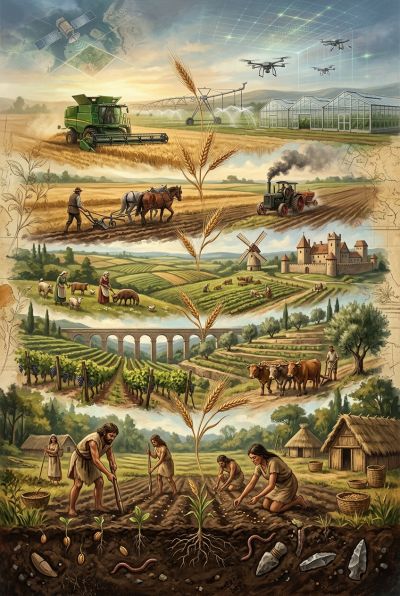
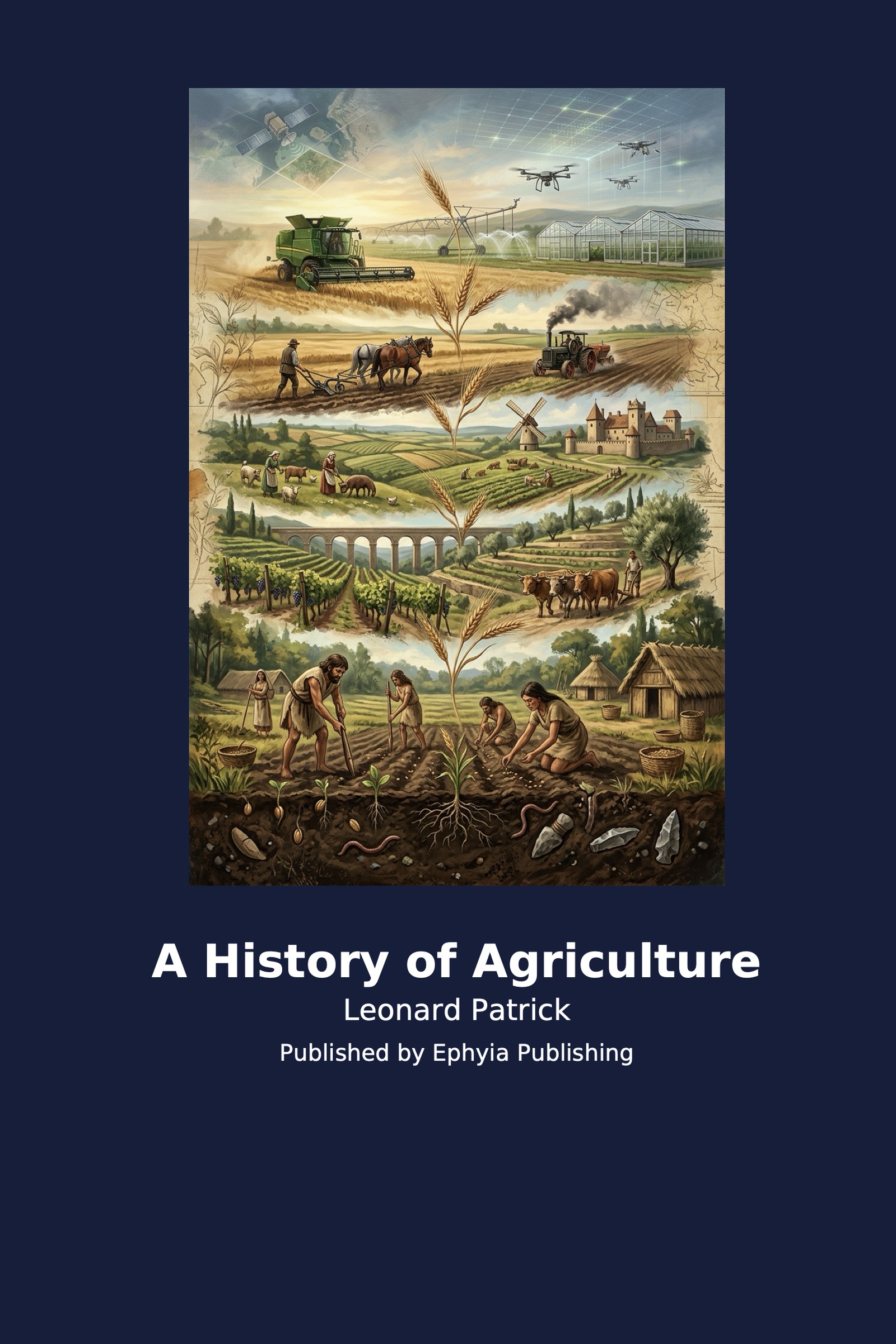
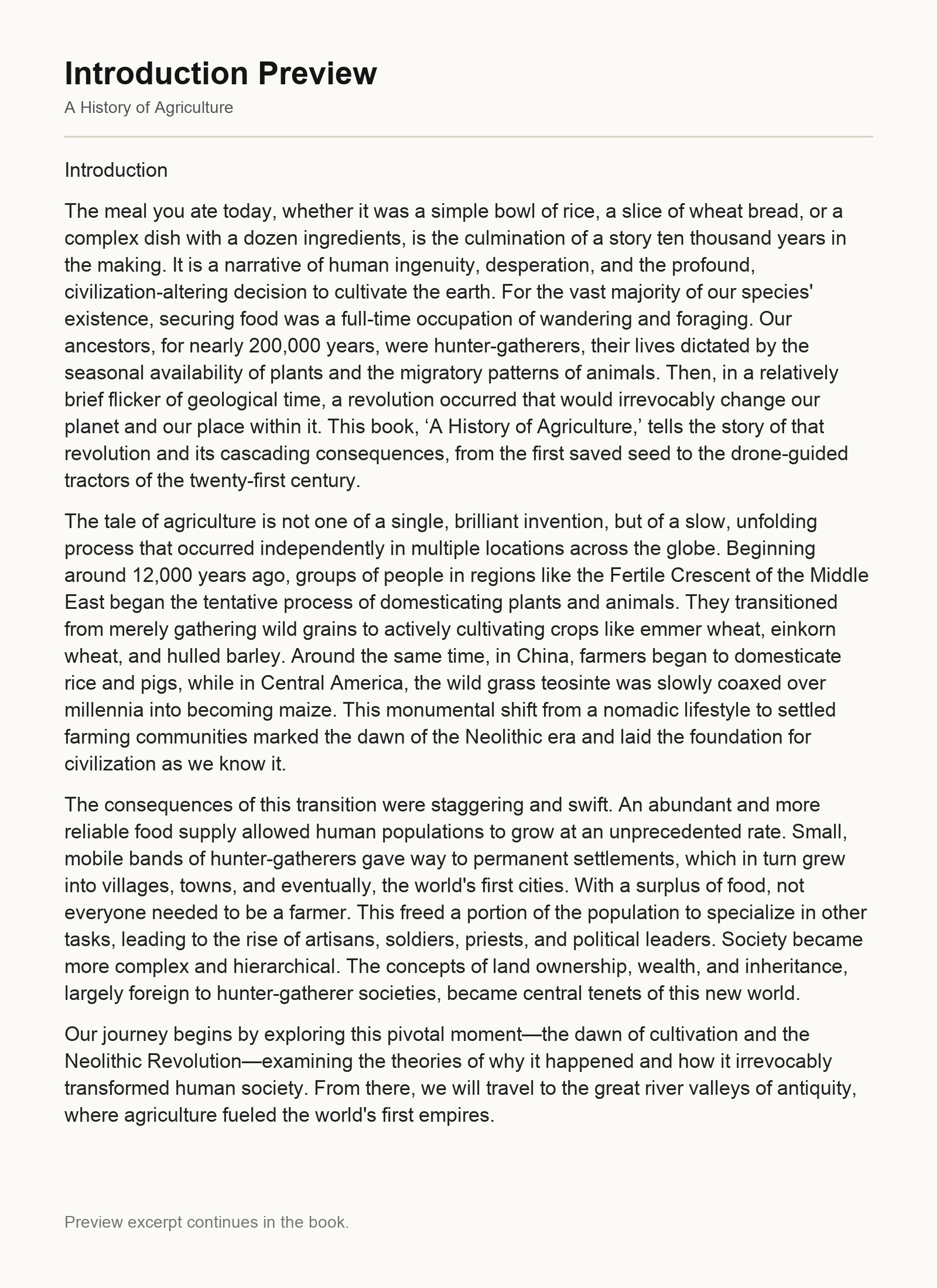
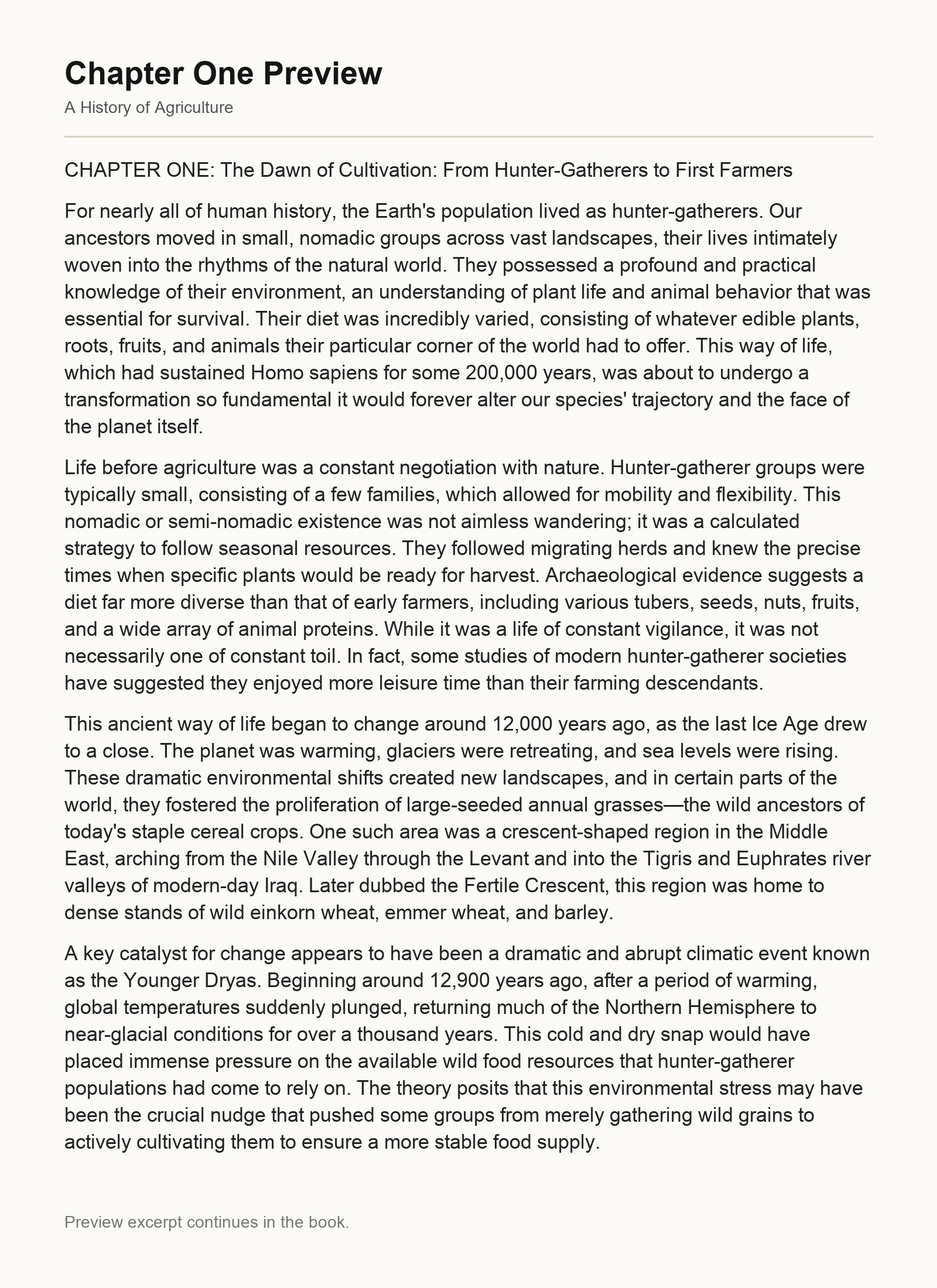
A History of Agriculture takes readers on a sweeping journey from the first tentative steps of domestication in the Fertile Crescent to the cutting‑edge farms of the twenty‑first century. You will discover how early hunter‑gatherers transitioned to settled farming, how the Neolithic Revolution laid the groundwork for cities and social hierarchies, and how independent agricultural breakthroughs in China, the Americas, and Africa reshaped human diets and landscapes. The narrative then moves through the great river valleys of Mesopotamia, Egypt, and the Indus Valley, revealing how irrigation engineering powered the world’s first civilizations and set patterns of state control that still echo today.
As you turn the pages, you will follow the spread of crops and techniques across continents, from the Arab Agricultural Revolution that introduced sugar, citrus, and cotton to the Mediterranean, to the Columbian Exchange that forever transformed global food systems by moving maize, potatoes, and tomatoes eastward and wheat, horses, and cattle westward. You will see how medieval Europe’s open‑field system and three‑field rotation gave way to enclosure and early capitalist farming, and how the plantation economies of the Americas were built on the brutal labor of enslaved peoples. The book then charts the British Agricultural Revolution, the rise of mechanization with steel plows and reapers, and the scientific advances that unlocked soil chemistry and plant genetics, culminating in the Green Revolution’s high‑yield varieties that fed a booming population.
Later chapters confront the consequences of intensive farming: soil degradation, water pollution, greenhouse gas emissions, and biodiversity loss, while also exploring the rise of organic, sustainable, and regenerative movements that seek to work with nature rather than against it. You will learn about the promises and controversies of biotechnology and genetically modified crops, the data‑driven precision of GPS‑guided tractors and drone monitoring, and the urgent challenges of water management in an era of aquifer depletion and climate variability. The discussion of climate change details how shifting temperatures, extreme weather, and rising CO2 levels threaten yields, alter pest ranges, and diminish nutritional quality of staple grains.
Finally, the book looks ahead to the innovations that may define agriculture’s next chapter: vertical farms stacked in city skyscrapers, autonomous robotic fleets, AI‑powered predictive analytics, and alternative proteins such as cultured meat and insect farming. You will gain a clear understanding of the yield gap between potential and actual production, and how sustainable intensification, regenerative soil practices, and demand‑side changes—like reducing food waste and shifting diets—could help feed a projected ten billion people by 2050 without exhausting the planet’s resources. By the end, you will have experienced agriculture not just as a technical history, but as a continuing story of human ingenuity, adaptation, and responsibility that shapes every meal we eat.
What You'll Find Inside:
- The independent origins of agriculture in multiple global centers and how the Neolithic Revolution transformed human society from hunter-gatherers to settled farming communities
- How ancient civilizations like Mesopotamia, Egypt, and the Indus Valley developed sophisticated irrigation systems that enabled the world's first empires and monumental architecture
- The Columbian Exchange's global transfer of plants, animals, and diseases that irreversibly altered diets, ecosystems, and demographic patterns worldwide
- The British Agricultural Revolution and Enclosure Movement's role in increasing productivity, enabling industrialization, and fundamentally restructuring rural society
- Modern challenges including climate change impacts, environmental consequences of industrial farming, and emerging solutions like precision agriculture, biotechnology, and vertical farming for feeding future populations
Who's It For:
This book is ideal for students, educators, and general readers interested in the intersection of history, agriculture, and environmental studies. It provides a comprehensive overview suitable for those seeking to understand how agricultural developments have shaped human civilization from ancient times to the present day. Professionals in agriculture, sustainability, or related fields will find valuable historical context for contemporary challenges, while environmentally conscious readers will appreciate the balanced examination of both agricultural innovations and their ecological consequences.
Table of Contents:
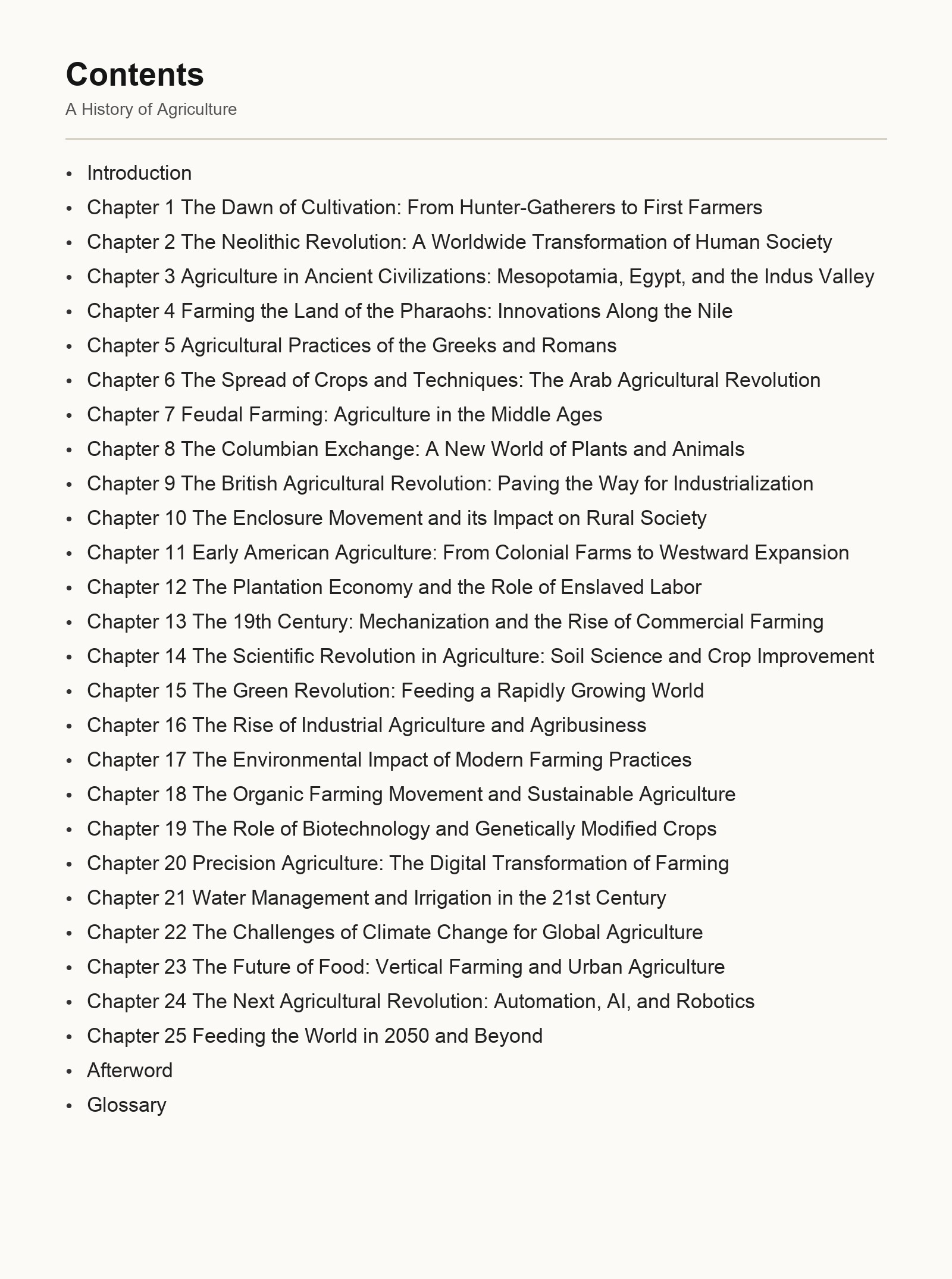
- Introduction
- Chapter 1 The Dawn of Cultivation: From Hunter-Gatherers to First Farmers
- Chapter 2 The Neolithic Revolution: A Worldwide Transformation of Human Society.
- Chapter 3 Agriculture in Ancient Civilizations: Mesopotamia, Egypt, and the Indus Valley
- Chapter 4 Farming the Land of the Pharaohs: Innovations Along the Nile
- Chapter 5 Agricultural Practices of the Greeks and Romans
- Chapter 6 The Spread of Crops and Techniques: The Arab Agricultural Revolution.
- Chapter 7 Feudal Farming: Agriculture in the Middle Ages
- Chapter 8 The Columbian Exchange: A New World of Plants and Animals
- Chapter 9 The British Agricultural Revolution: Paving the Way for Industrialization.
- Chapter 10 The Enclosure Movement and its Impact on Rural Society
- Chapter 11 Early American Agriculture: From Colonial Farms to Westward Expansion
- Chapter 12 The Plantation Economy and the Role of Enslaved Labor
- Chapter 13 The 19th Century: Mechanization and the Rise of Commercial Farming.
- Chapter 14 The Scientific Revolution in Agriculture: Soil Science and Crop Improvement
- Chapter 15 The Green Revolution: Feeding a Rapidly Growing World.
- Chapter 16 The Rise of Industrial Agriculture and Agribusiness
- Chapter 17 The Environmental Impact of Modern Farming Practices.
- Chapter 18 The Organic Farming Movement and Sustainable Agriculture.
- Chapter 19 The Role of Biotechnology and Genetically Modified Crops
- Chapter 20 Precision Agriculture: The Digital Transformation of Farming.
- Chapter 21 Water Management and Irrigation in the 21st Century
- Chapter 22 The Challenges of Climate Change for Global Agriculture
- Chapter 23 The Future of Food: Vertical Farming and Urban Agriculture.
- Chapter 24 The Next Agricultural Revolution: Automation, AI, and Robotics.
- Chapter 25 Feeding the World in 2050 and Beyond
- Afterword
- Glossary
Author:
Published By:
Date Published:
May 26, 2026
Type:
Nonfiction
Language:
English
Word Count:
54,672 words
Reading Time:
3 hours 50 minutes
Sample:
Order:
Buy the A History of Agriculture ebook on MixCache.com:
Buy NowThe full ebook will be available immediately to read instantly on any device.
$5 account credit for all new MixCache.com accounts, usable toward any ebook purchase!*





Ratings & Reviews
Ask Questions About This Book
Have a question about the content? Ask our AI assistant!
Start by asking a question about "A History of Agriculture"
Example: "Does this book mention William Shakespeare?"
Thinking...