
Browse by Category
Fiction
- Action & Adventure
- African American
- Anthologies
- Children's Fiction
- Classics
- Comics & Graphic Novels
- Coming of Age
- Contemporary
- Cultural & Regional
- Drama
- Erotica
- Fantasy
- General
- Historical Fiction
- Horror
- Humor & Satire
- Literary Fiction
- Mystery, Thriller & Suspense
- Poetry
- Religious & Inspirational
- Romance
- Science Fiction
- Short Stories
- War & Military
- Westerns
- Women's Fiction
- Young Adult
Non-Fiction
- Antiques & Collectibles
- Arts & Photography
- Biographies & Memoirs
- Business & Money
- Children's Non-Fiction
-
Computers & Technology
- Artificial Intelligence
- Computer Science
- Cybersecurity & Cryptography
- Data Science & Analytics
- Databases & Big Data
- Game Development & Design
- General
- Hardware & DIY
- Mobile App Development
- Networking & Cloud Computing
- Operating Systems
- Programming
- Robotics
- Software
- Software Engineering
- User Experience (UX) & Design
- Web Development & Design
- Cooking, Food & Wine
- Crafts, Hobbies & Home
- Education & Teaching
- Engineering
- General
- Health, Fitness & Dieting
-
History
- African History
- African History - North Africa
- African History - Sub-Saharan Africa
- American History
- American History - 20th Century
- American History - Civil War
- American History - Colonial Period
- Ancient History
- Asian History
- Asian History - China
- Asian History - India
- Asian History - Japan
- Asian History - Southeast Asia
- European History
- European History - Ancient Greece
- European History - Ancient Rome
- European History - Medieval
- European History - Modern
- European History - Renaissance
- General
- Middle Eastern History
- Military History
- Military History - Aviation
- Military History - Naval
- Social & Cultural History
- World History
- Humor & Entertainment
- Industrial Technology
- Language Learning
- Law
- LGBTQ+ Non-Fiction
- Literary Criticism
- Medical Books
- Parenting & Relationships
- Philosophy
- Politics & Social Sciences
- Reference
- Religion & Spirituality
-
Science & Math
- Agricultural Sciences
- Astronomy & Space Science
- Behavioral Sciences
- Biological Sciences
- Botany & Plant Science
- Chemistry
- Earth Sciences
- Engineering - Chemical
- Engineering - Civil
- Engineering - Electrical
- Engineering - Mechanical
- Environment
- General
- Geology
- Mathematics
- Nature & Ecology
- Oceanography
- Paleontology
- Physics
- Statistics
- Self-Help
- Sports & Outdoors
- Study Aids
- Sustainability & Green Living
- Textbooks
- Transportation
- Travel
- True Crime
- Urban Planning & Development
- Veterinary Medicine
- Writing & Publishing
Jump to Section
MixCache.com Total Access
Unlimited reading and audiobooks for every book published by MixCache.com.
Included titles carry the MTA badge.
Learn more →
Deep-Sea Frontiers: Technology and Discoveries in Abyssal Exploration
MTA
How ROVs, AUVs, submersibles, and sensors are revolutionizing deep-ocean science
About this book:
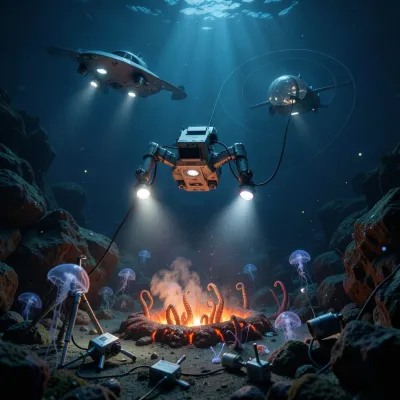
*Deep-Sea Frontiers* explores the technological and scientific evolution of abyssal exploration, tracing the journey from early 20th-century bathyspheres to modern autonomous swarms. The book details the extreme physical constraints of the deep ocean—immense pressure, total darkness, and near-freezing temperatures—and explains how engineers utilize specialized materials like titanium and syntactic foam to build resilient Remotely Operated Vehicles (ROVs) and Autonomous Underwater Vehicles (AUVs). These platforms, equipped with advanced sonar, chemical sensors, and high-definition imaging, have transformed the seabed from a mysterious void into a legible, mapped landscape teeming with unexpected life and geologic activity.
The text emphasizes that modern exploration is as much about data management and mission architecture as it is about hardware. It describes the sophisticated navigation systems required to operate without GPS and the acoustic telemetry used to communicate through water. Significant focus is placed on the discovery of chemosynthetic ecosystems, such as hydrothermal vents and cold seeps, which have redefined biological limits. Furthermore, the book highlights the rise of telepresence and cabled observatories, which allow for persistent, real-time monitoring of the deep sea from shore-based laboratories, shifting science from episodic expeditions to continuous observation.
Beyond technical achievement, the book addresses the complex ethical and political dimensions of the deep-sea frontier. It discusses the necessity of FAIR (Findable, Accessible, Interoperable, and Reusable) data practices, the protection of underwater cultural heritage, and the burgeoning debates over deep-sea mining and environmental stewardship. The narrative stresses the importance of equity, questioning who has access to these expensive technologies and how the benefits of discovery are shared among nations. This framework of stewardship is presented as vital for maintaining the integrity of fragile ecosystems that are increasingly impacted by surface climate change.
Looking toward the future, the book identifies swarms of coordinated robots and "digital twins"—dynamic virtual models of the ocean—as the next major milestones in marine science. These tools aim to create a more responsive and climate-ready exploration infrastructure, capable of forecasting changes in a warming ocean. Ultimately, *Deep-Sea Frontiers* argues that while technology has vastly expanded the reach of human curiosity, the future of the abyss depends on a disciplined balance of engineering ingenuity, international cooperation, and a humble commitment to preserving the planet's final frontier.
What You'll Find Inside:
- How ROVs, AUVs, and submersibles enable persistent deep-ocean observation despite extreme pressure, darkness, and isolation
- The science of deep-sea navigation without GPS using inertial systems, acoustic positioning, and visual odometry
- How advanced sensing technologies reveal invisible chemical, biological, and physical processes in the abyss
- The transformation of raw ocean data into actionable knowledge through FAIR data principles and annotation workflows
- Ethical frameworks for exploring fragile ecosystems like hydrothermal vents while balancing discovery with conservation
Who's It For:
This book is designed for students and early-career professionals in oceanography, marine engineering, and environmental science who seek a comprehensive understanding of deep-sea exploration technologies and methodologies. It also serves as a valuable reference for engineers developing ROVs, AUVs, and sensor systems, as well as researchers studying hydrothermal vents, trenches, and other abyssal ecosystems. Policymakers and conservationists involved in ocean governance will find relevant sections on stewardship, environmental justice, and regulatory frameworks. Ultimately, anyone with a rigorous curiosity about how we explore and understand Earth's final frontier will benefit from this integrated perspective.
Table of Contents:
- Introduction
- Chapter 1 From Bathyspheres to Bots: A Brief History of Deep-Sea Exploration
- Chapter 2 The Abyssal Environment: Pressure, Darkness, and Geologic Context
- Chapter 3 Platforms at Depth: ROVs, AUVs, and Human-Occupied Vehicles
- Chapter 4 Design for the Deep: Materials, Buoyancy, and Power Systems
- Chapter 5 Navigation Without GPS: Inertial, Acoustic, and Visual Odometry
- Chapter 6 Talking Through Water: Acoustic Communications and Telemetry
- Chapter 7 Seeing in the Dark: Imaging, Lighting, and Photogrammetry
- Chapter 8 Mapping the Seafloor: Sonar, Multibeam, and Bathymetry
- Chapter 9 Sensing the Invisible: Chemical, Physical, and Biological Sensors
- Chapter 10 Sampling with Care: Manipulators, Cores, and In Situ Experiments
- Chapter 11 Mission Architecture: Objectives, Risk, and Logistics
- Chapter 12 Autonomy at Sea: Planning, Control, and AI
- Chapter 13 Telepresence and the Virtual Ship: Real-Time Science Ashore
- Chapter 14 Data to Knowledge: Pipelines, Annotation, and QA/QC
- Chapter 15 Archives and Access: FAIR Data, Repositories, and Reuse
- Chapter 16 Ecosystems Revealed: Hydrothermal Vents and Cold Seeps
- Chapter 17 Life in the Hadal Zone: Trenches and Extreme Adaptations
- Chapter 18 Mountains Beneath the Waves: Seamounts and Mid-Ocean Ridges
- Chapter 19 Margins in Motion: Subduction, Slumps, and Hazards
- Chapter 20 Ice-Covered Oceans: Polar Operations and Under-Ice Autonomy
- Chapter 21 Wrecks and Heritage: Deep-Water Archaeology and Ethics
- Chapter 22 Monitoring a Dynamic Ocean: Cabled Observatories and Long-Term Sensors
- Chapter 23 Human Factors: Teams, Training, and Decision-Making
- Chapter 24 Stewardship at Depth: Governance, Equity, and Environmental Justice
- Chapter 25 The Next Frontier: Swarms, Digital Twins, and Climate-Ready Exploration
Author:
Published By:
Date Published:
May 3, 2026
Type:
Nonfiction
Language:
English
Word Count:
57,386 words
Reading Time:
4 hours 1 minutes
Sample:
MixCache.com Total Access
Get unlimited access to this book + all books published by MixCache.com for $11.99/month
Subscribe to MTAOr purchase this book individually below
Order:
Buy the Deep-Sea Frontiers: Technology and Discoveries in Abyssal Exploration ebook on MixCache.com:
Buy Now
Full ebook will be available immediately
- read online or download as a PDF file.
$5 account credit for all new MixCache.com accounts, usable toward any ebook purchase!*






Ratings & Reviews
Ask Questions About This Book
Have a question about the content? Ask our AI assistant!
Start by asking a question about "Deep-Sea Frontiers: Technology and Discoveries in Abyssal Exploration"
Example: "Does this book mention William Shakespeare?"
Thinking...