
Browse by Category
Fiction
- Action & Adventure
- African American
- Anthologies
- Children's Fiction
- Classics
- Comics & Graphic Novels
- Coming of Age
- Contemporary
- Cultural & Regional
- Drama
- Erotica
- Fantasy
- General
- Historical Fiction
- Horror
- Humor & Satire
- Literary Fiction
- Mystery, Thriller & Suspense
- Poetry
- Religious & Inspirational
- Romance
- Science Fiction
- Short Stories
- War & Military
- Westerns
- Women's Fiction
- Young Adult
Non-Fiction
- Antiques & Collectibles
- Arts & Photography
- Biographies & Memoirs
- Business & Money
- Children's Non-Fiction
-
Computers & Technology
- Artificial Intelligence
- Computer Science
- Cybersecurity & Cryptography
- Data Science & Analytics
- Databases & Big Data
- Game Development & Design
- General
- Hardware & DIY
- Mobile App Development
- Networking & Cloud Computing
- Operating Systems
- Programming
- Robotics
- Software
- Software Engineering
- User Experience (UX) & Design
- Web Development & Design
- Cooking, Food & Wine
- Crafts, Hobbies & Home
- Education & Teaching
- Engineering
- General
- Health, Fitness & Dieting
-
History
- African History
- African History - North Africa
- African History - Sub-Saharan Africa
- American History
- American History - 20th Century
- American History - Civil War
- American History - Colonial Period
- Ancient History
- Asian History
- Asian History - China
- Asian History - India
- Asian History - Japan
- Asian History - Southeast Asia
- European History
- European History - Ancient Greece
- European History - Ancient Rome
- European History - Medieval
- European History - Modern
- European History - Renaissance
- General
- Middle Eastern History
- Military History
- Military History - Aviation
- Military History - Naval
- Social & Cultural History
- World History
- Humor & Entertainment
- Industrial Technology
- Language Learning
- Law
- LGBTQ+ Non-Fiction
- Literary Criticism
- Medical Books
- Parenting & Relationships
- Philosophy
- Politics & Social Sciences
- Reference
- Religion & Spirituality
-
Science & Math
- Agricultural Sciences
- Astronomy & Space Science
- Behavioral Sciences
- Biological Sciences
- Botany & Plant Science
- Chemistry
- Earth Sciences
- Engineering - Chemical
- Engineering - Civil
- Engineering - Electrical
- Engineering - Mechanical
- Environment
- General
- Geology
- Mathematics
- Nature & Ecology
- Oceanography
- Paleontology
- Physics
- Statistics
- Self-Help
- Sports & Outdoors
- Study Aids
- Sustainability & Green Living
- Textbooks
- Transportation
- Travel
- True Crime
- Urban Planning & Development
- Veterinary Medicine
- Writing & Publishing
Jump to Section
MixCache.com Total Access
Unlimited reading and audiobooks for every book published by MixCache.com.
Included titles carry the MTA badge.
Learn more →
The 1% Use Case
How the Stuff that's not Used Much Dominates the World Economy
About this book:

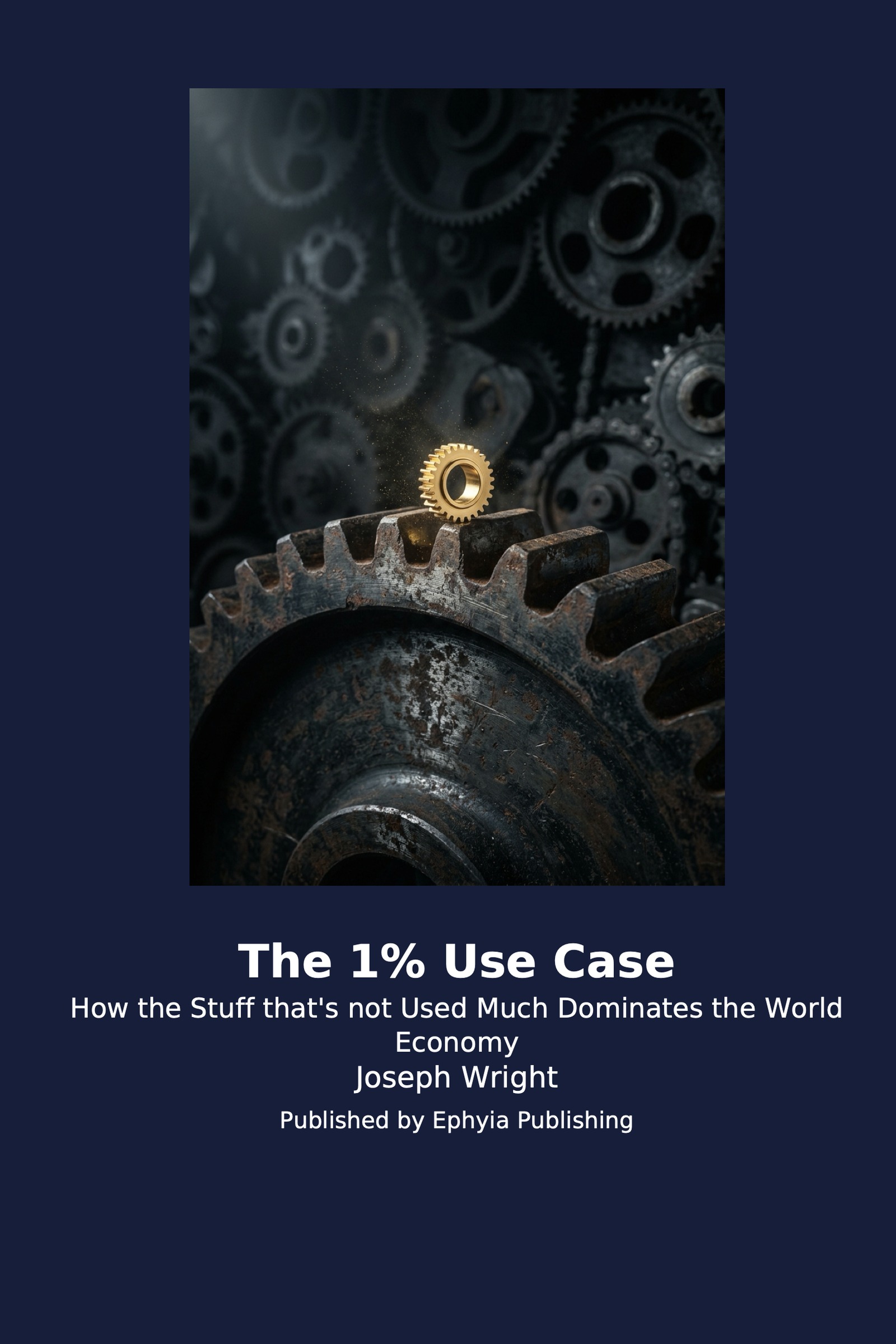
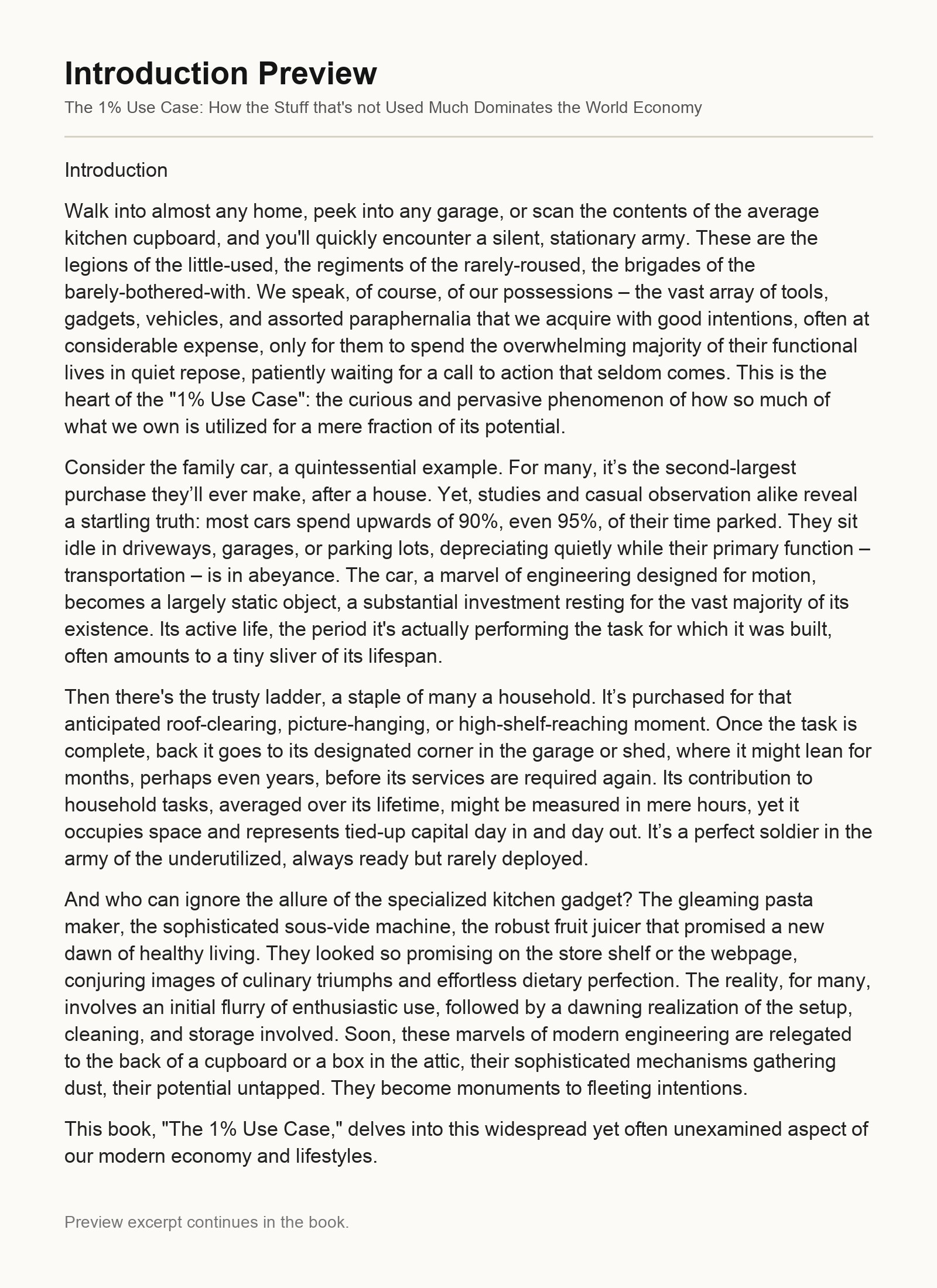
Discover how the everyday items we own—from cars that sit parked 95 % of the time to specialty kitchen gadgets that gather dust after a single use—form a hidden economy of underutilization that shapes our lives far more than we realize. This book reveals the pervasive “1 % Use Case,” showing how the vast majority of our possessions spend most of their existence idle, waiting for a call to action that rarely comes.
You’ll learn exactly what defines an idle asset, how to measure underutilization across categories, and why our brains are wired to buy for “just in case” or aspirational dreams rather than daily need. The chapters break down the psychology of accumulation, the economic weight of waiting goods, and the ways feature creep and planned obsolescence inflate costs while delivering little real utility.
Through vivid examples—driveway cars, garage ladders, kitchen graveyards, urban SUVs, digital hoarding, and subscription fatigue—you’ll see how these patterns ripple outward, influencing manufacturing, supply chains, environmental footprints, and even societal inequality. The book also explores the hidden costs of clutter: lost time, sacrificed space, and the mental load of managing things we hardly use.
Finally, you’ll discover pathways toward a higher utility economy: the sharing economy, mindful ownership, design for actual need, the resale revolution, and emerging access‑over‑ownership models. By the end, you’ll be equipped to recognize the silent army of unused goods around you, understand their true impact, and make more intentional choices about what you bring into your life.
What You'll Find Inside:
- Most consumer goods experience extreme underutilization, with cars parked 90-95% of time, kitchen appliances used briefly before abandonment, and digital subscriptions largely unwatched despite ongoing costs.
- Psychological drivers like 'just in case' preparedness, aspirational marketing for future selves, and fear of regret lead consumers to acquire goods they barely use, creating vast inventories of idle possessions.
- The economic impact includes distorted market demand, unnecessary manufacturing complexity from feature creep, and the rise of multi-billion dollar storage industries capitalizing on our reluctance to discard underused items.
- Environmental costs are dramatically amplified when resource-intensive goods see minimal use - a power drill used once a year has vastly higher ecological impact per function than one used regularly.
- Solutions explored include sharing economies that maximize asset utility, mindful ownership practices reducing aspirational purchases, and design innovations focused on actual user needs rather than speculative features.
Who's It For:
This book is essential reading for economists, sustainability professionals, product designers, and urban planners seeking to understand the systemic economic and environmental costs of consumer underutilization. It will particularly appeal to environmentally conscious consumers overwhelmed by household clutter, minimalists seeking validation for intentional consumption approaches, and anyone questioning their own patterns of acquiring rarely-used goods. Policymakers focused on waste reduction, circular economy initiatives, and resource efficiency will find valuable insights into how idle assets distort markets and supply chains.
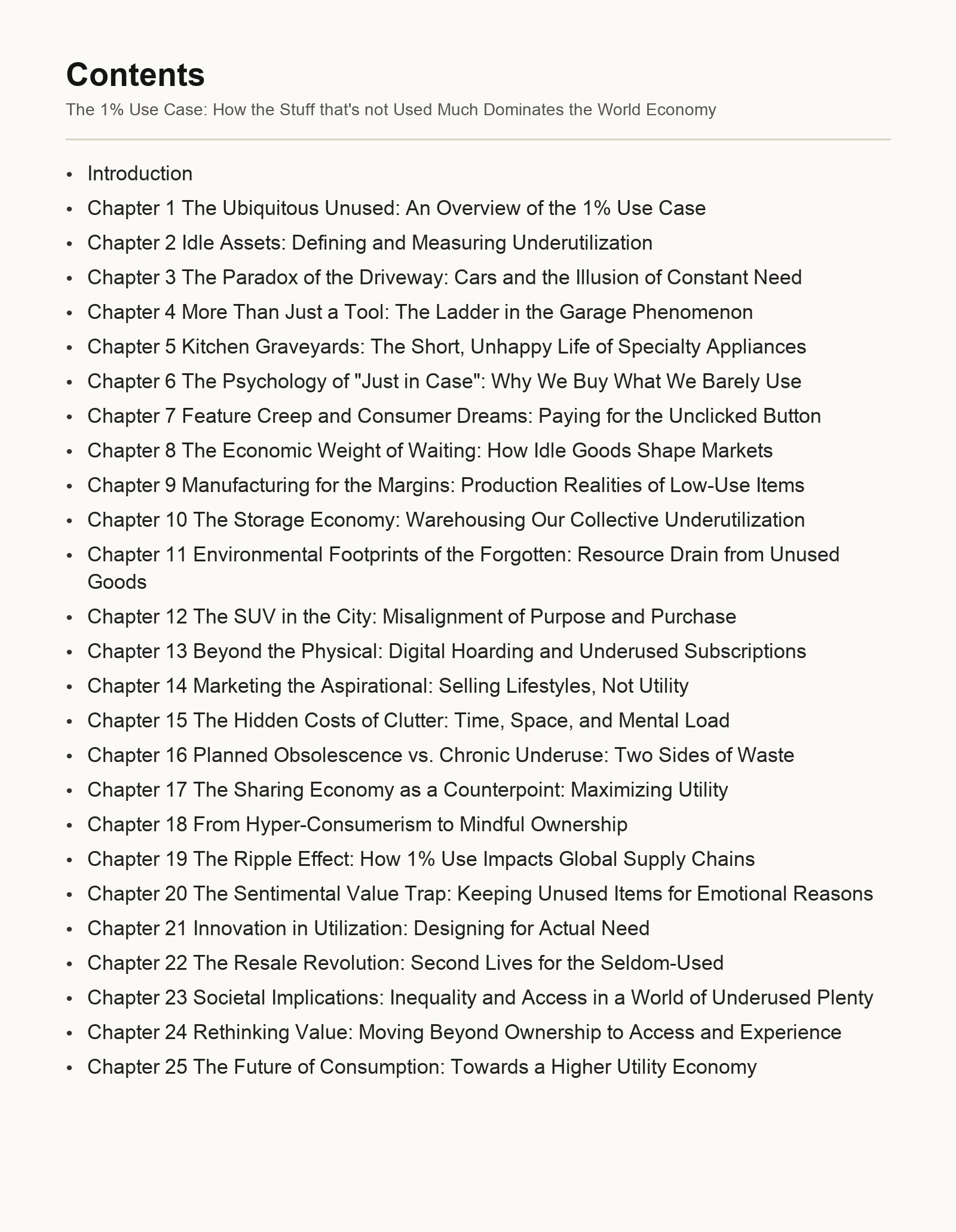
Table of Contents:
- Introduction
- Chapter 1 The Ubiquitous Unused: An Overview of the 1% Use Case
- Chapter 2 Idle Assets: Defining and Measuring Underutilization
- Chapter 3 The Paradox of the Driveway: Cars and the Illusion of Constant Need
- Chapter 4 More Than Just a Tool: The Ladder in the Garage Phenomenon
- Chapter 5 Kitchen Graveyards: The Short, Unhappy Life of Specialty Appliances
- Chapter 6 The Psychology of "Just in Case": Why We Buy What We Barely Use
- Chapter 7 Feature Creep and Consumer Dreams: Paying for the Unclicked Button
- Chapter 8 The Economic Weight of Waiting: How Idle Goods Shape Markets
- Chapter 9 Manufacturing for the Margins: Production Realities of Low-Use Items
- Chapter 10 The Storage Economy: Warehousing Our Collective Underutilization
- Chapter 11 Environmental Footprints of the Forgotten: Resource Drain from Unused Goods
- Chapter 12 The SUV in the City: Misalignment of Purpose and Purchase
- Chapter 13 Beyond the Physical: Digital Hoarding and Underused Subscriptions
- Chapter 14 Marketing the Aspirational: Selling Lifestyles, Not Utility
- Chapter 15 The Hidden Costs of Clutter: Time, Space, and Mental Load
- Chapter 16 Planned Obsolescence vs. Chronic Underuse: Two Sides of Waste
- Chapter 17 The Sharing Economy as a Counterpoint: Maximizing Utility
- Chapter 18 From Hyper-Consumerism to Mindful Ownership
- Chapter 19 The Ripple Effect: How 1% Use Impacts Global Supply Chains
- Chapter 20 The Sentimental Value Trap: Keeping Unused Items for Emotional Reasons
- Chapter 21 Innovation in Utilization: Designing for Actual Need
- Chapter 22 The Resale Revolution: Second Lives for the Seldom-Used
- Chapter 23 Societal Implications: Inequality and Access in a World of Underused Plenty
- Chapter 24 Rethinking Value: Moving Beyond Ownership to Access and Experience
- Chapter 25 The Future of Consumption: Towards a Higher Utility Economy
Author:
Published By:
Date Published:
May 18, 2026
Type:
Nonfiction
Language:
English
Also Available In:
Word Count:
54,764 words
Reading Time:
3 hours 50 minutes
Sample:
Order:
Buy the The 1% Use Case ebook on MixCache.com:
Buy NowThe full ebook will be available immediately to read instantly on any device.
$5 account credit for all new MixCache.com accounts, usable toward any ebook purchase!*


Ratings & Reviews
Ask Questions About This Book
Have a question about the content? Ask our AI assistant!
Start by asking a question about "The 1% Use Case"
Example: "Does this book mention William Shakespeare?"
Thinking...