Browse by Category
Fiction
- Action & Adventure
- African American
- Anthologies
- Children's Fiction
- Classics
- Comics & Graphic Novels
- Coming of Age
- Contemporary
- Cultural & Regional
- Drama
- Erotica
- Fantasy
- General
- Historical Fiction
- Horror
- Humor & Satire
- Literary Fiction
- Mystery, Thriller & Suspense
- Poetry
- Religious & Inspirational
- Romance
- Science Fiction
- Short Stories
- War & Military
- Westerns
- Women's Fiction
- Young Adult
Non-Fiction
- Antiques & Collectibles
- Arts & Photography
- Biographies & Memoirs
- Business & Money
- Children's Non-Fiction
-
Computers & Technology
- Artificial Intelligence
- Computer Science
- Cybersecurity & Cryptography
- Data Science & Analytics
- Databases & Big Data
- Game Development & Design
- General
- Hardware & DIY
- Mobile App Development
- Networking & Cloud Computing
- Operating Systems
- Programming
- Robotics
- Software
- Software Engineering
- User Experience (UX) & Design
- Web Development & Design
- Cooking, Food & Wine
- Crafts, Hobbies & Home
- Education & Teaching
- Engineering
- General
- Health, Fitness & Dieting
-
History
- African History
- African History - North Africa
- African History - Sub-Saharan Africa
- American History
- American History - 20th Century
- American History - Civil War
- American History - Colonial Period
- Ancient History
- Asian History
- Asian History - China
- Asian History - India
- Asian History - Japan
- Asian History - Southeast Asia
- European History
- European History - Ancient Greece
- European History - Ancient Rome
- European History - Medieval
- European History - Modern
- European History - Renaissance
- General
- Middle Eastern History
- Military History
- Military History - Aviation
- Military History - Naval
- Social & Cultural History
- World History
- Humor & Entertainment
- Industrial Technology
- Language Learning
- Law
- LGBTQ+ Non-Fiction
- Literary Criticism
- Medical Books
- Parenting & Relationships
- Philosophy
- Politics & Social Sciences
- Reference
- Religion & Spirituality
-
Science & Math
- Agricultural Sciences
- Astronomy & Space Science
- Behavioral Sciences
- Biological Sciences
- Botany & Plant Science
- Chemistry
- Earth Sciences
- Engineering - Chemical
- Engineering - Civil
- Engineering - Electrical
- Engineering - Mechanical
- Environment
- General
- Geology
- Mathematics
- Nature & Ecology
- Oceanography
- Paleontology
- Physics
- Statistics
- Self-Help
- Sports & Outdoors
- Study Aids
- Sustainability & Green Living
- Textbooks
- Transportation
- Travel
- True Crime
- Urban Planning & Development
- Veterinary Medicine
- Writing & Publishing
Jump to Section

Want unlimited access to all books published by MixCache.com (plus their audiobooks)? Try MixCache.com Total Access. Look for the MTA badge on book covers to identify included titles.
Access to infinite ebooks: Don't see the book you want? Suggest it and we'll create it (free!) for you from scratch with our powerful AI book writer. Then read it with MTA - besides profiting from any sales it makes!
Conquest and Continuity in Spanish America
MTA
How colonial institutions reshaped South American societies, 1500–1800
About this book:

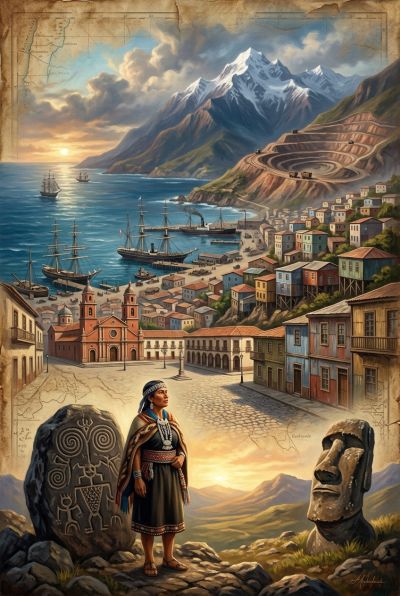
*Conquest and Continuity in Spanish America* argues that the three centuries of Spanish rule in South America (1500–1800) were defined by a complex tension between radical disruption and resilient continuity. While the arrival of Europeans and subsequent demographic collapse of Indigenous populations caused profound trauma, the book posits that colonial governance succeeded by repurposing, rather than erasing, pre-existing social and political structures. Through institutions like the *encomienda*, the *mita*, and the *cabildo*, the Spanish Crown consolidated an imperial hub—centered in the Viceroyalty of Peru—that relied heavily on Indigenous labor, knowledge, and intermediary elites like the *kurakas* to function.
The narrative details the architectural and economic pillars of this imperial order, highlighting the silver boom of Potosí as a catalyst for global trade and a driver of coercive labor regimes. Rural power was further solidified through *haciendas* and *obrajes*, which institutionalized land tenure and social hierarchy. Concurrently, the Catholic Church operated as a "state within a state," managing education, moral discipline, and land while facilitating a pervasive cultural and religious syncretism. This hybridity flourished in art, ritual, and language, creating a uniquely American society where European forms were constantly negotiated and reshaped by Indigenous and Afro-descendant agency.
As the empire matured, the eighteenth-century Bourbon Reforms attempted to re-centralize authority and maximize revenue, often exacerbating social tensions and sparking massive uprisings like those of the Comuneros and Túpac Amaru II. These rebellions exposed the limits of imperial accommodation and the depth of criollo and Indigenous grievances. However, the book concludes that even the wars of independence did not achieve a total break from the past. Instead, the nascent South American republics inherited the legal frameworks, administrative geographies, and racialized social hierarchies of the colonial era.
Ultimately, the book illustrates that the institutional "DNA" of the Spanish Empire remains embedded in the modern structures of the continent. From concentrated land ownership and centralized bureaucracies to persistent racial inequalities and vibrant cultural hybridity, the legacies of the viceroyalties continue to inform contemporary politics and identity. The history of Spanish America is thus presented not as a closed chapter, but as a foundational and ongoing process of adaptation and reinvention that continues to shape the region’s social and political landscape.
What You'll Find Inside:
- Explores the dual nature of Spanish colonization in South America, focusing on both the violent conquest and the enduring continuity of pre-Columbian social structures and cultural practices.
- Details the evolution of Spanish colonial institutions like encomiendas, audiencias, cabildos, and the mita, showing how they functioned as mechanisms of extraction and governance.
- Highlights the central role of Potosí and its silver economy in shaping global trade, labor regimes, and social hierarchies across the Viceroyalty of Peru.
- Examines the diverse forms of resistance and accommodation employed by Indigenous and Afro-descendant populations, from legal challenges and cultural syncretism to organized rebellions.
- Analyzes the profound and lasting legacies of colonial rule on modern South American institutions, social structures, and cultural identities, extending beyond the period of independence.
Who's It For:
This book is essential reading for students, scholars, and general readers interested in Latin American history, colonial studies, and the enduring impact of imperial systems. It will particularly appeal to those seeking a nuanced understanding of how historical institutions shaped contemporary political, economic, and social landscapes in South America, offering insights into the complex interplay of power, culture, and resistance.
Author:
Published By:
Date Published:
January 17, 2026
Type:
Nonfiction
Language:
English
Word Count:
86,822 words
Reading Time:
6 hours 5 minutes
Sample:
Order:
Order Conquest and Continuity in Spanish America (Paperback) on MixCache.com:
Buy NowPrint copy is made to order and ships worldwide. Includes the ebook free, ready to read instantly.
$5 account credit for all new MixCache.com accounts, usable toward any ebook purchase!*