
Browse by Category
Fiction
- Action & Adventure
- African American
- Anthologies
- Children's Fiction
- Classics
- Comics & Graphic Novels
- Coming of Age
- Contemporary
- Cultural & Regional
- Drama
- Erotica
- Fantasy
- General
- Historical Fiction
- Horror
- Humor & Satire
- Literary Fiction
- Mystery, Thriller & Suspense
- Poetry
- Religious & Inspirational
- Romance
- Science Fiction
- Short Stories
- War & Military
- Westerns
- Women's Fiction
- Young Adult
Non-Fiction
- Antiques & Collectibles
- Arts & Photography
- Biographies & Memoirs
- Business & Money
- Children's Non-Fiction
-
Computers & Technology
- Artificial Intelligence
- Computer Science
- Cybersecurity & Cryptography
- Data Science & Analytics
- Databases & Big Data
- Game Development & Design
- General
- Hardware & DIY
- Mobile App Development
- Networking & Cloud Computing
- Operating Systems
- Programming
- Robotics
- Software
- Software Engineering
- User Experience (UX) & Design
- Web Development & Design
- Cooking, Food & Wine
- Crafts, Hobbies & Home
- Education & Teaching
- Engineering
- General
- Health, Fitness & Dieting
-
History
- African History
- African History - North Africa
- African History - Sub-Saharan Africa
- American History
- American History - 20th Century
- American History - Civil War
- American History - Colonial Period
- Ancient History
- Asian History
- Asian History - China
- Asian History - India
- Asian History - Japan
- Asian History - Southeast Asia
- European History
- European History - Ancient Greece
- European History - Ancient Rome
- European History - Medieval
- European History - Modern
- European History - Renaissance
- General
- Middle Eastern History
- Military History
- Military History - Aviation
- Military History - Naval
- Social & Cultural History
- World History
- Humor & Entertainment
- Industrial Technology
- Language Learning
- Law
- LGBTQ+ Non-Fiction
- Literary Criticism
- Medical Books
- Parenting & Relationships
- Philosophy
- Politics & Social Sciences
- Reference
- Religion & Spirituality
-
Science & Math
- Agricultural Sciences
- Astronomy & Space Science
- Behavioral Sciences
- Biological Sciences
- Botany & Plant Science
- Chemistry
- Earth Sciences
- Engineering - Chemical
- Engineering - Civil
- Engineering - Electrical
- Engineering - Mechanical
- Environment
- General
- Geology
- Mathematics
- Nature & Ecology
- Oceanography
- Paleontology
- Physics
- Statistics
- Self-Help
- Sports & Outdoors
- Study Aids
- Sustainability & Green Living
- Textbooks
- Transportation
- Travel
- True Crime
- Urban Planning & Development
- Veterinary Medicine
- Writing & Publishing
Jump to Section
MixCache.com Total Access
Unlimited reading and audiobooks for every book published by MixCache.com.
Included titles carry the MTA badge.
Learn more →
Scramble and Partition: European Colonialism and the Making of Modern Africa
MTA
Diplomacy, Violence, and the Cartography of Empire, 1870–1960
About this book:
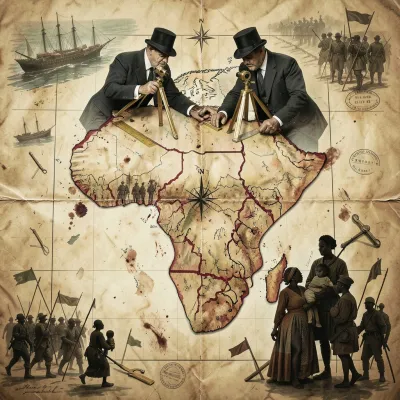
"Scramble and Partition: European Colonialism and the Making of Modern Africa" analyzes how European colonialism between 1870 and 1960 fundamentally reshaped Africa's political geography and social structures. The book employs the lenses of diplomacy, violence, and cartography to reveal how treaties and conferences established the framework for expansion, how military force enforced these claims, and how maps solidified these ambitions into enduring borders. It argues that Africa was a vibrant political landscape, not an empty space, into which European powers forcibly inserted themselves, leading to a complex interplay of conquest, resistance, and adaptation.
The narrative details the transition from initial exploration and claims to the systematic establishment of extractive states. Early chapters describe Europe's industrial and strategic rivalries in 1870 and how explorers, missionaries, and commercial interests gathered knowledge that facilitated later expropriation. The Berlin Conference of 1884–85 is highlighted not as a direct partition, but as a crucial event that codified principles like "effective occupation," legitimizing rapid territorial claims and enabling the proliferation of treaties and boundary commissions. The book then delves into the violent reality of conquest, utilizing gunboats and military columns, and examines the role of concessionary companies in resource extraction, notably exemplified by the brutal regime of the Congo Free State and the subsequent international outcry.
The text further explores how colonial powers consolidated their rule through administrative innovations. It discusses the "extractive state," characterized by hut taxes, forced labor, and the promotion of cash-crop economies, all supported by new infrastructures like railways and telegraphs. Missionaries are presented as instrumental in establishing schools and health services, inadvertently creating new African elites and shaping social hierarchies. The concept of "indirect rule" is analyzed as a deliberate invention of "tradition" to manage diverse populations, freezing fluid customs into codes that served colonial interests. The book also examines the distinct nature of settler colonies in Algeria, Kenya, and Southern Africa, where European populations fostered deep-seated segregation and land alienation.
Finally, the book addresses the profound impacts of global conflicts and the process of decolonization. World War I and II, alongside the Great Depression, intensified colonial exploitation and disrupted existing social orders, accelerating the rise of African nationalism expressed through parties, unions, and intellectuals. Decolonization is portrayed as an uneven process of negotiation, insurgency, and shifting international opinion, resulting in the emergence of independent states that inherited colonial borders, administrative structures, and economic dependencies. The concluding chapter reflects on these enduring "afterlives" of colonialism, emphasizing how the scramble's partitions continue to shape contemporary African politics, economies, legal systems, and identities, necessitating ongoing adaptation and contestation.
What You'll Find Inside:
- How diplomacy, violence, and cartography intertwined to establish and maintain European colonial rule across Africa from 1870-1960
- The role of concessionary companies in colonial governance and how they blurred public/private power while extracting resources
- How colonial states built extractive economies through taxation systems, forced labor, and cash-crop agriculture that persist in modern Africa
- The lasting political and social consequences of arbitrarily drawn colonial borders that divided ethnic groups and created enduring conflict zones
- African strategies of resistance, collaboration, and nationalism that shaped colonial rule and drove the decolonization process
Who's It For:
This book is ideal for students and scholars of African history, colonial studies, and imperial history seeking a comprehensive understanding of how European partition created Africa's modern political geography. It will also benefit researchers interested in the roots of contemporary African conflicts, development challenges, and state formation, as well as general readers with a strong interest in historical accounts of empire-building and its legacies.
Table of Contents:
- Introduction
- Chapter 1 The World of 1870: Europe, Africa, and the Balance of Power
- Chapter 2 From Exploration to Expropriation: Knowledge, Myths, and Motives
- Chapter 3 Diplomats and Deadlines: The Road to the Berlin Conference, 1884–85
- Chapter 4 Drawing Lines, Dividing Lives: The Berlin Rules and the Map
- Chapter 5 Conquest as Policy: Gunboats, Columns, and Colonial War
- Chapter 6 Corporate Empires: Concessionary Companies and the Business of Rule
- Chapter 7 The Congo Free State: Atrocity, Activism, and International Law
- Chapter 8 Frontiers in Motion: Resistance, Collaboration, and Civil War
- Chapter 9 Building the Extractive State: Taxes, Labor, and the Cash-Crop Economy
- Chapter 10 The Railway and the Telegraph: Infrastructures of Empire
- Chapter 11 Faith, Schools, and Science: Missionaries and the Production of Subjects
- Chapter 12 Custom and Code: Inventing Tradition and the Law of Indirect Rule
- Chapter 13 Settlers and Segregation: Algeria, Kenya, and Southern Africa
- Chapter 14 Disease, Famine, and the Ecology of Rule
- Chapter 15 World War I: African Fronts and the Reordering of Empire
- Chapter 16 Mandates and Modernities: The League of Nations and Postwar Governance
- Chapter 17 Depression and Dissent: Reform, Repression, and Everyday Survival, 1929–39
- Chapter 18 World War II: Mobilization, Resources, and the Promise of Change
- Chapter 19 Cities, Labor, and New Publics: Urban Africa under Colonial Rule
- Chapter 20 Paper Empires: Cartography, Censuses, and the Archive of Control
- Chapter 21 The Grammar of Nationalism: Parties, Unions, and Intellectuals
- Chapter 22 Decolonization in Motion: Negotiation, Insurgency, and International Opinion
- Chapter 23 The Problem of Borders: Partition, Union, and Secession
- Chapter 24 After Empire Begins: Sovereignty, Development, and the Early Postcolonial State, 1957–1960
- Chapter 25 Legacies and Lessons: Colonialism’s Afterlives in the Present
Author:
Published By:
Date Published:
May 5, 2026
Type:
Nonfiction
Language:
English
Word Count:
73,897 words
Reading Time:
5 hours 10 minutes
Sample:
MixCache.com Total Access
Get unlimited access to this book + all books published by MixCache.com for $11.99/month
Subscribe to MTAOr purchase this book individually below
Order:
Buy the Scramble and Partition: European Colonialism and the Making of Modern Africa ebook on MixCache.com:
Buy Now
Full ebook will be available immediately
- read online or download as a PDF file.
$5 account credit for all new MixCache.com accounts, usable toward any ebook purchase!*




Ratings & Reviews
Ask Questions About This Book
Have a question about the content? Ask our AI assistant!
Start by asking a question about "Scramble and Partition: European Colonialism and the Making of Modern Africa"
Example: "Does this book mention William Shakespeare?"
Thinking...