
Browse by Category
Fiction
- Action & Adventure
- African American
- Anthologies
- Children's Fiction
- Classics
- Comics & Graphic Novels
- Coming of Age
- Contemporary
- Cultural & Regional
- Drama
- Erotica
- Fantasy
- General
- Historical Fiction
- Horror
- Humor & Satire
- Literary Fiction
- Mystery, Thriller & Suspense
- Poetry
- Religious & Inspirational
- Romance
- Science Fiction
- Short Stories
- War & Military
- Westerns
- Women's Fiction
- Young Adult
Non-Fiction
- Antiques & Collectibles
- Arts & Photography
- Biographies & Memoirs
- Business & Money
- Children's Non-Fiction
-
Computers & Technology
- Artificial Intelligence
- Computer Science
- Cybersecurity & Cryptography
- Data Science & Analytics
- Databases & Big Data
- Game Development & Design
- General
- Hardware & DIY
- Mobile App Development
- Networking & Cloud Computing
- Operating Systems
- Programming
- Robotics
- Software
- Software Engineering
- User Experience (UX) & Design
- Web Development & Design
- Cooking, Food & Wine
- Crafts, Hobbies & Home
- Education & Teaching
- Engineering
- General
- Health, Fitness & Dieting
-
History
- African History
- African History - North Africa
- African History - Sub-Saharan Africa
- American History
- American History - 20th Century
- American History - Civil War
- American History - Colonial Period
- Ancient History
- Asian History
- Asian History - China
- Asian History - India
- Asian History - Japan
- Asian History - Southeast Asia
- European History
- European History - Ancient Greece
- European History - Ancient Rome
- European History - Medieval
- European History - Modern
- European History - Renaissance
- General
- Middle Eastern History
- Military History
- Military History - Aviation
- Military History - Naval
- Social & Cultural History
- World History
- Humor & Entertainment
- Industrial Technology
- Language Learning
- Law
- LGBTQ+ Non-Fiction
- Literary Criticism
- Medical Books
- Parenting & Relationships
- Philosophy
- Politics & Social Sciences
- Reference
- Religion & Spirituality
-
Science & Math
- Agricultural Sciences
- Astronomy & Space Science
- Behavioral Sciences
- Biological Sciences
- Botany & Plant Science
- Chemistry
- Earth Sciences
- Engineering - Chemical
- Engineering - Civil
- Engineering - Electrical
- Engineering - Mechanical
- Environment
- General
- Geology
- Mathematics
- Nature & Ecology
- Oceanography
- Paleontology
- Physics
- Statistics
- Self-Help
- Sports & Outdoors
- Study Aids
- Sustainability & Green Living
- Textbooks
- Transportation
- Travel
- True Crime
- Urban Planning & Development
- Veterinary Medicine
- Writing & Publishing
Jump to Section
MixCache.com Total Access
Unlimited reading and audiobooks for every book published by MixCache.com.
Included titles carry the MTA badge.
Learn more →
A History of the Arabs
Fifteen Centuries of Conquest, Culture, and Conflict
About this book:
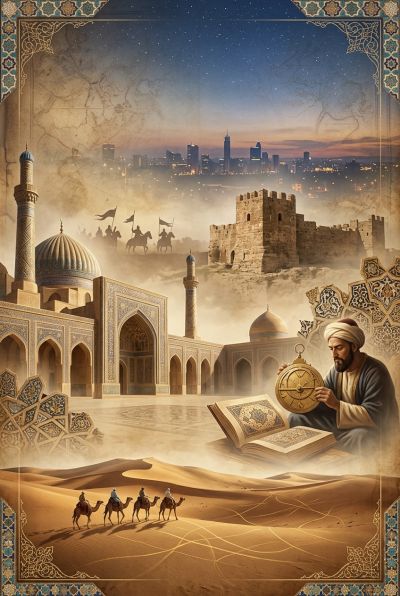
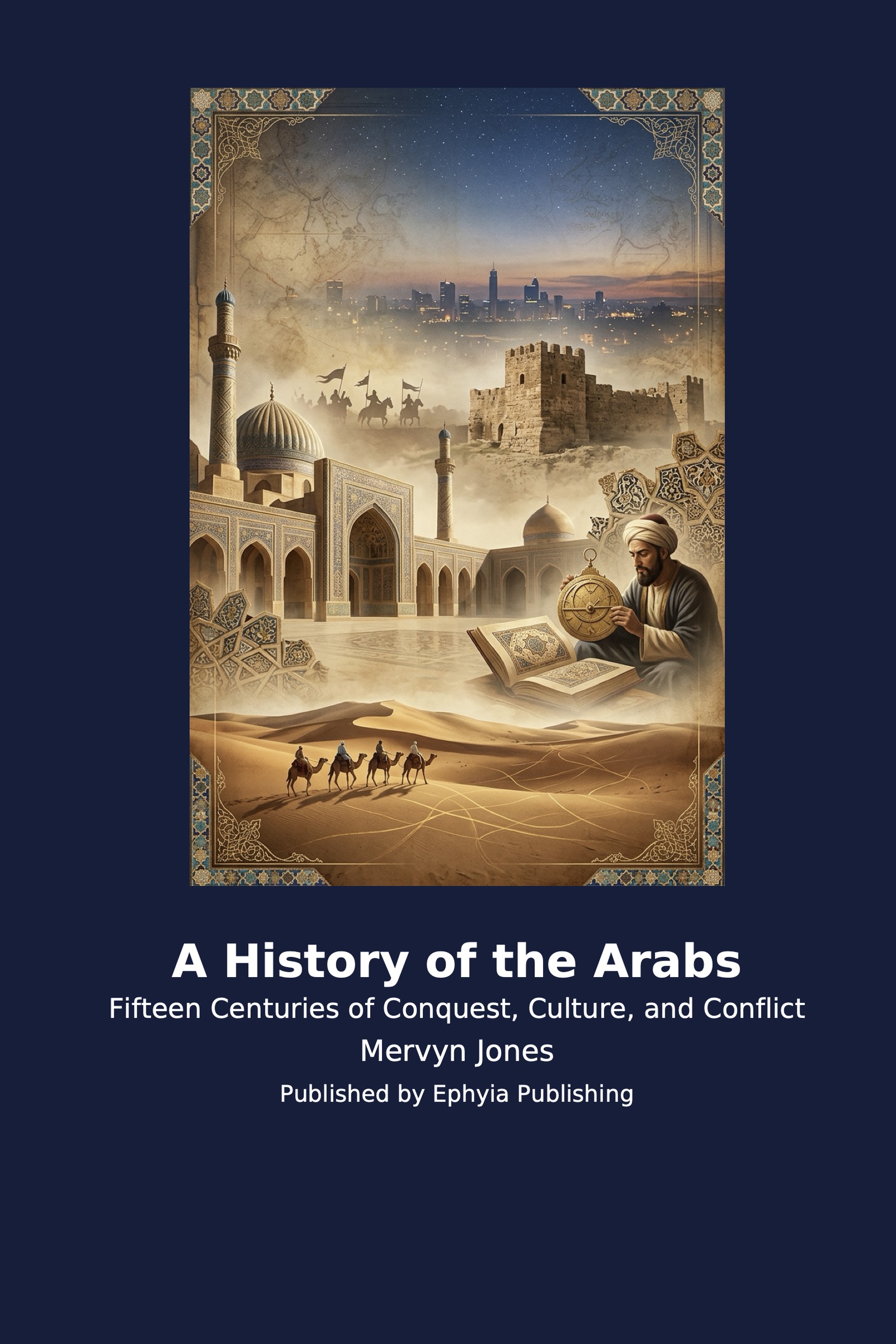
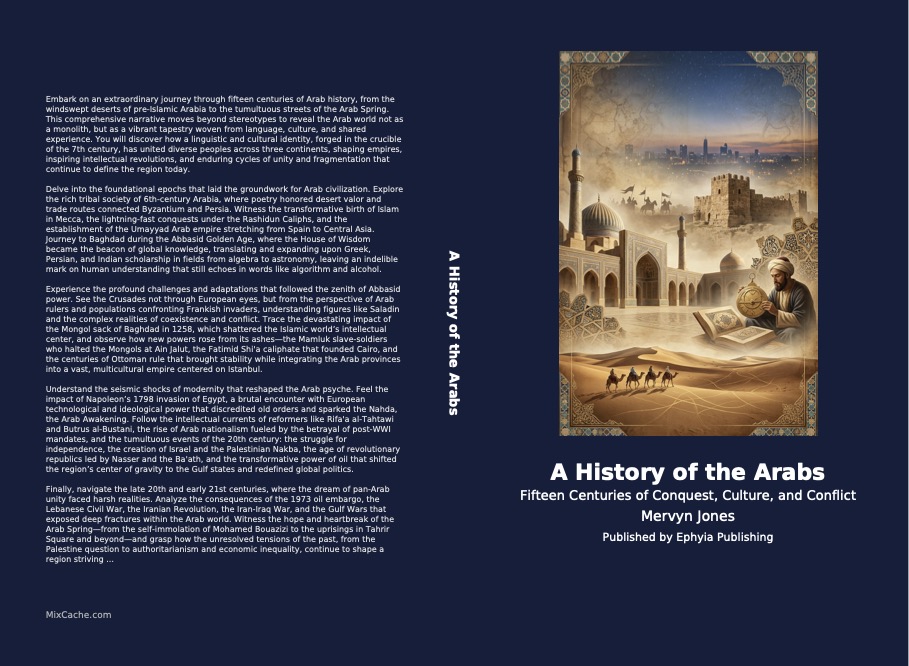
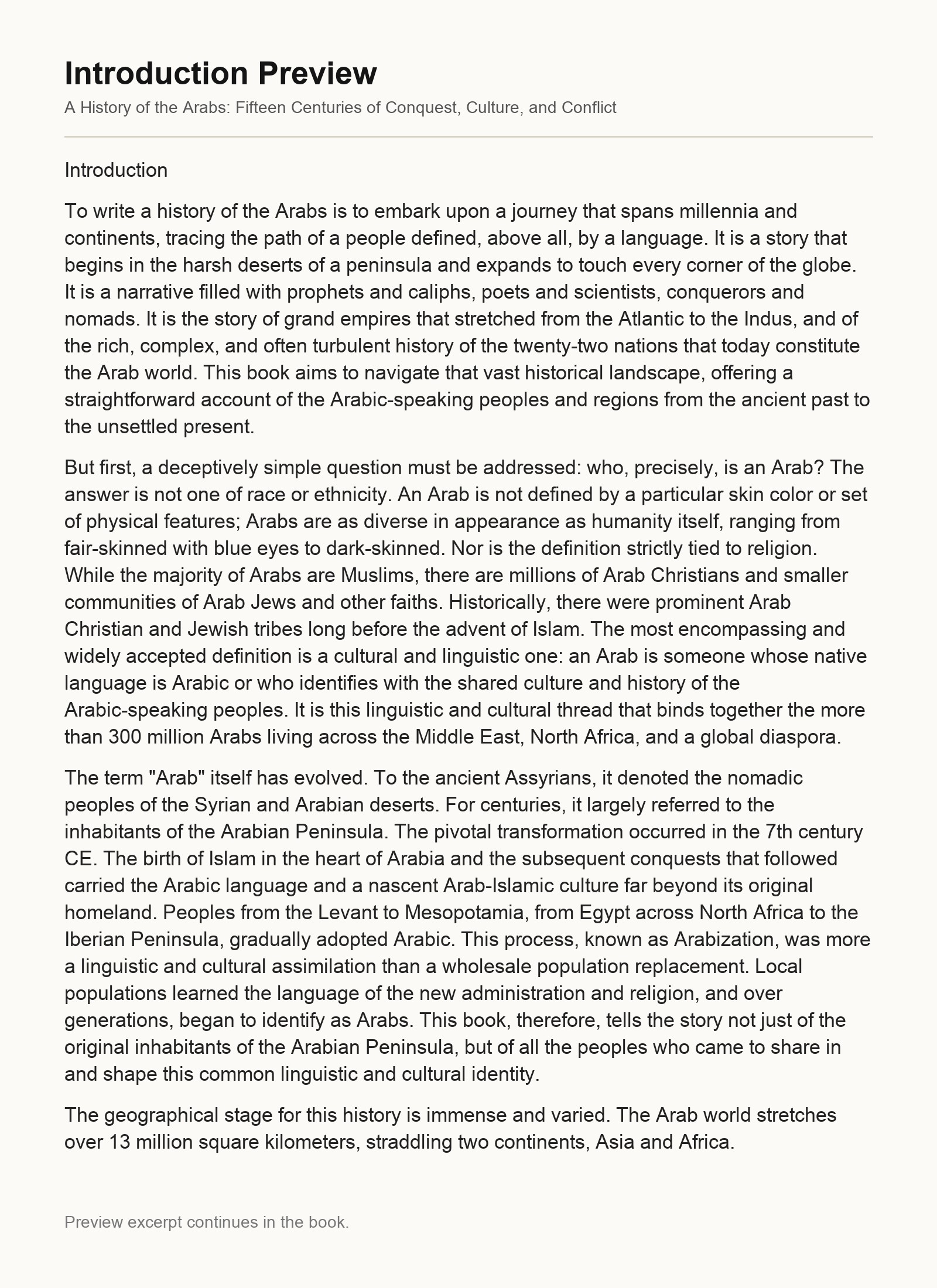
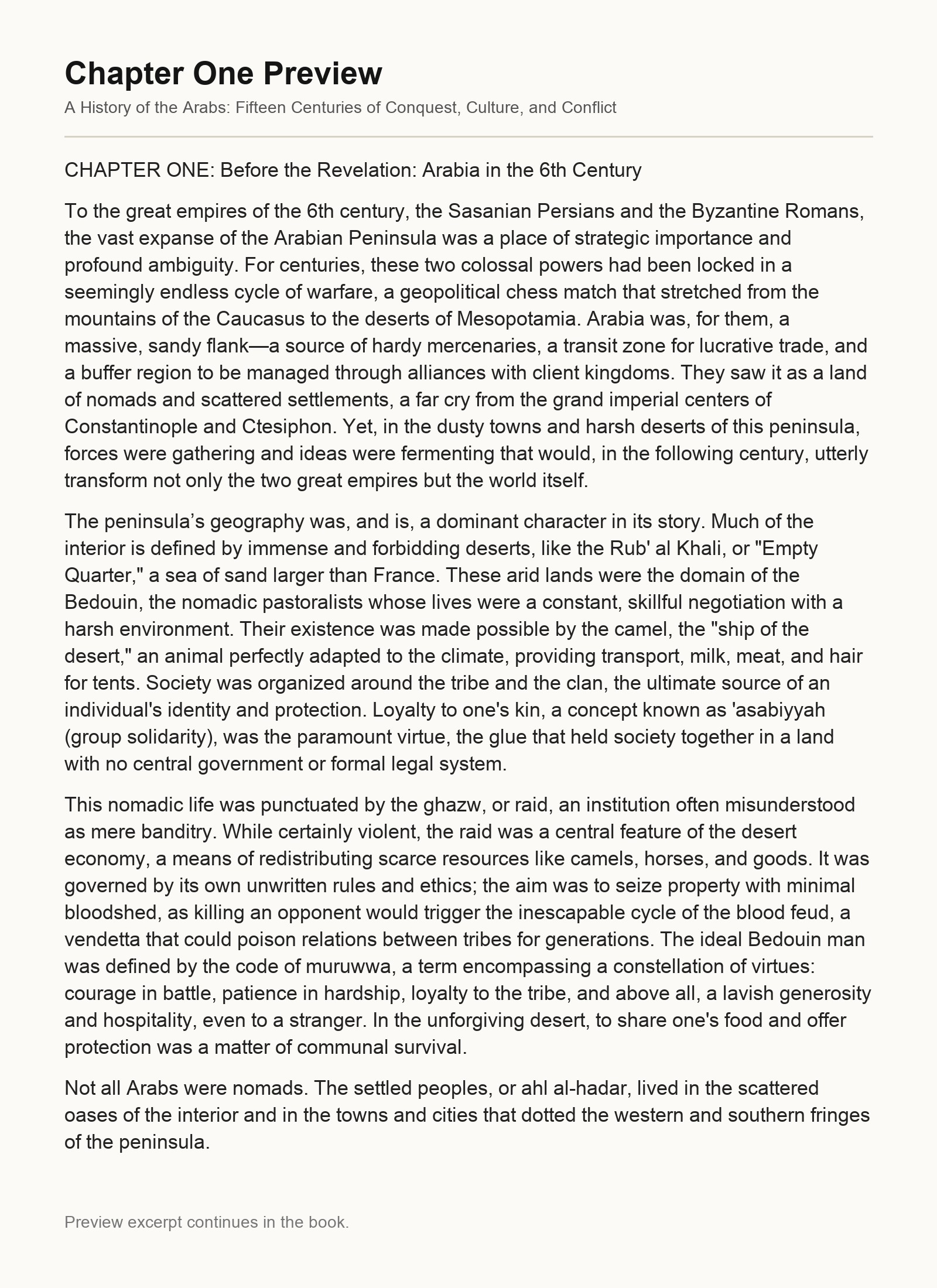
Embark on an extraordinary journey through fifteen centuries of Arab history, from the windswept deserts of pre-Islamic Arabia to the tumultuous streets of the Arab Spring. This comprehensive narrative moves beyond stereotypes to reveal the Arab world not as a monolith, but as a vibrant tapestry woven from language, culture, and shared experience. You will discover how a linguistic and cultural identity, forged in the crucible of the 7th century, has united diverse peoples across three continents, shaping empires, inspiring intellectual revolutions, and enduring cycles of unity and fragmentation that continue to define the region today.
Delve into the foundational epochs that laid the groundwork for Arab civilization. Explore the rich tribal society of 6th-century Arabia, where poetry honored desert valor and trade routes connected Byzantium and Persia. Witness the transformative birth of Islam in Mecca, the lightning-fast conquests under the Rashidun Caliphs, and the establishment of the Umayyad Arab empire stretching from Spain to Central Asia. Journey to Baghdad during the Abbasid Golden Age, where the House of Wisdom became the beacon of global knowledge, translating and expanding upon Greek, Persian, and Indian scholarship in fields from algebra to astronomy, leaving an indelible mark on human understanding that still echoes in words like algorithm and alcohol.
Experience the profound challenges and adaptations that followed the zenith of Abbasid power. See the Crusades not through European eyes, but from the perspective of Arab rulers and populations confronting Frankish invaders, understanding figures like Saladin and the complex realities of coexistence and conflict. Trace the devastating impact of the Mongol sack of Baghdad in 1258, which shattered the Islamic world’s intellectual center, and observe how new powers rose from its ashes—the Mamluk slave-soldiers who halted the Mongols at Ain Jalut, the Fatimid Shi'a caliphate that founded Cairo, and the centuries of Ottoman rule that brought stability while integrating the Arab provinces into a vast, multicultural empire centered on Istanbul.
Understand the seismic shocks of modernity that reshaped the Arab psyche. Feel the impact of Napoleon’s 1798 invasion of Egypt, a brutal encounter with European technological and ideological power that discredited old orders and sparked the Nahda, the Arab Awakening. Follow the intellectual currents of reformers like Rifa'a al-Tahtawi and Butrus al-Bustani, the rise of Arab nationalism fueled by the betrayal of post-WWI mandates, and the tumultuous events of the 20th century: the struggle for independence, the creation of Israel and the Palestinian Nakba, the age of revolutionary republics led by Nasser and the Ba'ath, and the transformative power of oil that shifted the region’s center of gravity to the Gulf states and redefined global politics.
Finally, navigate the late 20th and early 21st centuries, where the dream of pan-Arab unity faced harsh realities. Analyze the consequences of the 1973 oil embargo, the Lebanese Civil War, the Iranian Revolution, the Iran-Iraq War, and the Gulf Wars that exposed deep fractures within the Arab world. Witness the hope and heartbreak of the Arab Spring—from the self-immolation of Mohamed Bouazizi to the uprisings in Tahrir Square and beyond—and grasp how the unresolved tensions of the past, from the Palestine question to authoritarianism and economic inequality, continue to shape a region striving for dignity, justice, and a meaningful future in an ever-changing world. This is not just a history of the past; it is the essential key to understanding the present and potential future of the Arab world.
What You'll Find Inside:
- Explores how Arab identity is defined by language and culture rather than race or religion, tracing this concept from pre-Islamic times to the present.
- Chronicles the birth of Islam in 7th century Arabia and the remarkably rapid conquests that established an empire stretching from Spain to Central Asia.
- Details the Abbasid era's Islamic Golden Age, highlighting Baghdad's House of Wisdom as a global center of science, philosophy, and medicine that preserved and advanced ancient knowledge.
- Examines the aftermath of World War I, including the Arab Revolt and the betrayal of the Mandate system where Britain and France divided Arab lands against local wishes.
- Analyzes the modern Arab world's transformation through oil wealth, the rise of Arab nationalism, repeated conflicts with Israel, and the hopeful yet tragic events of the Arab Spring.
Who's It For:
This book is ideal for students, educators, and general readers seeking a comprehensive yet accessible overview of Arab history from pre-Islamic times to the 21st century. It will particularly benefit those wishing to understand the historical roots of contemporary Middle Eastern conflicts, cultural achievements, and political developments. Readers interested in world history, Islamic studies, or the origins of modern Arab nations will find valuable context and insight. The work serves as both an introduction for newcomers and a solid reference for those with prior knowledge of the region.
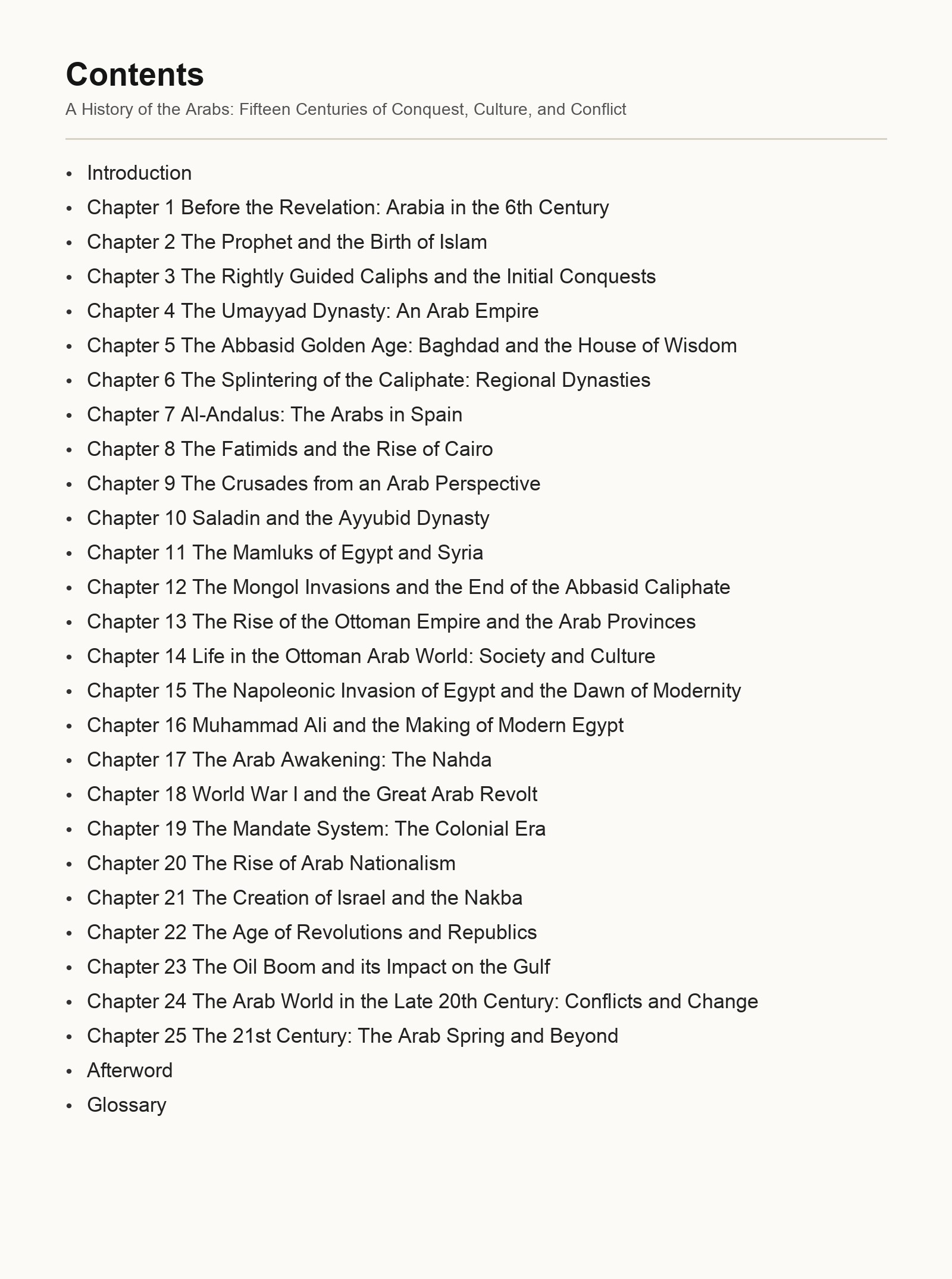
Table of Contents:
- Introduction
- Chapter 1 Before the Revelation: Arabia in the 6th Century
- Chapter 2 The Prophet and the Birth of Islam
- Chapter 3 The Rightly Guided Caliphs and the Initial Conquests
- Chapter 4 The Umayyad Dynasty: An Arab Empire
- Chapter 5 The Abbasid Golden Age: Baghdad and the House of Wisdom
- Chapter 6 The Splintering of the Caliphate: Regional Dynasties
- Chapter 7 Al-Andalus: The Arabs in Spain
- Chapter 8 The Fatimids and the Rise of Cairo
- Chapter 9 The Crusades from an Arab Perspective
- Chapter 10 Saladin and the Ayyubid Dynasty
- Chapter 11 The Mamluks of Egypt and Syria
- Chapter 12 The Mongol Invasions and the End of the Abbasid Caliphate
- Chapter 13 The Rise of the Ottoman Empire and the Arab Provinces
- Chapter 14 Life in the Ottoman Arab World: Society and Culture
- Chapter 15 The Napoleonic Invasion of Egypt and the Dawn of Modernity
- Chapter 16 Muhammad Ali and the Making of Modern Egypt
- Chapter 17 The Arab Awakening: The Nahda
- Chapter 18 World War I and the Great Arab Revolt
- Chapter 19 The Mandate System: The Colonial Era
- Chapter 20 The Rise of Arab Nationalism
- Chapter 21 The Creation of Israel and the Nakba
- Chapter 22 The Age of Revolutions and Republics
- Chapter 23 The Oil Boom and its Impact on the Gulf
- Chapter 24 The Arab World in the Late 20th Century: Conflicts and Change
- Chapter 25 The 21st Century: The Arab Spring and Beyond
- Afterword
- Glossary
Author:
Published By:
Date Published:
May 27, 2026
Type:
Nonfiction
Language:
English
Also Available In:
Spanish, French, Dutch, Portuguese
Word Count:
61,767 words
Reading Time:
4 hours 20 minutes
Sample:
Order:
Buy the A History of the Arabs ebook on MixCache.com:
Buy NowThe full ebook will be available immediately to read instantly on any device.
$5 account credit for all new MixCache.com accounts, usable toward any ebook purchase!*




Ratings & Reviews
Ask Questions About This Book
Have a question about the content? Ask our AI assistant!
Start by asking a question about "A History of the Arabs"
Example: "Does this book mention William Shakespeare?"
Thinking...