Browse by Category
Fiction
- Action & Adventure
- African American
- Anthologies
- Children's Fiction
- Classics
- Comics & Graphic Novels
- Coming of Age
- Contemporary
- Cultural & Regional
- Drama
- Erotica
- Fantasy
- General
- Historical Fiction
- Horror
- Humor & Satire
- Literary Fiction
- Mystery, Thriller & Suspense
- Poetry
- Religious & Inspirational
- Romance
- Science Fiction
- Short Stories
- War & Military
- Westerns
- Women's Fiction
- Young Adult
Non-Fiction
- Antiques & Collectibles
- Arts & Photography
- Biographies & Memoirs
- Business & Money
- Children's Non-Fiction
-
Computers & Technology
- Artificial Intelligence
- Computer Science
- Cybersecurity & Cryptography
- Data Science & Analytics
- Databases & Big Data
- Game Development & Design
- General
- Hardware & DIY
- Mobile App Development
- Networking & Cloud Computing
- Operating Systems
- Programming
- Robotics
- Software
- Software Engineering
- User Experience (UX) & Design
- Web Development & Design
- Cooking, Food & Wine
- Crafts, Hobbies & Home
- Education & Teaching
- Engineering
- General
- Health, Fitness & Dieting
-
History
- African History
- African History - North Africa
- African History - Sub-Saharan Africa
- American History
- American History - 20th Century
- American History - Civil War
- American History - Colonial Period
- Ancient History
- Asian History
- Asian History - China
- Asian History - India
- Asian History - Japan
- Asian History - Southeast Asia
- European History
- European History - Ancient Greece
- European History - Ancient Rome
- European History - Medieval
- European History - Modern
- European History - Renaissance
- General
- Middle Eastern History
- Military History
- Military History - Aviation
- Military History - Naval
- Social & Cultural History
- World History
- Humor & Entertainment
- Industrial Technology
- Language Learning
- Law
- LGBTQ+ Non-Fiction
- Literary Criticism
- Medical Books
- Parenting & Relationships
- Philosophy
- Politics & Social Sciences
- Reference
- Religion & Spirituality
-
Science & Math
- Agricultural Sciences
- Astronomy & Space Science
- Behavioral Sciences
- Biological Sciences
- Botany & Plant Science
- Chemistry
- Earth Sciences
- Engineering - Chemical
- Engineering - Civil
- Engineering - Electrical
- Engineering - Mechanical
- Environment
- General
- Geology
- Mathematics
- Nature & Ecology
- Oceanography
- Paleontology
- Physics
- Statistics
- Self-Help
- Sports & Outdoors
- Study Aids
- Sustainability & Green Living
- Textbooks
- Transportation
- Travel
- True Crime
- Urban Planning & Development
- Veterinary Medicine
- Writing & Publishing
Jump to Section
MixCache.com Total Access
Unlimited reading and audiobooks for every book published by MixCache.com.
Included titles carry the MTA badge.
Learn more →
Education In Brazil
MTA
A Comprehensive Overview from Early Childhood to Higher Education
About this book:
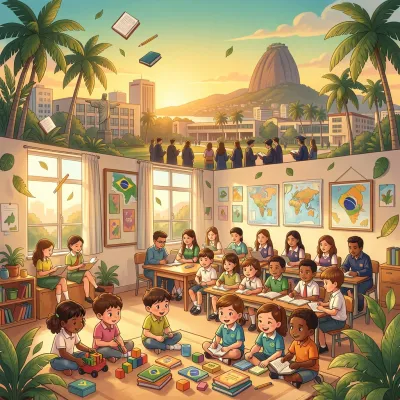
Brazil's educational system, as detailed in this comprehensive overview, is founded on the 1988 Federal Constitution which established education as a universal right and state duty, operating within a decentralized framework involving federal, state, and municipal governments guided by the Lei de Diretrizes e Bases da Educação Nacional (LDB). The system is structured into Basic Education (Early Childhood Education, Ensino Fundamental I and II, and Ensino Médio) and Higher Education (undergraduate and graduate programs), with significant modalities like Youth and Adult Education (EJA), Special Education, Indigenous School Education, Rural Education, and Professional and Technological Education (EPT). Historical evolution reveals influences from Jesuit missions, Pombaline reforms, the Vargas era's centralization, military dictatorship policies, and post-redemocratization efforts focused on access and equity, culminating in laws making pré-escola compulsory and establishing robust evaluation systems like SAEB and IDEB.
Early childhood education (creches for 0-3 years and pré-escolas for 4-5 years) emphasizes holistic development through play and interaction, with municipal responsibility and funding significantly bolstered by FUNDEB, especially after the 2009 constitutional amendment made pré-escola mandatory. Primary education (Ensino Fundamental) spans nine years, divided into Fundamental I (years 1-5, focused on literacy and numeracy) and Fundamental II (years 6-9, featuring subject specialization), guided by the Base Nacional Comum Curricular (BNCC) since 2017 to standardize competencies nationwide. Secondary education (Ensino Médio) was transformed by the Novo Ensino Médio (2017), introducing a common national core (BNCC) and flexible itineraries allowing academic or technical-vocational specialization, while the Exame Nacional do Ensino Médio (ENEM) serves as the primary gateway to higher education through the Unified Selection System (SiSU), alongside access programs like ProUni and FIES. Higher education encompasses universities, university centers, and isolated faculties, with public institutions (federal/state) offering tuition-free education focused on research and extension, and private institutions expanding access; key policies include the Quota Law reserving places for public school students and marginalized racial groups, and evaluation via SINAES and ENADE.
Persistent challenges include deep socioeconomic and regional inequality affecting resource allocation, teacher quality, and learning outcomes; issues of student retention and flow, particularly in Ensino Médio; gaps between curriculum implementation and local realities; and the ongoing tension between standardization and relevance. Innovations target these challenges through technological integration (EAD, adaptive learning), socio-emotional learning programs, targeted teacher development (PARFOR, BNCC training), expanded technical-vocational pathways within the Novo Ensino Médio, inclusive education policies via Specialized Educational Services (AEE), and efforts to strengthen rural and indigenous education through culturally relevant curricula and community leadership. Future directions center on deepening BNCC implementation, ensuring equitable access to Novo Ensino Médio itineraries, closing the digital divide, enhancing teacher valorization and development, strengthening industry-higher education links, refining affirmative action policies, and securing stable funding through reformed mechanisms like FUNDEB to achieve a more equitable, high-quality, and inclusive system for all Brazilians.
What You'll Find Inside:
- Historical evolution of Brazil's education system from colonial times to present, including key reforms and policy milestones.
- Comprehensive overview of the structure of the Brazilian educational system, covering early childhood, primary, secondary, and higher education levels.
- Analysis of current challenges including inequality, quality disparities, and student retention across all educational stages.
- Insights into the pivotal role of ENEM and higher education admission processes, including public-private dynamics and funding mechanisms.
- Exploration of innovative practices in special education, rural education, and the integration of technology to promote inclusive and equitable learning.
Who's It For:
This book is essential reading for educators, policymakers, researchers, and students interested in international education systems. It is particularly valuable for those seeking a detailed understanding of Brazil's educational structure, reforms, and ongoing challenges in achieving equitable access and quality. Readers engaged in global education policy, comparative studies, or international development will benefit from its comprehensive analysis. Additionally, it serves as a resource for professionals working in or with Latin American educational contexts, offering insights into regional strategies and innovations.
Table of Contents:
- Introduction
- Chapter 1: Historical Foundations of Brazilian Education
- Chapter 2: The Structure of the Brazilian Educational System
- Chapter 3: Early Childhood Education: Creches and Pré-escolas
- Chapter 4: Policies and Funding for Early Childhood Education
- Chapter 5: Primary Education: Ensino Fundamental I (Years 1-5)
- Chapter 6: Primary Education: Ensino Fundamental II (Years 6-9)
- Chapter 7: Curriculum and Assessment in Ensino Fundamental
- Chapter 8: Challenges and Innovations in Primary Education
- Chapter 9: Secondary Education: Ensino Médio
- Chapter 10: Technical and Vocational Education in Brazil
- Chapter 11: The Exame Nacional do Ensino Médio (ENEM)
- Chapter 12: Access and Equity in Secondary Education
- Chapter 13: Higher Education Landscape: Universities and Institutes
- Chapter 14: Public vs. Private Higher Education
- Chapter 15: Admission Processes and Quotas in Higher Education
- Chapter 16: Graduate Studies and Research in Brazil
- Chapter 17: Funding and Governance of Higher Education
- Chapter 18: Teacher Training and Professional Development
- Chapter 19: Educational Technology and Digital Inclusion
- Chapter 20: Special Education and Inclusive Practices
- Chapter 21: Education in Rural and Indigenous Communities
- Chapter 22: The Role of NGOs and International Cooperation in Education
- Chapter 23: Educational Reforms and Future Directions
- Chapter 24: Challenges: Inequality, Quality, and Retention
- Chapter 25: Prospects for the Future of Brazilian Education
Author:
Published By:
Date Published:
June 20, 2026
Type:
Nonfiction
Language:
English
Word Count:
46,162 words
Reading Time:
3 hours 14 minutes
Sample:
Order:
Order Education In Brazil (Paperback) on MixCache.com:
Buy NowPrint copy is made to order and ships worldwide. Includes the ebook free, ready to read instantly.
$5 account credit for all new MixCache.com accounts, usable toward any ebook purchase!*