Browse by Category
Fiction
- Action & Adventure
- African American
- Anthologies
- Children's Fiction
- Classics
- Comics & Graphic Novels
- Coming of Age
- Contemporary
- Cultural & Regional
- Drama
- Erotica
- Fantasy
- General
- Historical Fiction
- Horror
- Humor & Satire
- Literary Fiction
- Mystery, Thriller & Suspense
- Poetry
- Religious & Inspirational
- Romance
- Science Fiction
- Short Stories
- War & Military
- Westerns
- Women's Fiction
- Young Adult
Non-Fiction
- Antiques & Collectibles
- Arts & Photography
- Biographies & Memoirs
- Business & Money
- Children's Non-Fiction
-
Computers & Technology
- Artificial Intelligence
- Computer Science
- Cybersecurity & Cryptography
- Data Science & Analytics
- Databases & Big Data
- Game Development & Design
- General
- Hardware & DIY
- Mobile App Development
- Networking & Cloud Computing
- Operating Systems
- Programming
- Robotics
- Software
- Software Engineering
- User Experience (UX) & Design
- Web Development & Design
- Cooking, Food & Wine
- Crafts, Hobbies & Home
- Education & Teaching
- Engineering
- General
- Health, Fitness & Dieting
-
History
- African History
- African History - North Africa
- African History - Sub-Saharan Africa
- American History
- American History - 20th Century
- American History - Civil War
- American History - Colonial Period
- Ancient History
- Asian History
- Asian History - China
- Asian History - India
- Asian History - Japan
- Asian History - Southeast Asia
- European History
- European History - Ancient Greece
- European History - Ancient Rome
- European History - Medieval
- European History - Modern
- European History - Renaissance
- General
- Middle Eastern History
- Military History
- Military History - Aviation
- Military History - Naval
- Social & Cultural History
- World History
- Humor & Entertainment
- Industrial Technology
- Language Learning
- Law
- LGBTQ+ Non-Fiction
- Literary Criticism
- Medical Books
- Parenting & Relationships
- Philosophy
- Politics & Social Sciences
- Reference
- Religion & Spirituality
-
Science & Math
- Agricultural Sciences
- Astronomy & Space Science
- Behavioral Sciences
- Biological Sciences
- Botany & Plant Science
- Chemistry
- Earth Sciences
- Engineering - Chemical
- Engineering - Civil
- Engineering - Electrical
- Engineering - Mechanical
- Environment
- General
- Geology
- Mathematics
- Nature & Ecology
- Oceanography
- Paleontology
- Physics
- Statistics
- Self-Help
- Sports & Outdoors
- Study Aids
- Sustainability & Green Living
- Textbooks
- Transportation
- Travel
- True Crime
- Urban Planning & Development
- Veterinary Medicine
- Writing & Publishing
Jump to Section
MixCache.com Total Access
Unlimited reading and audiobooks for every book published by MixCache.com.
Included titles carry the MTA badge.
Learn more →
North Korea
A Short History
About this book:
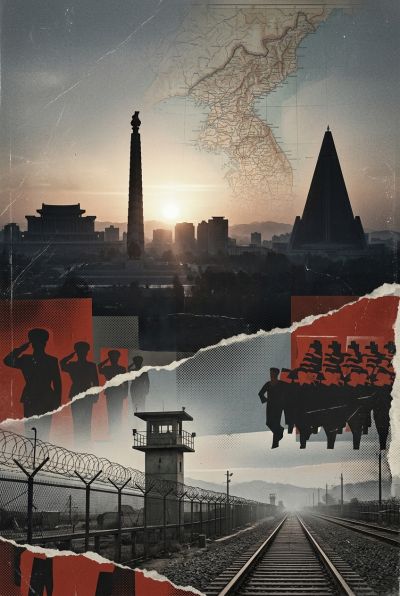

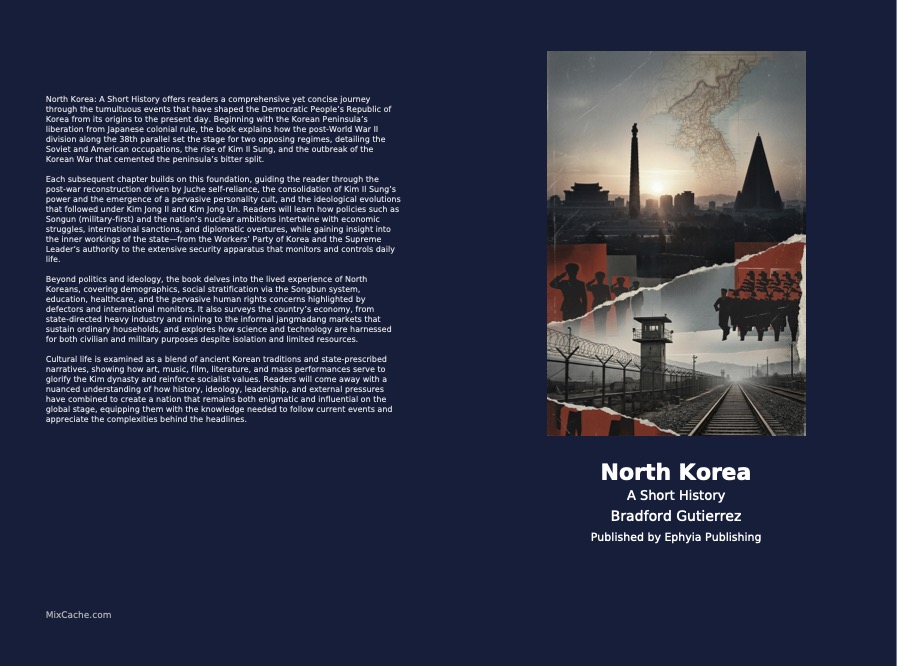
North Korea: A Short History offers readers a comprehensive yet concise journey through the tumultuous events that have shaped the Democratic People’s Republic of Korea from its origins to the present day. Beginning with the Korean Peninsula’s liberation from Japanese colonial rule, the book explains how the post‑World War II division along the 38th parallel set the stage for two opposing regimes, detailing the Soviet and American occupations, the rise of Kim Il Sung, and the outbreak of the Korean War that cemented the peninsula’s bitter split.
Each subsequent chapter builds on this foundation, guiding the reader through the post‑war reconstruction driven by Juche self‑reliance, the consolidation of Kim Il Sung’s power and the emergence of a pervasive personality cult, and the ideological evolutions that followed under Kim Jong Il and Kim Jong Un. Readers will learn how policies such as Songun (military‑first) and the nation’s nuclear ambitions intertwine with economic struggles, international sanctions, and diplomatic overtures, while gaining insight into the inner workings of the state—from the Workers’ Party of Korea and the Supreme Leader’s authority to the extensive security apparatus that monitors and controls daily life.
Beyond politics and ideology, the book delves into the lived experience of North Koreans, covering demographics, social stratification via the Songbun system, education, healthcare, and the pervasive human rights concerns highlighted by defectors and international monitors. It also surveys the country’s economy, from state‑directed heavy industry and mining to the informal jangmadang markets that sustain ordinary households, and explores how science and technology are harnessed for both civilian and military purposes despite isolation and limited resources.
Cultural life is examined as a blend of ancient Korean traditions and state‑prescribed narratives, showing how art, music, film, literature, and mass performances serve to glorify the Kim dynasty and reinforce socialist values. Readers will come away with a nuanced understanding of how history, ideology, leadership, and external pressures have combined to create a nation that remains both enigmatic and influential on the global stage, equipping them with the knowledge needed to follow current events and appreciate the complexities behind the headlines.
What You'll Find Inside:
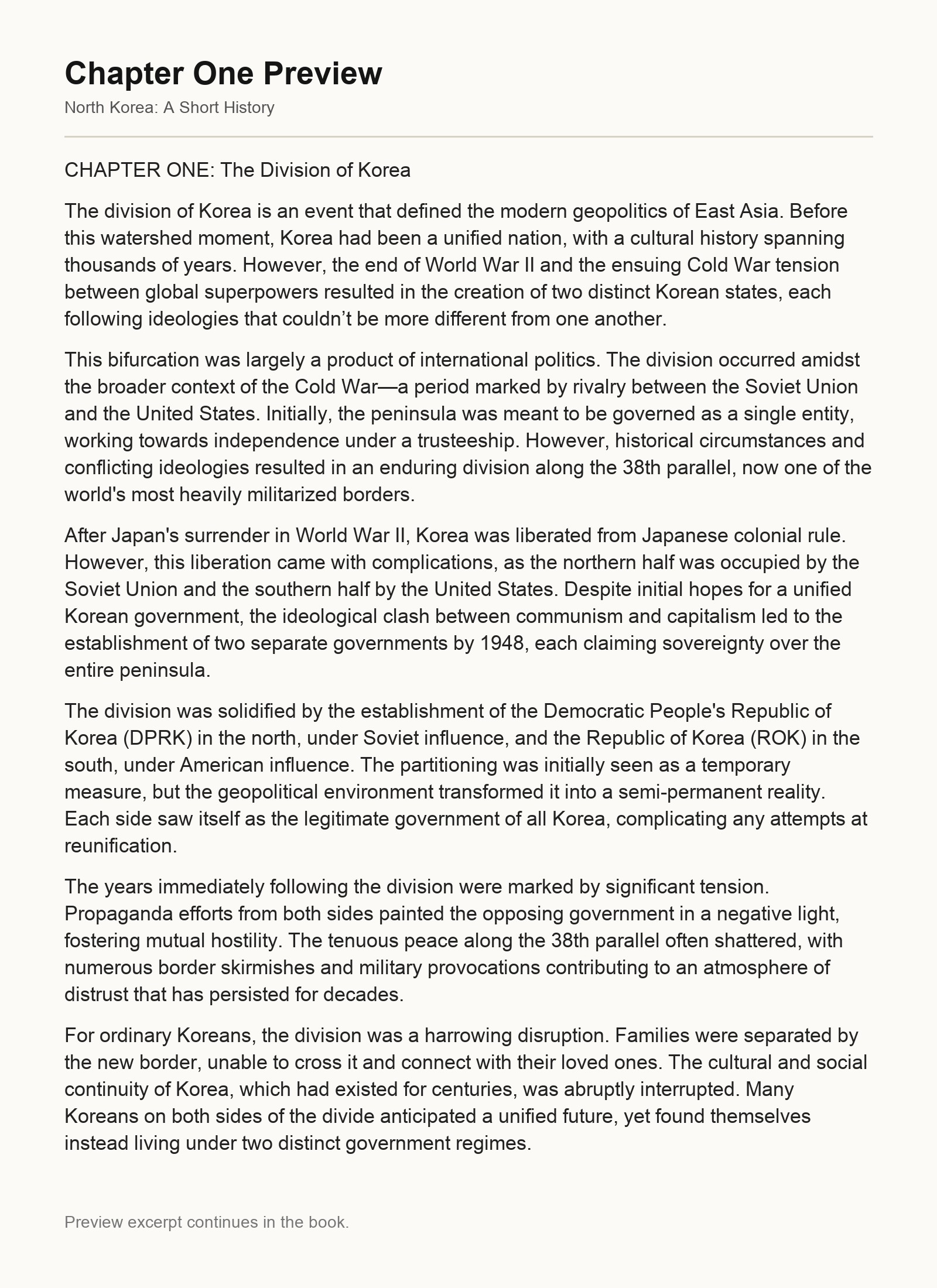
- Explains how Korea was divided after World War II, leading to the creation of the DPRK under Soviet influence and the ROK under American influence.
- Traces Kim Il Sung's rise to power, his consolidation of authority, and the establishment of a hereditary leadership cult centered on the Kim family.
- Details the Juche ideology of self-reliance and the Songun (military-first) policy, showing how they shape North Korea's politics, economy, and defense priorities.
- Analyzes North Korea's nuclear weapons program, human rights abuses, and the impact of international sanctions and isolation.
- Provides a glimpse into daily life, culture, economy, and social structure under the Kim dynasty, including education, propaganda, and informal markets.
Who's It For:
This book is ideal for students and scholars of East Asian studies, political science, and international relations who need a comprehensive yet accessible overview of North Korea's historical development and current dynamics. It also serves professionals such as policymakers, journalists, and analysts seeking a solid background on the country's leadership, ideology, and security challenges. General readers interested in understanding one of the world's most secretive and geopolitically significant nations will find the narrative both informative and engaging.
Table of Contents:
-
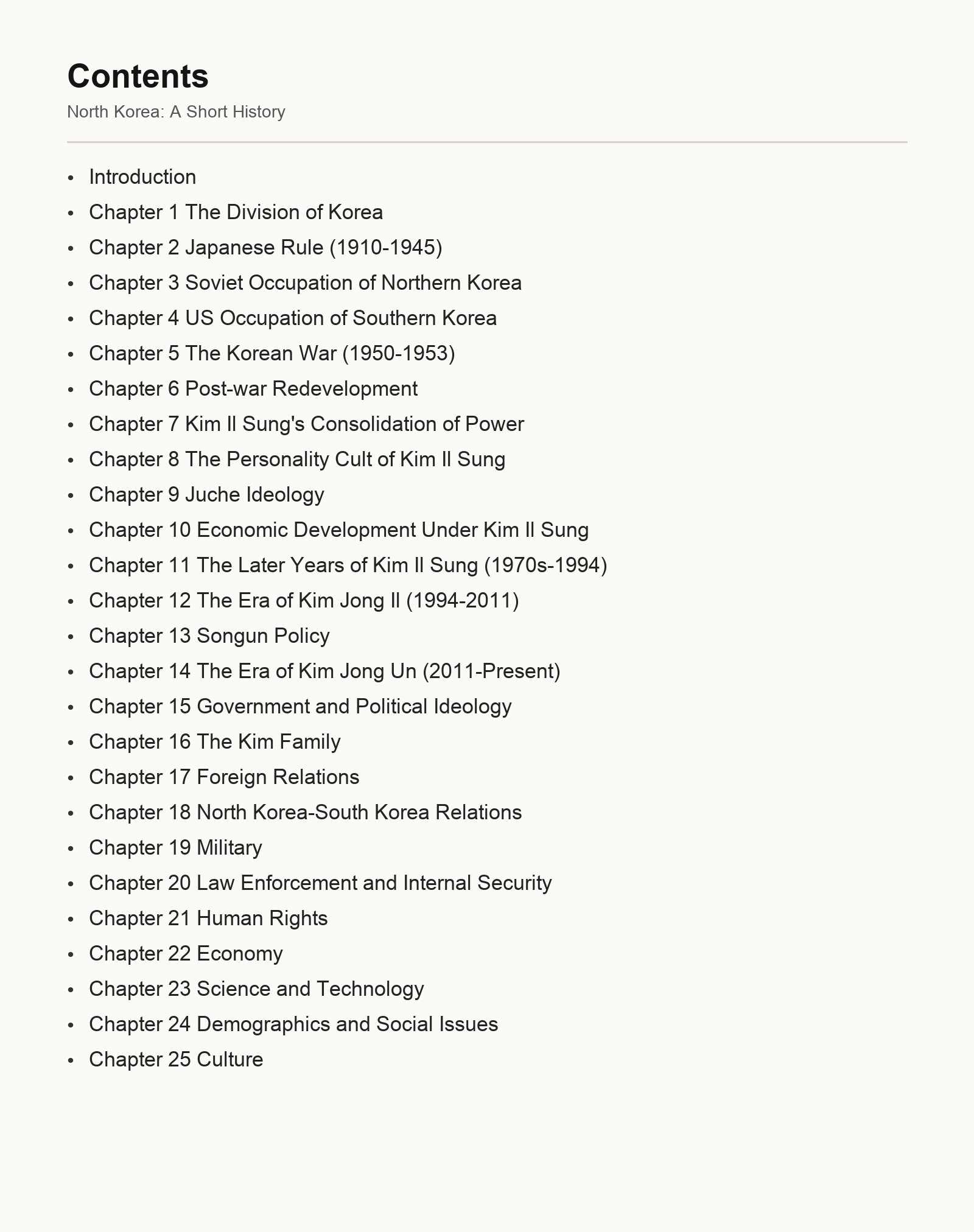
Introduction
-
Chapter 1 The Division of Korea
-
Chapter 2 Japanese Rule (1910-1945)
-
Chapter 3 Soviet Occupation of Northern Korea
-
Chapter 4 US Occupation of Southern Korea
-
Chapter 5 The Korean War (1950-1953)
-
Chapter 6 Post-war Redevelopment
-
Chapter 7 Kim Il Sung's Consolidation of Power
-
Chapter 8 The Personality Cult of Kim Il Sung
-
Chapter 9 Juche Ideology
-
Chapter 10 Economic Development Under Kim Il Sung
-
Chapter 11 The Later Years of Kim Il Sung (1970s-1994)
-
Chapter 12 The Era of Kim Jong Il (1994-2011)
-
Chapter 13 Songun Policy
-
Chapter 14 The Era of Kim Jong Un (2011-Present)
-
Chapter 15 Government and Political Ideology
-
Chapter 16 The Kim Family
-
Chapter 17 Foreign Relations
-
Chapter 18 North Korea-South Korea Relations
-
Chapter 19 Military
-
Chapter 20 Law Enforcement and Internal Security
-
Chapter 21 Human Rights
-
Chapter 22 Economy
-
Chapter 23 Science and Technology
-
Chapter 24 Demographics and Social Issues
-
Chapter 25 Culture
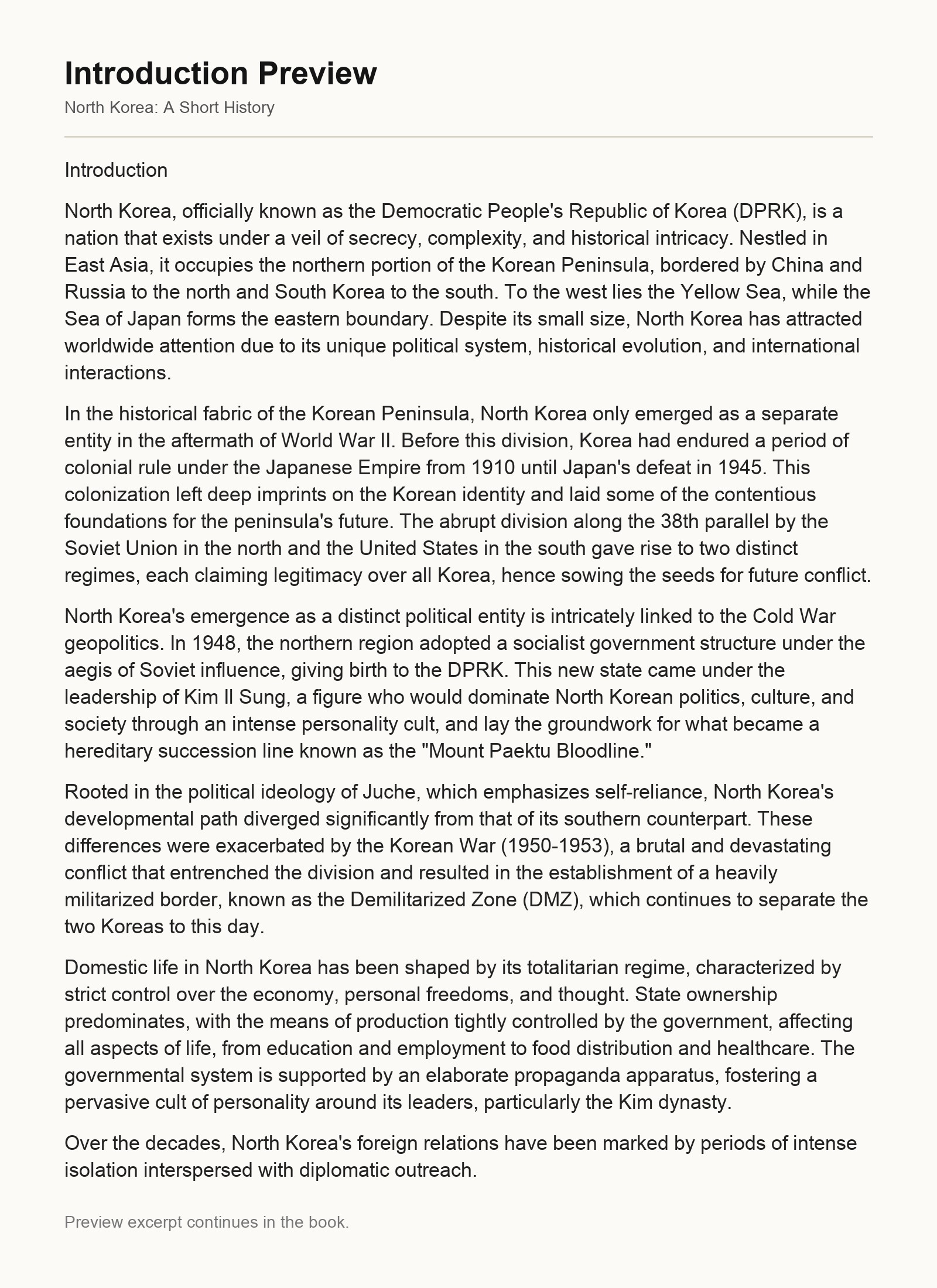
North Korea, officially known as the Democratic People's Republic of Korea (DPRK), is a nation that exists under a veil of secrecy, complexity, and historical intricacy. Nestled in East Asia, it occupies the northern portion of the Korean Peninsula, bordered by China and Russia to the north and South Korea to the south. To the west lies the Yellow Sea, while the Sea of Japan forms the eastern boundary. Despite its small size, North Korea has attracted worldwide attention due to its unique political system, historical evolution, and international interactions.
In the historical fabric of the Korean Peninsula, North Korea only emerged as a separate entity in the aftermath of World War II. Before this division, Korea had endured a period of colonial rule under the Japanese Empire from 1910 until Japan's defeat in 1945. This colonization left deep imprints on the Korean identity and laid some of the contentious foundations for the peninsula's future. The abrupt division along the 38th parallel by the Soviet Union in the north and the United States in the south gave rise to two distinct regimes, each claiming legitimacy over all Korea, hence sowing the seeds for future conflict.
North Korea's emergence as a distinct political entity is intricately linked to the Cold War geopolitics. In 1948, the northern region adopted a socialist government structure under the aegis of Soviet influence, giving birth to the DPRK. This new state came under the leadership of Kim Il Sung, a figure who would dominate North Korean politics, culture, and society through an intense personality cult, and lay the groundwork for what became a hereditary succession line known as the "Mount Paektu Bloodline."
Rooted in the political ideology of Juche, which emphasizes self-reliance, North Korea's developmental path diverged significantly from that of its southern counterpart. These differences were exacerbated by the Korean War (1950-1953), a brutal and devastating conflict that entrenched the division and resulted in the establishment of a heavily militarized border, known as the Demilitarized Zone (DMZ), which continues to separate the two Koreas to this day.
Domestic life in North Korea has been shaped by its totalitarian regime, characterized by strict control over the economy, personal freedoms, and thought. State ownership predominates, with the means of production tightly controlled by the government, affecting all aspects of life, from education and employment to food distribution and healthcare. The governmental system is supported by an elaborate propaganda apparatus, fostering a pervasive cult of personality around its leaders, particularly the Kim dynasty.
Over the decades, North Korea's foreign relations have been marked by periods of intense isolation interspersed with diplomatic outreach. The nation's relationships are most strongly defined by its historic ties with China and Russia, both of which have acted as strategic allies. Simultaneously, its adversarial stance towards South Korea, Japan, and the United States has contributed to ongoing tensions and periodically flares up in military confrontations and diplomatic stand-offs.
One of the most contentious aspects of North Korea's international profile is its development of nuclear weapons. The pursuit of nuclear capabilities has led to extensive international sanctions and efforts to bring North Korea back to diplomatic negotiation tables, with varying degrees of success. This pursuit not only complicates its international relations but also affects the internal socio-economic conditions of the country.
Despite the prominence of its leadership style and political ideology, the human dimension of North Korea often remains obscured. Accounts from defectors, limited foreign engagement, and various humanitarian reports highlight severe challenges faced by average citizens, such as chronic food shortages, human rights abuses, and an opaque legal system.
Culturally, North Korea is a confluence of preserved Korean traditions and state-imposed values, presenting a distinctive cultural milieu. Art and media in North Korea are curated to reinforce state ideology, with a strong emphasis on revolutionary themes and Korean heritage. Yet, the resilience of age-old customs amidst these modern impositions gives the culture a unique shadow of continuity and resistance.
The economic framework of North Korea, largely isolated due to self-imposed seclusion and international sanctions, nonetheless trudges forward through state-driven initiatives. Industrial activities, particularly in mining and military manufacturing, persist despite external pressures. However, the informal economy, often driven by small-scale markets, continues to play a vital yet precarious role in the everyday survival of its populace.
As the world grapples with the complexities North Korea presents, the country itself stands at a crossroads of maintaining its rigid ideological stance or gradually evolving through pragmatic reforms. The international community continues to watch closely as North Korea navigates its internal dynamics and external pressures, aware that any shifts within this nation will have broader implications for regional and global stability.
This book seeks to unravel the intricacies of North Korea by tracing its journey from a post-war division to its present-day existence as a focal point of global attention. Through each chapter, readers will gain a deeper understanding of how history, politics, culture, and international pressures have shaped the North Korean narrative—a narrative as enigmatic as it is compelling.
Author:
Published By:
Date Published:
May 28, 2026
Type:
Nonfiction
Language:
English
Also Available In:
Word Count:
25,344 words
Reading Time:
1 hour 46 minutes
Sample:
Order:
Order North Korea (Hardcover) on MixCache.com:
Buy NowPrint copy is made to order and ships worldwide. Includes the ebook free, ready to read instantly.
$5 account credit for all new MixCache.com accounts, usable toward any ebook purchase!*