
Browse by Category
Fiction
- Action & Adventure
- African American
- Anthologies
- Children's Fiction
- Classics
- Comics & Graphic Novels
- Coming of Age
- Contemporary
- Cultural & Regional
- Drama
- Erotica
- Fantasy
- General
- Historical Fiction
- Horror
- Humor & Satire
- Literary Fiction
- Mystery, Thriller & Suspense
- Poetry
- Religious & Inspirational
- Romance
- Science Fiction
- Short Stories
- War & Military
- Westerns
- Women's Fiction
- Young Adult
Non-Fiction
- Antiques & Collectibles
- Arts & Photography
- Biographies & Memoirs
- Business & Money
- Children's Non-Fiction
-
Computers & Technology
- Artificial Intelligence
- Computer Science
- Cybersecurity & Cryptography
- Data Science & Analytics
- Databases & Big Data
- Game Development & Design
- General
- Hardware & DIY
- Mobile App Development
- Networking & Cloud Computing
- Operating Systems
- Programming
- Robotics
- Software
- Software Engineering
- User Experience (UX) & Design
- Web Development & Design
- Cooking, Food & Wine
- Crafts, Hobbies & Home
- Education & Teaching
- Engineering
- General
- Health, Fitness & Dieting
-
History
- African History
- African History - North Africa
- African History - Sub-Saharan Africa
- American History
- American History - 20th Century
- American History - Civil War
- American History - Colonial Period
- Ancient History
- Asian History
- Asian History - China
- Asian History - India
- Asian History - Japan
- Asian History - Southeast Asia
- European History
- European History - Ancient Greece
- European History - Ancient Rome
- European History - Medieval
- European History - Modern
- European History - Renaissance
- General
- Middle Eastern History
- Military History
- Military History - Aviation
- Military History - Naval
- Social & Cultural History
- World History
- Humor & Entertainment
- Industrial Technology
- Language Learning
- Law
- LGBTQ+ Non-Fiction
- Literary Criticism
- Medical Books
- Parenting & Relationships
- Philosophy
- Politics & Social Sciences
- Reference
- Religion & Spirituality
-
Science & Math
- Agricultural Sciences
- Astronomy & Space Science
- Behavioral Sciences
- Biological Sciences
- Botany & Plant Science
- Chemistry
- Earth Sciences
- Engineering - Chemical
- Engineering - Civil
- Engineering - Electrical
- Engineering - Mechanical
- Environment
- General
- Geology
- Mathematics
- Nature & Ecology
- Oceanography
- Paleontology
- Physics
- Statistics
- Self-Help
- Sports & Outdoors
- Study Aids
- Sustainability & Green Living
- Textbooks
- Transportation
- Travel
- True Crime
- Urban Planning & Development
- Veterinary Medicine
- Writing & Publishing
Jump to Section
MixCache.com Total Access
Unlimited reading and audiobooks for every book published by MixCache.com.
Included titles carry the MTA badge.
Learn more →
The Amazon Condensed: Nature, Nations, and the Fight Over the Rainforest
MTA
Environmental history and geopolitical contestation in the Amazon basin
About this book:
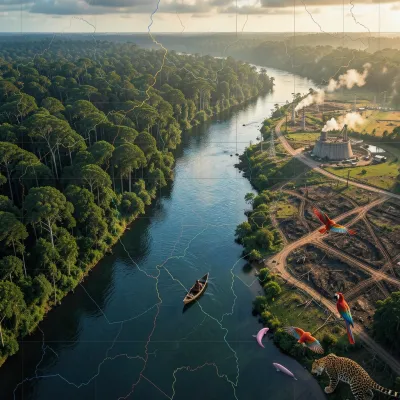
*The Amazon Condensed* explores the Amazon basin as a complex, living polity where environmental history, geopolitical interests, and Indigenous cosmologies intersect. The book traces the region’s evolution from an ancient, managed landscape to a modern frontline of global conflict. It argues that the Amazon is not a vacant wilderness but a "palimpsest" of past ambitions—from the brutal legacies of the rubber boom to contemporary struggles over gold, oil, soy, and cattle—each leaving deep scars on the land, its laws, and its people.
The narrative details the systemic pressures driving the rainforest toward an ecological tipping point, specifically the synergistic effects of deforestation, fire, and climate change. It examines the "extractive archipelago" of mining and drilling enclaves, the expansion of high-tension grids and highways, and the rise of illicit economies that thrive in the basin’s porous borderlands. Central to the book is the tension between national development projects and the territorial rights of Indigenous nations, who are presented as the forest's most effective guardians. The text highlights how modern tools, such as satellite monitoring and carbon markets (REDD+), have transformed the forest into a quantifiable global asset, often creating new forms of "green" contestation.
International diplomacy and subnational governance are scrutinized, showing how China, the EU, and the US exert influence through trade and regulation, while local governors and mayors improvise climate strategies. The book emphasizes that the "bioeconomy"—built on products like açaí and wild rubber—offers a potential alternative to extraction, provided it is supported by secure land tenure and fair markets. Ultimately, the work moves from the canopy to the courtroom, documenting the voices of those in conflict zones who resist dispossession and environmental degradation through both traditional knowledge and digital advocacy.
The concluding chapters offer a blueprint for action centered on the "governance of the commons." This framework prioritizes the formal recognition of Indigenous territories, the correction of perverse economic incentives that reward clearing, and the alignment of global finance with forest health. The book concludes that a durable future for the Amazon depends on a shift from viewing the basin as a warehouse of resources to treating it as a vital, self-regulating system. Success requires a commitment to justice, the dismantling of criminal networks, and a coordinated regional effort to value the standing forest over its destruction.
What You'll Find Inside:
- The Amazon's history reveals a palimpsest of Indigenous stewardship, colonial extraction, and modern development, showing how past patterns of land use, conflict, and governance continue to shape present struggles over the rainforest's future.
- Indigenous territories and traditional knowledge systems are consistently shown to be the most effective conservation strategy, with secure land tenure correlating with lower deforestation rates, higher biodiversity, and stronger forest resilience when communities have recognized rights and resources.
- Global commodity chains—from rubber and gold to soy and cattle—connect distant markets to local realities, creating boom-bust cycles that transform ecosystems, displace communities, and concentrate wealth while externalizing environmental and social costs.
- Infrastructure development (roads, dams, energy grids) has repeatedly opened the Amazon frontier to extraction and settlement, often accelerating deforestation and conflict despite promises of national integration, with benefits unevenly distributed and ecological costs frequently borne by vulnerable populations.
- Effective Amazonian governance requires aligning Indigenous rights, market incentives, enforcement mechanisms, and climate finance toward a forest-based economy that values standing forests over cleared land, correcting perverse incentives that currently favor destruction over stewardship.
Who's It For:
This book is essential reading for students and scholars of environmental history, geography, political science, and Latin American studies seeking a comprehensive understanding of the Amazon's complex past and present. It will also deeply benefit policy makers working on Amazon conservation, climate initiatives, or sustainable development; environmental activists and NGO professionals focused on rainforest protection; and practitioners in international development, natural resource management, or climate finance who need to grasp the interplay of ecology, economics, and geopolitics in shaping the basin's future. Anyone interested in how global power dynamics, local livelihoods, and environmental change intersect in one of Earth's most critical ecosystems will find valuable insights.
Table of Contents:
- Introduction
- Chapter 1 Origins of a Rainforest World
- Chapter 2 Peoples of the River Sea: Indigenous Nations and Cosmologies
- Chapter 3 Mapping Power: Borders, States, and the Making of the Amazon
- Chapter 4 The Rubber Boom and Its Afterlives
- Chapter 5 Forests in the Furnace: Deforestation, Fire, and the Tipping Point
- Chapter 6 Roads, Dams, and Grids: Building the Amazonian Frontier
- Chapter 7 Gold, Oil, and Bauxite: The Extractive Archipelago
- Chapter 8 Soy, Cattle, and the Global Plate
- Chapter 9 Law of the Forest: Constitutions, Codes, and Land Tenure
- Chapter 10 Guardians and Grileiros: Territories, Demarcation, and Land Grabbing
- Chapter 11 Rivers at Work: Fisheries, Transport, and Hydropower
- Chapter 12 Science in the Canopy: Biodiversity and Bioprospecting
- Chapter 13 Health of the Forest, Health of the People: Environmental Justice
- Chapter 14 Crime, Conflict, and the Green Border
- Chapter 15 Watching from Space: Satellites, Data, and Enforcement
- Chapter 16 The Politics of Conservation: Parks, Reserves, and Indigenous Management
- Chapter 17 REDD+, Carbon Markets, and the Price of Trees
- Chapter 18 Brazil and Its Neighbors: National Projects, Regional Plans
- Chapter 19 China, the EU, and the United States: External Powers in the Basin
- Chapter 20 Diplomacy on the River: The Amazon Cooperation Treaty Organization
- Chapter 21 Climate Governors: Subnational Pacts and City Forests
- Chapter 22 Bioeconomy and Forest Livelihoods: From Açaí to Wild Rubber
- Chapter 23 Voices from the Forest: Reportage from Conflict Zones
- Chapter 24 Futures at the Edge: Scenarios, Tipping Dynamics, and Adaptation
- Chapter 25 Governing the Commons We Share: A Blueprint for Action
Author:
Published By:
Date Published:
May 5, 2026
Type:
Nonfiction
Language:
English
Word Count:
63,302 words
Reading Time:
4 hours 26 minutes
Sample:
MixCache.com Total Access
Get unlimited access to this book + all books published by MixCache.com for $11.99/month
Subscribe to MTAOr purchase this book individually below
Order:
Buy the The Amazon Condensed: Nature, Nations, and the Fight Over the Rainforest ebook on MixCache.com:
Buy Now
Full ebook will be available immediately
- read online or download as a PDF file.
$5 account credit for all new MixCache.com accounts, usable toward any ebook purchase!*






Ratings & Reviews
Ask Questions About This Book
Have a question about the content? Ask our AI assistant!
Start by asking a question about "The Amazon Condensed: Nature, Nations, and the Fight Over the Rainforest"
Example: "Does this book mention William Shakespeare?"
Thinking...