
Browse by Category
Fiction
- Action & Adventure
- African American
- Anthologies
- Children's Fiction
- Classics
- Comics & Graphic Novels
- Coming of Age
- Contemporary
- Cultural & Regional
- Drama
- Erotica
- Fantasy
- General
- Historical Fiction
- Horror
- Humor & Satire
- Literary Fiction
- Mystery, Thriller & Suspense
- Poetry
- Religious & Inspirational
- Romance
- Science Fiction
- Short Stories
- War & Military
- Westerns
- Women's Fiction
- Young Adult
Non-Fiction
- Antiques & Collectibles
- Arts & Photography
- Biographies & Memoirs
- Business & Money
- Children's Non-Fiction
-
Computers & Technology
- Artificial Intelligence
- Computer Science
- Cybersecurity & Cryptography
- Data Science & Analytics
- Databases & Big Data
- Game Development & Design
- General
- Hardware & DIY
- Mobile App Development
- Networking & Cloud Computing
- Operating Systems
- Programming
- Robotics
- Software
- Software Engineering
- User Experience (UX) & Design
- Web Development & Design
- Cooking, Food & Wine
- Crafts, Hobbies & Home
- Education & Teaching
- Engineering
- General
- Health, Fitness & Dieting
-
History
- African History
- African History - North Africa
- African History - Sub-Saharan Africa
- American History
- American History - 20th Century
- American History - Civil War
- American History - Colonial Period
- Ancient History
- Asian History
- Asian History - China
- Asian History - India
- Asian History - Japan
- Asian History - Southeast Asia
- European History
- European History - Ancient Greece
- European History - Ancient Rome
- European History - Medieval
- European History - Modern
- European History - Renaissance
- General
- Middle Eastern History
- Military History
- Military History - Aviation
- Military History - Naval
- Social & Cultural History
- World History
- Humor & Entertainment
- Industrial Technology
- Language Learning
- Law
- LGBTQ+ Non-Fiction
- Literary Criticism
- Medical Books
- Parenting & Relationships
- Philosophy
- Politics & Social Sciences
- Reference
- Religion & Spirituality
-
Science & Math
- Agricultural Sciences
- Astronomy & Space Science
- Behavioral Sciences
- Biological Sciences
- Botany & Plant Science
- Chemistry
- Earth Sciences
- Engineering - Chemical
- Engineering - Civil
- Engineering - Electrical
- Engineering - Mechanical
- Environment
- General
- Geology
- Mathematics
- Nature & Ecology
- Oceanography
- Paleontology
- Physics
- Statistics
- Self-Help
- Sports & Outdoors
- Study Aids
- Sustainability & Green Living
- Textbooks
- Transportation
- Travel
- True Crime
- Urban Planning & Development
- Veterinary Medicine
- Writing & Publishing
Jump to Section
MixCache.com Total Access
Unlimited reading and audiobooks for every book published by MixCache.com.
Included titles carry the MTA badge.
Learn more →
A History of Dow Inc.
MTA
The Story of an S&P 500 Company
About this book:
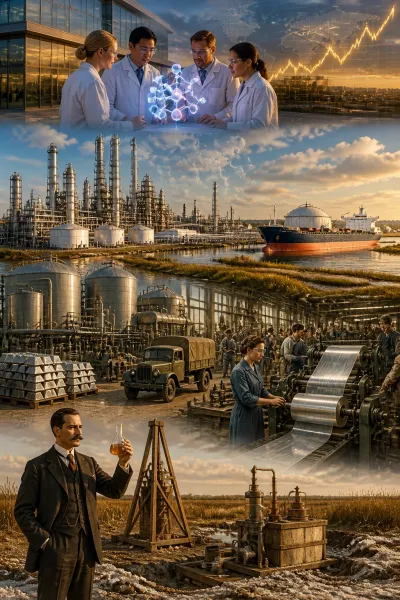
From its inception in 1897, when Herbert Henry Dow pioneered an electrolytic process to extract bromine from Midland, Michigan’s brine, The Dow Chemical Company established a legacy of innovation rooted in resource efficiency and chemical alchemy. The company rapidly diversified into chlorine, caustic soda, and magnesium, leveraging its unique feedstock advantage to become a critical supplier during both World Wars. Wartime demands catalyzed Dow’s entry into plastics—most notably styrene for synthetic rubber and Saran for packaging—transforming it from a commodity chemical maker into a materials science powerhouse. Post-war prosperity saw aggressive expansion into petrochemicals on the Gulf Coast and global markets, solidifying Dow’s position as an industrial titan and a staple of the S&P 500.
The latter half of the 20th century brought profound challenges that reshaped the corporate identity. The environmental awakening of the 1970s, the Bhopal tragedy (inherited via the 2001 Union Carbide acquisition), Agent Orange litigation, and dioxin contamination in Midland forced a reckoning with corporate responsibility. Dow responded by embracing the Responsible Care® initiative, investing heavily in waste reduction, product stewardship, and sustainability goals. Simultaneously, leadership pursued a strategic pivot toward high-value specialty products—performance materials, electronics, water solutions, and agricultural sciences—while navigating economic cycles through portfolio management, including the divestiture of pharmaceuticals and the Styron business.
The defining corporate transformation of the 21st century was the 2017 merger with DuPont and the subsequent 2019 three-way spin-off, which created the independent, materials-science-focused Dow Inc. This "pure-play" structure stripped away agricultural and specialty product divisions to concentrate on Packaging & Specialty Plastics, Industrial Intermediates & Infrastructure, and Performance Materials & Coatings. Freed from conglomerate complexity, the new entity prioritized agility, operational excellence, and a capital allocation strategy anchored by advantaged feedstock access on the U.S. Gulf Coast.
Today, Dow Inc. directs its century-old innovation engine toward the defining challenges of the modern era: climate change, plastic waste, and resource scarcity. The company is investing billions in decarbonization pathways, advanced chemical recycling technologies to enable a circular plastics economy, and digital tools like AI to accelerate materials discovery. By aligning its core business strategy with global sustainability imperatives—targeting carbon neutrality by 2050 and designing products for recyclability—Dow seeks to sustain its legacy not merely as a chemical manufacturer, but as a solutions provider essential to a sustainable future.
What You'll Find Inside:
- The founding vision of Herbert Dow and his revolutionary electrolytic process for extracting bromine from Michigan brine, which established the company's core competency in electrochemical innovation and resource efficiency.
- Dow's pivotal role in both World Wars, particularly its development of magnesium from seawater for aircraft and styrene for synthetic rubber, which catalyzed the company's expansion into plastics and polymer science.
- The strategic transformation from a commodity chemical producer to a specialty materials science leader through major mergers (Union Carbide, Rohm and Haas) and the landmark DowDuPont merger and subsequent three-way spin-off creating Dow Inc.
- The company's complex navigation of environmental crises and corporate responsibility challenges, including the Bhopal legacy, dioxin contamination in Midland, Agent Orange litigation, and the evolution toward sustainability and circular economy solutions.
- The 21st-century strategic pivot focusing on decarbonization, advanced recycling technologies, digitalization of R&D and manufacturing, and targeted growth in packaging, infrastructure, and performance materials to address global challenges.
Who's It For:
This book is ideal for business professionals, investors, and chemical industry executives seeking a comprehensive case study in corporate longevity and strategic reinvention. It will also appeal to students of industrial history and corporate strategy who want to understand how a 19th-century brine startup evolved into a modern S&P 500 materials science leader through wars, economic cycles, environmental reckonings, and radical portfolio transformations.
Table of Contents:
- Introduction
- Chapter 1: The Alchemist's Dream: Herbert Dow's Early Innovations and the Dawn of a Chemical Empire
- Chapter 2: From Brine to Billions: Establishing the Dow Chemical Company and Early Growth
- Chapter 3: War and Transformation: Dow's Role in World War I and Industrial Expansion
- Chapter 4: The Roaring Twenties and the Great Depression: Navigating Economic Upheaval
- Chapter 5: World War II and the Plastics Revolution: Dow's Contribution to the Allied Victory
- Chapter 6: Post-War Boom: Diversification, Expansion, and the Rise of Petrochemicals
- Chapter 7: The Cold War and Beyond: Innovation in a New Geopolitical Landscape
- Chapter 8: Environmental Awakening: Facing Challenges and Embracing Responsibility
- Chapter 9: Global Reach: International Expansion and the Quest for New Markets
- Chapter 10: Mergers and Acquisitions: Shaping the Modern Dow
- Chapter 11: The Age of Specialization: Focusing on High-Value Products
- Chapter 12: Research and Development: The Engine of Innovation
- Chapter 13: From Bhopal to Present: Crisis, Resilience, and Corporate Responsibility
- Chapter 14: Leadership Through the Decades: Key Figures Guiding Dow's Journey
- Chapter 15: The Rise of Polymers: Transforming Industries and Everyday Life
- Chapter 16: Agricultural Sciences: Feeding the World and Protecting Crops
- Chapter 17: Performance Materials: Engineered Solutions for a Changing World
- Chapter 18: Water, Energy, and Sustainability: Dow's Commitment to a Greener Future
- Chapter 19: Navigating Economic Cycles: Strategies for Growth and Stability
- Chapter 20: Divestitures and Spin-offs: Streamlining for Focus and Agility
- Chapter 21: The Dawn of Dow Inc.: A New Chapter as an Independent Company
- Chapter 22: Innovation in the 21st Century: Addressing Global Challenges
- Chapter 23: The S&P 500 Journey: Milestones and Market Impact
- Chapter 24: Corporate Culture and Values: The People Behind the Products
- Chapter 25: The Future of Dow Inc.: Sustaining a Legacy of Innovation and Impact
Author:
Published By:
Date Published:
October 15, 2026
Type:
Nonfiction
Language:
English
Word Count:
38,919 words
Reading Time:
2 hours 44 minutes
Sample:
MixCache.com Total Access
Get unlimited access to this book + all books published by MixCache.com for $11.99/month
Subscribe to MTAOr purchase this book individually below
Order:
Buy the A History of Dow Inc. ebook on MixCache.com:
Buy Now
Full ebook will be available immediately
- read online or download as a PDF file.
$5 account credit for all new MixCache.com accounts, usable toward any ebook purchase!*





Ratings & Reviews
Ask Questions About This Book
Have a question about the content? Ask our AI assistant!
Start by asking a question about "A History of Dow Inc."
Example: "Does this book mention William Shakespeare?"
Thinking...