
Browse by Category
Fiction
- Action & Adventure
- African American
- Anthologies
- Children's Fiction
- Classics
- Comics & Graphic Novels
- Coming of Age
- Contemporary
- Cultural & Regional
- Drama
- Erotica
- Fantasy
- General
- Historical Fiction
- Horror
- Humor & Satire
- Literary Fiction
- Mystery, Thriller & Suspense
- Poetry
- Religious & Inspirational
- Romance
- Science Fiction
- Short Stories
- War & Military
- Westerns
- Women's Fiction
- Young Adult
Non-Fiction
- Antiques & Collectibles
- Arts & Photography
- Biographies & Memoirs
- Business & Money
- Children's Non-Fiction
-
Computers & Technology
- Artificial Intelligence
- Computer Science
- Cybersecurity & Cryptography
- Data Science & Analytics
- Databases & Big Data
- Game Development & Design
- General
- Hardware & DIY
- Mobile App Development
- Networking & Cloud Computing
- Operating Systems
- Programming
- Robotics
- Software
- Software Engineering
- User Experience (UX) & Design
- Web Development & Design
- Cooking, Food & Wine
- Crafts, Hobbies & Home
- Education & Teaching
- Engineering
- General
- Health, Fitness & Dieting
-
History
- African History
- African History - North Africa
- African History - Sub-Saharan Africa
- American History
- American History - 20th Century
- American History - Civil War
- American History - Colonial Period
- Ancient History
- Asian History
- Asian History - China
- Asian History - India
- Asian History - Japan
- Asian History - Southeast Asia
- European History
- European History - Ancient Greece
- European History - Ancient Rome
- European History - Medieval
- European History - Modern
- European History - Renaissance
- General
- Middle Eastern History
- Military History
- Military History - Aviation
- Military History - Naval
- Social & Cultural History
- World History
- Humor & Entertainment
- Industrial Technology
- Language Learning
- Law
- LGBTQ+ Non-Fiction
- Literary Criticism
- Medical Books
- Parenting & Relationships
- Philosophy
- Politics & Social Sciences
- Reference
- Religion & Spirituality
-
Science & Math
- Agricultural Sciences
- Astronomy & Space Science
- Behavioral Sciences
- Biological Sciences
- Botany & Plant Science
- Chemistry
- Earth Sciences
- Engineering - Chemical
- Engineering - Civil
- Engineering - Electrical
- Engineering - Mechanical
- Environment
- General
- Geology
- Mathematics
- Nature & Ecology
- Oceanography
- Paleontology
- Physics
- Statistics
- Self-Help
- Sports & Outdoors
- Study Aids
- Sustainability & Green Living
- Textbooks
- Transportation
- Travel
- True Crime
- Urban Planning & Development
- Veterinary Medicine
- Writing & Publishing
Jump to Section
MixCache.com Total Access
Unlimited reading and audiobooks for every book published by MixCache.com.
Included titles carry the MTA badge.
Learn more →
A History of Wells Fargo
MTA
The Story of an S&P 500 Company
About this book:
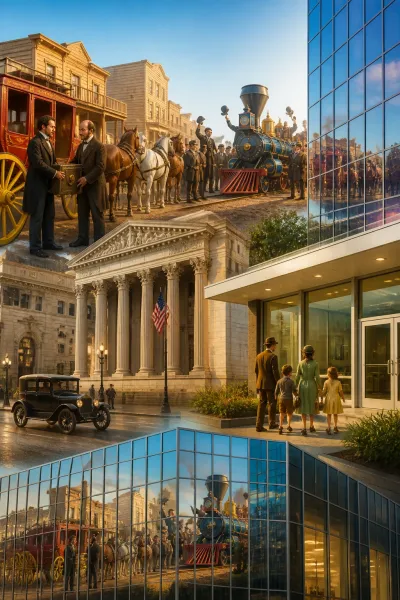
Wells Fargo began in 1852 as an express and banking venture by Henry Wells and William Fargo to serve the California Gold Rush, rapidly building a vast stagecoach and Pony Express network that connected the frontier to the nation. The company survived financial panics by maintaining conservative practices, transitioned from stagecoaches to railroads during the Transcontinental Railroad era, and evolved into a dominant Western financial institution. Forced to relinquish its express operations during World War I, Wells Fargo focused entirely on banking, weathering the Great Depression and World War II before expanding aggressively into consumer lending and credit cards during the post-war boom. The deregulation era of the 1980s and 1990s sparked a wave of strategic acquisitions—Crocker, First Interstate, and Norwest—that transformed the regional bank into a national powerhouse, culminating in the 2008 crisis-era acquisition of Wachovia, which doubled its size and solidified its coast-to-coast presence.
The 21st century brought a dual mandate of digital innovation and regulatory reckoning. Wells Fargo embraced online and mobile banking early, investing heavily in AI, blockchain, and fintech partnerships to modernize its platform while maintaining a vast physical branch network rooted in its community banking philosophy. However, the company faced a catastrophic reputational crisis in the mid-2010s when aggressive cross-selling quotas led to the creation of millions of unauthorized accounts, resulting in massive fines, congressional scrutiny, and an unprecedented Federal Reserve asset cap. This scandal forced a fundamental overhaul of corporate culture, incentive structures, and leadership, culminating in the 2019 appointment of CEO Charlie Scharf to drive remediation and restore trust.
Throughout its history, Wells Fargo has balanced its identity as a diversified financial services giant—spanning consumer banking, wealth management, commercial lending, and corporate investment banking—with a stated commitment to local community presence and social responsibility. The firm has navigated economic cycles, technological revolutions, and shifting regulatory landscapes while maintaining a continuous presence on the S&P 500. Today, having largely resolved its regulatory constraints and lifted the asset cap, Wells Fargo operates as one of America’s "Big Four" banks, focusing on digital transformation, ESG commitments, and cultural renewal to secure its legacy as a resilient, if occasionally flawed, pillar of the U.S. financial system.
What You'll Find Inside:
- Comprehensive history of Wells Fargo from its 1852 Gold Rush origins through its evolution into a modern S&P 500 financial giant.
- Detailed analysis of how the company adapted to major technological shifts—from stagecoaches and the Pony Express to the transcontinental railroad, internet banking, and fintech innovation.
- In-depth coverage of Wells Fargo's resilience through existential crises including the Panic of 1855, the Great Depression, the 2008 financial crisis, and the 2016 sales practices scandal.
- Examination of strategic mergers and acquisitions (Crocker, First Interstate, Norwest, Wachovia) that transformed a regional express company into a national banking powerhouse.
- Exploration of leadership evolution, corporate culture shifts, community banking philosophy, regulatory navigation, and modern ESG/sustainability commitments.
Who's It For:
This book is ideal for business historians, financial professionals, and corporate strategy students seeking a detailed case study of institutional longevity. It will particularly benefit readers interested in how American banking evolved from frontier express services to modern digital finance, and those studying how major corporations navigate crises, regulatory upheaval, and cultural transformation while maintaining market leadership.
Table of Contents:
- Introduction
- Chapter 1 The Genesis of a Giant: Henry Wells, William Fargo, and the American Express
- Chapter 2 The Gold Rush and Beyond: Establishing Wells, Fargo & Company
- Chapter 3 Pony Express and Stagecoach Empire: Delivering the West
- Chapter 4 Banking on the Frontier: Early Financial Services
- Chapter 5 The Transcontinental Railroad Era: Adapting to New Technologies
- Chapter 6 Diversification and Expansion: Growth in the Late 19th Century
- Chapter 7 The Early 20th Century: Navigating Economic Shifts
- Chapter 8 World Wars and the Great Depression: Resilience in Crisis
- Chapter 9 Post-War Boom: Expanding Consumer and Business Services
- Chapter 10 The 1960s and 1970s: A Period of Modernization
- Chapter 11 The Age of Deregulation: New Opportunities and Challenges
- Chapter 12 Mergers and Acquisitions: Shaping the Modern Wells Fargo
- Chapter 13 The Internet Revolution: Embracing Digital Banking
- Chapter 14 The New Millennium: Growth and Global Presence
- Chapter 15 The 2008 Financial Crisis: Impact and Recovery
- Chapter 16 Regulatory Scrutiny and Corporate Culture Shifts
- Chapter 17 Innovation in Financial Technology: Staying Ahead of the Curve
- Chapter 18 Community Banking and Local Presence: A Core Philosophy
- Chapter 19 Wealth Management and Investment Services
- Chapter 20 Commercial Banking and Corporate Clients
- Chapter 21 Social Responsibility and Sustainable Practices
- Chapter 22 Leadership Through the Decades: Key Figures and Their Impact
- Chapter 23 Wells Fargo and the S&P 500: A Continuous Presence
- Chapter 24 Adapting to the Future: Emerging Trends in Banking
- Chapter 25 Wells Fargo Today: A Legacy Continues
Author:
Published By:
Date Published:
October 14, 2026
Type:
Nonfiction
Language:
English
Word Count:
38,504 words
Reading Time:
2 hours 42 minutes
Sample:
MixCache.com Total Access
Get unlimited access to this book + all books published by MixCache.com for $11.99/month
Subscribe to MTAOr purchase this book individually below
Order:
Buy the A History of Wells Fargo ebook on MixCache.com:
Buy Now
Full ebook will be available immediately
- read online or download as a PDF file.
$5 account credit for all new MixCache.com accounts, usable toward any ebook purchase!*






Ratings & Reviews
Ask Questions About This Book
Have a question about the content? Ask our AI assistant!
Start by asking a question about "A History of Wells Fargo"
Example: "Does this book mention William Shakespeare?"
Thinking...