
Browse by Category
Fiction
- Action & Adventure
- African American
- Anthologies
- Children's Fiction
- Classics
- Comics & Graphic Novels
- Coming of Age
- Contemporary
- Cultural & Regional
- Drama
- Erotica
- Fantasy
- General
- Historical Fiction
- Horror
- Humor & Satire
- Literary Fiction
- Mystery, Thriller & Suspense
- Poetry
- Religious & Inspirational
- Romance
- Science Fiction
- Short Stories
- War & Military
- Westerns
- Women's Fiction
- Young Adult
Non-Fiction
- Antiques & Collectibles
- Arts & Photography
- Biographies & Memoirs
- Business & Money
- Children's Non-Fiction
-
Computers & Technology
- Artificial Intelligence
- Computer Science
- Cybersecurity & Cryptography
- Data Science & Analytics
- Databases & Big Data
- Game Development & Design
- General
- Hardware & DIY
- Mobile App Development
- Networking & Cloud Computing
- Operating Systems
- Programming
- Robotics
- Software
- Software Engineering
- User Experience (UX) & Design
- Web Development & Design
- Cooking, Food & Wine
- Crafts, Hobbies & Home
- Education & Teaching
- Engineering
- General
- Health, Fitness & Dieting
-
History
- African History
- African History - North Africa
- African History - Sub-Saharan Africa
- American History
- American History - 20th Century
- American History - Civil War
- American History - Colonial Period
- Ancient History
- Asian History
- Asian History - China
- Asian History - India
- Asian History - Japan
- Asian History - Southeast Asia
- European History
- European History - Ancient Greece
- European History - Ancient Rome
- European History - Medieval
- European History - Modern
- European History - Renaissance
- General
- Middle Eastern History
- Military History
- Military History - Aviation
- Military History - Naval
- Social & Cultural History
- World History
- Humor & Entertainment
- Industrial Technology
- Language Learning
- Law
- LGBTQ+ Non-Fiction
- Literary Criticism
- Medical Books
- Parenting & Relationships
- Philosophy
- Politics & Social Sciences
- Reference
- Religion & Spirituality
-
Science & Math
- Agricultural Sciences
- Astronomy & Space Science
- Behavioral Sciences
- Biological Sciences
- Botany & Plant Science
- Chemistry
- Earth Sciences
- Engineering - Chemical
- Engineering - Civil
- Engineering - Electrical
- Engineering - Mechanical
- Environment
- General
- Geology
- Mathematics
- Nature & Ecology
- Oceanography
- Paleontology
- Physics
- Statistics
- Self-Help
- Sports & Outdoors
- Study Aids
- Sustainability & Green Living
- Textbooks
- Transportation
- Travel
- True Crime
- Urban Planning & Development
- Veterinary Medicine
- Writing & Publishing
Jump to Section
MixCache.com Total Access
Unlimited reading and audiobooks for every book published by MixCache.com.
Included titles carry the MTA badge.
Learn more →
The History of Space Exploration
MTA
From Sputnik to Mars Colonies
About this book:
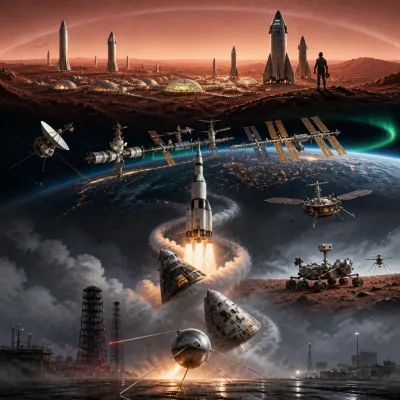
The book chronicles humanity's journey from the launch of Sputnik 1 in 1957 to the ambitious vision of Martian colonies, framing space exploration as a narrative of geopolitical rivalry, scientific ingenuity, and evolving international collaboration. It details the early Space Race milestones—Yuri Gagarin’s historic orbit, the Mercury and Gemini programs, and the Apollo lunar landings—highlighting the technological breakthroughs and tragic setbacks, such as the Apollo 1 fire and the Challenger disaster, that forged a culture of rigorous safety and resilience. The narrative progresses through the era of long-duration orbital habitation with the Soviet Salyut and Mir stations and the American Skylab, culminating in the unprecedented multinational effort of the International Space Station, which established a continuous human presence in low Earth orbit and became a vital testbed for deep-space technologies.
Simultaneously, the book explores the revolutionary impact of robotic explorers, from the Voyager probes' "Grand Tour" of the outer planets to the successive generations of Mars rovers—Sojourner, Spirit, Opportunity, Curiosity, and Perseverance—that transformed the Red Planet from a distant enigma into a characterized world with a watery past and potential for life. These robotic precursors provided the critical data on radiation, geology, and in-situ resource utilization necessary to plan human missions. The text emphasizes the pivotal 21st-century shift from government-led programs to commercial spaceflight, detailing the rise of companies like SpaceX and Blue Origin, whose development of reusable rockets drastically lowered launch costs and enabled new mission architectures, such as NASA’s Artemis program aimed at a sustainable return to the Moon.
The final chapters project a future defined by the establishment of lunar gateways and permanent Moon bases as stepping stones for human missions to Mars, detailing the immense physiological, psychological, and engineering challenges of interplanetary travel, including propulsion, life support, and radiation shielding. The book examines the concepts of terraforming and self-sustaining Martian settlements, the potential for resource utilization in the asteroid belt, and the theoretical propulsion technologies required for outer solar system and interstellar travel. It concludes by addressing the profound ethical and societal implications of becoming a multi-planetary species, including planetary protection, space law, resource equity, governance of off-world settlements, and the existential significance of potential extraterrestrial life discovery.
What You'll Find Inside:
- The complete historical arc from Sputnik's 1957 launch through the Apollo Moon landings, Space Shuttle era, and International Space Station, documenting how Cold War competition evolved into international collaboration.
- The pivotal transition from government-dominated spaceflight to the commercial space revolution, highlighting SpaceX's reusable rocket breakthrough and the rise of private companies transforming launch economics.
- The critical role of robotic explorers—from the Voyager grand tours to Mars rovers like Perseverance—in scouting destinations, discovering resources, and reducing risk for future human missions.
- Detailed roadmap for humanity's next steps: NASA's Artemis program returning to the Moon, Lunar Gateway construction, permanent Moon bases, and the ambitious journey toward human Mars missions and potential terraforming.
- Examination of profound ethical and societal questions including planetary protection, space resource ownership, off-world governance, and the long-term implications of becoming a multi-planetary species.
Who's It For:
This book is ideal for space enthusiasts, history buffs, and students of aerospace seeking a comprehensive single-volume narrative of humanity's journey from first orbit to interplanetary ambitions. General readers fascinated by the intersection of technology, geopolitics, and exploration will appreciate the accessible chronicle of iconic missions and emerging commercial frontiers. Professionals in STEM fields and policy makers will value the detailed analysis of past lessons shaping future lunar and Martian endeavors.
Table of Contents:
- Introduction
- Chapter 1: The Dawn of the Space Age: Sputnik and Beyond
- Chapter 2: Yuri Gagarin and the First Human in Space
- Chapter 3: Project Mercury: America's First Steps
- Chapter 4: Gemini: Paving the Way to the Moon
- Chapter 5: Apollo's Genesis: The Tragic Beginning
- Chapter 6: Apollo 11 and the Lunar Landing
- Chapter 7: The Apollo Missions: Further Expeditions to the Moon
- Chapter 8: Salyut and Skylab: Early Space Stations
- Chapter 9: The Space Shuttle Era Begins
- Chapter 10: Challenger: A Nation Pauses
- Chapter 11: The Hubble Space Telescope: Unveiling the Universe
- Chapter 12: Mir: A Monument to Endurance
- Chapter 13: The International Space Station: A New Era of Collaboration
- Chapter 14: Robotic Explorers: Voyagers and Mars Rovers
- Chapter 15: Commercial Spaceflight: New Players in the Cosmos
- Chapter 16: The Rise of Private Space Companies
- Chapter 17: SpaceX and Reusable Rockets
- Chapter 18: The Artemis Program: Returning to the Moon
- Chapter 19: Lunar Gateways and Permanent Moon Bases
- Chapter 20: The Journey to Mars: Early Concepts and Challenges
- Chapter 21: Martian Robotics: Preparing the Red Planet
- Chapter 22: Human Missions to Mars: The Next Giant Leap
- Chapter 23: Terraforming and Martian Settlements
- Chapter 24: Beyond Mars: The Future of Human Spaceflight
- Chapter 25: The Ethical and Societal Implications of Space Exploration
Author:
Published By:
Date Published:
August 16, 2026
Type:
Nonfiction
Language:
English
Word Count:
44,436 words
Reading Time:
3 hours 7 minutes
Sample:
MixCache.com Total Access
Get unlimited access to this book + all books published by MixCache.com for $11.99/month
Subscribe to MTAOr purchase this book individually below
Order:
Buy the The History of Space Exploration ebook on MixCache.com:
Buy Now
Full ebook will be available immediately
- read online or download as a PDF file.
$5 account credit for all new MixCache.com accounts, usable toward any ebook purchase!*





Ratings & Reviews
Ask Questions About This Book
Have a question about the content? Ask our AI assistant!
Start by asking a question about "The History of Space Exploration"
Example: "Does this book mention William Shakespeare?"
Thinking...