
Browse by Category
Fiction
- Action & Adventure
- African American
- Anthologies
- Children's Fiction
- Classics
- Comics & Graphic Novels
- Coming of Age
- Contemporary
- Cultural & Regional
- Drama
- Erotica
- Fantasy
- General
- Historical Fiction
- Horror
- Humor & Satire
- Literary Fiction
- Mystery, Thriller & Suspense
- Poetry
- Religious & Inspirational
- Romance
- Science Fiction
- Short Stories
- War & Military
- Westerns
- Women's Fiction
- Young Adult
Non-Fiction
- Antiques & Collectibles
- Arts & Photography
- Biographies & Memoirs
- Business & Money
- Children's Non-Fiction
-
Computers & Technology
- Artificial Intelligence
- Computer Science
- Cybersecurity & Cryptography
- Data Science & Analytics
- Databases & Big Data
- Game Development & Design
- General
- Hardware & DIY
- Mobile App Development
- Networking & Cloud Computing
- Operating Systems
- Programming
- Robotics
- Software
- Software Engineering
- User Experience (UX) & Design
- Web Development & Design
- Cooking, Food & Wine
- Crafts, Hobbies & Home
- Education & Teaching
- Engineering
- General
- Health, Fitness & Dieting
-
History
- African History
- African History - North Africa
- African History - Sub-Saharan Africa
- American History
- American History - 20th Century
- American History - Civil War
- American History - Colonial Period
- Ancient History
- Asian History
- Asian History - China
- Asian History - India
- Asian History - Japan
- Asian History - Southeast Asia
- European History
- European History - Ancient Greece
- European History - Ancient Rome
- European History - Medieval
- European History - Modern
- European History - Renaissance
- General
- Middle Eastern History
- Military History
- Military History - Aviation
- Military History - Naval
- Social & Cultural History
- World History
- Humor & Entertainment
- Industrial Technology
- Language Learning
- Law
- LGBTQ+ Non-Fiction
- Literary Criticism
- Medical Books
- Parenting & Relationships
- Philosophy
- Politics & Social Sciences
- Reference
- Religion & Spirituality
-
Science & Math
- Agricultural Sciences
- Astronomy & Space Science
- Behavioral Sciences
- Biological Sciences
- Botany & Plant Science
- Chemistry
- Earth Sciences
- Engineering - Chemical
- Engineering - Civil
- Engineering - Electrical
- Engineering - Mechanical
- Environment
- General
- Geology
- Mathematics
- Nature & Ecology
- Oceanography
- Paleontology
- Physics
- Statistics
- Self-Help
- Sports & Outdoors
- Study Aids
- Sustainability & Green Living
- Textbooks
- Transportation
- Travel
- True Crime
- Urban Planning & Development
- Veterinary Medicine
- Writing & Publishing
Jump to Section
MixCache.com Total Access
Unlimited reading and audiobooks for every book published by MixCache.com.
Included titles carry the MTA badge.
Learn more →
The Forgotten Women Scientists Who Changed History
MTA
Uncovering the Contributions of Underrated Female Pioneers in Science
About this book:
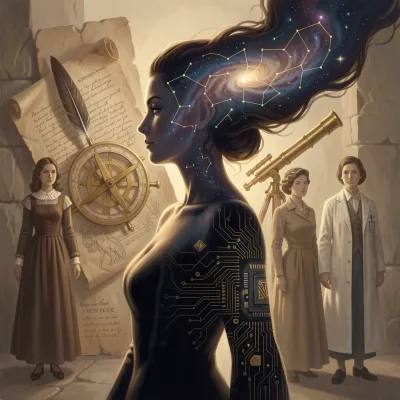
*The Forgotten Women Scientists Who Changed History* explores the often-overlooked but pivotal contributions of women to scientific progress across millennia. The book challenges the male-dominated narratives of scientific history by uncovering the achievements of women in diverse fields—from ancient healers and mathematicians to modern computer programmers and environmentalists—who were systematically marginalized due to societal and institutional barriers. Through chapters organized chronologically and thematically, it highlights figures like Hypatia, Émilie du Châtelet, and Ada Lovelace, alongside lesser-known pioneers such as Caroline Herschel and the ENIAC programmers, demonstrating how these women shaped disciplines including astronomy, chemistry, medicine, and more, often through collaboration, domestic work, or informal networks.
The narrative emphasizes the systemic obstacles these women faced, including exclusion from formal education, scientific societies, and professional recognition, while illustrating their resilience in overcoming these challenges. It delves into cases like Lise Meitner’s theoretical work on nuclear fission and Rosalind Franklin’s DNA research, which were overshadowed by Nobel snubs and male-dominated attributions. The book also expands the lens globally, showcasing contributions from women in the Islamic Golden Age, Africa, and Asia, and underscores how cultural and colonial biases further obscured non-Western voices. By examining partnerships and mentorship, the text reveals how women often thrived in collaborative settings, such as the all-female "human computers" at Harvard and NASA, whose collective work was foundational to astronomical and computational breakthroughs.
Chapters on overcoming bias and advocating for inclusion frame the stories within the broader struggle for equity in STEM, linking historical injustices to ongoing challenges in the field. The book argues that recognizing these women’s legacies is not merely about correcting history but addressing contemporary issues like workplace discrimination, the leaky pipeline in STEM careers, and the need for intersectional approaches to diversity. By reclaiming these narratives, it aims to inspire future generations and foster a more inclusive vision of scientific progress that honors the full spectrum of human ingenuity.
Ultimately, *The Forgotten Women Scientists Who Changed History* redefines the history of science as a shared human endeavor, enriched by women’s intellectual rigor, creativity, and determination. Their contributions, once relegated to the margins, are repositioned as central to advancing knowledge, challenging stereotypes, and building a future where no scientist is limited by gender. The book serves as both a historical reclamation and a call to action, urging society to ensure that the tapestry of scientific discovery includes all its threads, fostering equity and innovation for generations to come.
What You'll Find Inside:
- Explores the overlooked contributions of women across centuries and scientific disciplines, from ancient healers to modern pioneers in physics, chemistry, and technology.
- Highlights systemic gender biases that hindered women's access to education, professional recognition, and leadership roles in scientific fields.
- Showcases the critical role of collaboration and partnership in scientific breakthroughs, particularly through unsung female collaborators and teams.
- Addresses the historical erasure of women from scientific narratives, including Nobel Prize omissions and the fight for equitable recognition.
- Advocates for global inclusion in STEM, emphasizing the need to recognize diverse voices and ensure no talent is marginalized.
Who's It For:
This book is ideal for educators, students, and history enthusiasts seeking to broaden their understanding of scientific progress beyond traditional male-centric narratives. It is particularly valuable for advocates of gender equality and those interested in uncovering the overlooked legacies of women in STEM. Readers will gain a deeper appreciation for the systemic challenges faced by women and the enduring impact of their contributions on modern science and society.
Table of Contents:
- Introduction
- Chapter 1 The Invisible Pioneers: Setting the Stage for Forgotten Genius
- Chapter 2 Ancient Healers and Philosophers: Early Contributions from the Shadows
- Chapter 3 Medieval Minds: Women in the pursuit of Knowledge During the Dark Ages
- Chapter 4 Renaissance Revelations: Breaking Barriers in a Man's World
- Chapter 5 The Enlightenment's Unsung Voices: Women in the Age of Reason
- Chapter 6 Revolutionary Discoveries: Pushing the Boundaries of 18th-Century Science
- Chapter 7 Victorian Era Visionaries: Navigating Societal Constraints in the Pursuit of Science
- Chapter 8 Beyond the Curies: Other Luminous Figures in Early 20th-Century Physics
- Chapter 9 Chemistry's Quiet Catalysts: Women Who Shaped the Elements
- Chapter 10 Biological Breakthroughs: Unveiling the Secrets of Life
- Chapter 11 Medical Mavericks: Pioneering Women in Health and Healing
- Chapter 12 Astronomical Achievements: Gazing at the Stars and Beyond
- Chapter 13 Earth Shakers: Women in Geology and Environmental Science
- Chapter 14 Engineering Elegance: Building the Future, Brick by Scientific Brick
- Chapter 15 Mathematical Minds: Quantifying the World with Female Ingenuity
- Chapter 16 The Digital Dawn: Women Who Programmed the Future
- Chapter 17 Overcoming Obstacles: Systemic Bias and the Fight for Recognition
- Chapter 18 Collaborative Geniuses: Women in Scientific Partnerships
- Chapter 19 The Nobel Omissions: Recognizing Deserving but Uncredited Work
- Chapter 20 From the Lab to the Field: Diverse Contributions Across Disciplines
- Chapter 21 Inspiring the Next Generation: The Legacy of Forgotten Women Scientists
- Chapter 22 Beyond the Textbook: Reclaiming Their Stories
- Chapter 23 The Future of Inclusion: Ensuring No Scientist is Left Behind
- Chapter 24 A Global Perspective: Women Scientists from Around the World
- Chapter 25 Unveiling the Full Tapestry: A Concluding Look at Scientific Herstory
Author:
Published By:
Date Published:
July 12, 2026
Type:
Nonfiction
Language:
English
Word Count:
44,911 words
Reading Time:
3 hours 9 minutes
Sample:
MixCache.com Total Access
Get unlimited access to this book + all books published by MixCache.com for $11.99/month
Subscribe to MTAOr purchase this book individually below
Order:
Buy the The Forgotten Women Scientists Who Changed History ebook on MixCache.com:
Buy Now
Full ebook will be available immediately
- read online or download as a PDF file.
$5 account credit for all new MixCache.com accounts, usable toward any ebook purchase!*




Ratings & Reviews
Ask Questions About This Book
Have a question about the content? Ask our AI assistant!
Start by asking a question about "The Forgotten Women Scientists Who Changed History"
Example: "Does this book mention William Shakespeare?"
Thinking...