
Browse by Category
Fiction
- Action & Adventure
- African American
- Anthologies
- Children's Fiction
- Classics
- Comics & Graphic Novels
- Coming of Age
- Contemporary
- Cultural & Regional
- Drama
- Erotica
- Fantasy
- General
- Historical Fiction
- Horror
- Humor & Satire
- Literary Fiction
- Mystery, Thriller & Suspense
- Poetry
- Religious & Inspirational
- Romance
- Science Fiction
- Short Stories
- War & Military
- Westerns
- Women's Fiction
- Young Adult
Non-Fiction
- Antiques & Collectibles
- Arts & Photography
- Biographies & Memoirs
- Business & Money
- Children's Non-Fiction
-
Computers & Technology
- Artificial Intelligence
- Computer Science
- Cybersecurity & Cryptography
- Data Science & Analytics
- Databases & Big Data
- Game Development & Design
- General
- Hardware & DIY
- Mobile App Development
- Networking & Cloud Computing
- Operating Systems
- Programming
- Robotics
- Software
- Software Engineering
- User Experience (UX) & Design
- Web Development & Design
- Cooking, Food & Wine
- Crafts, Hobbies & Home
- Education & Teaching
- Engineering
- General
- Health, Fitness & Dieting
-
History
- African History
- African History - North Africa
- African History - Sub-Saharan Africa
- American History
- American History - 20th Century
- American History - Civil War
- American History - Colonial Period
- Ancient History
- Asian History
- Asian History - China
- Asian History - India
- Asian History - Japan
- Asian History - Southeast Asia
- European History
- European History - Ancient Greece
- European History - Ancient Rome
- European History - Medieval
- European History - Modern
- European History - Renaissance
- General
- Middle Eastern History
- Military History
- Military History - Aviation
- Military History - Naval
- Social & Cultural History
- World History
- Humor & Entertainment
- Industrial Technology
- Language Learning
- Law
- LGBTQ+ Non-Fiction
- Literary Criticism
- Medical Books
- Parenting & Relationships
- Philosophy
- Politics & Social Sciences
- Reference
- Religion & Spirituality
-
Science & Math
- Agricultural Sciences
- Astronomy & Space Science
- Behavioral Sciences
- Biological Sciences
- Botany & Plant Science
- Chemistry
- Earth Sciences
- Engineering - Chemical
- Engineering - Civil
- Engineering - Electrical
- Engineering - Mechanical
- Environment
- General
- Geology
- Mathematics
- Nature & Ecology
- Oceanography
- Paleontology
- Physics
- Statistics
- Self-Help
- Sports & Outdoors
- Study Aids
- Sustainability & Green Living
- Textbooks
- Transportation
- Travel
- True Crime
- Urban Planning & Development
- Veterinary Medicine
- Writing & Publishing
Jump to Section
MixCache.com Total Access
Unlimited reading and audiobooks for every book published by MixCache.com.
Included titles carry the MTA badge.
Learn more →
Bosnia and Herzegovina: A Fractured State in the Balkans
MTA
Ethnic Conflict, International Intervention, and Uncertain Futures
About this book:
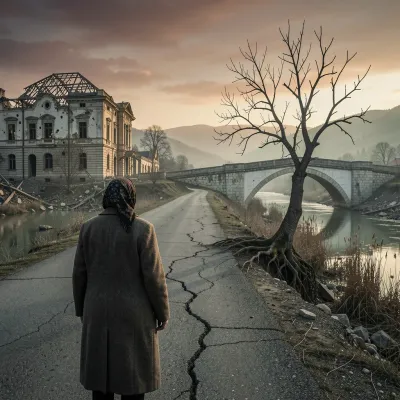
Bosnia and Herzegovina is a small Balkan nation with a rich, multi-ethnic history, having been a crossroads of civilizations under Ottoman and Austro-Hungarian rule and later a republic within Yugoslavia. This complex tapestry tragically unraveled in the 1990s with the rise of ethno-nationalism, leading to the dissolution of Yugoslavia and a devastating war from 1992 to 1995. The conflict was characterized by brutal siege warfare, systematic ethnic cleansing, and the genocide at Srebrenica, all documented as war crimes. The international community's response was initially marked by failed diplomacy and an ineffective arms embargo, only shifting decisively after the Srebrenica massacre and NATO intervention.
The Dayton Accords ended the fighting in 1995 but imposed a deeply fragmented state structure, dividing the country into the highly autonomous Federation of Bosnia and Herzegovina and Republika Srpska, further subdivided into cantons. This complex architecture, designed to balance ethnic interests, institutionalized divisions and created a weak central government, leading to chronic political dysfunction. The Office of the High Representative was established with powerful "Bonn Powers" to oversee civilian implementation, effectively making Bosnia an international protectorate. While the peace held and reconstruction began, the political system became a battleground for ethno-nationalist parties, resulting in constant gridlock and a failure to implement necessary reforms.
The post-war period has been defined by economic stagnation, high unemployment, and a severe brain drain as young, educated citizens leave for opportunities abroad. Social divisions are perpetuated by a segregated education system, where children learn different versions of history, often under "two schools under one roof," and by the powerful role of religious institutions in reinforcing ethno-national identities. The return of refugees, a cornerstone of the peace agreement, was only partly successful, and deep societal reconciliation remains elusive. Civil society and grassroots movements work tirelessly to bridge these divides, but face significant political and funding challenges.
Bosnia's future remains profoundly uncertain. Its aspirations for European Union membership are hindered by the very constitutional and political dysfunction Dayton created, while external influences from Serbia, Croatia, Russia, and Turkey further complicate internal dynamics. The country oscillates between the hope of becoming a functional, integrated European state and the risk of continued stagnation or even renewed fragmentation, particularly if secessionist rhetoric from Republika Srpska escalates. Ultimately, Bosnia's evolution depends on its citizens' resilience, the emergence of leaders willing to prioritize shared interests over ethnic divisions, and the sustained, principled engagement of the international community.
What You'll Find Inside:
- Explores the deep historical roots of Bosnia's multi-ethnic society from Illyrian times through Ottoman and Austro-Hungarian rule, showing how centuries of empires shaped its complex identity.
- Provides a detailed account of the 1992-1995 Bosnian War, including the sieges of Sarajevo and other cities, ethnic cleansing campaigns, and the Srebrenica genocide.
- Analyses the Dayton Accords and the unique, complex political structure they created, including the division into the Federation of Bosnia and Herzegovina and the Republika Srpska.
- Examines post-war challenges such as political dysfunction, economic stagnation, the devastating brain drain, and the role of education in perpetuating ethnic divisions.
- Discusses Bosnia's uncertain future prospects, including the path toward European integration, the influence of regional and external powers, and grassroots efforts for reconciliation.
Who's It For:
This book is written for students, scholars, and policymakers specializing in Balkan history, international relations, and post-conflict studies. It is also highly valuable for journalists, diplomats, and humanitarian workers seeking a comprehensive understanding of the region's complex ethnic dynamics, the legacy of the Bosnian War, and the ongoing challenges of building a functional multi-ethnic state in the heart of Europe.
Table of Contents:
- Introduction
- Chapter 1: The Historical Tapestry of Bosnia and Herzegovina: A Crossroads of Civilizations
- Chapter 2: Ottoman Rule and the Shaping of Bosnian Identity
- Chapter 3: Austro-Hungarian Annexation and the Seeds of Nationalism
- Chapter 4: Yugoslavia's Formation: Bosnia's Place in the First and Second Incarnations
- Chapter 5: The Rise of Ethnic Tensions in the Late 20th Century
- Chapter 6: The Dissolution of Yugoslavia and Bosnia's Path to Independence
- Chapter 7: The Bosnian War: A Descent into Conflict (1992-1995)
- Chapter 8: Siege Warfare and Urban Destruction: Sarajevo and Beyond
- Chapter 9: Ethnic Cleansing and Genocide: Documenting Atrocities
- Chapter 10: International Response and Failed Diplomacy
- Chapter 11: The Dayton Accords: Imposing Peace and a Fragmented State
- Chapter 12: The Architecture of Dayton: Entities, Cantons, and Shared Governance
- Chapter 13: The High Representative: International Oversight and its Limits
- Chapter 14: Post-Conflict Reconstruction: Infrastructure, Economy, and Society
- Chapter 15: The Return of Refugees and Displaced Persons: Challenges and Successes
- Chapter 16: Political Dysfunction and Ethnic Divisions in Post-War Bosnia
- Chapter 17: Economic Stagnation and the Brain Drain
- Chapter 18: The Role of Religious Institutions in a Multi-Ethnic Society
- Chapter 19: Education and the Perpetuation of Divisions
- Chapter 20: Bosnia and Herzegovina's Aspirations for European Integration
- Chapter 21: Regional Dynamics and External Influences
- Chapter 22: Transitional Justice and Reconciliation Efforts
- Chapter 23: The Brčko District: A Model of Coexistence or Continued Contention?
- Chapter 24: Civil Society and Grassroots Movements for Change
- Chapter 25: Uncertain Futures: Scenarios for Bosnia and Herzegovina's Evolution
Author:
Published By:
Date Published:
July 19, 2026
Type:
Nonfiction
Language:
English
Word Count:
45,313 words
Reading Time:
3 hours 10 minutes
Sample:
MixCache.com Total Access
Get unlimited access to this book + all books published by MixCache.com for $11.99/month
Subscribe to MTAOr purchase this book individually below
Order:
Buy the Bosnia and Herzegovina: A Fractured State in the Balkans ebook on MixCache.com:
Buy Now
Full ebook will be available immediately
- read online or download as a PDF file.
$5 account credit for all new MixCache.com accounts, usable toward any ebook purchase!*




Ratings & Reviews
Ask Questions About This Book
Have a question about the content? Ask our AI assistant!
Start by asking a question about "Bosnia and Herzegovina: A Fractured State in the Balkans"
Example: "Does this book mention William Shakespeare?"
Thinking...