
Browse by Category
Fiction
- Action & Adventure
- African American
- Anthologies
- Children's Fiction
- Classics
- Comics & Graphic Novels
- Coming of Age
- Contemporary
- Cultural & Regional
- Drama
- Erotica
- Fantasy
- General
- Historical Fiction
- Horror
- Humor & Satire
- Literary Fiction
- Mystery, Thriller & Suspense
- Poetry
- Religious & Inspirational
- Romance
- Science Fiction
- Short Stories
- War & Military
- Westerns
- Women's Fiction
- Young Adult
Non-Fiction
- Antiques & Collectibles
- Arts & Photography
- Biographies & Memoirs
- Business & Money
- Children's Non-Fiction
-
Computers & Technology
- Artificial Intelligence
- Computer Science
- Cybersecurity & Cryptography
- Data Science & Analytics
- Databases & Big Data
- Game Development & Design
- General
- Hardware & DIY
- Mobile App Development
- Networking & Cloud Computing
- Operating Systems
- Programming
- Robotics
- Software
- Software Engineering
- User Experience (UX) & Design
- Web Development & Design
- Cooking, Food & Wine
- Crafts, Hobbies & Home
- Education & Teaching
- Engineering
- General
- Health, Fitness & Dieting
-
History
- African History
- African History - North Africa
- African History - Sub-Saharan Africa
- American History
- American History - 20th Century
- American History - Civil War
- American History - Colonial Period
- Ancient History
- Asian History
- Asian History - China
- Asian History - India
- Asian History - Japan
- Asian History - Southeast Asia
- European History
- European History - Ancient Greece
- European History - Ancient Rome
- European History - Medieval
- European History - Modern
- European History - Renaissance
- General
- Middle Eastern History
- Military History
- Military History - Aviation
- Military History - Naval
- Social & Cultural History
- World History
- Humor & Entertainment
- Industrial Technology
- Language Learning
- Law
- LGBTQ+ Non-Fiction
- Literary Criticism
- Medical Books
- Parenting & Relationships
- Philosophy
- Politics & Social Sciences
- Reference
- Religion & Spirituality
-
Science & Math
- Agricultural Sciences
- Astronomy & Space Science
- Behavioral Sciences
- Biological Sciences
- Botany & Plant Science
- Chemistry
- Earth Sciences
- Engineering - Chemical
- Engineering - Civil
- Engineering - Electrical
- Engineering - Mechanical
- Environment
- General
- Geology
- Mathematics
- Nature & Ecology
- Oceanography
- Paleontology
- Physics
- Statistics
- Self-Help
- Sports & Outdoors
- Study Aids
- Sustainability & Green Living
- Textbooks
- Transportation
- Travel
- True Crime
- Urban Planning & Development
- Veterinary Medicine
- Writing & Publishing
Jump to Section
MixCache.com Total Access
Unlimited reading and audiobooks for every book published by MixCache.com.
Included titles carry the MTA badge.
Learn more →A History of Brazil
About this book:
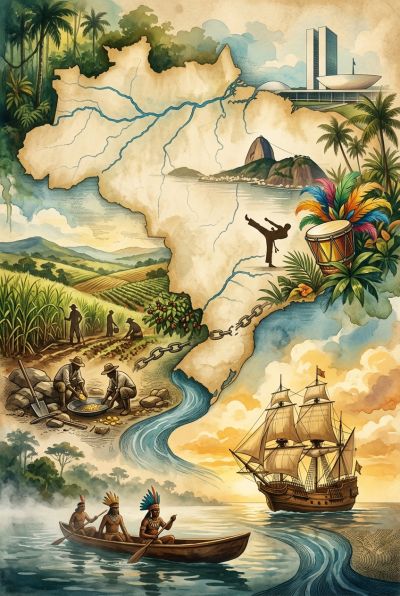


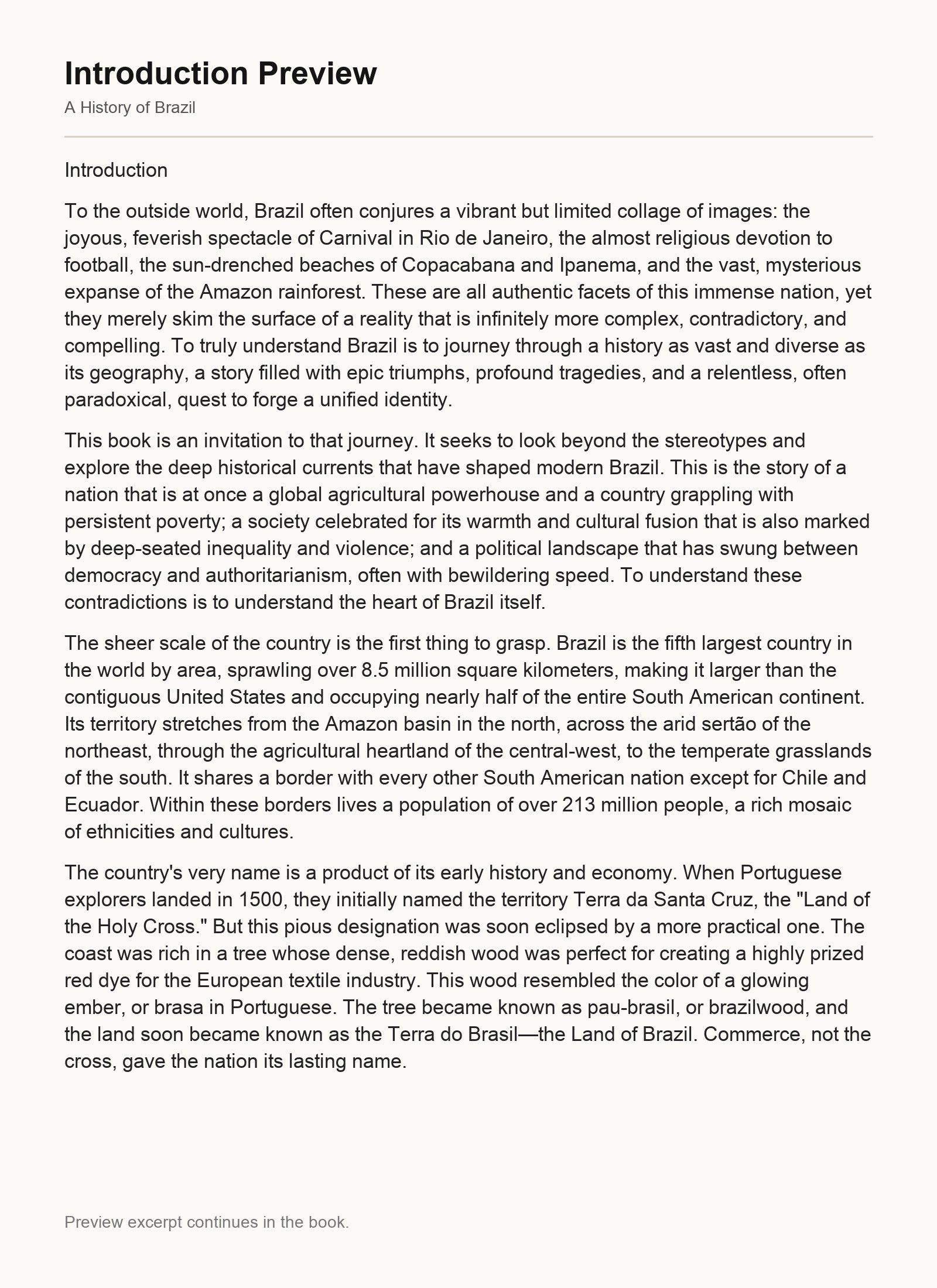
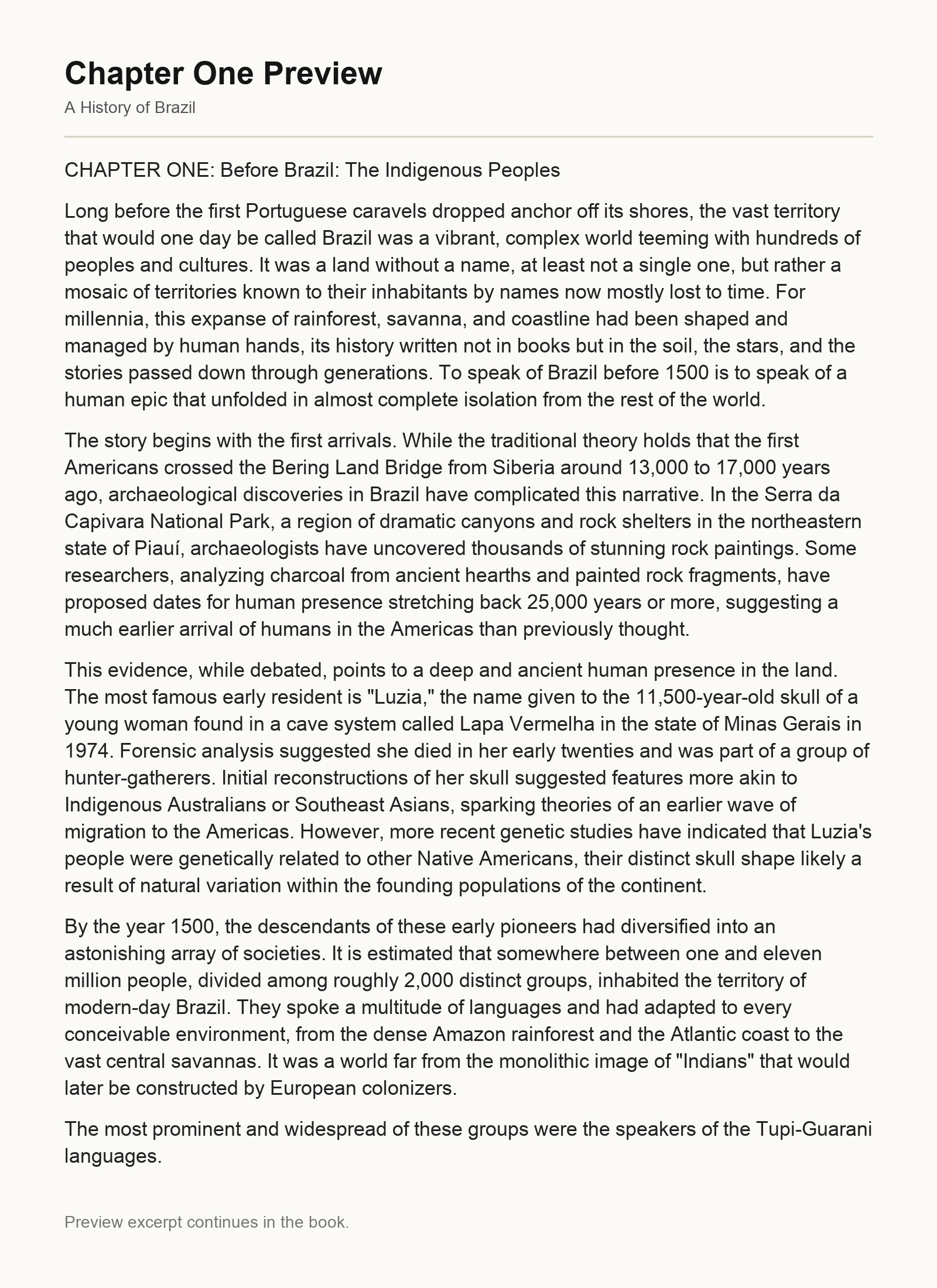
A History of Brazil offers a sweeping, single‑volume narrative that carries the reader from the ancient societies that first shaped the land to the turbulent politics of the 21st century. Drawing on the latest scholarship, the book weaves together economic, social, political, and cultural strands into a clear chronological account that reveals how a continent‑sized nation has continually reinvented itself. Whether you are a student, a traveler, or simply curious about one of the world’s most dynamic countries, this volume provides the foundation for understanding Brazil’s past and its present contradictions.
The work highlights the recurring cycles of boom and bust that have defined Brazil’s economy—from the early brazilwood trade, through the sugar plantations and gold rushes of Minas Gerais, to the coffee empire and later industrialization efforts. It shows how each commodity boom forged new social hierarchies, spurred internal migrations, and left lasting marks on the landscape and the people. At the same time, the book traces the intricate blending of Indigenous, European, and African peoples that created Brazil’s uniquely diverse society, examining the myths of racial democracy and the persistent realities of inequality and cultural resistance.
Readers will follow Brazil’s political transformation step by step: the colonial captaincies and the rise of a centralized government, the unexpected path to independence under Dom Pedro I, the long imperial era of Pedro II, the tumultuous First Republic dominated by coffee oligarchs, the revolutionary Vargas years and the Estado Novo, the military dictatorship of the 1960s‑80s, the gradual abertura that restored democracy, and the recent polarization that has reshaped the nation’s political culture. Each chapter explains not just what happened, but why it mattered for the everyday lives of Brazilians.
Beyond politics and economics, the book delves into the cultural life that emerged from Brazil’s mixed heritage. It explores the brutal legacy of slavery and the powerful abolitionist movement, the development of Afro‑Brazilian religions such as Candomblé, the flourishing of literature and art during the Minas Gerais baroque era, the birth of Bossa Nova and Tropicalismo, and the role of festivals, music, and food in forging a national identity. The Amazon rainforest is presented not only as a geographical marvel but as a living actor in Brazil’s story—its exploitation, its protection, and the struggles of its Indigenous peoples.
By the end of A History of Brazil, the reader will have gained a nuanced appreciation of the nation’s enduring tensions: between unity and regionalism, between progress and inequality, between authoritarian impulses and democratic aspirations. This deep historical insight equips you to understand contemporary debates over the environment, social policy, and Brazil’s place in the world, making the book both an enlightening read and a valuable guide to one of the most fascinating stories on the planet.
What You'll Find Inside:
- The book explores Brazil's origins, detailing the rich diversity of Indigenous societies before 1500 and their sophisticated agricultural and land‑management practices such as terra preta.
- It examines how Portuguese colonization built wealth on the sugar and gold economies, relying on enslaved African labor and sparking resistance like the quilombos, which shaped a deeply unequal colonial society.
- The narrative follows Brazil's political transformation from a monarchy under Dom Pedro I and II, through the coffee‑dominated Old Republic and Getúlio Vargas's Estado Novo, to the military dictatorship and its economic miracle.
- It covers the struggle for abolition, the fall of the empire, the redemocratization process (abertura), the defeat of hyperinflation via the Real Plan, and the social advances of the Lula era including Bolsa Família and Brazil's heightened global role.
- Finally, it analyzes the deep political polarization of the 2010s‑2020s, the Bolsonaro presidency, the January 8, 2023 insurrection, and the ongoing challenges of inequality, environmental preservation, and democratic resilience.
Who's It For:
This book is suited for university students and scholars of Latin American history, political science, or sociology, as well as educated general readers seeking a comprehensive, nuanced understanding of Brazil's complex past and its relevance to today's social, economic, and political challenges.
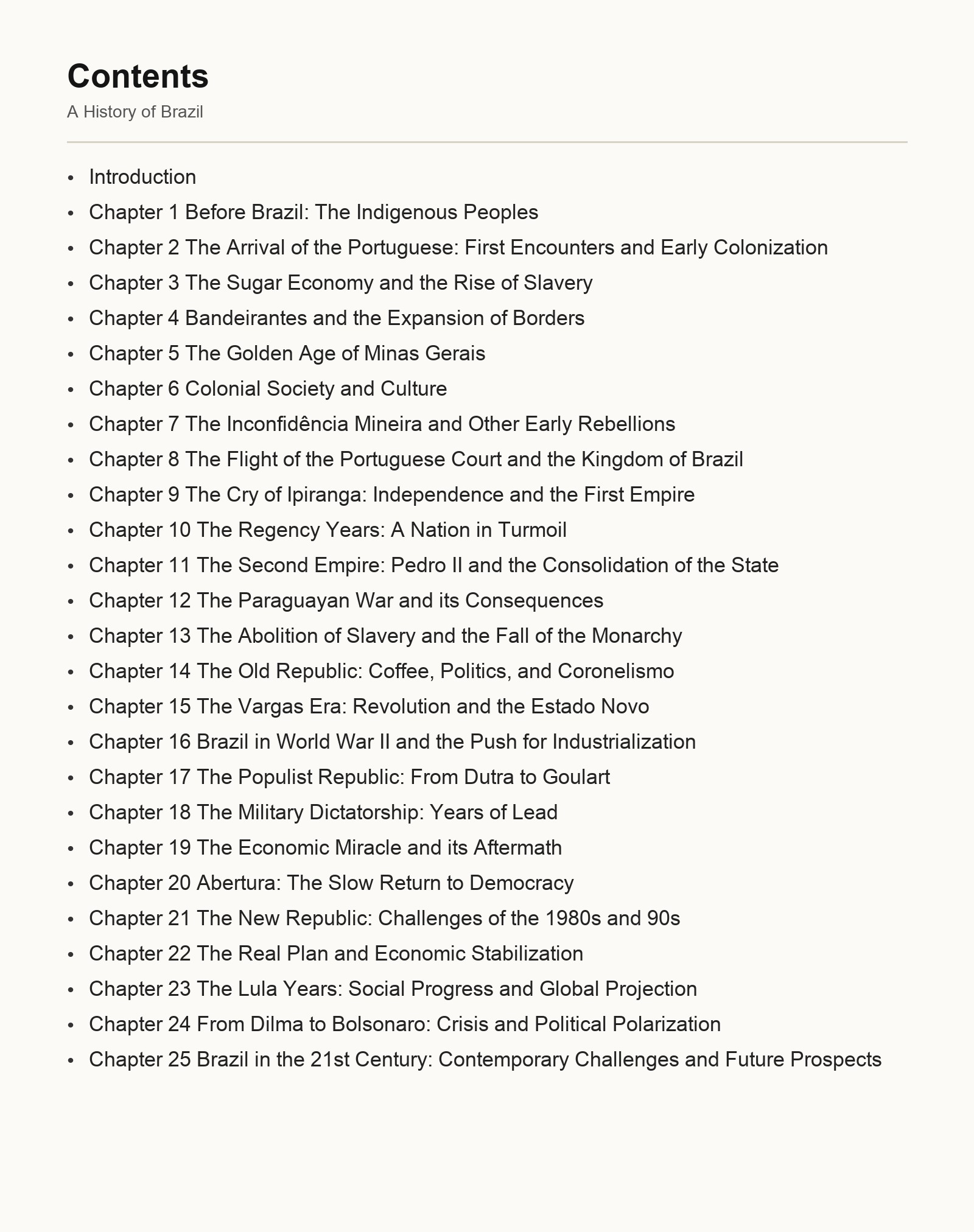
Table of Contents:
- Introduction
- Chapter 1 Before Brazil: The Indigenous Peoples
- Chapter 2 The Arrival of the Portuguese: First Encounters and Early Colonization
- Chapter 3 The Sugar Economy and the Rise of Slavery
- Chapter 4 Bandeirantes and the Expansion of Borders
- Chapter 5 The Golden Age of Minas Gerais
- Chapter 6 Colonial Society and Culture
- Chapter 7 The Inconfidência Mineira and Other Early Rebellions
- Chapter 8 The Flight of the Portuguese Court and the Kingdom of Brazil
- Chapter 9 The Cry of Ipiranga: Independence and the First Empire
- Chapter 10 The Regency Years: A Nation in Turmoil
- Chapter 11 The Second Empire: Pedro II and the Consolidation of the State
- Chapter 12 The Paraguayan War and its Consequences
- Chapter 13 The Abolition of Slavery and the Fall of the Monarchy
- Chapter 14 The Old Republic: Coffee, Politics, and Coronelismo
- Chapter 15 The Vargas Era: Revolution and the Estado Novo
- Chapter 16 Brazil in World War II and the Push for Industrialization
- Chapter 17 The Populist Republic: From Dutra to Goulart
- Chapter 18 The Military Dictatorship: Years of Lead
- Chapter 19 The Economic Miracle and its Aftermath
- Chapter 20 Abertura: The Slow Return to Democracy
- Chapter 21 The New Republic: Challenges of the 1980s and 90s
- Chapter 22 The Real Plan and Economic Stabilization
- Chapter 23 The Lula Years: Social Progress and Global Projection
- Chapter 24 From Dilma to Bolsonaro: Crisis and Political Polarization
- Chapter 25 Brazil in the 21st Century: Contemporary Challenges and Future Prospects
Author:
Published By:
Date Published:
May 25, 2026
Type:
Nonfiction
Language:
English
Also Available In:
Word Count:
52,904 words
Reading Time:
3 hours 42 minutes
Sample:
Order:
Buy the A History of Brazil ebook on MixCache.com:
Buy NowThe full ebook will be available immediately to read instantly on any device.
$5 account credit for all new MixCache.com accounts, usable toward any ebook purchase!*


Ratings & Reviews
Ask Questions About This Book
Have a question about the content? Ask our AI assistant!
Start by asking a question about "A History of Brazil"
Example: "Does this book mention William Shakespeare?"
Thinking...