Browse by Category
Fiction
- Action & Adventure
- African American
- Anthologies
- Children's Fiction
- Classics
- Comics & Graphic Novels
- Coming of Age
- Contemporary
- Cultural & Regional
- Drama
- Erotica
- Fantasy
- General
- Historical Fiction
- Horror
- Humor & Satire
- Literary Fiction
- Mystery, Thriller & Suspense
- Poetry
- Religious & Inspirational
- Romance
- Science Fiction
- Short Stories
- War & Military
- Westerns
- Women's Fiction
- Young Adult
Non-Fiction
- Antiques & Collectibles
- Arts & Photography
- Biographies & Memoirs
- Business & Money
- Children's Non-Fiction
-
Computers & Technology
- Artificial Intelligence
- Computer Science
- Cybersecurity & Cryptography
- Data Science & Analytics
- Databases & Big Data
- Game Development & Design
- General
- Hardware & DIY
- Mobile App Development
- Networking & Cloud Computing
- Operating Systems
- Programming
- Robotics
- Software
- Software Engineering
- User Experience (UX) & Design
- Web Development & Design
- Cooking, Food & Wine
- Crafts, Hobbies & Home
- Education & Teaching
- Engineering
- General
- Health, Fitness & Dieting
-
History
- African History
- African History - North Africa
- African History - Sub-Saharan Africa
- American History
- American History - 20th Century
- American History - Civil War
- American History - Colonial Period
- Ancient History
- Asian History
- Asian History - China
- Asian History - India
- Asian History - Japan
- Asian History - Southeast Asia
- European History
- European History - Ancient Greece
- European History - Ancient Rome
- European History - Medieval
- European History - Modern
- European History - Renaissance
- General
- Middle Eastern History
- Military History
- Military History - Aviation
- Military History - Naval
- Social & Cultural History
- World History
- Humor & Entertainment
- Industrial Technology
- Language Learning
- Law
- LGBTQ+ Non-Fiction
- Literary Criticism
- Medical Books
- Parenting & Relationships
- Philosophy
- Politics & Social Sciences
- Reference
- Religion & Spirituality
-
Science & Math
- Agricultural Sciences
- Astronomy & Space Science
- Behavioral Sciences
- Biological Sciences
- Botany & Plant Science
- Chemistry
- Earth Sciences
- Engineering - Chemical
- Engineering - Civil
- Engineering - Electrical
- Engineering - Mechanical
- Environment
- General
- Geology
- Mathematics
- Nature & Ecology
- Oceanography
- Paleontology
- Physics
- Statistics
- Self-Help
- Sports & Outdoors
- Study Aids
- Sustainability & Green Living
- Textbooks
- Transportation
- Travel
- True Crime
- Urban Planning & Development
- Veterinary Medicine
- Writing & Publishing
Jump to Section

Want unlimited access to all books published by MixCache.com (plus their audiobooks)? Try MixCache.com Total Access. Look for the MTA badge on book covers to identify included titles.
Access to infinite ebooks: Don't see the book you want? Suggest it and we'll create it (free!) for you from scratch with our powerful AI book writer. Then read it with MTA - besides profiting from any sales it makes!
Education In Croatia
MTA
A Comprehensive Overview from Early Childhood to Higher Education
About this book:
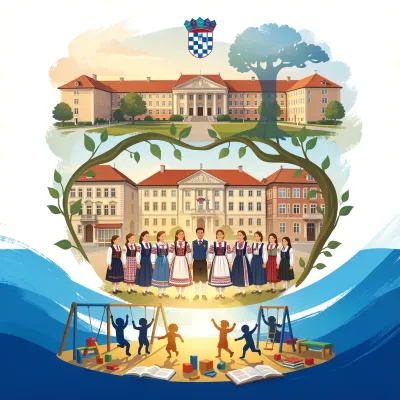
Education in Croatia has evolved from ecclesiastical and Glagolitic-rooted beginnings in the medieval period through Habsburg reforms, Yugoslav socialist transformations, and post‑independence modernization. The system is centrally steered by the Ministry of Science and Education, supported by specialized agencies (ETTA, ASOO, ASHE, NCEEE, AMEUP) that handle curriculum, teacher training, vocational education, quality assurance, and EU programme implementation, while counties and municipalities manage school founding and maintenance. Legal foundations include the Primary and Secondary Education Act, the Act on Higher Education and Scientific Activity, and the Croatian Qualifications Framework, which together ensure national standards and alignment with European benchmarks.
Early childhood education and care emphasizes holistic, play‑based development in public and private kindergartens, with a strong focus on inclusion and parental partnership. Preschool education builds readiness skills through child‑centered, thematic learning. Primary education spans eight years, moving from a single class‑teacher model in grades 1‑4 to a subject‑teacher model in grades 5‑8, delivering a nationally prescribed curriculum that integrates Croatian language, mathematics, natural sciences, history, geography, foreign languages, arts, technical education, physical and health education, and cross‑curricular civic education, assessed via continuous formative and summative grading. Secondary education offers general tracks in various gymnasium types (general, natural sciences‑mathematics, language, classical) preparing students for university, and vocational tracks ranging from three‑year craft programmes to four‑year technical and five‑year specialized programmes that combine theory with substantial work‑based learning and provide pathways to both employment and higher education; art schools provide specialized artistic training. Higher education follows the Bologna three‑cycle structure, with universities offering research‑oriented bachelor’s, master’s and doctoral programmes, and polytechnics and colleges of applied sciences delivering professionally oriented studies; admission hinges largely on the State Matura exam, complemented by secondary grades and, for some fields, additional aptitude tests. Student life is supported by subsidized meals, dormitories, scholarships, and a vibrant extracurricular scene, while international mobility is facilitated chiefly through Erasmus+.
Quality assurance is overseen by the Agency for Science and Higher Education (ASHE), which conducts external accreditation and aligns with EU standards, complemented by mandatory internal systems at institutions. Research and development in universities are funded by state budgets, the Croatian Science Foundation, EU programmes, and industry collaboration, with a growing emphasis on technology transfer and doctoral training. Teacher education requires five‑year integrated programmes, a probationary induction, and continuous professional development led by ETTA, with recent reforms such as “School for Life” promoting critical thinking, digital literacy, and competency‑based learning. Inclusive education mandates individualized education plans and support services for students with special needs, while education of national minorities follows three models (A, B, C) to balance mother‑tongue instruction with integration into the Croatian system. EU membership has driven structural reforms (Bologna Process), quality‑framework alignment, funding via structural funds, and expanded mobility and cooperation. Funding blends state budget allocations, local government contributions for operational and infrastructural costs, EU structural funds (ESF, ERDF), and limited tuition fees, with ongoing challenges regarding equitable resource distribution, demographic decline, teacher recruitment, curriculum relevance, and digital inclusion. Current reforms target digitalization (e‑Schools project), lifelong learning, work‑based learning in VET, and sustainable adult education, while future perspectives envision deeper technological integration, personalized learning pathways, stronger labour‑market linkages, expanded lifelong learning, and continued internationalization to prepare Croatian learners for a rapidly changing, globalized world.
What You'll Find Inside:
- A complete overview of Croatia's education system spanning early childhood education through higher education, including structure, governance, and key characteristics at each level.
- Detailed examination of Croatia's dual-track secondary education system, covering both general education (gymnasiums) and vocational education and training (VET) pathways, with insights into specialized programs and their labor market relevance.
- Analysis of major educational reforms in Croatia, including the Bologna Process alignment, the 'School for Life' initiative, and ongoing efforts to modernize curriculum and pedagogical approaches.
- Exploration of inclusive education practices for students with special needs and national minorities, highlighting Croatia's commitment to equity and diversity within its educational framework.
- Examination of Croatia's integration with European educational frameworks, including EU policy impacts, international cooperation programs like Erasmus+, and alignment with European Qualifications Framework.
Who's It For:
This book is ideal for educators, policymakers, and education administrators seeking comprehensive insights into the Croatian education system. It will also benefit researchers and academics studying comparative education or Balkan studies, as well as students pursuing degrees in education or international relations. Anyone with professional or personal interest in understanding how Croatia's educational landscape has evolved and functions today will find valuable information within its pages.
Author:
Published By:
Date Published:
June 21, 2026
Type:
Nonfiction
Language:
English
Word Count:
47,872 words
Reading Time:
3 hours 21 minutes
Sample:
Order:
Order Education In Croatia (Hardcover) on MixCache.com:
Buy NowPrint copy is made to order and ships worldwide. Includes the ebook free, ready to read instantly.
$5 account credit for all new MixCache.com accounts, usable toward any ebook purchase!*