
Browse by Category
Fiction
- Action & Adventure
- African American
- Anthologies
- Children's Fiction
- Classics
- Comics & Graphic Novels
- Coming of Age
- Contemporary
- Cultural & Regional
- Drama
- Erotica
- Fantasy
- General
- Historical Fiction
- Horror
- Humor & Satire
- Literary Fiction
- Mystery, Thriller & Suspense
- Poetry
- Religious & Inspirational
- Romance
- Science Fiction
- Short Stories
- War & Military
- Westerns
- Women's Fiction
- Young Adult
Non-Fiction
- Antiques & Collectibles
- Arts & Photography
- Biographies & Memoirs
- Business & Money
- Children's Non-Fiction
-
Computers & Technology
- Artificial Intelligence
- Computer Science
- Cybersecurity & Cryptography
- Data Science & Analytics
- Databases & Big Data
- Game Development & Design
- General
- Hardware & DIY
- Mobile App Development
- Networking & Cloud Computing
- Operating Systems
- Programming
- Robotics
- Software
- Software Engineering
- User Experience (UX) & Design
- Web Development & Design
- Cooking, Food & Wine
- Crafts, Hobbies & Home
- Education & Teaching
- Engineering
- General
- Health, Fitness & Dieting
-
History
- African History
- African History - North Africa
- African History - Sub-Saharan Africa
- American History
- American History - 20th Century
- American History - Civil War
- American History - Colonial Period
- Ancient History
- Asian History
- Asian History - China
- Asian History - India
- Asian History - Japan
- Asian History - Southeast Asia
- European History
- European History - Ancient Greece
- European History - Ancient Rome
- European History - Medieval
- European History - Modern
- European History - Renaissance
- General
- Middle Eastern History
- Military History
- Military History - Aviation
- Military History - Naval
- Social & Cultural History
- World History
- Humor & Entertainment
- Industrial Technology
- Language Learning
- Law
- LGBTQ+ Non-Fiction
- Literary Criticism
- Medical Books
- Parenting & Relationships
- Philosophy
- Politics & Social Sciences
- Reference
- Religion & Spirituality
-
Science & Math
- Agricultural Sciences
- Astronomy & Space Science
- Behavioral Sciences
- Biological Sciences
- Botany & Plant Science
- Chemistry
- Earth Sciences
- Engineering - Chemical
- Engineering - Civil
- Engineering - Electrical
- Engineering - Mechanical
- Environment
- General
- Geology
- Mathematics
- Nature & Ecology
- Oceanography
- Paleontology
- Physics
- Statistics
- Self-Help
- Sports & Outdoors
- Study Aids
- Sustainability & Green Living
- Textbooks
- Transportation
- Travel
- True Crime
- Urban Planning & Development
- Veterinary Medicine
- Writing & Publishing
Jump to Section

Want unlimited access to all books published by MixCache.com (plus their audiobooks)? Try MixCache.com Total Access. Look for the MTA badge on book covers to identify included titles.
Access to infinite ebooks: Don't see the book you want? Suggest it and we'll create it (free!) for you from scratch with our powerful AI book writer. Then read it with MTA - besides profiting from any sales it makes!
Education In Cuba
MTA
A Comprehensive Overview from Early Childhood to Higher Education
About this book:
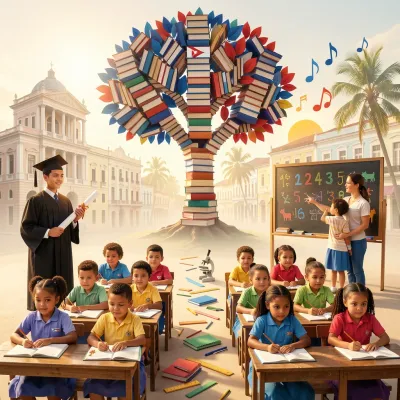
Education in Cuba has been shaped by a revolutionary commitment to universal, free, and equitable schooling rooted in the belief that education is a fundamental human right and a tool for social justice. From the National Literacy Campaign of 1961 to the present, the system has prioritized access for all regardless of socioeconomic status, geography, or ability, integrating early childhood programs like círculos infantiles and mandatory pre‑school, six‑year primary education, three‑year basic secondary, and a bifurcated upper secondary track leading either to pre‑university preparation or technical and vocational education. Higher education—universities, pedagogical institutes, and specialized centers—remains state‑funded and merit‑based, with strong links to research, innovation, and community service. Throughout, the curriculum emphasizes holistic development, combining academic rigor with civic education, the study‑work principle, arts, sports, and health, all guided by Marxist‑Leninist ideals and revolutionary values that aim to cultivate socially conscious, productive citizens.
The Cuban model is distinguished by its extensive teacher training through dedicated pedagogical institutes, a nationally standardized yet adaptable curriculum overseen by MINED, and robust mechanisms for inclusion, such as special education services that blend specialized schools with integrated classrooms and early intervention. Arts and sports are compulsory components designed to foster collective identity and physical well‑being, while science and technology education stresses self‑reliance and applied research, evidenced by achievements in biotechnology and medicine despite material constraints. Family and community involvement is institutionalized through parent councils, mass organizations, and local learning hubs, and health services are deeply woven into schools via regular screenings, vaccinations, and the training of medical professionals within educational settings. Assessment focuses on formative feedback and holistic development rather than high‑stakes ranking, aiming to identify learning gaps and provide support for all students.
The system has demonstrated remarkable resilience, especially during the Special Period, when televised lessons (TeleClases) maintained instructional continuity amid severe shortages. Ongoing challenges include resource limitations due to the U.S. embargo, infrastructure upkeep, technological integration, and aligning training with evolving labor market demands. Cuba addresses these through international solidarity programs like the Yo Sí Puedo literacy method and the Latin American School of Medicine, continued investment in adult and rural education, emphasis on teacher professional development, and strategic initiatives such as Science and Technology Parks to link research with productivity. Looking ahead, Cuba seeks to deepen ICT use, strengthen education‑economy linkages, expand autonomous yet equitable local governance, and sustain its core principle that education is a universal right and a driver of national development and global solidarity.
What You'll Find Inside:
- Cuba's education system is built on the principle of universal, free access from early childhood through higher education, ensuring equity regardless of socioeconomic status or geographic location.
- The 1961 National Literacy Campaign was a transformative national effort that reduced illiteracy from 23% to under 4% in one year, mobilizing over 250,000 volunteers and earning international acclaim.
- Cuban education emphasizes holistic development, integrating academic learning with arts, sports, productive labor ('study-work' principle), and revolutionary values to cultivate well-rounded, socially responsible citizens.
- Despite severe economic challenges—especially during the Special Period following the collapse of the Soviet Union—Cuba prioritized education, innovating with tools like televised classes (TeleClases) to maintain continuity of instruction.
- Cuba has achieved global recognition in specialized fields such as medical education and biotechnology, training thousands of international students through programs like the Latin American School of Medicine (ELAM) and developing homegrown vaccines despite resource constraints.
Who's It For:
This book is ideal for educators, policymakers, researchers, and students interested in comparative education, particularly those examining how a developing nation with limited resources has achieved high literacy rates, universal access, and strong educational outcomes. It will also appeal to individuals studying Latin American studies, socialist pedagogy, or international development, offering insights into how ideology, community engagement, and state investment shape educational systems. Additionally, practitioners in global health, adult literacy, and special education will find valuable case studies on Cuba’s innovative and inclusive approaches.
Author:
Published By:
Date Published:
June 22, 2026
Type:
Nonfiction
Language:
English
Word Count:
37,938 words
Reading Time:
2 hours 39 minutes
Sample:
MixCache.com Total Access
Get unlimited access to this book + all books published by MixCache.com for $11.99/month
Subscribe to MTAOr purchase this book individually below
Order:
Buy the Education In Cuba ebook on MixCache.com:
Buy Now
Full ebook will be available immediately
- read online or download as a PDF file.
$5 account credit for all new MixCache.com accounts, usable toward any ebook purchase!*




Ratings & Reviews
Ask Questions About This Book
Have a question about the content? Ask our AI assistant!
Start by asking a question about "Education In Cuba"
Example: "Does this book mention William Shakespeare?"
Thinking...