Browse by Category
Fiction
- Action & Adventure
- African American
- Anthologies
- Children's Fiction
- Classics
- Comics & Graphic Novels
- Coming of Age
- Contemporary
- Cultural & Regional
- Drama
- Erotica
- Fantasy
- General
- Historical Fiction
- Horror
- Humor & Satire
- Literary Fiction
- Mystery, Thriller & Suspense
- Poetry
- Religious & Inspirational
- Romance
- Science Fiction
- Short Stories
- War & Military
- Westerns
- Women's Fiction
- Young Adult
Non-Fiction
- Antiques & Collectibles
- Arts & Photography
- Biographies & Memoirs
- Business & Money
- Children's Non-Fiction
-
Computers & Technology
- Artificial Intelligence
- Computer Science
- Cybersecurity & Cryptography
- Data Science & Analytics
- Databases & Big Data
- Game Development & Design
- General
- Hardware & DIY
- Mobile App Development
- Networking & Cloud Computing
- Operating Systems
- Programming
- Robotics
- Software
- Software Engineering
- User Experience (UX) & Design
- Web Development & Design
- Cooking, Food & Wine
- Crafts, Hobbies & Home
- Education & Teaching
- Engineering
- General
- Health, Fitness & Dieting
-
History
- African History
- African History - North Africa
- African History - Sub-Saharan Africa
- American History
- American History - 20th Century
- American History - Civil War
- American History - Colonial Period
- Ancient History
- Asian History
- Asian History - China
- Asian History - India
- Asian History - Japan
- Asian History - Southeast Asia
- European History
- European History - Ancient Greece
- European History - Ancient Rome
- European History - Medieval
- European History - Modern
- European History - Renaissance
- General
- Middle Eastern History
- Military History
- Military History - Aviation
- Military History - Naval
- Social & Cultural History
- World History
- Humor & Entertainment
- Industrial Technology
- Language Learning
- Law
- LGBTQ+ Non-Fiction
- Literary Criticism
- Medical Books
- Parenting & Relationships
- Philosophy
- Politics & Social Sciences
- Reference
- Religion & Spirituality
-
Science & Math
- Agricultural Sciences
- Astronomy & Space Science
- Behavioral Sciences
- Biological Sciences
- Botany & Plant Science
- Chemistry
- Earth Sciences
- Engineering - Chemical
- Engineering - Civil
- Engineering - Electrical
- Engineering - Mechanical
- Environment
- General
- Geology
- Mathematics
- Nature & Ecology
- Oceanography
- Paleontology
- Physics
- Statistics
- Self-Help
- Sports & Outdoors
- Study Aids
- Sustainability & Green Living
- Textbooks
- Transportation
- Travel
- True Crime
- Urban Planning & Development
- Veterinary Medicine
- Writing & Publishing
Jump to Section

Want unlimited access to all books published by MixCache.com (plus their audiobooks)? Try MixCache.com Total Access. Look for the MTA badge on book covers to identify included titles.
Access to infinite ebooks: Don't see the book you want? Suggest it and we'll create it (free!) for you from scratch with our powerful AI book writer. Then read it with MTA - besides profiting from any sales it makes!
Education In Chile
MTA
A Comprehensive Overview from Early Childhood to Higher Education
About this book:
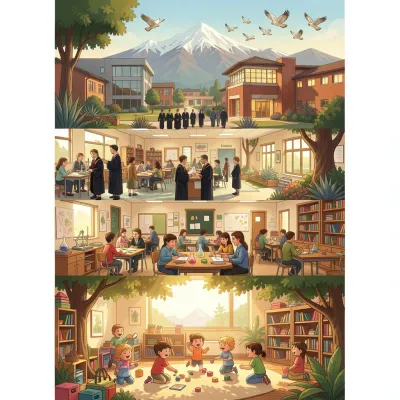
# Education In Chile: A Comprehensive Overview from Early Childhood to Higher Education
Education in Chile presents a multifaceted journey from early childhood to higher education, shaped by a complex interplay of historical legacies, governance structures, and ongoing reforms. Rooted in indigenous traditions and transformed through colonial, republican, and military dictatorship influences, the modern system features a mixed public-private model. Overseen by the Ministry of Education (MINEDUC), it includes municipal public schools, private subsidized institutions, and private establishments, with a persistent focus on equity, access, and quality. Early childhood education, managed primarily by JUNJI and Fundación Integra, emphasizes play-based learning and foundational development, while primary and secondary education follows a national curriculum with distinct Humanistic-Scientific (HC) and Technical-Professional (TP) pathways. The system is committed to inclusive education, acknowledging the needs of indigenous languages and diverse populations, though challenges in equitable resource distribution, teacher training, and infrastructure persist, especially in rural areas.
Governance and structure reflect a decentralized model, with municipal governments managing public schools and private entities administering subsidized institutions. This setup has led to significant disparities in educational outcomes tied to socioeconomic status, prompting reforms like the 2009 General Education Law (LGE) to reduce profit in subsidized schools and strengthen public education. The higher education landscape includes universities, Professional Institutes (IPs), and Technical Training Centers (CFTs), regulated by strict quality assurance standards via the National Agency for Quality Assurance (CNA-Chile). University admissions, centered on the PAES exams, emphasize academic merit but grapple with equity concerns. Funding mechanisms blend public subsidies with tuition fees, though "gratuidad" (free tuition) for low-income students has emerged as a landmark reform, aiming to democratize access and reduce student debt.
Teacher training and professional development are pivotal, with rigorous initial programs and ongoing initiatives like "Docente Más" to refine pedagogical skills. The system addresses workforce needs through Technical-Professional education, aligning curricula with industry demands, and vocational training via agencies like SENCE. Technology integration drives pedagogical innovation, though the digital divide complicates equitable access. Bilingual education, encompassing English and indigenous languages like Mapudungun, reflects efforts to honor cultural diversity while enhancing global competitiveness. Internationalization continues to expand through student mobility and global partnerships, fostering academic excellence and cross-cultural exchange.
Ongoing challenges include persistent inequities between urban and rural schools, socioeconomic segregation, and the need for inclusive practices for marginalized groups. The system's future prioritizes technological adaptation, lifelong learning, and sustainable development, aiming to prepare students for a dynamic global landscape. Emphasis on student well-being, mental health support, and community collaboration underscores a holistic approach. Research and innovation are central to addressing these challenges, informing evidence-based policies and pedagogies. As Chile navigates future trends, the focus remains on fostering an equitable, high-quality education system that reflects its diverse culture and meets the demands of the 21st century.
What You'll Find Inside:
- The book traces the historical evolution of Chilean education from indigenous traditions through colonial, republican, and reform eras, highlighting how past policies shape today's system.
- It details the current structure and governance, emphasizing the mixed public-private model, decentralization to municipalities, and the central role of MINEDUC in setting curriculum and standards.
- Early childhood education is examined as a critical foundation, covering JUNJI and Integra programs, curricular bases, and efforts to expand access and quality for holistic development.
- The text analyzes equity and access challenges across socioeconomic, geographic, and institutional lines, discussing reforms like gratuidad, SEP, and PACE aimed at reducing disparities.
- Future perspectives explore technology integration, 21st-century skills, lifelong learning, indigenous language revitalization, and ongoing efforts to balance quality, inclusion, and system sustainability.
Who's It For:
This book is intended for policymakers, educators, researchers, and students seeking a comprehensive understanding of Chile's educational system. It will also benefit anyone interested in comparative education, social equity in schooling, or the interplay of policy, history, and reform in a national context.
Author:
Published By:
Date Published:
June 21, 2026
Type:
Nonfiction
Language:
English
Word Count:
43,252 words
Reading Time:
3 hours 2 minutes
Sample:
Order:
Order Education In Chile (Paperback) on MixCache.com:
Buy NowPrint copy is made to order and ships worldwide. Includes the ebook free, ready to read instantly.
$5 account credit for all new MixCache.com accounts, usable toward any ebook purchase!*