Browse by Category
Fiction
- Action & Adventure
- African American
- Anthologies
- Children's Fiction
- Classics
- Comics & Graphic Novels
- Coming of Age
- Contemporary
- Cultural & Regional
- Drama
- Erotica
- Fantasy
- General
- Historical Fiction
- Horror
- Humor & Satire
- Literary Fiction
- Mystery, Thriller & Suspense
- Poetry
- Religious & Inspirational
- Romance
- Science Fiction
- Short Stories
- War & Military
- Westerns
- Women's Fiction
- Young Adult
Non-Fiction
- Antiques & Collectibles
- Arts & Photography
- Biographies & Memoirs
- Business & Money
- Children's Non-Fiction
-
Computers & Technology
- Artificial Intelligence
- Computer Science
- Cybersecurity & Cryptography
- Data Science & Analytics
- Databases & Big Data
- Game Development & Design
- General
- Hardware & DIY
- Mobile App Development
- Networking & Cloud Computing
- Operating Systems
- Programming
- Robotics
- Software
- Software Engineering
- User Experience (UX) & Design
- Web Development & Design
- Cooking, Food & Wine
- Crafts, Hobbies & Home
- Education & Teaching
- Engineering
- General
- Health, Fitness & Dieting
-
History
- African History
- African History - North Africa
- African History - Sub-Saharan Africa
- American History
- American History - 20th Century
- American History - Civil War
- American History - Colonial Period
- Ancient History
- Asian History
- Asian History - China
- Asian History - India
- Asian History - Japan
- Asian History - Southeast Asia
- European History
- European History - Ancient Greece
- European History - Ancient Rome
- European History - Medieval
- European History - Modern
- European History - Renaissance
- General
- Middle Eastern History
- Military History
- Military History - Aviation
- Military History - Naval
- Social & Cultural History
- World History
- Humor & Entertainment
- Industrial Technology
- Language Learning
- Law
- LGBTQ+ Non-Fiction
- Literary Criticism
- Medical Books
- Parenting & Relationships
- Philosophy
- Politics & Social Sciences
- Reference
- Religion & Spirituality
-
Science & Math
- Agricultural Sciences
- Astronomy & Space Science
- Behavioral Sciences
- Biological Sciences
- Botany & Plant Science
- Chemistry
- Earth Sciences
- Engineering - Chemical
- Engineering - Civil
- Engineering - Electrical
- Engineering - Mechanical
- Environment
- General
- Geology
- Mathematics
- Nature & Ecology
- Oceanography
- Paleontology
- Physics
- Statistics
- Self-Help
- Sports & Outdoors
- Study Aids
- Sustainability & Green Living
- Textbooks
- Transportation
- Travel
- True Crime
- Urban Planning & Development
- Veterinary Medicine
- Writing & Publishing
Jump to Section

Want unlimited access to all books published by MixCache.com (plus their audiobooks)? Try MixCache.com Total Access. Look for the MTA badge on book covers to identify included titles.
Access to infinite ebooks: Don't see the book you want? Suggest it and we'll create it (free!) for you from scratch with our powerful AI book writer. Then read it with MTA - besides profiting from any sales it makes!
Education In Central African Republic
MTA
A Comprehensive Overview from Early Childhood to Higher Education
About this book:
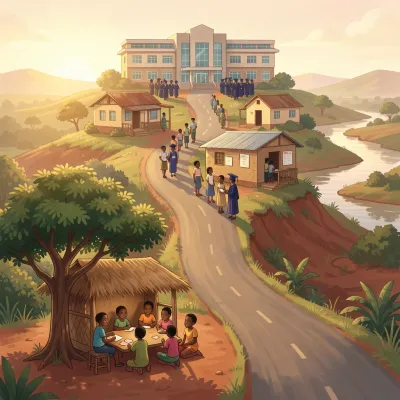
Education in the Central African Republic presents a complex and deeply challenging landscape, encompassing early childhood through higher education, profoundly shaped by a history of colonial legacy, persistent political instability, and recurring conflict. The educational system struggles with foundational issues, including a severe shortage of qualified teachers, dilapidated infrastructure, and a chronic lack of basic learning materials. Access and equity remain significant hurdles, with many children — especially girls, those in rural areas, and children with disabilities — facing formidable barriers to enrollment and retention. Gender disparities are stark, driven by cultural norms, early marriage, and economic priorities. Furthermore, the pervasive impact of conflict has led to widespread displacement, school closures, and significant trauma, demanding a crucial integration of psychosocial support and emergency education. Financially, the sector relies heavily on unpredictable international aid, as national budget allocations remain woefully insufficient, affecting everything from teacher salaries to curriculum development.
The structure of the system, largely inherited from the French model, includes primary, secondary (lower and upper), vocational, and higher education, with French as the dominant language of instruction — a significant barrier for many students. Challenges extend across all stages: early childhood education is nascent and fragmented; primary schools are overcrowded and under-resourced; secondary education suffers from high attrition and a disconnect between academic pathways and labor market needs; and vocational and technical education remains underfunded and undervalued despite its potential to address skills gaps. Higher education, primarily embodied by the University of Bangui, grapples with a severe brain drain of qualified academics, limited research capacity, and outdated facilities, hindering its role in national development.
Despite the overwhelming difficulties, there are beacons of resilience and innovation. Community-led initiatives, often driven by women's groups and volunteer teachers, provide informal learning spaces where formal systems have collapsed. International aid, while complex, delivers essential resources, technical expertise, and emergency education. Success stories include the effective deployment of Accelerated Learning Programs for out-of-school youth, the integration of psychosocial support, and the use of technologies like radio and offline digital tablets to extend reach and enhance learning. Pedagogical innovations focused on localizing curriculum and exploring mother-tongue instruction show promise. Ultimately, the future of education in the CAR hinges on a sustained increase in national investment, comprehensive teacher training, strategic infrastructure development, and a commitment to inclusive, relevant, and quality learning for all its children, recognizing education as the cornerstone of peace and prosperity.
What You'll Find Inside:
- An in-depth analysis of the historical context and governance structures shaping the Central African Republic's educational system, including the roles of the Ministry of National Education and international partners.
- Exploration of foundational challenges and opportunities in early childhood education, highlighting the critical role of community initiatives and NGOs in addressing access and quality gaps.
- Examination of primary and secondary education barriers, including socio-economic disparities, gender inequities, and the impact of conflict on access, retention, and learning outcomes.
- Insights into vocational and technical education, higher education reform efforts, and innovative pedagogical approaches aimed at bridging skills gaps and enhancing relevance to labor market needs.
- Discussion of international aid's pivotal role in sustaining education, alongside community-driven solutions, technology integration, and strategic policy frameworks for inclusive and equitable learning.
Who's It For:
This book is essential for policymakers, educators, researchers, international donors, and NGOs working in the Central African Republic. It also serves stakeholders in education development, conflict-sensitive pedagogy, and multilingual education, offering actionable insights into systemic challenges and innovative solutions for building resilient educational systems in crisis-affected regions.
Author:
Published By:
Date Published:
June 21, 2026
Type:
Nonfiction
Language:
English
Word Count:
43,499 words
Reading Time:
3 hours 3 minutes
Sample:
Order:
Order Education In Central African Republic (Paperback) on MixCache.com:
Buy NowPrint copy is made to order and ships worldwide. Includes the ebook free, ready to read instantly.
$5 account credit for all new MixCache.com accounts, usable toward any ebook purchase!*