
Browse by Category
Fiction
- Action & Adventure
- African American
- Anthologies
- Children's Fiction
- Classics
- Comics & Graphic Novels
- Coming of Age
- Contemporary
- Cultural & Regional
- Drama
- Erotica
- Fantasy
- General
- Historical Fiction
- Horror
- Humor & Satire
- Literary Fiction
- Mystery, Thriller & Suspense
- Poetry
- Religious & Inspirational
- Romance
- Science Fiction
- Short Stories
- War & Military
- Westerns
- Women's Fiction
- Young Adult
Non-Fiction
- Antiques & Collectibles
- Arts & Photography
- Biographies & Memoirs
- Business & Money
- Children's Non-Fiction
-
Computers & Technology
- Artificial Intelligence
- Computer Science
- Cybersecurity & Cryptography
- Data Science & Analytics
- Databases & Big Data
- Game Development & Design
- General
- Hardware & DIY
- Mobile App Development
- Networking & Cloud Computing
- Operating Systems
- Programming
- Robotics
- Software
- Software Engineering
- User Experience (UX) & Design
- Web Development & Design
- Cooking, Food & Wine
- Crafts, Hobbies & Home
- Education & Teaching
- Engineering
- General
- Health, Fitness & Dieting
-
History
- African History
- African History - North Africa
- African History - Sub-Saharan Africa
- American History
- American History - 20th Century
- American History - Civil War
- American History - Colonial Period
- Ancient History
- Asian History
- Asian History - China
- Asian History - India
- Asian History - Japan
- Asian History - Southeast Asia
- European History
- European History - Ancient Greece
- European History - Ancient Rome
- European History - Medieval
- European History - Modern
- European History - Renaissance
- General
- Middle Eastern History
- Military History
- Military History - Aviation
- Military History - Naval
- Social & Cultural History
- World History
- Humor & Entertainment
- Industrial Technology
- Language Learning
- Law
- LGBTQ+ Non-Fiction
- Literary Criticism
- Medical Books
- Parenting & Relationships
- Philosophy
- Politics & Social Sciences
- Reference
- Religion & Spirituality
-
Science & Math
- Agricultural Sciences
- Astronomy & Space Science
- Behavioral Sciences
- Biological Sciences
- Botany & Plant Science
- Chemistry
- Earth Sciences
- Engineering - Chemical
- Engineering - Civil
- Engineering - Electrical
- Engineering - Mechanical
- Environment
- General
- Geology
- Mathematics
- Nature & Ecology
- Oceanography
- Paleontology
- Physics
- Statistics
- Self-Help
- Sports & Outdoors
- Study Aids
- Sustainability & Green Living
- Textbooks
- Transportation
- Travel
- True Crime
- Urban Planning & Development
- Veterinary Medicine
- Writing & Publishing
Jump to Section

Want unlimited access to all books published by MixCache.com (plus their audiobooks)? Try MixCache.com Total Access. Look for the MTA badge on book covers to identify included titles.
Access to infinite ebooks: Don't see the book you want? Suggest it and we'll create it (free!) for you from scratch with our powerful AI book writer. Then read it with MTA - besides profiting from any sales it makes!
Education In Costa Rica
MTA
A Comprehensive Overview from Early Childhood to Higher Education
About this book:
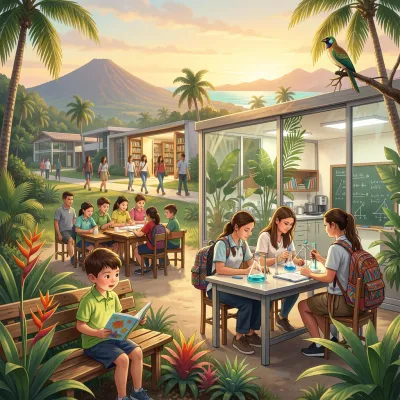
Costa Rica's educational system stands as a cornerstone of the nation's identity, deeply intertwined with its historical commitment to peace, democracy, and social progress. Since abolishing its military in 1948, the country has channeled significant resources into public education, establishing a constitutional mandate for free and compulsory schooling from early childhood through secondary levels. The system is structured into preschool, primary, and secondary cycles, with higher education provided by both public universities and private institutions. Governance is centralized under the Ministry of Public Education (MEP), though regional directorates ensure local implementation, while quality assurance is maintained through accreditation bodies like SINAES.
The educational philosophy emphasizes humanistic values, equity, environmental stewardship, and holistic development. Early childhood programs focus on play-based learning, while primary and secondary curricula integrate core subjects with arts, physical education, and increasingly, technology and bilingual instruction in English. Technical and vocational pathways offer practical training aligned with labor market needs. Special and inclusive education policies aim to integrate students with diverse needs into mainstream classrooms through individualized support. Challenges remain in addressing urban-rural disparities, dropout rates, and ensuring consistent funding, despite a constitutional goal of allocating 8% of GDP to education.
Higher education thrives through prestigious public universities that drive research and innovation, particularly in sustainability, technology, and social sciences, alongside a growing private sector. International cooperation has bolstered reforms in teacher training, curriculum development, and digital integration. Overall, Costa Rica's investment in education has yielded high literacy rates, strong democratic engagement, environmental consciousness, and economic diversification, solidifying its reputation as a regional leader in human development and a model for leveraging education as a transformative force for national prosperity.
What You'll Find Inside:
- Traces the unique historical development of Costa Rica's education system, highlighting how the 1948 abolition of the military redirected national resources toward universal, free, and compulsory public education.
- Explores the comprehensive structure of education from early childhood (cunas, guarderías, kindergartens) through primary, secondary (academic and technical/vocational tracks), and higher education (public and private universities and technical institutes).
- Examines key philosophical commitments including humanistic, peace-oriented, and equity-focused goals, with strong emphasis on environmental sustainability, integral student development, and cultural identity.
- Details governance and quality assurance mechanisms, including the roles of the Ministry of Public Education (MEP), SINAES accreditation, CONESUP oversight, and constitutional mandates for educational funding (8% of GDP target).
- Addresses pressing challenges and innovations such as urban-rural disparities, inclusive and special education, bilingual (Spanish-English and indigenous languages) education, technology integration, indigenous cultural preservation, and ongoing curriculum reforms for 21st-century skills.
Who's It For:
This book is ideal for educators, education policymakers, researchers, and students of comparative education interested in Latin American development models. It is particularly valuable for those studying how sustained investment in public education—especially in contexts prioritizing peace and social welfare over military spending—can drive national development, equity, and environmental stewardship. International development professionals and NGOs working in education policy or cooperation in Central America will also find it highly relevant.
Author:
Published By:
Date Published:
June 20, 2026
Type:
Nonfiction
Language:
English
Word Count:
41,477 words
Reading Time:
2 hours 54 minutes
Sample:
MixCache.com Total Access
Get unlimited access to this book + all books published by MixCache.com for $11.99/month
Subscribe to MTAOr purchase this book individually below
Order:
Buy the Education In Costa Rica ebook on MixCache.com:
Buy Now
Full ebook will be available immediately
- read online or download as a PDF file.
$5 account credit for all new MixCache.com accounts, usable toward any ebook purchase!*




Ratings & Reviews
Ask Questions About This Book
Have a question about the content? Ask our AI assistant!
Start by asking a question about "Education In Costa Rica"
Example: "Does this book mention William Shakespeare?"
Thinking...