
Browse by Category
Fiction
- Action & Adventure
- African American
- Anthologies
- Children's Fiction
- Classics
- Comics & Graphic Novels
- Coming of Age
- Contemporary
- Cultural & Regional
- Drama
- Erotica
- Fantasy
- General
- Historical Fiction
- Horror
- Humor & Satire
- Literary Fiction
- Mystery, Thriller & Suspense
- Poetry
- Religious & Inspirational
- Romance
- Science Fiction
- Short Stories
- War & Military
- Westerns
- Women's Fiction
- Young Adult
Non-Fiction
- Antiques & Collectibles
- Arts & Photography
- Biographies & Memoirs
- Business & Money
- Children's Non-Fiction
-
Computers & Technology
- Artificial Intelligence
- Computer Science
- Cybersecurity & Cryptography
- Data Science & Analytics
- Databases & Big Data
- Game Development & Design
- General
- Hardware & DIY
- Mobile App Development
- Networking & Cloud Computing
- Operating Systems
- Programming
- Robotics
- Software
- Software Engineering
- User Experience (UX) & Design
- Web Development & Design
- Cooking, Food & Wine
- Crafts, Hobbies & Home
- Education & Teaching
- Engineering
- General
- Health, Fitness & Dieting
-
History
- African History
- African History - North Africa
- African History - Sub-Saharan Africa
- American History
- American History - 20th Century
- American History - Civil War
- American History - Colonial Period
- Ancient History
- Asian History
- Asian History - China
- Asian History - India
- Asian History - Japan
- Asian History - Southeast Asia
- European History
- European History - Ancient Greece
- European History - Ancient Rome
- European History - Medieval
- European History - Modern
- European History - Renaissance
- General
- Middle Eastern History
- Military History
- Military History - Aviation
- Military History - Naval
- Social & Cultural History
- World History
- Humor & Entertainment
- Industrial Technology
- Language Learning
- Law
- LGBTQ+ Non-Fiction
- Literary Criticism
- Medical Books
- Parenting & Relationships
- Philosophy
- Politics & Social Sciences
- Reference
- Religion & Spirituality
-
Science & Math
- Agricultural Sciences
- Astronomy & Space Science
- Behavioral Sciences
- Biological Sciences
- Botany & Plant Science
- Chemistry
- Earth Sciences
- Engineering - Chemical
- Engineering - Civil
- Engineering - Electrical
- Engineering - Mechanical
- Environment
- General
- Geology
- Mathematics
- Nature & Ecology
- Oceanography
- Paleontology
- Physics
- Statistics
- Self-Help
- Sports & Outdoors
- Study Aids
- Sustainability & Green Living
- Textbooks
- Transportation
- Travel
- True Crime
- Urban Planning & Development
- Veterinary Medicine
- Writing & Publishing
Jump to Section
MixCache.com Total Access
Unlimited reading and audiobooks for every book published by MixCache.com.
Included titles carry the MTA badge.
Learn more →
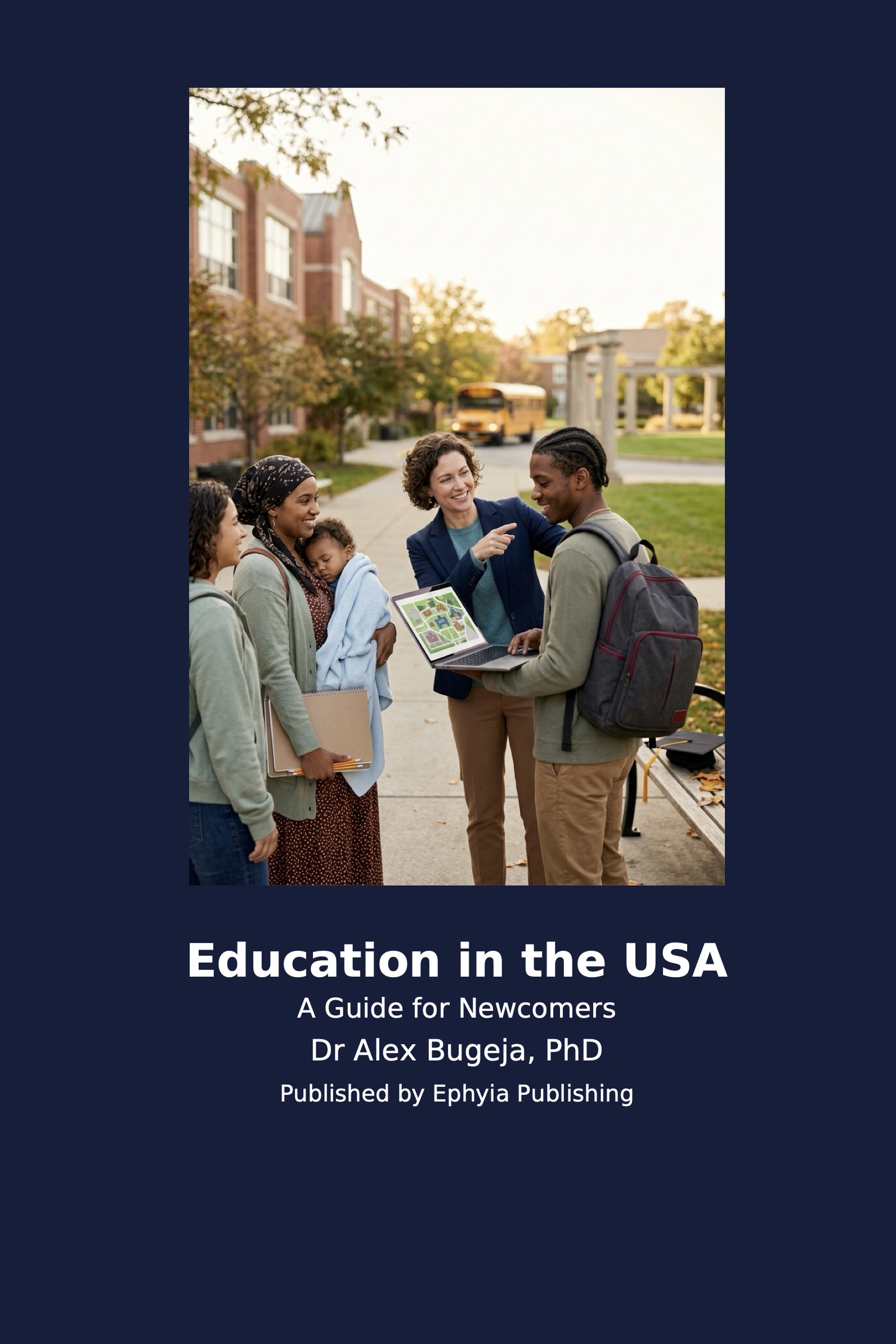
Education in the USA
A Guide for Newcomers
About this book:

# Education in the USA: A Guide for Newcomers
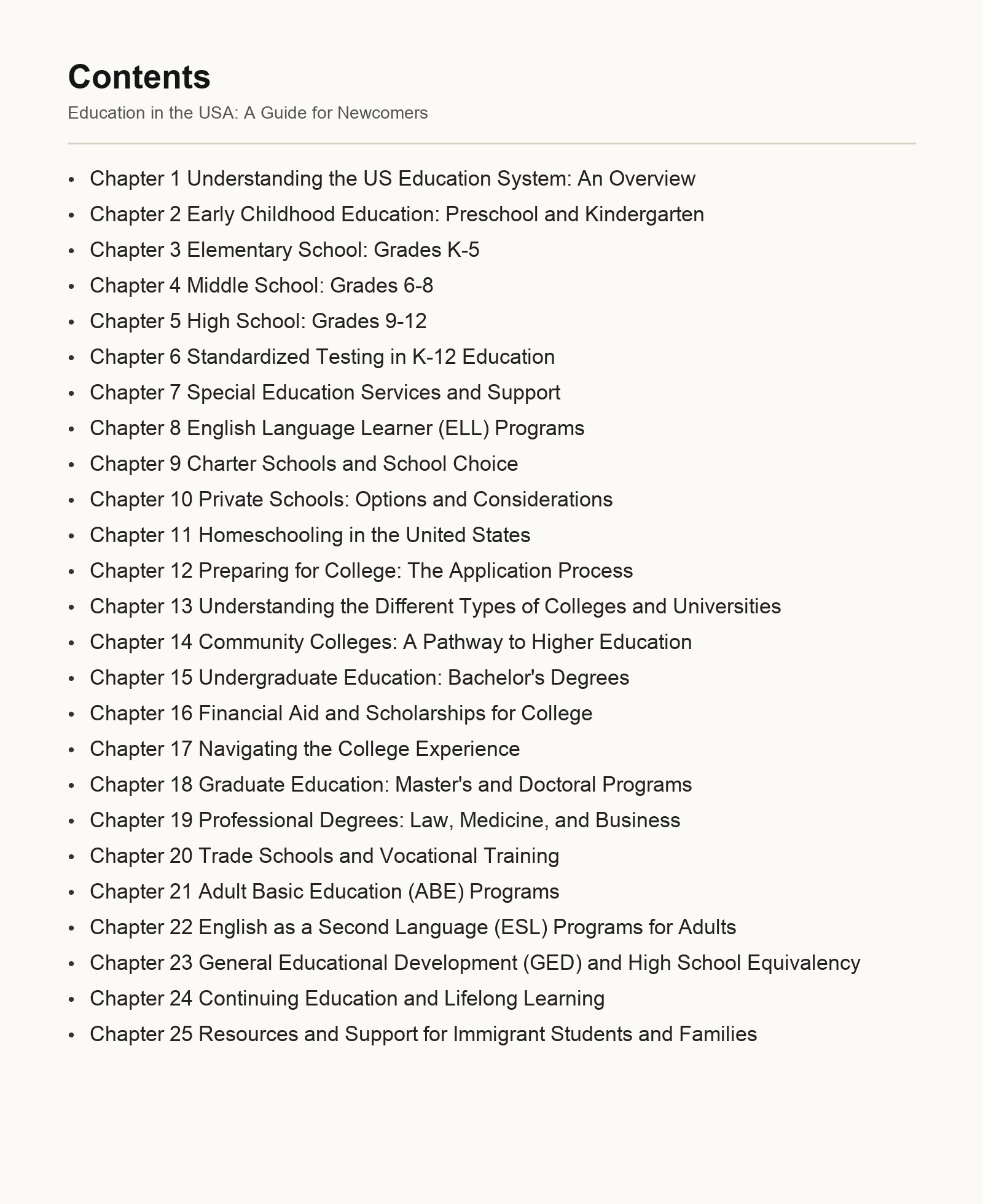
This book provides a comprehensive overview of the American education system, tailored for newcomers navigating its complexities. It begins by emphasizing the decentralized nature of U.S. education, where local school districts manage day-to-day operations under state oversight rather than a centralized national system. The structure progresses through key stages: early childhood education (preschool, kindergarten), elementary school (K-5), middle school (6-8), and high school (9-12), each with distinct academic and social transitions. The system prioritizes holistic development through extracurriculars and electives, alongside core subjects like English, math, science, and social studies. Standardized testing, special education services (IDEA), and ELL programs are integral, ensuring access and support for diverse learners. School choice options include traditional public schools, charter schools, magnet schools, private schools, and homeschooling, offering families varied pathways aligned with their values and goals.
Higher education in the U.S. spans community colleges (two-year institutions offering affordable, open-access pathways), public and private four-year universities, and specialized professional schools (law, medicine, business). Students typically earn credits to fulfill graduation requirements, with the option to transfer from community colleges to four-year institutions. Financial aid is crucial, primarily through the FAFSA form, enabling access via grants, scholarships, and loans. Graduate education includes master’s and doctoral programs, emphasizing specialized expertise (M.A./M.S.) or research (Ph.D.), alongside professional degrees. Trade schools and vocational training provide practical, hands-on skills through certificates, associate degrees, or apprenticeships, with career-focused programs in healthcare, technology, and skilled trades. Adult education programs such as Adult Basic Education (ABE), ESL for non-native speakers, and High School Equivalency (GED/HiSET) credentials support lifelong learning and skill development, while continuing education through community colleges and online platforms fosters professional growth.
The book concludes by emphasizing resources tailored for immigrant families, including legal protections (Plyler v. Doe, IDEA, and FERPA ensuring educational access and privacy), culturally sensitive support from ESL teachers, school counselors, and parent liaisons, and external advocacy from organizations like Colorín Colorado and TheDream.US. It underscores the importance of navigating systems like FAFSA and leveraging community-based organizations to access financial aid, mental health services, and parental engagement tools. By highlighting the interplay of structure, choice, and support, the text positions education as a pathway to empowerment, adaptability, and long-term success in the U.S., recognizing the unique challenges faced by newcomers.
What You'll Find Inside:
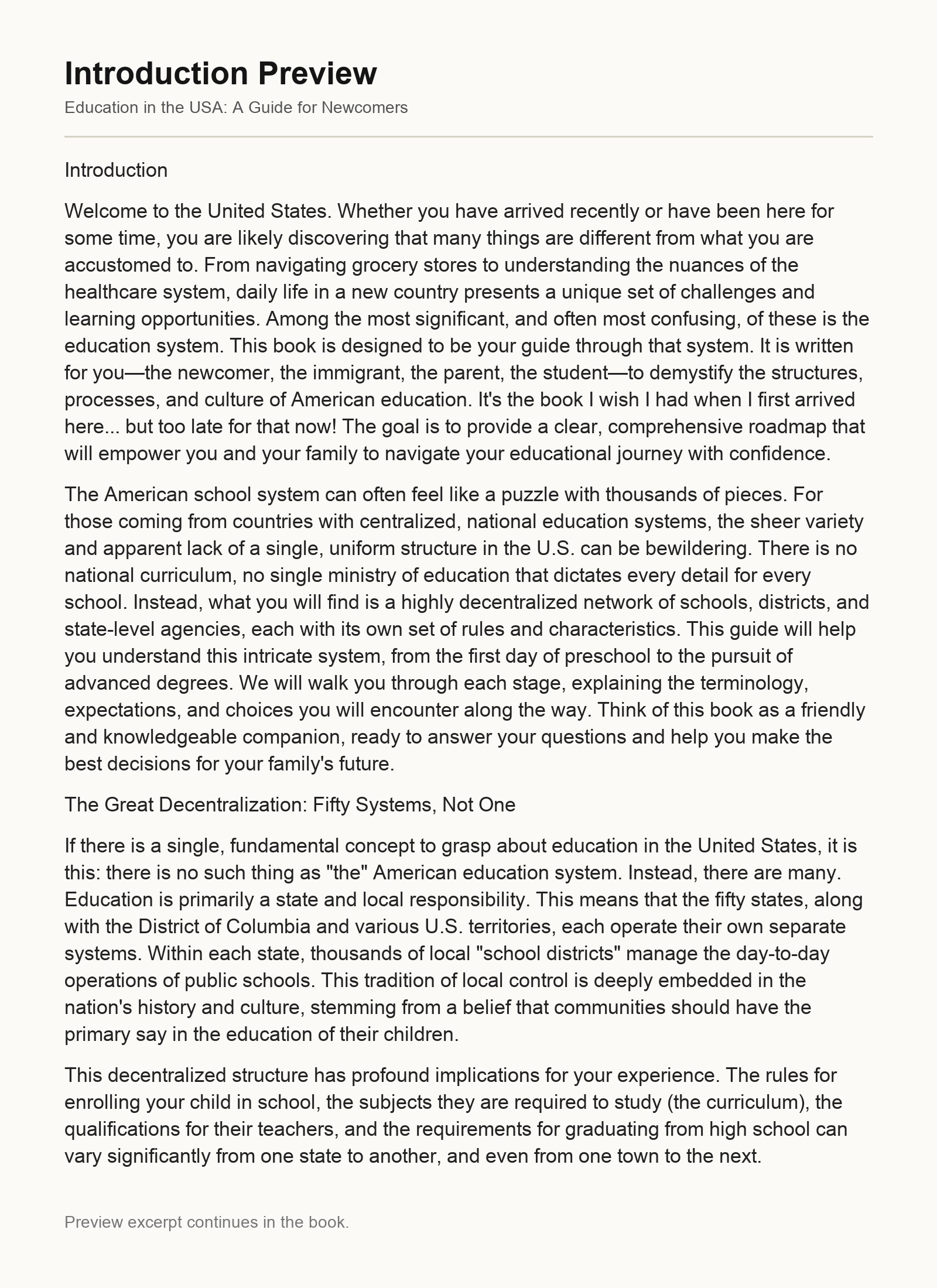
- The US education system is highly decentralized, with no single national curriculum; rules for enrollment, curriculum, and graduation vary significantly by state and local school district.
- American education emphasizes creating 'well-rounded' students through a broad curriculum that includes core academics, arts, physical education, and highly valued extracurricular activities.
- Multiple school options exist beyond traditional public schools, including charter schools (publicly funded but independently run), private schools (tuition-based), and homeschooling (legal in all 50 states).
- A comprehensive support structure is in place for diverse learners, including Special Education services (mandated by IDEA), English Language Learner (ELL) programs, and Gifted and Talented education.
- Pathways to higher education are varied and accessible, ranging from four-year universities and community colleges to trade schools, with a complex but navigable system of financial aid and scholarships available to help manage costs.
Who's It For:
This book is an essential guide for newcomers to the United States, including immigrants, refugees, and their families, who need to understand the structure and culture of the American education system. It is also an invaluable resource for parents and students navigating K-12 schooling, standardized testing, and the college application process. Additionally, adult learners seeking information on English as a Second Language (ESL), high school equivalency (GED), or vocational training will find practical and empowering information within these pages.
Author:
Published By:
Date Published:
May 26, 2026
Type:
Nonfiction
Language:
English
Also Available In:
Word Count:
66,501 words
Reading Time:
4 hours 39 minutes
Sample:
Order:
Buy the Education in the USA ebook on MixCache.com:
Buy NowThe full ebook will be available immediately to read instantly on any device.
$5 account credit for all new MixCache.com accounts, usable toward any ebook purchase!*




Ratings & Reviews
Ask Questions About This Book
Have a question about the content? Ask our AI assistant!
Start by asking a question about "Education in the USA"
Example: "Does this book mention William Shakespeare?"
Thinking...