
Browse by Category
Fiction
- Action & Adventure
- African American
- Anthologies
- Children's Fiction
- Classics
- Comics & Graphic Novels
- Coming of Age
- Contemporary
- Cultural & Regional
- Drama
- Erotica
- Fantasy
- General
- Historical Fiction
- Horror
- Humor & Satire
- Literary Fiction
- Mystery, Thriller & Suspense
- Poetry
- Religious & Inspirational
- Romance
- Science Fiction
- Short Stories
- War & Military
- Westerns
- Women's Fiction
- Young Adult
Non-Fiction
- Antiques & Collectibles
- Arts & Photography
- Biographies & Memoirs
- Business & Money
- Children's Non-Fiction
-
Computers & Technology
- Artificial Intelligence
- Computer Science
- Cybersecurity & Cryptography
- Data Science & Analytics
- Databases & Big Data
- Game Development & Design
- General
- Hardware & DIY
- Mobile App Development
- Networking & Cloud Computing
- Operating Systems
- Programming
- Robotics
- Software
- Software Engineering
- User Experience (UX) & Design
- Web Development & Design
- Cooking, Food & Wine
- Crafts, Hobbies & Home
- Education & Teaching
- Engineering
- General
- Health, Fitness & Dieting
-
History
- African History
- African History - North Africa
- African History - Sub-Saharan Africa
- American History
- American History - 20th Century
- American History - Civil War
- American History - Colonial Period
- Ancient History
- Asian History
- Asian History - China
- Asian History - India
- Asian History - Japan
- Asian History - Southeast Asia
- European History
- European History - Ancient Greece
- European History - Ancient Rome
- European History - Medieval
- European History - Modern
- European History - Renaissance
- General
- Middle Eastern History
- Military History
- Military History - Aviation
- Military History - Naval
- Social & Cultural History
- World History
- Humor & Entertainment
- Industrial Technology
- Language Learning
- Law
- LGBTQ+ Non-Fiction
- Literary Criticism
- Medical Books
- Parenting & Relationships
- Philosophy
- Politics & Social Sciences
- Reference
- Religion & Spirituality
-
Science & Math
- Agricultural Sciences
- Astronomy & Space Science
- Behavioral Sciences
- Biological Sciences
- Botany & Plant Science
- Chemistry
- Earth Sciences
- Engineering - Chemical
- Engineering - Civil
- Engineering - Electrical
- Engineering - Mechanical
- Environment
- General
- Geology
- Mathematics
- Nature & Ecology
- Oceanography
- Paleontology
- Physics
- Statistics
- Self-Help
- Sports & Outdoors
- Study Aids
- Sustainability & Green Living
- Textbooks
- Transportation
- Travel
- True Crime
- Urban Planning & Development
- Veterinary Medicine
- Writing & Publishing
Jump to Section

Want unlimited access to all books published by MixCache.com (plus their audiobooks)? Try MixCache.com Total Access. Look for the MTA badge on book covers to identify included titles.
Access to infinite ebooks: Don't see the book you want? Suggest it and we'll create it (free!) for you from scratch with our powerful AI book writer. Then read it with MTA - besides profiting from any sales it makes!
Education In Cape Verde
MTA
A Comprehensive Overview from Early Childhood to Higher Education
About this book:
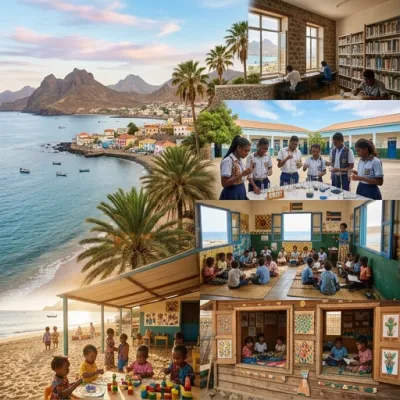
Education in Cape Verde has evolved from limited, Eurocentric colonial provisions to a post‑independence system that prioritizes universal access and human‑capital development. Early formal schooling began with Portuguese‑run institutions in the 19th century, but literacy remained low until the mid‑20th century. After independence in 1975, the government extended primary education from four to six years, expanded secondary schooling, and created teacher‑training institutes that later became the Instituto Superior de Educação. Higher education emerged only after 2000, with the public University of Cape Verde (formed in 2006) and several private universities now offering undergraduate and postgraduate programs. Technical and Vocational Education and Training (TVET) has been emphasized throughout to meet labor‑market needs, especially in tourism, construction, fisheries, and ICT.
The Cape Verdean educational system is centralized under the Ministry of Education and Sports, which sets national curricula, standards, and oversees public institutions from early childhood (creches and preschools) through primary (Ensino Básico, six years, compulsory), secondary (Ensino Secundário, six years, compulsory with a unified first cycle and a second cycle offering general or vocational tracks), TVET, and higher education (university and polytechnic branches). Portuguese is the official language of instruction, though efforts to integrate Cape Verdean Creole through bilingual models are ongoing. Assessment relies on formative classroom checks and national examinations at the end of primary and secondary education, with the Higher Education Regulatory Agency (ARES) ensuring tertiary quality. Funding comes principally from the national budget, supplemented by international aid, private contributions, and tuition fees, while equity initiatives target geographical, socio‑economic, gender, disability, and language barriers through community schools, scholarships, infrastructure upgrades, teacher incentives, and distance learning.
Persistent challenges include the archipelago’s dispersed geography, limited fiscal space, teacher retention in remote areas, the language gap between Creole‑speaking learners and Portuguese instruction, youth unemployment, and brain drain of skilled graduates and educators. Opportunities lie in expanding digital connectivity and e‑learning, strengthening TVET‑industry linkages, leveraging the diaspora for knowledge transfer and investment, promoting inclusive and multicultural curricula, advancing adult education and lifelong learning, and deepening international cooperation for capacity building. Future strategic directions emphasize quality improvement, teacher professional development, technology integration, curriculum reform toward 21st‑century skills, enhanced education‑employment alignment, inclusive practices for special needs, and robust governance to ensure transparency, accountability, and responsiveness to national development goals.
What You'll Find Inside:
- Explores the historical evolution of Cape Verdean education, from colonial foundations to post-independence reforms aimed at universal access and curriculum expansion.
- Outlines the structure of the educational system, including early childhood, primary, secondary, vocational tracks, and higher education institutions like Uni-CV and UniPiaget.
- Addresses persistent challenges in access and equity, particularly in rural and remote islands, alongside strategies like community schools and financial support programs.
- Examines the integration of technology and bilingual education efforts, focusing on balancing Portuguese instruction with Cape Verdean Creole to enhance learning inclusivity.
- Analyzes the impact of migration and international cooperation on educational development, including brain drain concerns and partnerships with organizations like UNICEF and the Global Partnership for Education.
Who's It For:
This book is essential for policymakers, educators, and researchers interested in educational systems of small island developing states or African nations. It offers a comprehensive analysis of Cape Verde's educational landscape, from early childhood to higher learning, with insights into challenges like equity, technology integration, and migration impacts. The content benefits stakeholders seeking to understand or replicate successful strategies for equitable, culturally relevant education in diverse contexts.
Author:
Published By:
Date Published:
June 20, 2026
Type:
Nonfiction
Language:
English
Word Count:
40,833 words
Reading Time:
2 hours 52 minutes
Sample:
MixCache.com Total Access
Get unlimited access to this book + all books published by MixCache.com for $11.99/month
Subscribe to MTAOr purchase this book individually below
Order:
Buy the Education In Cape Verde ebook on MixCache.com:
Buy Now
Full ebook will be available immediately
- read online or download as a PDF file.
$5 account credit for all new MixCache.com accounts, usable toward any ebook purchase!*



Ratings & Reviews
Ask Questions About This Book
Have a question about the content? Ask our AI assistant!
Start by asking a question about "Education In Cape Verde"
Example: "Does this book mention William Shakespeare?"
Thinking...