Browse by Category
Fiction
- Action & Adventure
- African American
- Anthologies
- Children's Fiction
- Classics
- Comics & Graphic Novels
- Coming of Age
- Contemporary
- Cultural & Regional
- Drama
- Erotica
- Fantasy
- General
- Historical Fiction
- Horror
- Humor & Satire
- Literary Fiction
- Mystery, Thriller & Suspense
- Poetry
- Religious & Inspirational
- Romance
- Science Fiction
- Short Stories
- War & Military
- Westerns
- Women's Fiction
- Young Adult
Non-Fiction
- Antiques & Collectibles
- Arts & Photography
- Biographies & Memoirs
- Business & Money
- Children's Non-Fiction
-
Computers & Technology
- Artificial Intelligence
- Computer Science
- Cybersecurity & Cryptography
- Data Science & Analytics
- Databases & Big Data
- Game Development & Design
- General
- Hardware & DIY
- Mobile App Development
- Networking & Cloud Computing
- Operating Systems
- Programming
- Robotics
- Software
- Software Engineering
- User Experience (UX) & Design
- Web Development & Design
- Cooking, Food & Wine
- Crafts, Hobbies & Home
- Education & Teaching
- Engineering
- General
- Health, Fitness & Dieting
-
History
- African History
- African History - North Africa
- African History - Sub-Saharan Africa
- American History
- American History - 20th Century
- American History - Civil War
- American History - Colonial Period
- Ancient History
- Asian History
- Asian History - China
- Asian History - India
- Asian History - Japan
- Asian History - Southeast Asia
- European History
- European History - Ancient Greece
- European History - Ancient Rome
- European History - Medieval
- European History - Modern
- European History - Renaissance
- General
- Middle Eastern History
- Military History
- Military History - Aviation
- Military History - Naval
- Social & Cultural History
- World History
- Humor & Entertainment
- Industrial Technology
- Language Learning
- Law
- LGBTQ+ Non-Fiction
- Literary Criticism
- Medical Books
- Parenting & Relationships
- Philosophy
- Politics & Social Sciences
- Reference
- Religion & Spirituality
-
Science & Math
- Agricultural Sciences
- Astronomy & Space Science
- Behavioral Sciences
- Biological Sciences
- Botany & Plant Science
- Chemistry
- Earth Sciences
- Engineering - Chemical
- Engineering - Civil
- Engineering - Electrical
- Engineering - Mechanical
- Environment
- General
- Geology
- Mathematics
- Nature & Ecology
- Oceanography
- Paleontology
- Physics
- Statistics
- Self-Help
- Sports & Outdoors
- Study Aids
- Sustainability & Green Living
- Textbooks
- Transportation
- Travel
- True Crime
- Urban Planning & Development
- Veterinary Medicine
- Writing & Publishing
Jump to Section

Want unlimited access to all books published by MixCache.com (plus their audiobooks)? Try MixCache.com Total Access. Look for the MTA badge on book covers to identify included titles.
Access to infinite ebooks: Don't see the book you want? Suggest it and we'll create it (free!) for you from scratch with our powerful AI book writer. Then read it with MTA - besides profiting from any sales it makes!
Education In Burkina Faso
MTA
A Comprehensive Overview from Early Childhood to Higher Education
About this book:
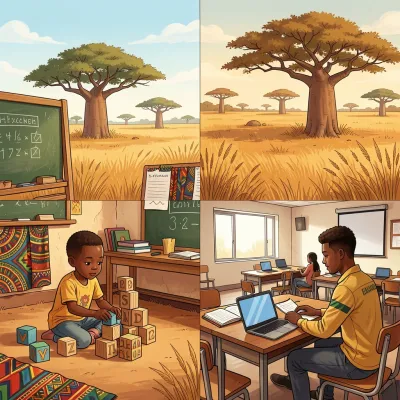
Burkina Faso’s education system has evolved from indigenous, community-based learning rooted in oral traditions, apprenticeships, and moral instruction into a formal system shaped by French colonial rule and post-independence nation-building. Colonial education was limited, elitist, and French-centered, leaving a legacy of language barriers, urban concentration, and uneven access. Since independence, successive governments have expanded schooling, promoted literacy, and attempted to make curricula more relevant to Burkinabé society, with major efforts under Thomas Sankara and through later national education plans.
The system spans early childhood education, six years of compulsory primary education, lower and upper secondary education, vocational and technical training, higher education, and non-formal adult learning. Primary education remains the foundation, but challenges in enrollment, retention, and completion persist, especially for girls, rural children, poor families, and children with disabilities. Secondary education offers general and technical pathways, while vocational training is increasingly seen as essential for youth employment and economic diversification. Higher education, centered on universities and specialized Grandes Écoles, plays a key role in professional training, research, and innovation, though it faces overcrowding, funding constraints, and access inequalities.
Across all levels, Burkina Faso’s education sector confronts deep disparities linked to poverty, geography, gender, language, disability, and insecurity. Rural students often have fewer schools, less qualified teachers, weaker infrastructure, and greater language barriers than urban students. French remains the dominant language of instruction, despite growing support for mother-tongue and multilingual education. Gender inequality, early marriage, school fees, inadequate sanitation, and cultural expectations continue to affect girls’ participation. The ongoing security crisis has intensified these challenges, closing thousands of schools, displacing students and teachers, and forcing reliance on radio education, temporary learning spaces, and emergency support.
The book emphasizes that improving education in Burkina Faso requires coordinated action by government, international partners, NGOs, communities, teachers, and families. Key priorities include expanding early childhood and secondary education, strengthening teacher training, improving curricula, investing in vocational and technical education, promoting national languages, integrating technology, supporting adult literacy, and building inclusive systems for marginalized learners. Future progress depends on increased domestic funding, better governance, stronger quality assurance, resilient education in emergencies, and sustained commitment to equity so that education can fulfill its role as a foundation for national development, peace, and human empowerment.
What You'll Find Inside:
- Trace the historical evolution of education in Burkina Faso from indigenous learning traditions through colonial influence and post-independence reforms.
- Understand the structure of the Burkinabé education system, from early childhood and primary schooling to secondary, vocational, and higher education.
- Explore major challenges affecting access, retention, completion, and quality, including poverty, rural-urban disparities, gender gaps, language barriers, and conflict.
- Learn how government policy, international aid, NGOs, and community participation shape education development across the country.
- Review future priorities and recommendations, including teacher training, technology integration, inclusive education, research, and education in emergencies.
Who's It For:
This book is especially valuable for policymakers, educators, researchers, development practitioners, and students focused on education in Burkina Faso or West Africa. It is also useful for NGO professionals, international aid organizations, and anyone interested in educational equity, curriculum reform, vocational training, or education in conflict-affected settings.
Author:
Published By:
Date Published:
June 19, 2026
Type:
Nonfiction
Language:
English
Word Count:
45,579 words
Reading Time:
3 hours 12 minutes
Sample:
Order:
Order Education In Burkina Faso (Paperback) on MixCache.com:
Buy NowPrint copy is made to order and ships worldwide. Includes the ebook free, ready to read instantly.
$5 account credit for all new MixCache.com accounts, usable toward any ebook purchase!*