Browse by Category
Fiction
- Action & Adventure
- African American
- Anthologies
- Children's Fiction
- Classics
- Comics & Graphic Novels
- Coming of Age
- Contemporary
- Cultural & Regional
- Drama
- Erotica
- Fantasy
- General
- Historical Fiction
- Horror
- Humor & Satire
- Literary Fiction
- Mystery, Thriller & Suspense
- Poetry
- Religious & Inspirational
- Romance
- Science Fiction
- Short Stories
- War & Military
- Westerns
- Women's Fiction
- Young Adult
Non-Fiction
- Antiques & Collectibles
- Arts & Photography
- Biographies & Memoirs
- Business & Money
- Children's Non-Fiction
-
Computers & Technology
- Artificial Intelligence
- Computer Science
- Cybersecurity & Cryptography
- Data Science & Analytics
- Databases & Big Data
- Game Development & Design
- General
- Hardware & DIY
- Mobile App Development
- Networking & Cloud Computing
- Operating Systems
- Programming
- Robotics
- Software
- Software Engineering
- User Experience (UX) & Design
- Web Development & Design
- Cooking, Food & Wine
- Crafts, Hobbies & Home
- Education & Teaching
- Engineering
- General
- Health, Fitness & Dieting
-
History
- African History
- African History - North Africa
- African History - Sub-Saharan Africa
- American History
- American History - 20th Century
- American History - Civil War
- American History - Colonial Period
- Ancient History
- Asian History
- Asian History - China
- Asian History - India
- Asian History - Japan
- Asian History - Southeast Asia
- European History
- European History - Ancient Greece
- European History - Ancient Rome
- European History - Medieval
- European History - Modern
- European History - Renaissance
- General
- Middle Eastern History
- Military History
- Military History - Aviation
- Military History - Naval
- Social & Cultural History
- World History
- Humor & Entertainment
- Industrial Technology
- Language Learning
- Law
- LGBTQ+ Non-Fiction
- Literary Criticism
- Medical Books
- Parenting & Relationships
- Philosophy
- Politics & Social Sciences
- Reference
- Religion & Spirituality
-
Science & Math
- Agricultural Sciences
- Astronomy & Space Science
- Behavioral Sciences
- Biological Sciences
- Botany & Plant Science
- Chemistry
- Earth Sciences
- Engineering - Chemical
- Engineering - Civil
- Engineering - Electrical
- Engineering - Mechanical
- Environment
- General
- Geology
- Mathematics
- Nature & Ecology
- Oceanography
- Paleontology
- Physics
- Statistics
- Self-Help
- Sports & Outdoors
- Study Aids
- Sustainability & Green Living
- Textbooks
- Transportation
- Travel
- True Crime
- Urban Planning & Development
- Veterinary Medicine
- Writing & Publishing
Jump to Section

Want unlimited access to all books published by MixCache.com (plus their audiobooks)? Try MixCache.com Total Access. Look for the MTA badge on book covers to identify included titles.
Access to infinite ebooks: Don't see the book you want? Suggest it and we'll create it (free!) for you from scratch with our powerful AI book writer. Then read it with MTA - besides profiting from any sales it makes!
Education In Algeria
MTA
A Comprehensive Overview from Early Childhood to Higher Education
About this book:
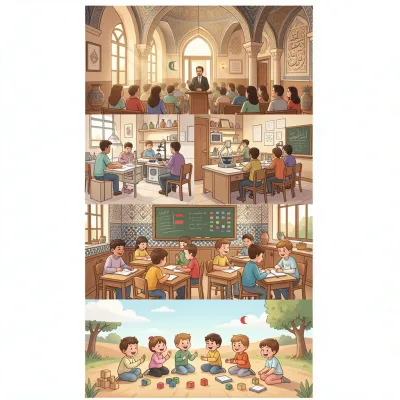
Education in Algeria has evolved from a rich Islamic scholarly tradition suppressed during French colonial rule to a centralized, state‑funded system prioritizing national identity and universal access after independence in 1962. The post‑independence government launched an aggressive Arabization policy, made education free and compulsory, and invested heavily in expanding schools and universities, laying the foundation for a system overseen by the Ministry of National Education for pre‑university levels and the Ministry of Higher Education and Scientific Research for tertiary education. This structure features a hierarchical governance model with national ministries setting policy, provincial directorates implementing it, and individual schools managing daily operations, all while striving to balance uniformity with local needs.
Early childhood education, delivered through public and private nurseries and kindergartens, prepares children for primary school, which spans five years and emphasizes Arabic language, mathematics, Islamic education, scientific awareness, social studies, and the introduction of French as a foreign language. Secondary education follows three years of basic education and offers scientific, literary, and technical streams culminating in the high‑stakes Baccalauréat examination, the primary gateway to public higher education. Parallel to the academic track, Technical and Vocational Education and Training (TVET) provides hands‑on training in sectors such as construction, manufacturing, ICT, and hospitality, closely aligned with industry needs and increasingly incorporating digital skills and work‑based learning.
Higher education adopts the LMD (Licence‑Master‑Doctorat) framework, offering a wide array of disciplines in universities, university centers, and selective Grandes Écoles, with Arabic as the main language of instruction in humanities and French dominating scientific, technical, and medical fields. Access is determined chiefly by Baccalauréat scores through a centralized online application, supplemented by scholarships and social support to promote equity. Undergraduate programs focus on foundational knowledge and practical skills, while postgraduate studies emphasize research, producing Master’s theses and doctoral dissertations that contribute to national R&D priorities in areas like renewable energy, biotechnology, and public health. Quality assurance is enforced via school inspectorates and the National Commission for Evaluation and Accreditation of Higher Education Institutions, and technology integration—from digital labs to e‑learning platforms—is expanding despite urban‑rural disparities. Persistent challenges include overcrowding, resource gaps, teacher distribution, curriculum relevance, graduate employability, and dependence on hydrocarbon revenues, yet ongoing reforms target digital transformation, industry‑academia partnerships, inclusive education, regional equity, diversified financing, and international cooperation to enhance global competitiveness and prepare a skilled, multilingual populace for future development.
What You'll Find Inside:
- A complete historical overview of Algerian education from indigenous Islamic scholarship through French colonial rule to post-independence Arabization and modernization efforts.
- Detailed analysis of the educational system's structure across all levels - early childhood, primary, secondary, technical/vocational, and higher education - including governance, curriculum, and language policies.
- Critical examination of persistent challenges including rural-urban disparities, graduate employability, linguistic duality, and the need for systemic reforms to improve quality.
- Exploration of technological integration, international partnerships, and innovative approaches shaping Algeria's educational future in a globalized context.
- Comprehensive coverage of specialized areas including teacher training, inclusive education for special needs, private education growth, and research development in higher education.
Who's It For:
This book is essential reading for education policymakers and administrators seeking to understand Algeria's educational landscape for informed decision-making. It will also benefit researchers and academics in comparative education, African studies, and post-colonial analysis who need a comprehensive reference on the system's evolution. Educators and teacher trainers will find valuable insights into curriculum design, language policies, and professional development practices. Additionally, students of education and international development workers focused on the MENA region will gain crucial context for understanding educational challenges and opportunities in Algeria.
Author:
Published By:
Date Published:
June 16, 2026
Type:
Nonfiction
Language:
English
Word Count:
42,724 words
Reading Time:
3 hours
Sample:
Order:
Order Education In Algeria (Hardcover) on MixCache.com:
Buy NowPrint copy is made to order and ships worldwide. Includes the ebook free, ready to read instantly.
$5 account credit for all new MixCache.com accounts, usable toward any ebook purchase!*