
Browse by Category
Fiction
- Action & Adventure
- African American
- Anthologies
- Children's Fiction
- Classics
- Comics & Graphic Novels
- Coming of Age
- Contemporary
- Cultural & Regional
- Drama
- Erotica
- Fantasy
- General
- Historical Fiction
- Horror
- Humor & Satire
- Literary Fiction
- Mystery, Thriller & Suspense
- Poetry
- Religious & Inspirational
- Romance
- Science Fiction
- Short Stories
- War & Military
- Westerns
- Women's Fiction
- Young Adult
Non-Fiction
- Antiques & Collectibles
- Arts & Photography
- Biographies & Memoirs
- Business & Money
- Children's Non-Fiction
-
Computers & Technology
- Artificial Intelligence
- Computer Science
- Cybersecurity & Cryptography
- Data Science & Analytics
- Databases & Big Data
- Game Development & Design
- General
- Hardware & DIY
- Mobile App Development
- Networking & Cloud Computing
- Operating Systems
- Programming
- Robotics
- Software
- Software Engineering
- User Experience (UX) & Design
- Web Development & Design
- Cooking, Food & Wine
- Crafts, Hobbies & Home
- Education & Teaching
- Engineering
- General
- Health, Fitness & Dieting
-
History
- African History
- African History - North Africa
- African History - Sub-Saharan Africa
- American History
- American History - 20th Century
- American History - Civil War
- American History - Colonial Period
- Ancient History
- Asian History
- Asian History - China
- Asian History - India
- Asian History - Japan
- Asian History - Southeast Asia
- European History
- European History - Ancient Greece
- European History - Ancient Rome
- European History - Medieval
- European History - Modern
- European History - Renaissance
- General
- Middle Eastern History
- Military History
- Military History - Aviation
- Military History - Naval
- Social & Cultural History
- World History
- Humor & Entertainment
- Industrial Technology
- Language Learning
- Law
- LGBTQ+ Non-Fiction
- Literary Criticism
- Medical Books
- Parenting & Relationships
- Philosophy
- Politics & Social Sciences
- Reference
- Religion & Spirituality
-
Science & Math
- Agricultural Sciences
- Astronomy & Space Science
- Behavioral Sciences
- Biological Sciences
- Botany & Plant Science
- Chemistry
- Earth Sciences
- Engineering - Chemical
- Engineering - Civil
- Engineering - Electrical
- Engineering - Mechanical
- Environment
- General
- Geology
- Mathematics
- Nature & Ecology
- Oceanography
- Paleontology
- Physics
- Statistics
- Self-Help
- Sports & Outdoors
- Study Aids
- Sustainability & Green Living
- Textbooks
- Transportation
- Travel
- True Crime
- Urban Planning & Development
- Veterinary Medicine
- Writing & Publishing
Jump to Section

Want unlimited access to all books published by MixCache.com (plus their audiobooks)? Try MixCache.com Total Access. Look for the MTA badge on book covers to identify included titles.
Access to infinite ebooks: Don't see the book you want? Suggest it and we'll create it (free!) for you from scratch with our powerful AI book writer. Then read it with MTA - besides profiting from any sales it makes!
Layers of Sofia: Byzantine Churches, Ottoman Markets, and Bulgaria’s Revival
MTA
Sofia’s multi-layered past and its role in Balkan cultural and political history
About this book:
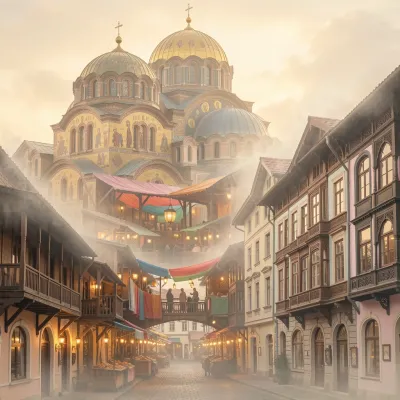
Sofia is presented as a living palimpsest where successive historical strata—Roman Serdica, Byzantine Sredets, Ottoman urbanism, Bulgarian national revival, socialist reconstruction, and post‑1989 liberalization—overlap and interact rather than being erased. The book traces how each period adapted, repurposed, and imbued meaning onto earlier structures, from the conversion of Byzantine basilicas into mosques and the reuse of spolia, to the socialist Largo built atop Roman ruins and the contemporary revival of informal markets echoing Ottoman bazaars. This layered approach reveals a city where continuity and change coexist, and where religious, commercial, and civic spaces constantly negotiate their shared geography.
Through archaeological, architectural, and social lenses, the work examines how Sofia’s sacred topographies (churches, mosques, synagogues) and market ecologies (bezistens, hans, coffeehouses) have shaped its identity. It highlights the persistence of multiconfessional interaction under Ottoman millet governance, the role of guilds and craft traditions in urban sociability, and the ways water management and bath culture linked rituals of cleanliness to commerce and community. The Bulgarian Revival is shown as a pivotal moment when schools, printing, and the Exarchate reoriented loyalties toward a European‑style nation‑state, prompting a capitalscape of boulevards, monuments, and neoclassical architecture that simultaneously asserted Bulgarian heritage and modern aspirations.
The narrative continues into the twentieth century, detailing socialist reconstruction’s ideological imposition of the Largo and panelki housing, the cautious preservation of religious buildings as cultural monuments under state atheism, and the post‑1989 resurgence of private enterprise, malls, and informal bazaars that revived Ottoman‑era market dynamics. Comparative chapters with Thessaloniki and Skopje situate Sofia’s particular blend of Byzantine, Ottoman, and European influences within broader Balkan patterns of imperial governance, nationalist mobilization, and postsocialist transition. Finally, the book addresses contemporary challenges—climate change, tourism pressures, and digital technologies—and proposes strategies for heritage management that respect Sofia’s complex, layered character while ensuring its sustainable future as a living urban palimpsest.
What You'll Find Inside:
- Explore Sofia’s multi-layered history from Roman Serdica through Byzantine Christianity to Ottoman markets and modern transformations, revealing how each era physically and culturally shaped the city.
- Examine Byzantine sacred architecture and its theological significance in stone and pigment, including churches like St. Sofia and St. George, and their role in defining Sofia's identity.
- Understand the Ottoman period's impact on urban planning, commerce, and multiconfessional life through markets, baths, and the Bezisten system, alongside the preservation of Christian and Jewish communities.
- Discover how the Bulgarian National Revival influenced architecture, education, and religious institutions, leading to post-1878 transformations into a modern European capital.
- Learn about contemporary challenges in heritage preservation, tourism, and urban development, including socialist reconstruction's legacy, post-1989 changes, and future threats from climate and digitalization.
Who's It For:
This book is for scholars and practitioners studying Southeastern European urban history, archaeology, and cultural heritage, particularly those interested in interdisciplinary approaches to layered cities. Heritage travelers, urban planners, and architects will benefit from its synthesis of religious architecture, economic geography, and heritage policy, while its practical itineraries offer value for visitors seeking to understand Sofia's complex identity. Researchers in Byzantine studies, Ottoman history, and post-socialist transitions will find comparative insights into how empires and nation-states have shaped Balkan urbanism.
Author:
Published By:
Date Published:
June 11, 2026
Type:
Nonfiction
Language:
English
Word Count:
62,805 words
Reading Time:
4 hours 24 minutes
Sample:
MixCache.com Total Access
Get unlimited access to this book + all books published by MixCache.com for $11.99/month
Subscribe to MTAOr purchase this book individually below
Order:
Buy the Layers of Sofia: Byzantine Churches, Ottoman Markets, and Bulgaria’s Revival ebook on MixCache.com:
Buy Now
Full ebook will be available immediately
- read online or download as a PDF file.
$5 account credit for all new MixCache.com accounts, usable toward any ebook purchase!*



Ratings & Reviews
Ask Questions About This Book
Have a question about the content? Ask our AI assistant!
Start by asking a question about "Layers of Sofia: Byzantine Churches, Ottoman Markets, and Bulgaria’s Revival"
Example: "Does this book mention William Shakespeare?"
Thinking...