
Browse by Category
Fiction
- Action & Adventure
- African American
- Anthologies
- Children's Fiction
- Classics
- Comics & Graphic Novels
- Coming of Age
- Contemporary
- Cultural & Regional
- Drama
- Erotica
- Fantasy
- General
- Historical Fiction
- Horror
- Humor & Satire
- Literary Fiction
- Mystery, Thriller & Suspense
- Poetry
- Religious & Inspirational
- Romance
- Science Fiction
- Short Stories
- War & Military
- Westerns
- Women's Fiction
- Young Adult
Non-Fiction
- Antiques & Collectibles
- Arts & Photography
- Biographies & Memoirs
- Business & Money
- Children's Non-Fiction
-
Computers & Technology
- Artificial Intelligence
- Computer Science
- Cybersecurity & Cryptography
- Data Science & Analytics
- Databases & Big Data
- Game Development & Design
- General
- Hardware & DIY
- Mobile App Development
- Networking & Cloud Computing
- Operating Systems
- Programming
- Robotics
- Software
- Software Engineering
- User Experience (UX) & Design
- Web Development & Design
- Cooking, Food & Wine
- Crafts, Hobbies & Home
- Education & Teaching
- Engineering
- General
- Health, Fitness & Dieting
-
History
- African History
- African History - North Africa
- African History - Sub-Saharan Africa
- American History
- American History - 20th Century
- American History - Civil War
- American History - Colonial Period
- Ancient History
- Asian History
- Asian History - China
- Asian History - India
- Asian History - Japan
- Asian History - Southeast Asia
- European History
- European History - Ancient Greece
- European History - Ancient Rome
- European History - Medieval
- European History - Modern
- European History - Renaissance
- General
- Middle Eastern History
- Military History
- Military History - Aviation
- Military History - Naval
- Social & Cultural History
- World History
- Humor & Entertainment
- Industrial Technology
- Language Learning
- Law
- LGBTQ+ Non-Fiction
- Literary Criticism
- Medical Books
- Parenting & Relationships
- Philosophy
- Politics & Social Sciences
- Reference
- Religion & Spirituality
-
Science & Math
- Agricultural Sciences
- Astronomy & Space Science
- Behavioral Sciences
- Biological Sciences
- Botany & Plant Science
- Chemistry
- Earth Sciences
- Engineering - Chemical
- Engineering - Civil
- Engineering - Electrical
- Engineering - Mechanical
- Environment
- General
- Geology
- Mathematics
- Nature & Ecology
- Oceanography
- Paleontology
- Physics
- Statistics
- Self-Help
- Sports & Outdoors
- Study Aids
- Sustainability & Green Living
- Textbooks
- Transportation
- Travel
- True Crime
- Urban Planning & Development
- Veterinary Medicine
- Writing & Publishing
Jump to Section
MixCache.com Total Access
Unlimited reading and audiobooks for every book published by MixCache.com.
Included titles carry the MTA badge.
Learn more →
Propaganda and the Home Front: Media, Morale, and the Politics of Perception
MTA
How Governments Shape Public Opinion and Sustain Wartime Commitment
About this book:
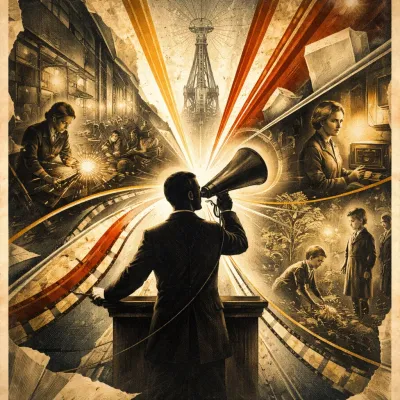
This book, "Propaganda and the Home Front: Media, Morale, and the Politics of Perception," examines how governments throughout history have manipulated public opinion to sustain wartime commitment and control civilian behavior. It argues that the home front is a critical battlespace, where the struggle for hearts and minds is as vital as military engagement. The book defines propaganda not merely as falsehood, but as a spectrum of communication designed to influence interpretation through selective truth-telling, framing, and emotional appeals. It also delineates censorship as the active suppression or controlled circulation of information, working in tandem with propaganda to create a curated information environment.
The study provides a comparative historical analysis, tracing the evolution of information control from ancient inscriptions and early pamphlets to modern digital platforms. It highlights key technological shifts, such as the printing press, radio, cinema, and social media, and how each innovation offered new opportunities and challenges for propagandists. Case studies cover diverse contexts, including democratic nations grappling with freedom and control, totalitarian states employing fear and spectacle, and imperial powers contending with anti-colonial narratives. A central theme is the psychology of morale, exploring how governments cultivate belief in the cause, manage expectations, and encourage sacrifice by tapping into needs for meaning, collective identity, and trust in authority, while also addressing inherent human resistance.
The book delves into specific aspects of home front mobilization, such as the gendered appeals that encouraged women into both factories and domestic roles, and the economic messaging around labor, rationing, and sacrifice that aimed to ensure compliance. It examines how institutions like faith organizations, families, and schools were enlisted as engines of morale and ideological transmission. Furthermore, it explores the dark side of wartime information control, including the scapegoating of domestic enemies, surveillance, and the suppression of dissent. Later chapters address the impact of new media on conflicts, from television's role in the Vietnam War's crisis of credibility to the complexities of counterinsurgency campaigns and the pervasive influence of social media, bots, and algorithmic amplification in contemporary "digital battlegrounds."
Finally, the book considers the enduring legacy of wartime information control, focusing on postwar narratives, memory, and justice. It reveals how wartime propaganda transforms into peacetime mythology, shaping national identity, historical understanding, and the commemoration of conflict. The study emphasizes the continuous struggle between official narratives and independent scrutiny, acknowledging the persistent human capacity for skepticism and the evolving nature of societal resilience against manipulation. Ultimately, "Propaganda and the Home Front" underscores that the politics of perception is not a peripheral concern, but the connective tissue of modern warfare, with profound and lasting consequences for both states and their citizens.
What You'll Find Inside:
- How governments treat the home front as a strategic battlespace where civilian beliefs and behaviors are as crucial as military operations
- The psychological mechanisms behind morale-building and how propaganda manipulates perception through emotional appeals, identity formation, and cognitive biases
- The historical evolution of propaganda techniques from pre-modern pamphlets to digital algorithmic amplification across different media eras
- Comparative analysis of information control strategies in democracies versus totalitarian regimes, highlighting tensions between security and freedom
- The long-term ethical consequences of wartime propaganda, including its impact on collective memory, trust in institutions, and postwar reconciliation efforts
Who's It For:
This book is ideal for students, scholars, and professionals in political science, history, media studies, and international relations who seek to understand how governments shape public opinion during conflicts. It will particularly benefit those interested in the psychology of persuasion, historical case studies of propaganda from WWI to the digital age, and the ethical dilemmas of information control in wartime contexts. Policymakers and communications professionals looking to design resilient information ecosystems or analyze contemporary disinformation campaigns will also find valuable insights.
Table of Contents:
- Introduction
- Chapter 1 The Home Front as a Battlespace
- Chapter 2 Defining Propaganda, Censorship, and Information Control
- Chapter 3 The Psychology of Morale and the Politics of Perception
- Chapter 4 From Pamphlets to Posters: Pre-Modern Roots and Industrial Age Mobilization
- Chapter 5 Newspapers and Nationhood: The Press in Total War
- Chapter 6 World War I: Managing Truth, Rumor, and Dissent
- Chapter 7 Radio Revolutions: Voice, Intimacy, and Authority
- Chapter 8 Cinema and Newsreels: The Spectacle of Unity
- Chapter 9 Totalitarian Toolkits: Germany, Italy, and the Soviet Union
- Chapter 10 Democracies at War: The U.S. and U.K. Between Freedom and Control
- Chapter 11 Empire and Colony: Information Warfare in Imperial and Anti-Colonial Conflicts
- Chapter 12 Domestic Enemies: Scapegoating, Surveillance, and Internal Security
- Chapter 13 Women, Work, and the Hearth: Gendered Appeals on the Home Front
- Chapter 14 Labor, Rationing, and Sacrifice: Economic Messaging and Compliance
- Chapter 15 Faith, Family, and Schools: Institutions as Engines of Morale
- Chapter 16 The Photographic War: Images, Censorship, and Casualty Sensitivity
- Chapter 17 Cold War Consensus: Containment, Culture, and Covert Messaging
- Chapter 18 Television Comes Home: Vietnam and the Crisis of Credibility
- Chapter 19 Insurgency, Counterinsurgency, and Hearts-and-Minds Campaigns
- Chapter 20 Humanitarian Frames and the Politics of Suffering
- Chapter 21 Digital Battlegrounds: Social Media, Bots, and Algorithmic Amplification
- Chapter 22 Diasporas, Exiles, and Transnational Publics
- Chapter 23 Counterpropaganda, Fact-Checking, and Societal Resilience
- Chapter 24 Measuring Effectiveness: Methods, Metrics, and Causal Claims
- Chapter 25 After the Guns Fall Silent: Memory, Justice, and Postwar Narratives
Author:
Published By:
Date Published:
May 13, 2026
Type:
Nonfiction
Language:
English
Word Count:
86,450 words
Reading Time:
6 hours 3 minutes
Sample:
MixCache.com Total Access
Get unlimited access to this book + all books published by MixCache.com for $11.99/month
Subscribe to MTAOr purchase this book individually below
Order:
Buy the Propaganda and the Home Front: Media, Morale, and the Politics of Perception ebook on MixCache.com:
Buy Now
Full ebook will be available immediately
- read online or download as a PDF file.
$5 account credit for all new MixCache.com accounts, usable toward any ebook purchase!*
 Includes Audiobook




Ratings & Reviews
Ask Questions About This Book
Have a question about the content? Ask our AI assistant!
Start by asking a question about "Propaganda and the Home Front: Media, Morale, and the Politics of Perception"
Example: "Does this book mention William Shakespeare?"
Thinking...