
Browse by Category
Fiction
- Action & Adventure
- African American
- Anthologies
- Children's Fiction
- Classics
- Comics & Graphic Novels
- Coming of Age
- Contemporary
- Cultural & Regional
- Drama
- Erotica
- Fantasy
- General
- Historical Fiction
- Horror
- Humor & Satire
- Literary Fiction
- Mystery, Thriller & Suspense
- Poetry
- Religious & Inspirational
- Romance
- Science Fiction
- Short Stories
- War & Military
- Westerns
- Women's Fiction
- Young Adult
Non-Fiction
- Antiques & Collectibles
- Arts & Photography
- Biographies & Memoirs
- Business & Money
- Children's Non-Fiction
-
Computers & Technology
- Artificial Intelligence
- Computer Science
- Cybersecurity & Cryptography
- Data Science & Analytics
- Databases & Big Data
- Game Development & Design
- General
- Hardware & DIY
- Mobile App Development
- Networking & Cloud Computing
- Operating Systems
- Programming
- Robotics
- Software
- Software Engineering
- User Experience (UX) & Design
- Web Development & Design
- Cooking, Food & Wine
- Crafts, Hobbies & Home
- Education & Teaching
- Engineering
- General
- Health, Fitness & Dieting
-
History
- African History
- African History - North Africa
- African History - Sub-Saharan Africa
- American History
- American History - 20th Century
- American History - Civil War
- American History - Colonial Period
- Ancient History
- Asian History
- Asian History - China
- Asian History - India
- Asian History - Japan
- Asian History - Southeast Asia
- European History
- European History - Ancient Greece
- European History - Ancient Rome
- European History - Medieval
- European History - Modern
- European History - Renaissance
- General
- Middle Eastern History
- Military History
- Military History - Aviation
- Military History - Naval
- Social & Cultural History
- World History
- Humor & Entertainment
- Industrial Technology
- Language Learning
- Law
- LGBTQ+ Non-Fiction
- Literary Criticism
- Medical Books
- Parenting & Relationships
- Philosophy
- Politics & Social Sciences
- Reference
- Religion & Spirituality
-
Science & Math
- Agricultural Sciences
- Astronomy & Space Science
- Behavioral Sciences
- Biological Sciences
- Botany & Plant Science
- Chemistry
- Earth Sciences
- Engineering - Chemical
- Engineering - Civil
- Engineering - Electrical
- Engineering - Mechanical
- Environment
- General
- Geology
- Mathematics
- Nature & Ecology
- Oceanography
- Paleontology
- Physics
- Statistics
- Self-Help
- Sports & Outdoors
- Study Aids
- Sustainability & Green Living
- Textbooks
- Transportation
- Travel
- True Crime
- Urban Planning & Development
- Veterinary Medicine
- Writing & Publishing
Jump to Section

Want unlimited access to all books published by MixCache.com (plus their audiobooks)? Try MixCache.com Total Access. Look for the MTA badge on book covers to identify included titles.
Access to infinite ebooks: Don't see the book you want? Suggest it and we'll create it (free!) for you from scratch with our powerful AI book writer. Then read it with MTA - besides profiting from any sales it makes!
Divided City: Berlin between Emperors, Ideologies, and Reunification
MTA
A 20th-century history focusing on division, memory, and urban rebirth in Berlin
About this book:
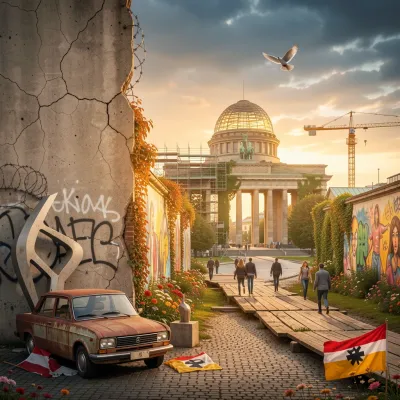
Berlin’s twentieth‑century history is a story of successive regimes attempting to imprint their ideologies onto the city’s urban fabric, only to be continually reshaped by everyday life, protest, and memory. From its imperial rise under the Kaisers—marked by grand boulevards, monuments like the Siegesallee, and the beginnings of the U‑Bahn—to the Weimar Republic’s bold social‑housing experiments and vibrant cultural scene, Berlin oscillated between utopian vision and stark inequality. The Nazi seizure of the city turned planning into a tool of racial engineering, culminating in Albert Speer’s monstrous Germania project, which would have erased entire neighborhoods to erect a colossal, authoritarian capital that never materialized beyond foundations and rubble.
War reduced Berlin to a landscape of ruin, from which the “Trümmerfrauen” cleared debris and laid the groundwork for a divided city administered by the four Allied powers. The ensuing Cold War saw Berlin split into competing showcases: East Berlin’s socialist classicism exemplified by Stalinallee/Karl‑Marx‑Allee and monumental public squares, versus West Berlin’s modernist, open‑space ideals displayed in the Interbau exhibition and the Hansa‑Viertel. The construction of the Berlin Wall in 1961 hardened this division into a fortified border regime, creating a death strip, watchtowers, and countless human tragedies, while simultaneously spurring ingenious escapes and a lasting culture of resistance and memory on both sides.
The fall of the Wall in 1989 and the subsequent decision to reunify Germany with Berlin as its capital initiated a massive process of administrative fusion, economic transformation, and urban renewal. Guided by the doctrine of “critical reconstruction,” planners sought to restore pre‑war block structures and street grids, balancing historical continuity with new demands for government quarters, corporate skylines at Potsdamer Platz, and transparent institutions like the Reichstag’s glass dome. Memory became a central arena of debate, from the preservation of Wall segments and memorials to the Stolpersteine and the contested Humboldt Forum. In the post‑reunification era, Berlin has emerged as a creative, migrant‑laden metropolis—techno clubs, startup hubs, and vibrant multicultural neighborhoods coexist with ongoing struggles over gentrification, sustainability, and the city’s role as a palimpsest where past ideologies and present aspirations continually overwrite one another.
What You'll Find Inside:
- Explores Berlin's transformation from imperial capital through the upheavals of the 20th century, including division, war, and reunification.
- Analyzes the contrasting urban development models of East and West Berlin during the Cold War, highlighting their ideological and architectural differences.
- Examines key historical events such as the Berlin Blockade/Airlift, the construction and fall of the Berlin Wall, and their profound impacts on the city's physical and social fabric.
- Investigates the challenges and processes of reunification, including administrative fusion, critical reconstruction, and the competition between Bonn and Berlin as capital cities.
- Discusses contemporary Berlin's struggle with gentrification, sustainability, and its identity as a creative, migrant metropolis in the 21st century.
Who's It For:
This book is for historians, urban planners, architects, and students of European studies who are interested in Berlin's complex 20th-century history and urban development. It is also suitable for general readers seeking to understand how political ideologies, wars, and division have shaped a major European capital, and how cities rebuild and reinvent themselves after profound trauma and geopolitical shifts.
Author:
Published By:
Date Published:
June 11, 2026
Type:
Nonfiction
Language:
English
Word Count:
63,709 words
Reading Time:
4 hours 28 minutes
Sample:
MixCache.com Total Access
Get unlimited access to this book + all books published by MixCache.com for $11.99/month
Subscribe to MTAOr purchase this book individually below
Order:
Buy the Divided City: Berlin between Emperors, Ideologies, and Reunification ebook on MixCache.com:
Buy Now
Full ebook will be available immediately
- read online or download as a PDF file.
$5 account credit for all new MixCache.com accounts, usable toward any ebook purchase!*





Ratings & Reviews
Ask Questions About This Book
Have a question about the content? Ask our AI assistant!
Start by asking a question about "Divided City: Berlin between Emperors, Ideologies, and Reunification"
Example: "Does this book mention William Shakespeare?"
Thinking...