
Browse by Category
Fiction
- Action & Adventure
- African American
- Anthologies
- Children's Fiction
- Classics
- Comics & Graphic Novels
- Coming of Age
- Contemporary
- Cultural & Regional
- Drama
- Erotica
- Fantasy
- General
- Historical Fiction
- Horror
- Humor & Satire
- Literary Fiction
- Mystery, Thriller & Suspense
- Poetry
- Religious & Inspirational
- Romance
- Science Fiction
- Short Stories
- War & Military
- Westerns
- Women's Fiction
- Young Adult
Non-Fiction
- Antiques & Collectibles
- Arts & Photography
- Biographies & Memoirs
- Business & Money
- Children's Non-Fiction
-
Computers & Technology
- Artificial Intelligence
- Computer Science
- Cybersecurity & Cryptography
- Data Science & Analytics
- Databases & Big Data
- Game Development & Design
- General
- Hardware & DIY
- Mobile App Development
- Networking & Cloud Computing
- Operating Systems
- Programming
- Robotics
- Software
- Software Engineering
- User Experience (UX) & Design
- Web Development & Design
- Cooking, Food & Wine
- Crafts, Hobbies & Home
- Education & Teaching
- Engineering
- General
- Health, Fitness & Dieting
-
History
- African History
- African History - North Africa
- African History - Sub-Saharan Africa
- American History
- American History - 20th Century
- American History - Civil War
- American History - Colonial Period
- Ancient History
- Asian History
- Asian History - China
- Asian History - India
- Asian History - Japan
- Asian History - Southeast Asia
- European History
- European History - Ancient Greece
- European History - Ancient Rome
- European History - Medieval
- European History - Modern
- European History - Renaissance
- General
- Middle Eastern History
- Military History
- Military History - Aviation
- Military History - Naval
- Social & Cultural History
- World History
- Humor & Entertainment
- Industrial Technology
- Language Learning
- Law
- LGBTQ+ Non-Fiction
- Literary Criticism
- Medical Books
- Parenting & Relationships
- Philosophy
- Politics & Social Sciences
- Reference
- Religion & Spirituality
-
Science & Math
- Agricultural Sciences
- Astronomy & Space Science
- Behavioral Sciences
- Biological Sciences
- Botany & Plant Science
- Chemistry
- Earth Sciences
- Engineering - Chemical
- Engineering - Civil
- Engineering - Electrical
- Engineering - Mechanical
- Environment
- General
- Geology
- Mathematics
- Nature & Ecology
- Oceanography
- Paleontology
- Physics
- Statistics
- Self-Help
- Sports & Outdoors
- Study Aids
- Sustainability & Green Living
- Textbooks
- Transportation
- Travel
- True Crime
- Urban Planning & Development
- Veterinary Medicine
- Writing & Publishing
Jump to Section
MixCache.com Total Access
Unlimited reading and audiobooks for every book published by MixCache.com.
Included titles carry the MTA badge.
Learn more →
Queens and Queen-Makers: Women, Power, and Dynastic Survival
MTA
Female rulership and the networks that enabled queens to rule across cultures
About this book:
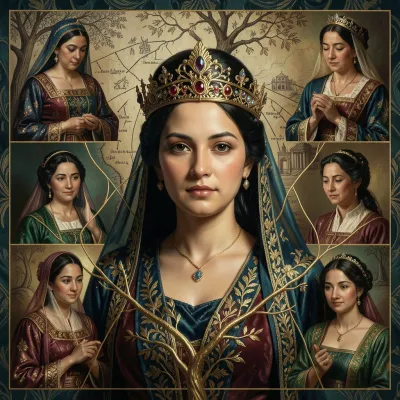
*Queens and Queen-Makers: Women, Power, and Dynastic Survival* explores how women navigated and mastered monarchical systems designed to exclude them. By examining the diverse roles of queens regnant, consorts, queen-mothers, and regents, the text argues that female agency was not an exceptional anomaly but a structural necessity for dynastic continuity. Across cultures—from the Asantehemaa of West Africa and the Valide Sultans of the Ottoman Empire to European sovereigns like Isabella of Castile—royal women utilized a consistent toolkit of marriage statecraft, economic autonomy through dower and dowry, and the cultivation of sophisticated patronage networks.
The book details the practical "infrastructure of rule," demonstrating how women converted domestic spaces, such as the household and the nursery, into centers of administrative and political power. Through the management of education, medical politics, and communication networks, queens influenced the next generation of rulers and gathered vital intelligence to navigate factional court politics. Furthermore, the text highlights how royal women used ritual, pageantry, and architectural patronage to manufacture legitimacy and anchor their authority in the public imagination, often performing the functions of sovereignty even when they did not hold the formal title of monarch.
Expanding its scope beyond Europe, the narrative analyzes the unique configurations of female power in the Islamic world, Asia, and the indigenous Americas. It illustrates how women in these regions leveraged religious law, matrilineal traditions, and maritime trade to protect their realms from internal collapse and external colonial threats. Whether through the direct military leadership of figures like Rani Lakshmibai or the "soft power" of diplomatic correspondence, these women acted as "queen-makers" who stabilized regimes during successional crises and interregnums.
Ultimately, the book examines the long-term legacies and "afterlives" of these women, showing how their reputations have been curated, mythologized, or erased by subsequent historical narratives. By recovering the financial ledgers, legal petitions, and architectural footprints they left behind, the text asserts that the survival of monarchies depended on the adaptability and resourcefulness of women. Their history serves as a recalibrated map of power, placing queens at the heart of political history as indispensable architects of statecraft and dynastic survival.
What You'll Find Inside:
- Queenship is analyzed as a set of practices—including sovereign rule, indirect governance, and informal networks—rather than merely a formal title, revealing how women accessed and sustained power within patriarchal systems.
- Marriage functioned as political statecraft where royal unions served as treaties that secured alliances, transmitted territorial claims, and produced heirs to ensure dynastic continuity.
- Economic independence through dowry, dower, and personal estates provided queens with financial autonomy to act as patrons, creditors, and power brokers when formal authority was restricted.
- Regency offered a legitimate and recurrent pathway for women to exercise sovereign power during royal minorities, illness, or absence, often serving as a stabilizing force for dynasties.
- The book employs a cross-cultural framework comparing queenship across Africa, Asia, the Islamic world, Europe, and the Americas to reveal shared strategies and local adaptations in female rule.
Who's It For:
This book is intended for students and scholars of history, gender studies, and political science seeking a comprehensive, comparative analysis of female power in monarchical systems. It will particularly benefit readers interested in understanding how women exercised authority through networks, economic resources, and cultural practices across different historical periods and geographic regions. Academics researching queenship, royal studies, or women's influence in premodern societies will find the institutional and network-based approach especially valuable.
Table of Contents:
- Introduction
- Chapter 1 What Is Queenship? Concepts, Terms, and Methods
- Chapter 2 The Queen as Sovereign: Ruling in Her Own Name
- Chapter 3 Queen-Mothers and the Power of Maternity
- Chapter 4 Marriage as Statecraft: Dynastic Unions and Alliances
- Chapter 5 Dower, Dowry, and Domain: Economic Foundations of Female Power
- Chapter 6 Regency: Governing Between Kings
- Chapter 7 Factions, Favorites, and Patronage Networks
- Chapter 8 Council, Court, and Household: The Infrastructure of Rule
- Chapter 9 Ritual and Representation: Coronations, Progresses, and Pageantry
- Chapter 10 Law and Legitimation: Capabilities and Constraints
- Chapter 11 Faith and Authority: Religion as Resource and Battleground
- Chapter 12 Letters and Intelligence: Communication, Espionage, and Soft Power
- Chapter 13 War and Peace: Negotiation, Command, and Military Influence
- Chapter 14 The Queen as Builder: Art, Architecture, and Memory
- Chapter 15 Bodies, Heirs, and Medical Politics
- Chapter 16 Education and Tutelage: Raising Heirs and Governing Minors
- Chapter 17 Colonies and Frontiers: Queenship Beyond the Metropole
- Chapter 18 Queenship in Africa: Asantehemaa, Iyoba, and Beyond
- Chapter 19 Queenship in Asia: From Wu Zetian to the Dowager Courts
- Chapter 20 Queenship in the Islamic World: Sultanas and Valide Sultans
- Chapter 21 Queenship in Europe: From Eleanor of Aquitaine to Maria Theresa
- Chapter 22 Indigenous Americas: Coyas, Consorts, and Queen-Mothers
- Chapter 23 The Pacific and Indian Ocean Worlds: Maharanis and Island Queens
- Chapter 24 Crisis and Survival: Deposition, Exile, and Restoration
- Chapter 25 Legacies and Afterlives: Memory, Myth, and Modern Monarchy
Author:
Published By:
Date Published:
May 2, 2026
Type:
Nonfiction
Language:
English
Word Count:
62,821 words
Reading Time:
4 hours 24 minutes
Sample:
MixCache.com Total Access
Get unlimited access to this book + all books published by MixCache.com for $11.99/month
Subscribe to MTAOr purchase this book individually below
Order:
Buy the Queens and Queen-Makers: Women, Power, and Dynastic Survival ebook on MixCache.com:
Buy Now
Full ebook will be available immediately
- read online or download as a PDF file.
$5 account credit for all new MixCache.com accounts, usable toward any ebook purchase!*






Ratings & Reviews
Ask Questions About This Book
Have a question about the content? Ask our AI assistant!
Start by asking a question about "Queens and Queen-Makers: Women, Power, and Dynastic Survival"
Example: "Does this book mention William Shakespeare?"
Thinking...