Browse by Category
Fiction
- Action & Adventure
- African American
- Anthologies
- Children's Fiction
- Classics
- Comics & Graphic Novels
- Coming of Age
- Contemporary
- Cultural & Regional
- Drama
- Erotica
- Fantasy
- General
- Historical Fiction
- Horror
- Humor & Satire
- Literary Fiction
- Mystery, Thriller & Suspense
- Poetry
- Religious & Inspirational
- Romance
- Science Fiction
- Short Stories
- War & Military
- Westerns
- Women's Fiction
- Young Adult
Non-Fiction
- Antiques & Collectibles
- Arts & Photography
- Biographies & Memoirs
- Business & Money
- Children's Non-Fiction
-
Computers & Technology
- Artificial Intelligence
- Computer Science
- Cybersecurity & Cryptography
- Data Science & Analytics
- Databases & Big Data
- Game Development & Design
- General
- Hardware & DIY
- Mobile App Development
- Networking & Cloud Computing
- Operating Systems
- Programming
- Robotics
- Software
- Software Engineering
- User Experience (UX) & Design
- Web Development & Design
- Cooking, Food & Wine
- Crafts, Hobbies & Home
- Education & Teaching
- Engineering
- General
- Health, Fitness & Dieting
-
History
- African History
- African History - North Africa
- African History - Sub-Saharan Africa
- American History
- American History - 20th Century
- American History - Civil War
- American History - Colonial Period
- Ancient History
- Asian History
- Asian History - China
- Asian History - India
- Asian History - Japan
- Asian History - Southeast Asia
- European History
- European History - Ancient Greece
- European History - Ancient Rome
- European History - Medieval
- European History - Modern
- European History - Renaissance
- General
- Middle Eastern History
- Military History
- Military History - Aviation
- Military History - Naval
- Social & Cultural History
- World History
- Humor & Entertainment
- Industrial Technology
- Language Learning
- Law
- LGBTQ+ Non-Fiction
- Literary Criticism
- Medical Books
- Parenting & Relationships
- Philosophy
- Politics & Social Sciences
- Reference
- Religion & Spirituality
-
Science & Math
- Agricultural Sciences
- Astronomy & Space Science
- Behavioral Sciences
- Biological Sciences
- Botany & Plant Science
- Chemistry
- Earth Sciences
- Engineering - Chemical
- Engineering - Civil
- Engineering - Electrical
- Engineering - Mechanical
- Environment
- General
- Geology
- Mathematics
- Nature & Ecology
- Oceanography
- Paleontology
- Physics
- Statistics
- Self-Help
- Sports & Outdoors
- Study Aids
- Sustainability & Green Living
- Textbooks
- Transportation
- Travel
- True Crime
- Urban Planning & Development
- Veterinary Medicine
- Writing & Publishing
Jump to Section
MixCache.com Total Access
Unlimited reading and audiobooks for every book published by MixCache.com.
Included titles carry the MTA badge.
Learn more →
Palaces and Protests: Bucharest between Ottoman Influence and Communist Grandeur
MTA
How Bucharest’s eclectic architecture tells Romania’s turbulent modern story
About this book:
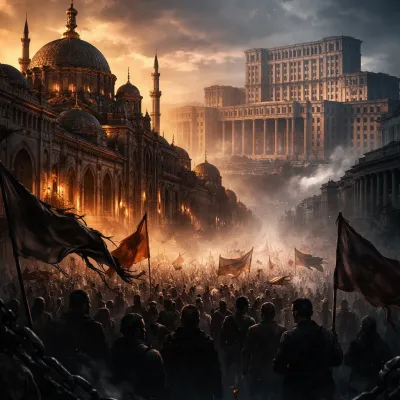
Palaces and Protests reads Bucharest’s built environment as a political biography, tracing how successive regimes have inscribed their ambitions onto the city’s streets while residents have continually responded with improvisation, irony, and open defiance. Beginning with Ottoman‑era hans and mahalas, the book shows how a fluid, commerce‑driven urban fabric fostered adaptability and communal life, a legacy that persisted beneath later attempts to impose order. Phanariot rulers introduced neoclassical ornament and grandiose courts, setting a pattern of elite display that coexisted with the vernacular neighborhoods they sought to reshape.
The 19th‑century drive to create a “Paris of the East” brought Haussmann‑inspired boulevards, Beaux‑Arts ministries, and a burgeoning Neo‑Romanian style that blended European forms with local motifs, expressing Romania’s nascent nationhood. Interwar Bucharest intensified this eclecticism, welcoming Art Deco villas, modernist blocks, and a cosmopolitan middle class, even as authoritarian movements began to choreograph public squares for spectacle and surveillance. World War II bombings shattered much of this layered city, leaving a ruined canvas that the communist regime seized upon to impose Socialist Realism, monumental housing blocks, and the systematization campaign that razed historic districts to make way for the Civic Centre and the Palace of the People.
After the 1989 revolution, Bucharest’s monumental spaces were reclaimed as sites of protest and memory, while post‑communist shock capitalism generated glass towers, malls, and a resurgent corner‑shop culture, all layered over aging panel blocks and imperial boulevards. The book argues that the city’s enduring eclecticism is not a failure of planning but a record of political contestation—a palimpsest where palaces built to awe and protests staged to answer them together reveal Romania’s turbulent modern story. By following the negotiations visible in façades, courtyards, and infrastructure, the work reveals how power attempts to make space legible and how inhabitants continually make it livable.
What You'll Find Inside:
- The book traces Bucharest's evolution from Ottoman-era organic urbanism (hans, mahalas, courtyards) through Phanariot monumentalism to French-inspired boulevards, revealing a city constantly negotiating between imported models and local adaptation.
- It examines how successive regimes used architecture as political spectacle - from royal monuments defining nationhood to communist grand projects like the Palace of the People, and how citizens responded by reclaiming spaces for protest in Piața Universției and Piața Victoriei.
- The 1977 earthquake served as a catalyst for Ceaușescu's systematization program, leading to massive demolitions, the Civic Centre project, and the controversial moving of churches that erased neighborhoods while attempting to preserve religious symbols.
- Post-communist Bucharest developed through 'shock capitalism' with glass towers and malls, alongside grassroots heritage movements fighting to preserve the city's eclectic identity amid unregulated development.
- The book argues Bucharest's enduring eclecticism - blending Ottoman afterlives, European aspirations, and socialist monumentalism - is not a planning failure but an honest record of political contestation where power builds palaces and people stage protests.
Who's It For:
This book appeals to readers interested in urban history, architectural studies, and Eastern European politics. It's particularly valuable for students, researchers, and professionals in urban planning, architecture, and cultural studies who want to understand how built environments reflect political power struggles. General readers fascinated by Bucharest's unique transformation from Ottoman crossroads to communist spectacle to democratic capital would also find it engaging, especially those interested in how cities remember and forget through their architecture.
Table of Contents:
- Introduction
- Chapter 1 City of Inns and Mahalas: Ottoman Bucharest’s Urban Fabric
- Chapter 2 Phanariot Power and the Architecture of Rule
- Chapter 3 Fire, Plague, and Rebuilding: Resilience before the Nation
- Chapter 4 1848 and the Idea of a Capital
- Chapter 5 “Paris of the East”? French Models and Neo‑Romanian Identity
- Chapter 6 Nationhood in Stone: Ministries, Monuments, and the Royal Axis
- Chapter 7 From Markets to Boulevards: Taming the Dâmbovița
- Chapter 8 Greater Romania and the Interwar Metropolis
- Chapter 9 Modernism Arrives: Villas, Blocks, and a New Middle Class
- Chapter 10 Iron Guard Spectacle and Authoritarian Urbanism
- Chapter 11 War, Ruin, and the 1944 Bombings
- Chapter 12 Socialist Realism and the People’s Aesthetic, 1948–1965
- Chapter 13 Panel Blocks and Micro‑Rayons: The Architecture of Everyday Socialism
- Chapter 14 The 1977 Earthquake and the Logic of Demolition
- Chapter 15 Systematization as Spectacle: The Civic Centre Project
- Chapter 16 The Palace of the People: Building Absolute Power
- Chapter 17 Moving Churches, Erasing Neighborhoods: The Human Cost
- Chapter 18 Choreographing Consent: Parades, Squares, and Surveillance
- Chapter 19 December 1989: Spaces of Revolt and Memory
- Chapter 20 Shock Capitalism: Malls, Towers, and the Return of the Corner Shop
- Chapter 21 Contesting the City: NGOs, Heritage Wars, and Grassroots Preservation
- Chapter 22 After the Grand Boulevards: Reprogramming Monumentality
- Chapter 23 Post‑Socialist Infrastructures: Metro, Ring Roads, and Smart‑City Dreams
- Chapter 24 Protest Urbanism: From Piața Universității to Piața Victoriei
- Chapter 25 Looking East and West: Bucharest’s European and Ottoman Afterlives
Author:
Published By:
Date Published:
June 10, 2026
Type:
Nonfiction
Language:
English
Word Count:
61,477 words
Reading Time:
4 hours 18 minutes
Sample:
Order:
Order Palaces and Protests: Bucharest between Ottoman Influence and Communist Grandeur (Paperback) on MixCache.com:
Buy NowPrint copy is made to order and ships worldwide. Includes the ebook free, ready to read instantly.
$5 account credit for all new MixCache.com accounts, usable toward any ebook purchase!*