
Browse by Category
Fiction
- Action & Adventure
- African American
- Anthologies
- Children's Fiction
- Classics
- Comics & Graphic Novels
- Coming of Age
- Contemporary
- Cultural & Regional
- Drama
- Erotica
- Fantasy
- General
- Historical Fiction
- Horror
- Humor & Satire
- Literary Fiction
- Mystery, Thriller & Suspense
- Poetry
- Religious & Inspirational
- Romance
- Science Fiction
- Short Stories
- War & Military
- Westerns
- Women's Fiction
- Young Adult
Non-Fiction
- Antiques & Collectibles
- Arts & Photography
- Biographies & Memoirs
- Business & Money
- Children's Non-Fiction
-
Computers & Technology
- Artificial Intelligence
- Computer Science
- Cybersecurity & Cryptography
- Data Science & Analytics
- Databases & Big Data
- Game Development & Design
- General
- Hardware & DIY
- Mobile App Development
- Networking & Cloud Computing
- Operating Systems
- Programming
- Robotics
- Software
- Software Engineering
- User Experience (UX) & Design
- Web Development & Design
- Cooking, Food & Wine
- Crafts, Hobbies & Home
- Education & Teaching
- Engineering
- General
- Health, Fitness & Dieting
-
History
- African History
- African History - North Africa
- African History - Sub-Saharan Africa
- American History
- American History - 20th Century
- American History - Civil War
- American History - Colonial Period
- Ancient History
- Asian History
- Asian History - China
- Asian History - India
- Asian History - Japan
- Asian History - Southeast Asia
- European History
- European History - Ancient Greece
- European History - Ancient Rome
- European History - Medieval
- European History - Modern
- European History - Renaissance
- General
- Middle Eastern History
- Military History
- Military History - Aviation
- Military History - Naval
- Social & Cultural History
- World History
- Humor & Entertainment
- Industrial Technology
- Language Learning
- Law
- LGBTQ+ Non-Fiction
- Literary Criticism
- Medical Books
- Parenting & Relationships
- Philosophy
- Politics & Social Sciences
- Reference
- Religion & Spirituality
-
Science & Math
- Agricultural Sciences
- Astronomy & Space Science
- Behavioral Sciences
- Biological Sciences
- Botany & Plant Science
- Chemistry
- Earth Sciences
- Engineering - Chemical
- Engineering - Civil
- Engineering - Electrical
- Engineering - Mechanical
- Environment
- General
- Geology
- Mathematics
- Nature & Ecology
- Oceanography
- Paleontology
- Physics
- Statistics
- Self-Help
- Sports & Outdoors
- Study Aids
- Sustainability & Green Living
- Textbooks
- Transportation
- Travel
- True Crime
- Urban Planning & Development
- Veterinary Medicine
- Writing & Publishing
Jump to Section
MixCache.com Total Access
Unlimited reading and audiobooks for every book published by MixCache.com.
Included titles carry the MTA badge.
Learn more →A History of South Sudan
About this book:

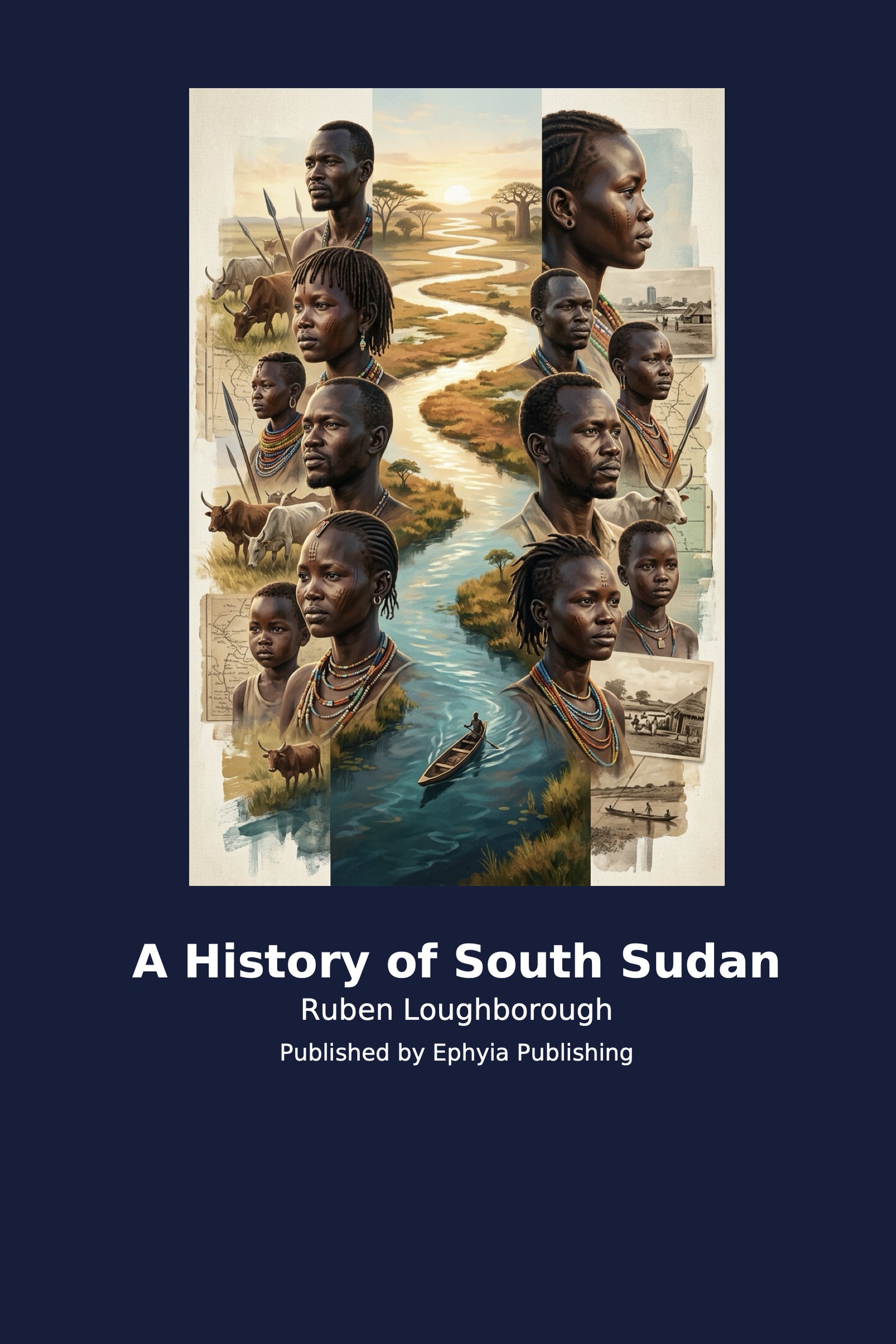
A History of South Sudan offers readers a comprehensive journey through the nation’s deep past and turbulent present, beginning with the ancient landscapes and diverse ethnic groups that have shaped the region for millennia. From the Nilotic migrations and the rise of early societies such as the Dinka, Nuer, and Shilluk kingdoms, to the impact of external powers like the Turco‑Egyptian slave traders and the Anglo‑Egyptian Condominium, the book reveals how geography, trade, and conquest have continually influenced South Sudan’s social fabric. Readers will gain insight into the origins of cultural traditions, the role of cattle in pastoral life, and the ways in which indigenous belief systems interacted with incoming religions and colonial administrations.
The narrative then moves into the violent eras of the 19th and 20th centuries, detailing the devastating slave trade, the scramble for ivory, and the rise of warlords such as al‑Zubayr Pasha, whose networks of fortified stations shattered communities and sowed seeds of mistrust that endure today. It explains how the British policy of “Southern Policy” deliberately isolated the south, fostering a separate identity rooted in Christianity and English education while neglecting development, and how these divisions set the stage for the mutiny at Torit that ignited the first Sudanese civil war. The book chronicles the successive conflicts, from the Anya Nya rebellion to the formation of the Sudan People’s Liberation Army/Movement under John Garang, illustrating how ideology, ethnic rivalry, and external support transformed a struggle for autonomy into a protracted, multidimensional war.
Readers will experience the turning points that eventually led to independence, including the discovery of oil, the Addis Ababa Agreement, the Comprehensive Peace Agreement of 2005, and the historic 2011 referendum that created the world’s newest nation. The text examines the euphoria of nation‑building, the challenges of constructing state institutions from scratch, and the immediate crises that followed independence—economic dependence on oil, ethnic power struggles, and the eruption of civil war in 2013. It provides a clear view of how internal politics, regional interventions, and humanitarian catastrophes intertwined to shape South Sudan’s trajectory after statehood.
Finally, the book brings the story up to the present day, analyzing the Revitalised Agreement on the Resolution of the Conflict, the formation of transitional governments, and the ongoing battles over security sector reform, economic management, and climate‑induced floods. It highlights the persistent obstacles to lasting peace, such as the delayed Hybrid Court, the patronage‑driven civil service, and the dependence on international aid, while also showcasing the resilience of South Sudanese women, the efforts of civil society, and the enduring hope for a just and prosperous future. By the end, readers will have a nuanced understanding of the forces that have forged South Sudan’s identity and the profound challenges it faces as it seeks stability in the 21st century.
What You'll Find Inside:
- Traces South Sudan's evolution from ancient Nilotic societies and pre-colonial kingdoms through centuries of external exploitation including slave trade, colonial rule, and resource conflicts.
- Examines how British colonial 'Southern Policy' deliberately isolated and underdeveloped southern Sudan, creating institutional and cultural divisions that fueled post-independence conflicts.
- Details the dual role of oil discovery as both a potential path to development and a catalyst for conflict, exacerbating north-south tensions and shaping post-independence economic vulnerability.
- Documents the devastating humanitarian toll of prolonged civil wars, including ethnic violence, mass displacement, famine, and the disproportionate impact on women and children.
- Analyzes the immense challenges of state-building in South Sudan, from institution creation after independence to ongoing struggles with governance, security sector reform, and economic diversification.
Who's It For:
This book is ideal for students, researchers, and professionals in African studies, international relations, conflict resolution, and development studies who seek a comprehensive understanding of South Sudan's complex history. It will also benefit policymakers, humanitarian workers, and journalists working in or on the region, as well as general readers interested in the challenges of nation-building, the legacy of colonialism, and the dynamics of civil war and peacebuilding in contemporary Africa.
Table of Contents:
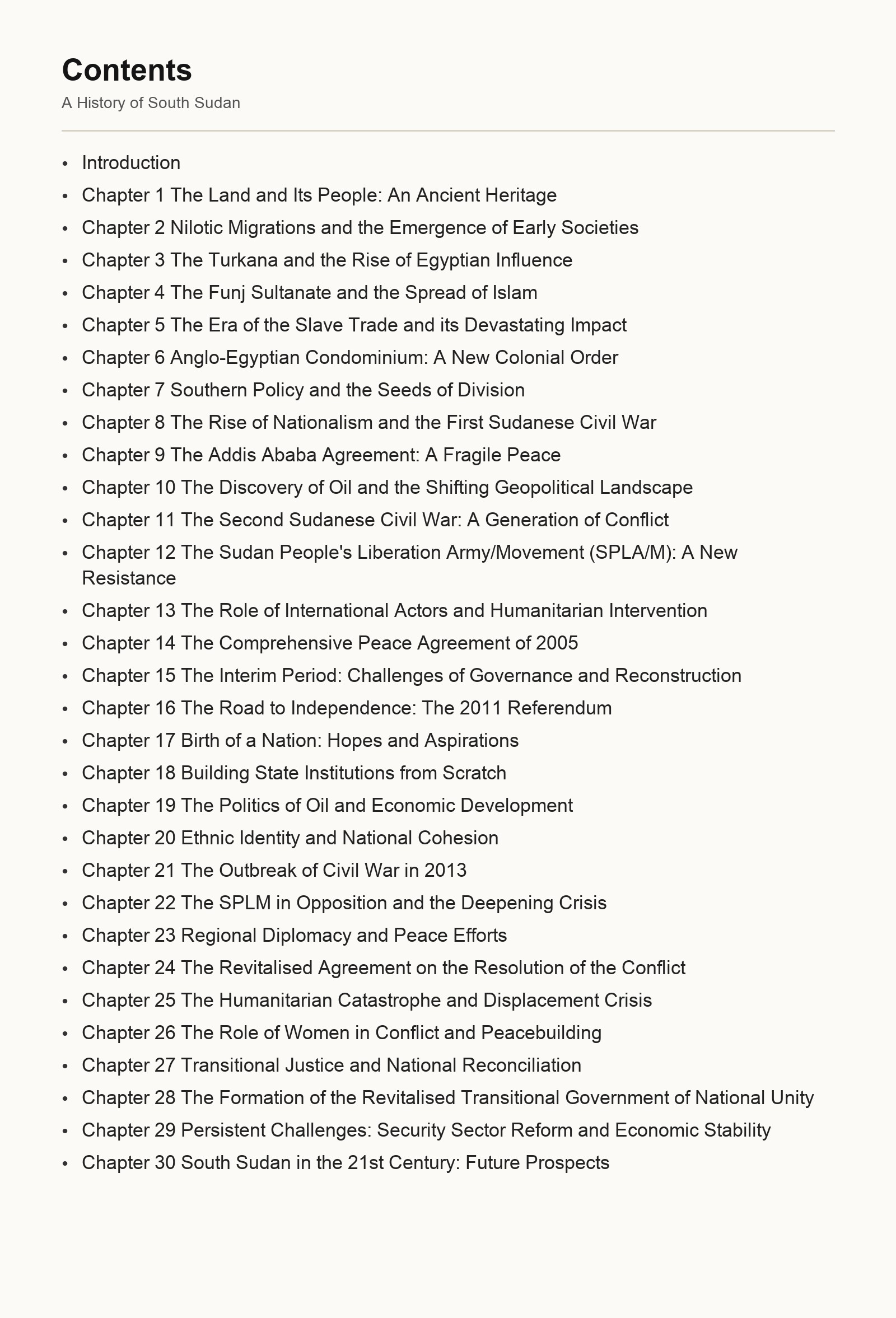
- Introduction
- Chapter 1 The Land and Its People: An Ancient Heritage
- Chapter 2 Nilotic Migrations and the Emergence of Early Societies
- Chapter 3 The Turkana and the Rise of Egyptian Influence
- Chapter 4 The Funj Sultanate and the Spread of Islam
- Chapter 5 The Era of the Slave Trade and its Devastating Impact
- Chapter 6 Anglo-Egyptian Condominium: A New Colonial Order
- Chapter 7 Southern Policy and the Seeds of Division
- Chapter 8 The Rise of Nationalism and the First Sudanese Civil War
- Chapter 9 The Addis Ababa Agreement: A Fragile Peace
- Chapter 10 The Discovery of Oil and the Shifting Geopolitical Landscape
- Chapter 11 The Second Sudanese Civil War: A Generation of Conflict
- Chapter 12 The Sudan People's Liberation Army/Movement (SPLA/M): A New Resistance
- Chapter 13 The Role of International Actors and Humanitarian Intervention
- Chapter 14 The Comprehensive Peace Agreement of 2005
- Chapter 15 The Interim Period: Challenges of Governance and Reconstruction
- Chapter 16 The Road to Independence: The 2011 Referendum
- Chapter 17 Birth of a Nation: Hopes and Aspirations
- Chapter 18 Building State Institutions from Scratch
- Chapter 19 The Politics of Oil and Economic Development
- Chapter 20 Ethnic Identity and National Cohesion
- Chapter 21 The Outbreak of Civil War in 2013
- Chapter 22 The SPLM in Opposition and the Deepening Crisis
- Chapter 23 Regional Diplomacy and Peace Efforts
- Chapter 24 The Revitalised Agreement on the Resolution of the Conflict
- Chapter 25 The Humanitarian Catastrophe and Displacement Crisis
- Chapter 26 The Role of Women in Conflict and Peacebuilding
- Chapter 27 Transitional Justice and National Reconciliation
- Chapter 28 The Formation of the Revitalised Transitional Government of National Unity
- Chapter 29 Persistent Challenges: Security Sector Reform and Economic Stability
- Chapter 30 South Sudan in the 21st Century: Future Prospects
Author:
Published By:
Date Published:
May 27, 2026
Type:
Nonfiction
Language:
English
Also Available In:
Word Count:
55,686 words
Reading Time:
3 hours 54 minutes
Sample:
Order:
Order A History of South Sudan (Paperback) on MixCache.com:
Buy NowPrint copy is made to order and ships worldwide. Includes the ebook free, ready to read instantly.
$5 account credit for all new MixCache.com accounts, usable toward any ebook purchase!*


