
Browse by Category
Fiction
- Action & Adventure
- African American
- Anthologies
- Children's Fiction
- Classics
- Comics & Graphic Novels
- Coming of Age
- Contemporary
- Cultural & Regional
- Drama
- Erotica
- Fantasy
- General
- Historical Fiction
- Horror
- Humor & Satire
- Literary Fiction
- Mystery, Thriller & Suspense
- Poetry
- Religious & Inspirational
- Romance
- Science Fiction
- Short Stories
- War & Military
- Westerns
- Women's Fiction
- Young Adult
Non-Fiction
- Antiques & Collectibles
- Arts & Photography
- Biographies & Memoirs
- Business & Money
- Children's Non-Fiction
-
Computers & Technology
- Artificial Intelligence
- Computer Science
- Cybersecurity & Cryptography
- Data Science & Analytics
- Databases & Big Data
- Game Development & Design
- General
- Hardware & DIY
- Mobile App Development
- Networking & Cloud Computing
- Operating Systems
- Programming
- Robotics
- Software
- Software Engineering
- User Experience (UX) & Design
- Web Development & Design
- Cooking, Food & Wine
- Crafts, Hobbies & Home
- Education & Teaching
- Engineering
- General
- Health, Fitness & Dieting
-
History
- African History
- African History - North Africa
- African History - Sub-Saharan Africa
- American History
- American History - 20th Century
- American History - Civil War
- American History - Colonial Period
- Ancient History
- Asian History
- Asian History - China
- Asian History - India
- Asian History - Japan
- Asian History - Southeast Asia
- European History
- European History - Ancient Greece
- European History - Ancient Rome
- European History - Medieval
- European History - Modern
- European History - Renaissance
- General
- Middle Eastern History
- Military History
- Military History - Aviation
- Military History - Naval
- Social & Cultural History
- World History
- Humor & Entertainment
- Industrial Technology
- Language Learning
- Law
- LGBTQ+ Non-Fiction
- Literary Criticism
- Medical Books
- Parenting & Relationships
- Philosophy
- Politics & Social Sciences
- Reference
- Religion & Spirituality
-
Science & Math
- Agricultural Sciences
- Astronomy & Space Science
- Behavioral Sciences
- Biological Sciences
- Botany & Plant Science
- Chemistry
- Earth Sciences
- Engineering - Chemical
- Engineering - Civil
- Engineering - Electrical
- Engineering - Mechanical
- Environment
- General
- Geology
- Mathematics
- Nature & Ecology
- Oceanography
- Paleontology
- Physics
- Statistics
- Self-Help
- Sports & Outdoors
- Study Aids
- Sustainability & Green Living
- Textbooks
- Transportation
- Travel
- True Crime
- Urban Planning & Development
- Veterinary Medicine
- Writing & Publishing
Jump to Section
MixCache.com Total Access
Unlimited reading and audiobooks for every book published by MixCache.com.
Included titles carry the MTA badge.
Learn more →
A History of River Engineering
From Ancient Channels to Modern Waterways: The Evolution of River Control and Management
About this book:
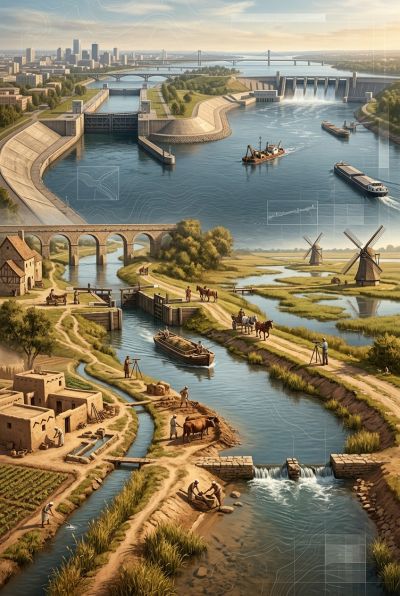
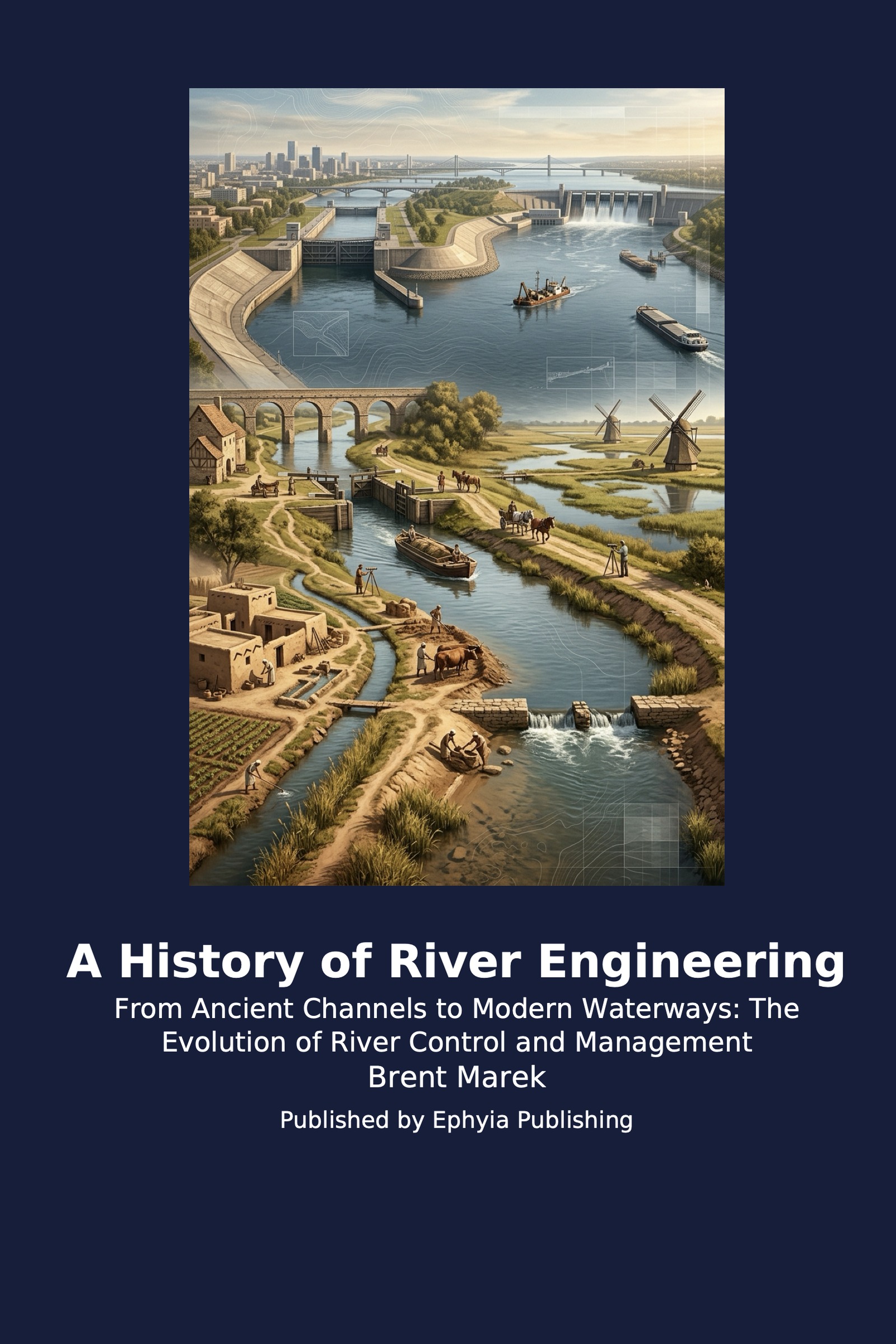
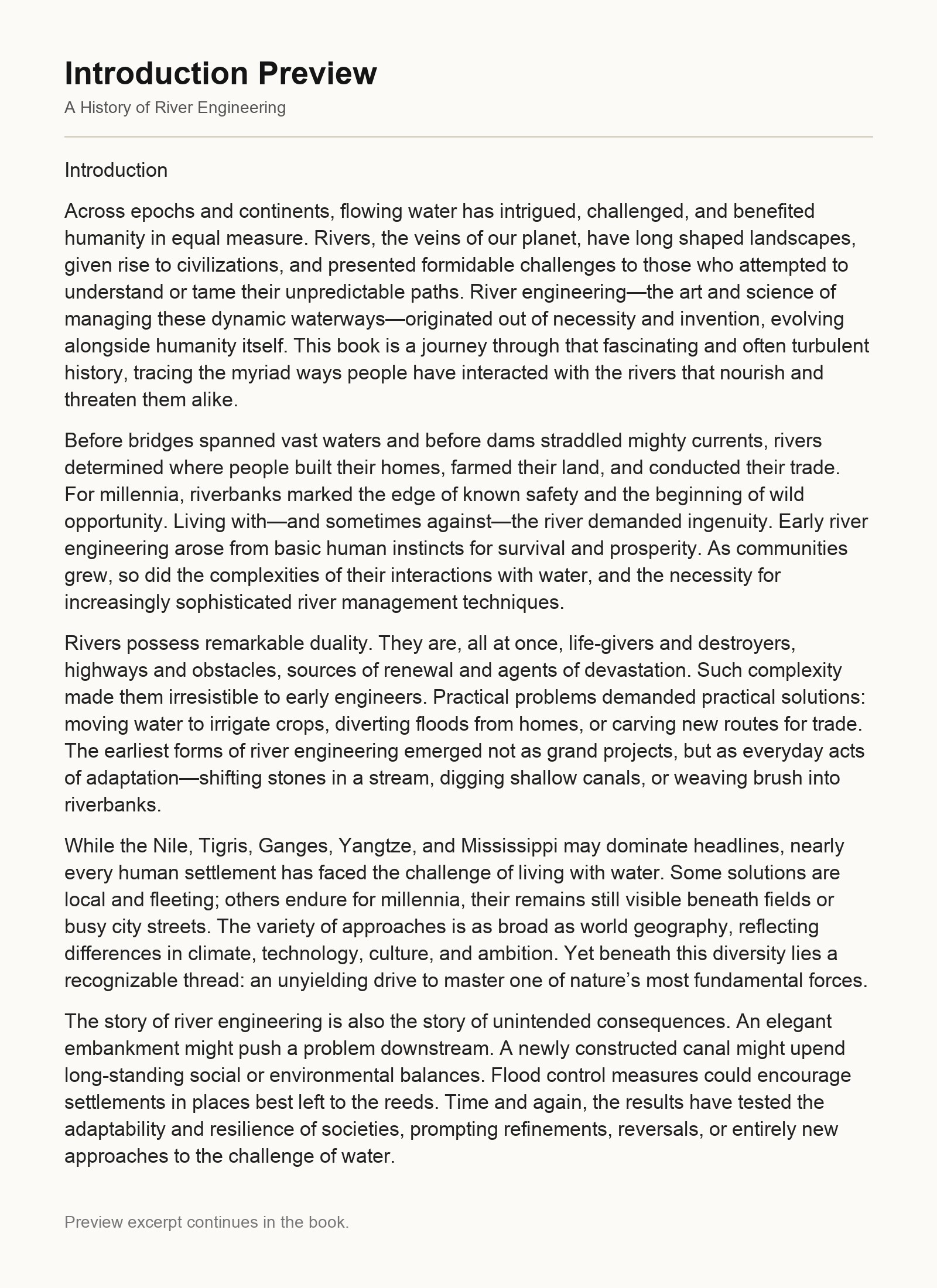
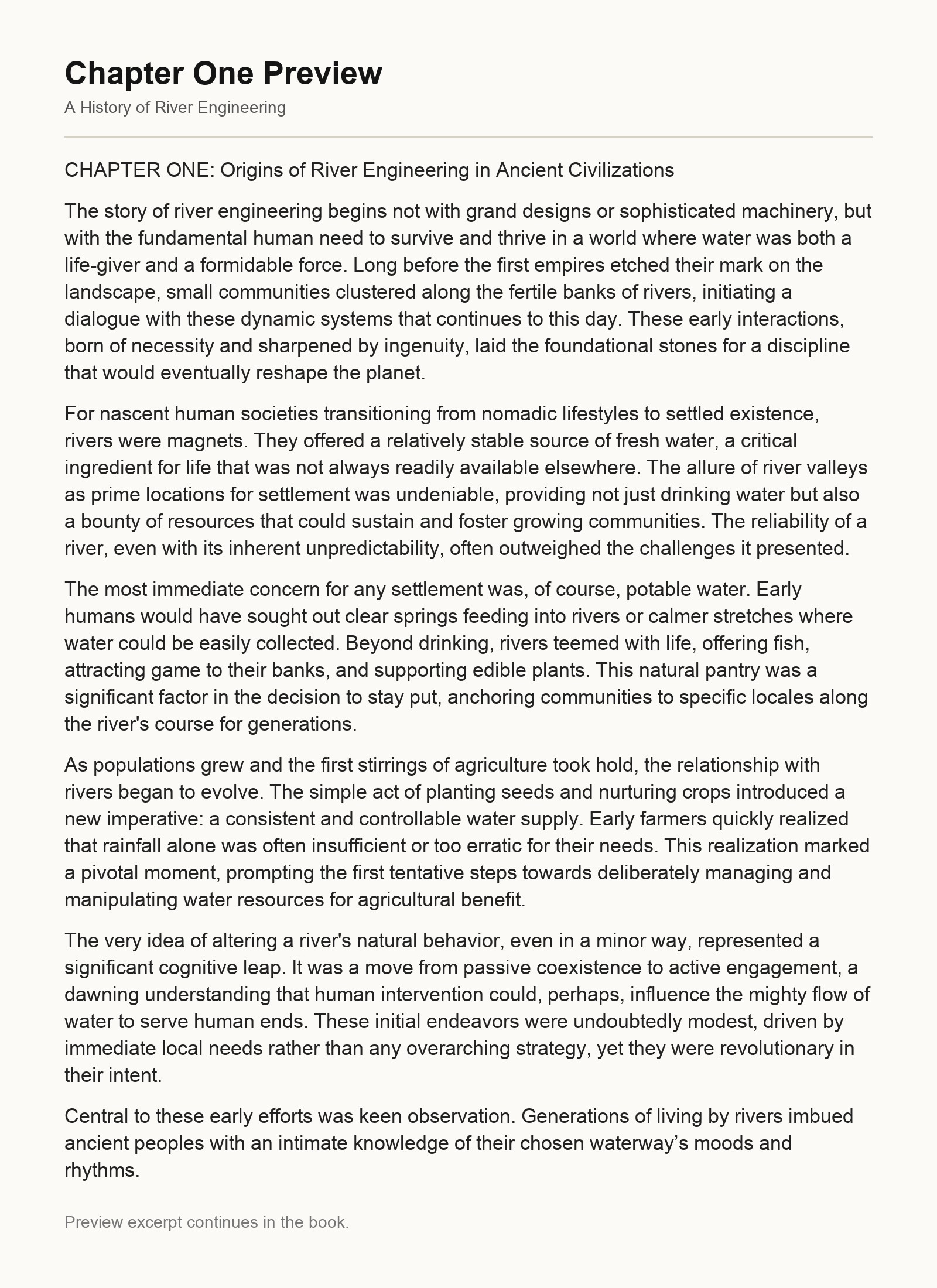
From the earliest stone‑lined ditches to today’s computer‑modeled flood defenses, this book traces the full sweep of humanity’s attempts to shape and manage rivers. Readers will travel across continents and millennia, discovering how ancient Egyptians harnessed the Nile’s annual flood, how Mesopotamians built the world’s first large‑scale canal networks, and how Chinese engineers created the Grand Canal and the self‑regulating Dujiangyan system without dams. Each chapter grounds these achievements in the daily needs of survival, trade, and agriculture that sparked the first innovations.
The narrative continues through the classical worlds of Greece and Rome, where aqueducts, harbors, and early dams revealed a growing mastery of water transport and urban supply. Medieval Europe’s watermills, dike‑building communes, and monastic hydraulic experiments show how local ingenuity kept river knowledge alive even as centralized empires waned. The Islamic Golden Age further refined irrigation, introduced sophisticated water‑lifting devices like the noria, and produced theoretical works on groundwater that would influence European practice for centuries.
Industrialization transformed rivers into arteries of coal, steel, and goods, spurring the canal boom, the rise of steamboats, and massive engineering feats such as the Erie Canal, the Panama Canal, and the lock‑filled waterways of Europe and North America. The book details the evolution of locks, dams, and channelization techniques, from timber mitre gates to concrete gravity dams, and explains how these structures served navigation, flood control, hydropower, and irrigation—often simultaneously in multipurpose projects like the Tennessee Valley Authority and Hoover Dam.
Beyond concrete and steel, the work examines the social and ecological dimensions of river engineering: the salinization crises of ancient Mesopotamia, the floodplain dislocations caused by levees‑only policies, the emergence of environmental impact assessments, and the growing movement toward river restoration, dam removal, and nature‑based solutions. Readers will see how cultural beliefs, legal frameworks, and labor systems—from corvée in Egypt to enslaved labor in the New World—have shaped every major project, and how today’s engineers grapple with climate change, sediment management, and the need for adaptive, resilient infrastructure.
Finally, the book looks ahead to the next generation of river management, exploring digital twins, real‑time sensor networks, AI‑driven forecasting, and green infrastructure approaches that work with natural processes rather than against them. By the end, readers will not only understand the technical milestones of river engineering but also appreciate the profound ways rivers have influenced societies, economies, and the environment—and how our evolving relationship with these vital waterways will shape the future.
What You'll Find Inside:
- Traces the evolution of river engineering from ancient irrigation and flood‑control works to modern multipurpose dams and smart‑water systems.
- Highlights landmark projects such as Egypt’s Nile basin irrigation, China’s Grand Canal and Dujiangyan, Dutch dikes and polders, and the Mississippi River control structures.
- Explores the technological advances in locks, dams, channelization, and hydropower that enabled large‑scale water management across continents.
- Examines the shift toward ecological awareness, river restoration, climate‑resilient design, and nature‑based solutions in contemporary river management.
- Discusses the cultural, social, and transboundary dimensions of river control, including heritage, governance, and the ongoing challenges of equity and sustainability.
Who's It For:
This book is suited for civil and environmental engineering students, water‑resource professionals, historians, policymakers, and anyone interested in how societies have shaped and been shaped by rivers. It provides both a comprehensive technical overview and a rich cultural‑historical context, making it valuable for readers seeking to understand past practices, current challenges, and future directions in river engineering and water management.
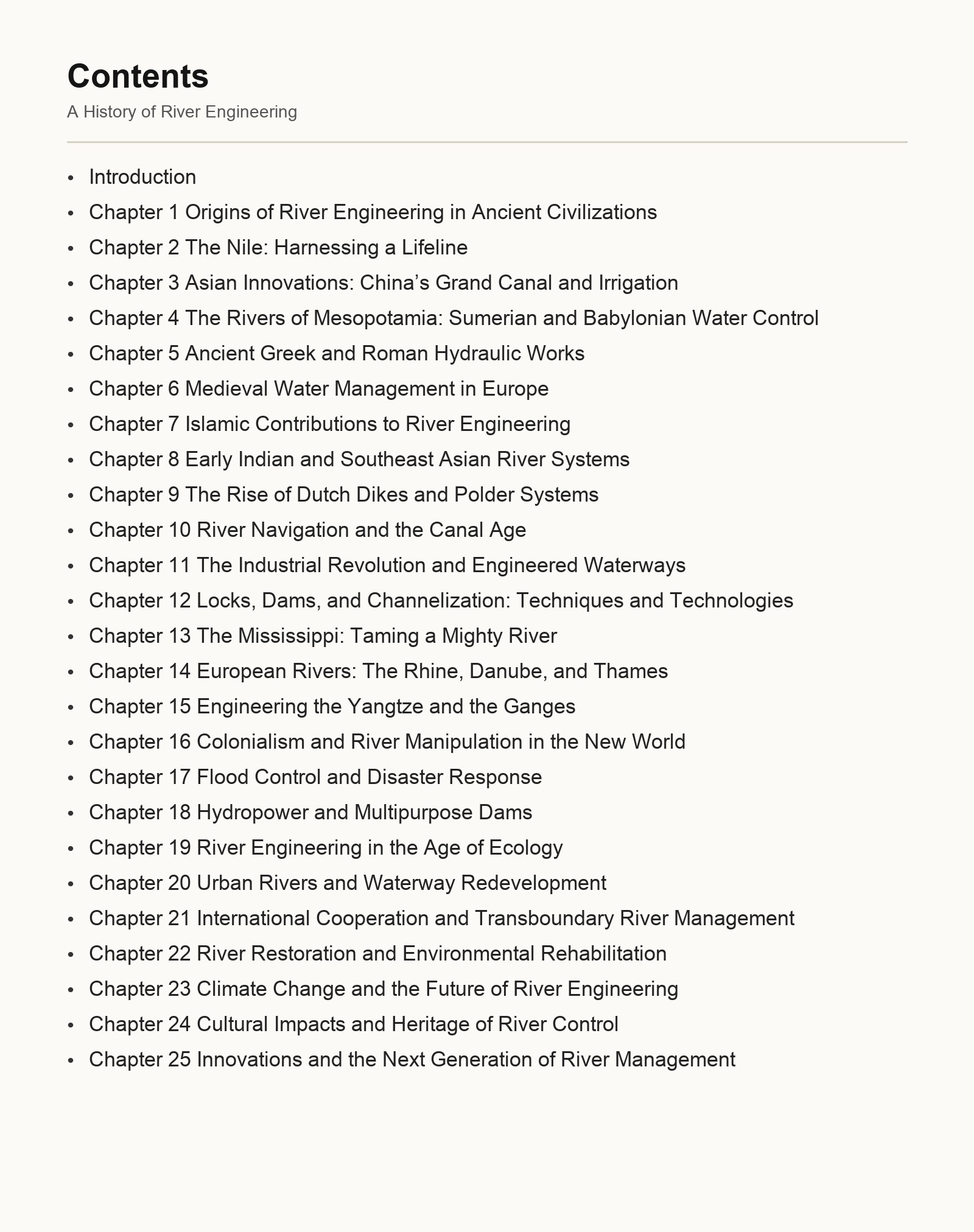
Table of Contents:
-
Introduction
-
Chapter 1 Origins of River Engineering in Ancient Civilizations
-
Chapter 2 The Nile: Harnessing a Lifeline
-
Chapter 3 Asian Innovations: China’s Grand Canal and Irrigation
-
Chapter 4 The Rivers of Mesopotamia: Sumerian and Babylonian Water Control
-
Chapter 5 Ancient Greek and Roman Hydraulic Works
-
Chapter 6 Medieval Water Management in Europe
-
Chapter 7 Islamic Contributions to River Engineering
-
Chapter 8 Early Indian and Southeast Asian River Systems
-
Chapter 9 The Rise of Dutch Dikes and Polder Systems
-
Chapter 10 River Navigation and the Canal Age
-
Chapter 11 The Industrial Revolution and Engineered Waterways
-
Chapter 12 Locks, Dams, and Channelization: Techniques and Technologies
-
Chapter 13 The Mississippi: Taming a Mighty River
-
Chapter 14 European Rivers: The Rhine, Danube, and Thames
-
Chapter 15 Engineering the Yangtze and the Ganges
-
Chapter 16 Colonialism and River Manipulation in the New World
-
Chapter 17 Flood Control and Disaster Response
-
Chapter 18 Hydropower and Multipurpose Dams
-
Chapter 19 River Engineering in the Age of Ecology
-
Chapter 20 Urban Rivers and Waterway Redevelopment
-
Chapter 21 International Cooperation and Transboundary River Management
-
Chapter 22 River Restoration and Environmental Rehabilitation
-
Chapter 23 Climate Change and the Future of River Engineering
-
Chapter 24 Cultural Impacts and Heritage of River Control
-
Chapter 25 Innovations and the Next Generation of River Management
Author:
Published By:
Date Published:
May 20, 2026
Type:
Nonfiction
Language:
English
Also Available In:
Word Count:
50,907 words
Reading Time:
3 hours 34 minutes
Sample:
Order:
Order A History of River Engineering (Hardcover) on MixCache.com:
Buy NowPrint copy is made to order and ships worldwide. Includes the ebook free, ready to read instantly.
$5 account credit for all new MixCache.com accounts, usable toward any ebook purchase!*


