
Browse by Category
Fiction
- Action & Adventure
- African American
- Anthologies
- Children's Fiction
- Classics
- Comics & Graphic Novels
- Coming of Age
- Contemporary
- Cultural & Regional
- Drama
- Erotica
- Fantasy
- General
- Historical Fiction
- Horror
- Humor & Satire
- Literary Fiction
- Mystery, Thriller & Suspense
- Poetry
- Religious & Inspirational
- Romance
- Science Fiction
- Short Stories
- War & Military
- Westerns
- Women's Fiction
- Young Adult
Non-Fiction
- Antiques & Collectibles
- Arts & Photography
- Biographies & Memoirs
- Business & Money
- Children's Non-Fiction
-
Computers & Technology
- Artificial Intelligence
- Computer Science
- Cybersecurity & Cryptography
- Data Science & Analytics
- Databases & Big Data
- Game Development & Design
- General
- Hardware & DIY
- Mobile App Development
- Networking & Cloud Computing
- Operating Systems
- Programming
- Robotics
- Software
- Software Engineering
- User Experience (UX) & Design
- Web Development & Design
- Cooking, Food & Wine
- Crafts, Hobbies & Home
- Education & Teaching
- Engineering
- General
- Health, Fitness & Dieting
-
History
- African History
- African History - North Africa
- African History - Sub-Saharan Africa
- American History
- American History - 20th Century
- American History - Civil War
- American History - Colonial Period
- Ancient History
- Asian History
- Asian History - China
- Asian History - India
- Asian History - Japan
- Asian History - Southeast Asia
- European History
- European History - Ancient Greece
- European History - Ancient Rome
- European History - Medieval
- European History - Modern
- European History - Renaissance
- General
- Middle Eastern History
- Military History
- Military History - Aviation
- Military History - Naval
- Social & Cultural History
- World History
- Humor & Entertainment
- Industrial Technology
- Language Learning
- Law
- LGBTQ+ Non-Fiction
- Literary Criticism
- Medical Books
- Parenting & Relationships
- Philosophy
- Politics & Social Sciences
- Reference
- Religion & Spirituality
-
Science & Math
- Agricultural Sciences
- Astronomy & Space Science
- Behavioral Sciences
- Biological Sciences
- Botany & Plant Science
- Chemistry
- Earth Sciences
- Engineering - Chemical
- Engineering - Civil
- Engineering - Electrical
- Engineering - Mechanical
- Environment
- General
- Geology
- Mathematics
- Nature & Ecology
- Oceanography
- Paleontology
- Physics
- Statistics
- Self-Help
- Sports & Outdoors
- Study Aids
- Sustainability & Green Living
- Textbooks
- Transportation
- Travel
- True Crime
- Urban Planning & Development
- Veterinary Medicine
- Writing & Publishing
Jump to Section
MixCache.com Total Access
Unlimited reading and audiobooks for every book published by MixCache.com.
Included titles carry the MTA badge.
Learn more →A History of Eswatini
About this book:
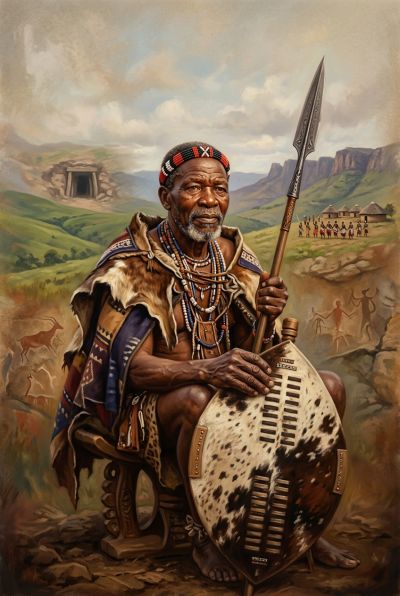
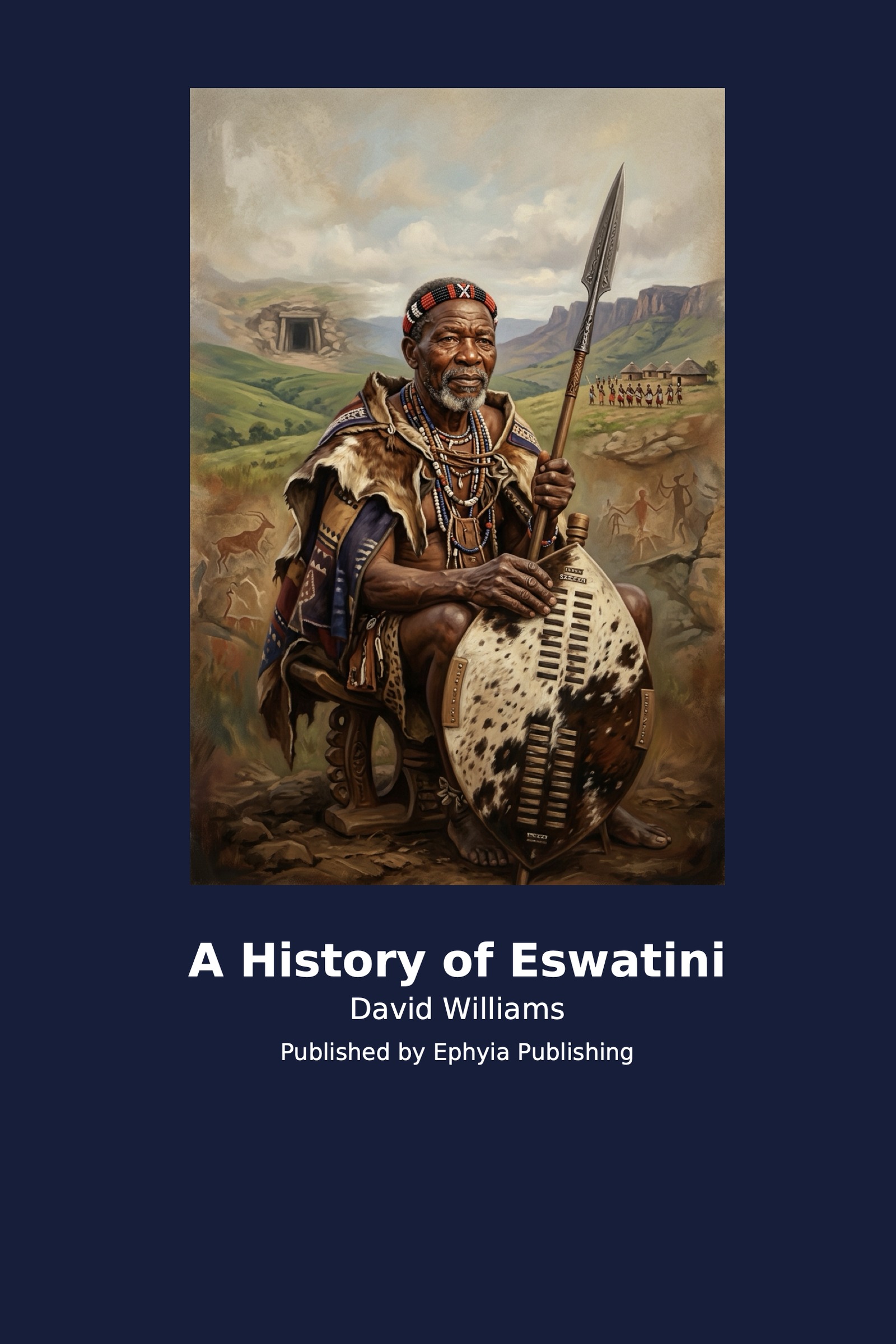
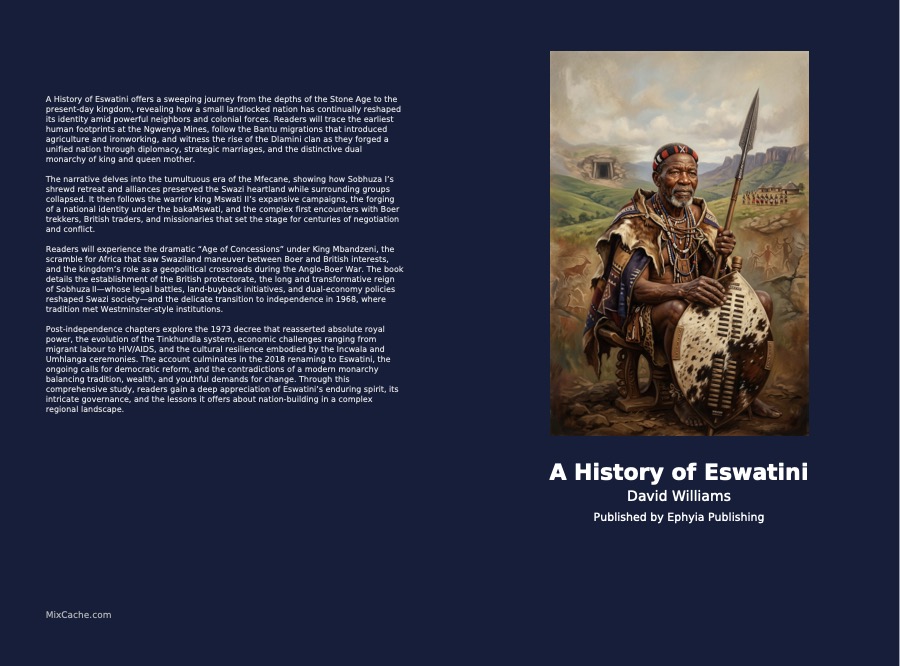
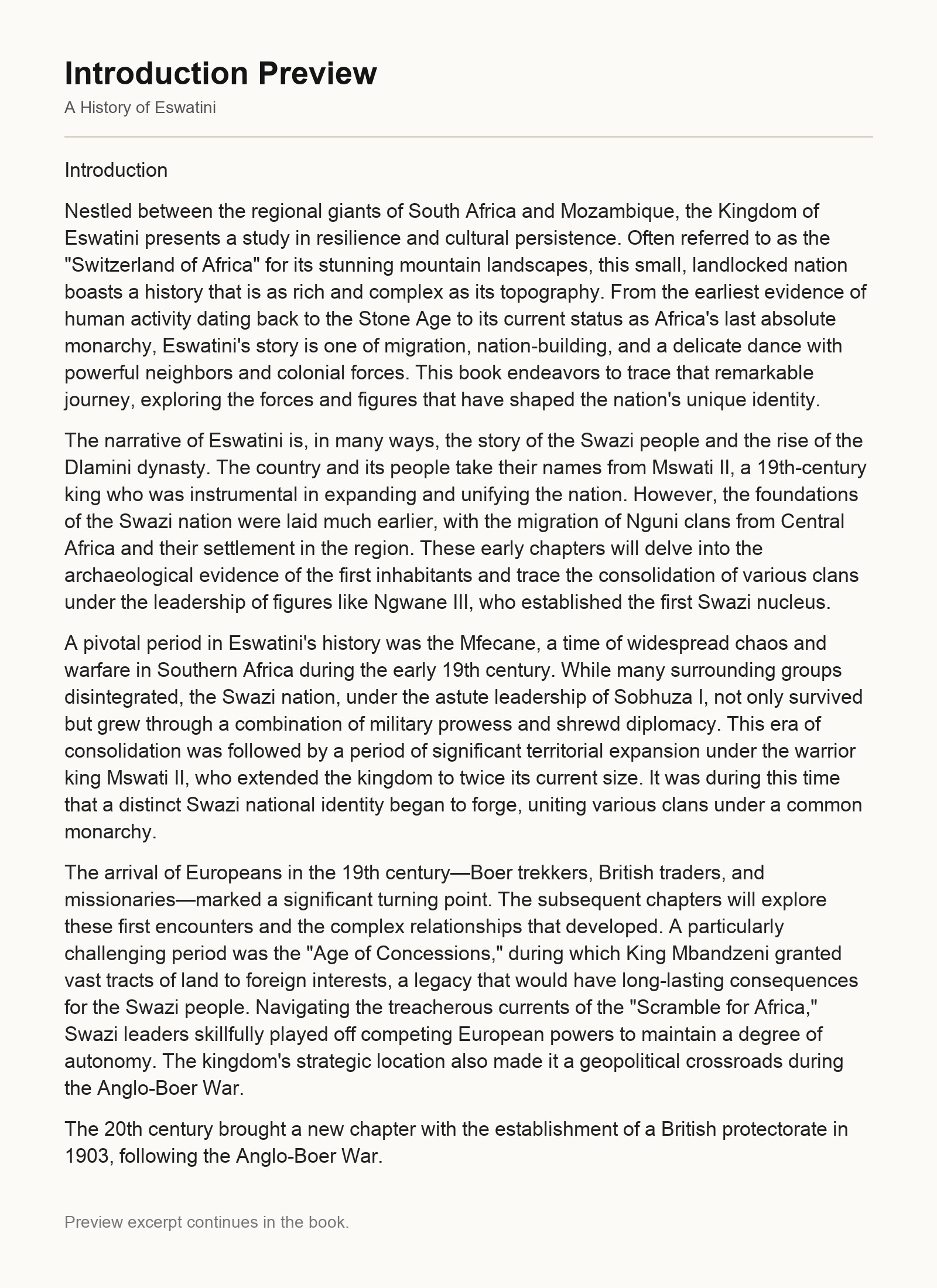
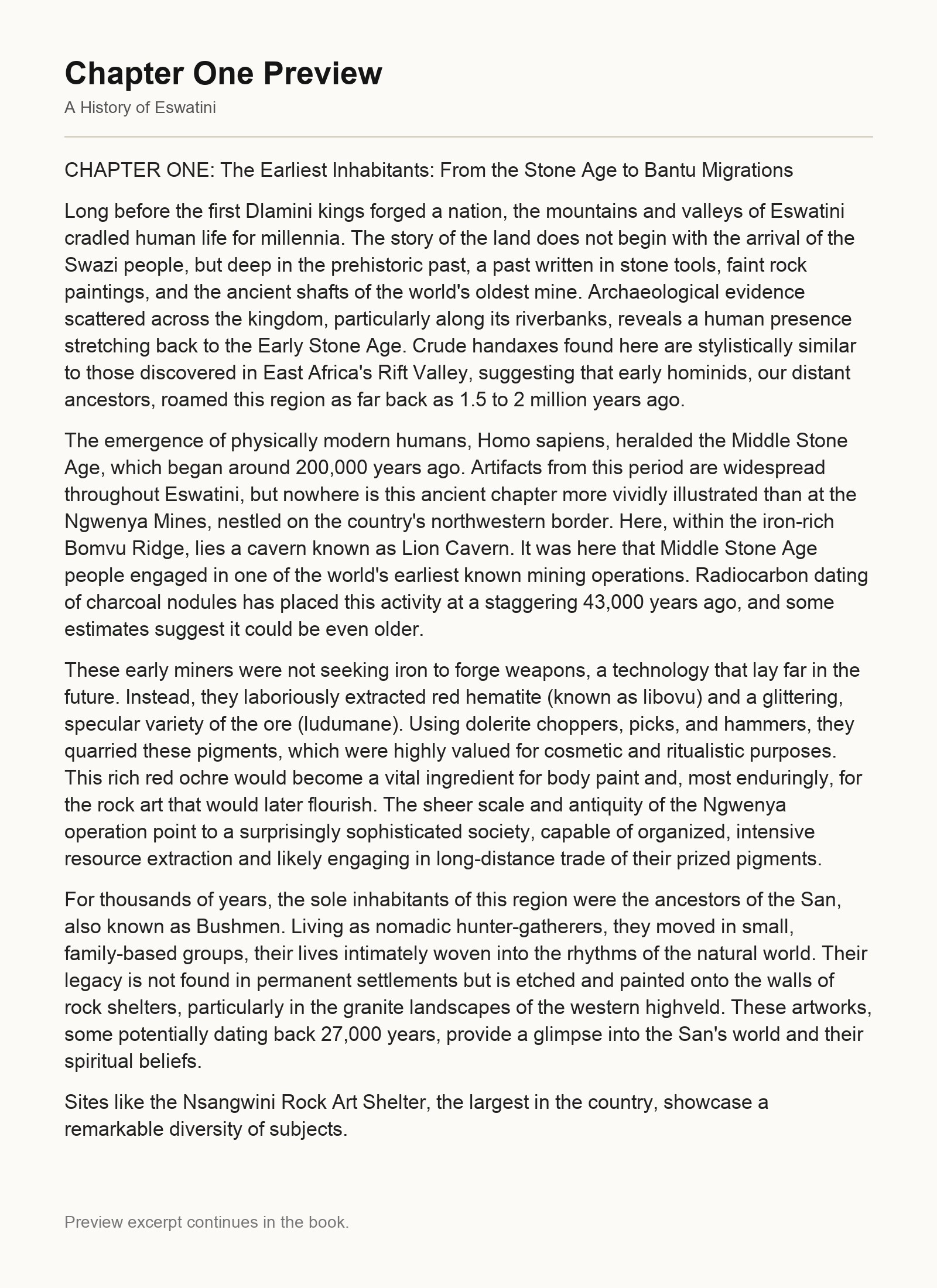
A History of Eswatini offers a sweeping journey from the depths of the Stone Age to the present‑day kingdom, revealing how a small landlocked nation has continually reshaped its identity amid powerful neighbors and colonial forces. Readers will trace the earliest human footprints at the Ngwenya Mines, follow the Bantu migrations that introduced agriculture and ironworking, and witness the rise of the Dlamini clan as they forged a unified nation through diplomacy, strategic marriages, and the distinctive dual monarchy of king and queen mother.
The narrative delves into the tumultuous era of the Mfecane, showing how Sobhuza I’s shrewd retreat and alliances preserved the Swazi heartland while surrounding groups collapsed. It then follows the warrior king Mswati II’s expansive campaigns, the forging of a national identity under the bakaMswati, and the complex first encounters with Boer trekkers, British traders, and missionaries that set the stage for centuries of negotiation and conflict.
Readers will experience the dramatic “Age of Concessions” under King Mbandzeni, the scramble for Africa that saw Swaziland maneuver between Boer and British interests, and the kingdom’s role as a geopolitical crossroads during the Anglo‑Boer War. The book details the establishment of the British protectorate, the long and transformative reign of Sobhuza II—whose legal battles, land‑buyback initiatives, and dual‑economy policies reshaped Swazi society—and the delicate transition to independence in 1968, where tradition met Westminster‑style institutions.
Post‑independence chapters explore the 1973 decree that reasserted absolute royal power, the evolution of the Tinkhundla system, economic challenges ranging from migrant labour to HIV/AIDS, and the cultural resilience embodied by the Incwala and Umhlanga ceremonies. The account culminates in the 2018 renaming to Eswatini, the ongoing calls for democratic reform, and the contradictions of a modern monarchy balancing tradition, wealth, and youthful demands for change. Through this comprehensive study, readers gain a deep appreciation of Eswatini’s enduring spirit, its intricate governance, and the lessons it offers about nation‑building in a complex regional landscape.
What You'll Find Inside:
- Traces Eswatini's deep roots from Stone Age hunter-gatherers and San rock art through Bantu migrations and early iron smelting at Ngwenya Mines.
- Details the rise of the Dlamini clan, the formation of the dual monarchy (Ngwenyama and Indlovukazi), and the forging of a unified Swazi identity.
- Examines pivotal eras such as the Mfecane, Sobhuza I's diplomatic survival, Mswati II's territorial expansion, and the colonial land concessions that dispossessed the Swazi people.
- Covers the path to independence in 1968, Sobhuza II's record‑long reign, the 1973 repeal of the constitution, and the establishment of absolute monarchy under the Tinkhundla system.
- Discusses modern Eswatini: economic challenges, the HIV/AIDS epidemic, cultural persistence, the 2018 rename to Eswatini, and ongoing calls for democratic reform.
Who's It For:
This book is ideal for students and scholars of African history, particularly those focusing on Southern Africa, colonialism, and post‑colonial state formation. It also appeals to general readers interested in understanding how a small nation preserved its cultural identity amid powerful neighbors, and to anyone studying the dynamics of absolute monarchy in the contemporary world.
Table of Contents:
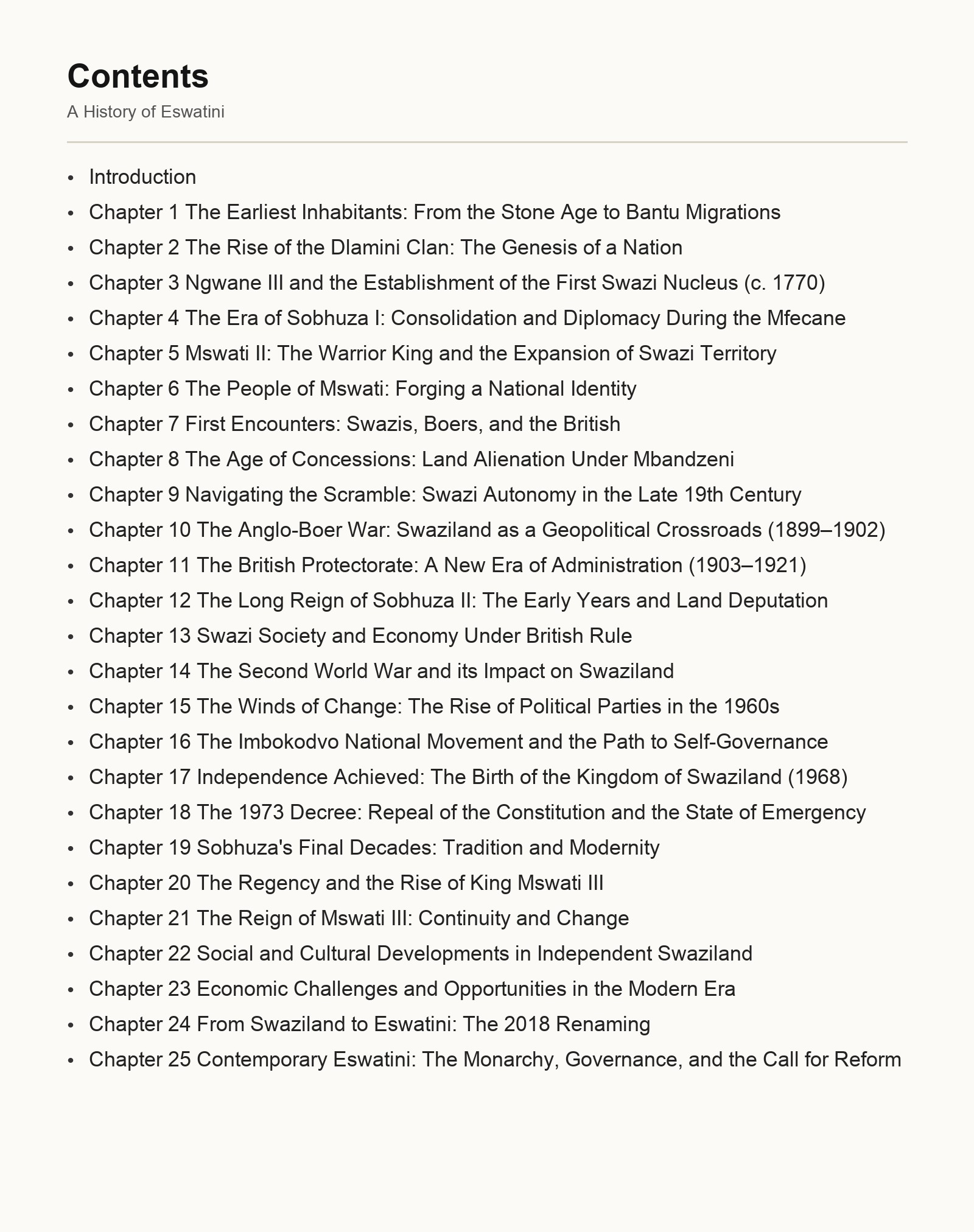
- Introduction
- Chapter 1 The Earliest Inhabitants: From the Stone Age to Bantu Migrations
- Chapter 2 The Rise of the Dlamini Clan: The Genesis of a Nation
- Chapter 3 Ngwane III and the Establishment of the First Swazi Nucleus (c. 1770)
- Chapter 4 The Era of Sobhuza I: Consolidation and Diplomacy During the Mfecane
- Chapter 5 Mswati II: The Warrior King and the Expansion of Swazi Territory
- Chapter 6 The People of Mswati: Forging a National Identity
- Chapter 7 First Encounters: Swazis, Boers, and the British
- Chapter 8 The Age of Concessions: Land Alienation Under Mbandzeni
- Chapter 9 Navigating the Scramble: Swazi Autonomy in the Late 19th Century
- Chapter 10 The Anglo-Boer War: Swaziland as a Geopolitical Crossroads (1899–1902)
- Chapter 11 The British Protectorate: A New Era of Administration (1903–1921)
- Chapter 12 The Long Reign of Sobhuza II: The Early Years and Land Deputation
- Chapter 13 Swazi Society and Economy Under British Rule
- Chapter 14 The Second World War and its Impact on Swaziland
- Chapter 15 The Winds of Change: The Rise of Political Parties in the 1960s
- Chapter 16 The Imbokodvo National Movement and the Path to Self-Governance
- Chapter 17 Independence Achieved: The Birth of the Kingdom of Swaziland (1968)
- Chapter 18 The 1973 Decree: Repeal of the Constitution and the State of Emergency
- Chapter 19 Sobhuza's Final Decades: Tradition and Modernity
- Chapter 20 The Regency and the Rise of King Mswati III
- Chapter 21 The Reign of Mswati III: Continuity and Change
- Chapter 22 Social and Cultural Developments in Independent Swaziland
- Chapter 23 Economic Challenges and Opportunities in the Modern Era
- Chapter 24 From Swaziland to Eswatini: The 2018 Renaming
- Chapter 25 Contemporary Eswatini: The Monarchy, Governance, and the Call for Reform
Author:
Published By:
Date Published:
May 21, 2026
Type:
Nonfiction
Language:
English
Also Available In:
Word Count:
37,315 words
Reading Time:
2 hours 37 minutes
Sample:
Order:
Buy the A History of Eswatini ebook on MixCache.com:
Buy NowThe full ebook will be available immediately to read instantly on any device.
$5 account credit for all new MixCache.com accounts, usable toward any ebook purchase!*


Ratings & Reviews
Ask Questions About This Book
Have a question about the content? Ask our AI assistant!
Start by asking a question about "A History of Eswatini"
Example: "Does this book mention William Shakespeare?"
Thinking...