
Browse by Category
Fiction
- Action & Adventure
- African American
- Anthologies
- Children's Fiction
- Classics
- Comics & Graphic Novels
- Coming of Age
- Contemporary
- Cultural & Regional
- Drama
- Erotica
- Fantasy
- General
- Historical Fiction
- Horror
- Humor & Satire
- Literary Fiction
- Mystery, Thriller & Suspense
- Poetry
- Religious & Inspirational
- Romance
- Science Fiction
- Short Stories
- War & Military
- Westerns
- Women's Fiction
- Young Adult
Non-Fiction
- Antiques & Collectibles
- Arts & Photography
- Biographies & Memoirs
- Business & Money
- Children's Non-Fiction
-
Computers & Technology
- Artificial Intelligence
- Computer Science
- Cybersecurity & Cryptography
- Data Science & Analytics
- Databases & Big Data
- Game Development & Design
- General
- Hardware & DIY
- Mobile App Development
- Networking & Cloud Computing
- Operating Systems
- Programming
- Robotics
- Software
- Software Engineering
- User Experience (UX) & Design
- Web Development & Design
- Cooking, Food & Wine
- Crafts, Hobbies & Home
- Education & Teaching
- Engineering
- General
- Health, Fitness & Dieting
-
History
- African History
- African History - North Africa
- African History - Sub-Saharan Africa
- American History
- American History - 20th Century
- American History - Civil War
- American History - Colonial Period
- Ancient History
- Asian History
- Asian History - China
- Asian History - India
- Asian History - Japan
- Asian History - Southeast Asia
- European History
- European History - Ancient Greece
- European History - Ancient Rome
- European History - Medieval
- European History - Modern
- European History - Renaissance
- General
- Middle Eastern History
- Military History
- Military History - Aviation
- Military History - Naval
- Social & Cultural History
- World History
- Humor & Entertainment
- Industrial Technology
- Language Learning
- Law
- LGBTQ+ Non-Fiction
- Literary Criticism
- Medical Books
- Parenting & Relationships
- Philosophy
- Politics & Social Sciences
- Reference
- Religion & Spirituality
-
Science & Math
- Agricultural Sciences
- Astronomy & Space Science
- Behavioral Sciences
- Biological Sciences
- Botany & Plant Science
- Chemistry
- Earth Sciences
- Engineering - Chemical
- Engineering - Civil
- Engineering - Electrical
- Engineering - Mechanical
- Environment
- General
- Geology
- Mathematics
- Nature & Ecology
- Oceanography
- Paleontology
- Physics
- Statistics
- Self-Help
- Sports & Outdoors
- Study Aids
- Sustainability & Green Living
- Textbooks
- Transportation
- Travel
- True Crime
- Urban Planning & Development
- Veterinary Medicine
- Writing & Publishing
Jump to Section
MixCache.com Total Access
Unlimited reading and audiobooks for every book published by MixCache.com.
Included titles carry the MTA badge.
Learn more →A History of Meteorology
About this book:
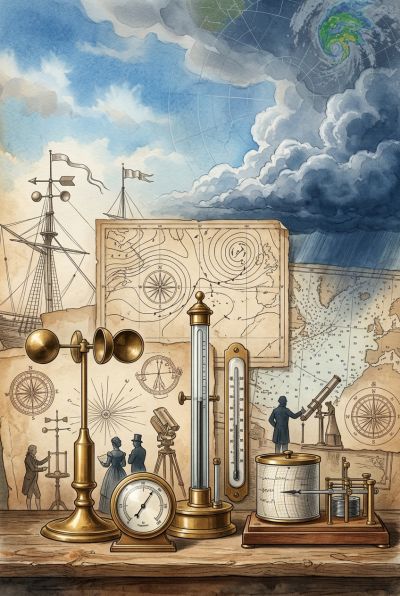
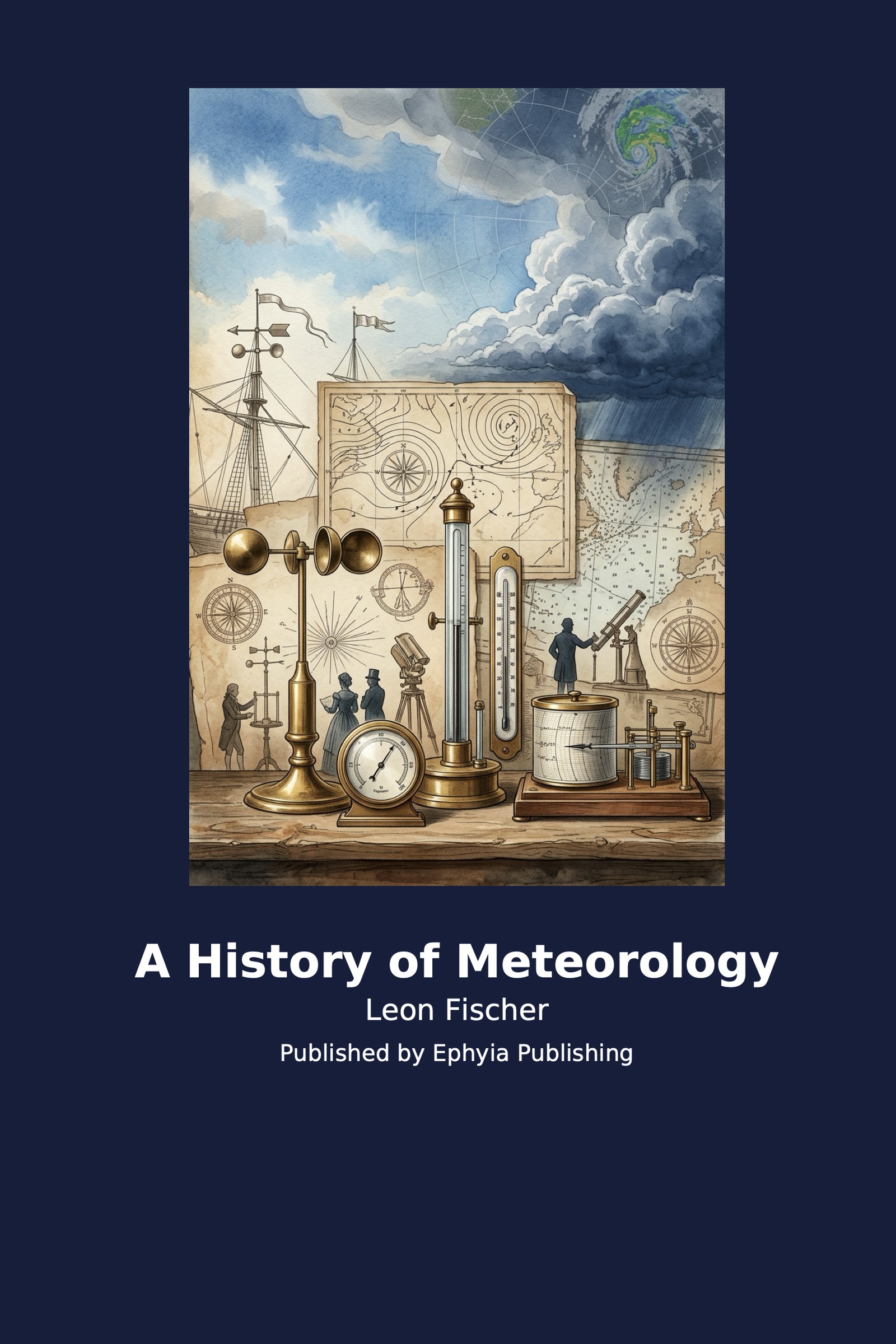

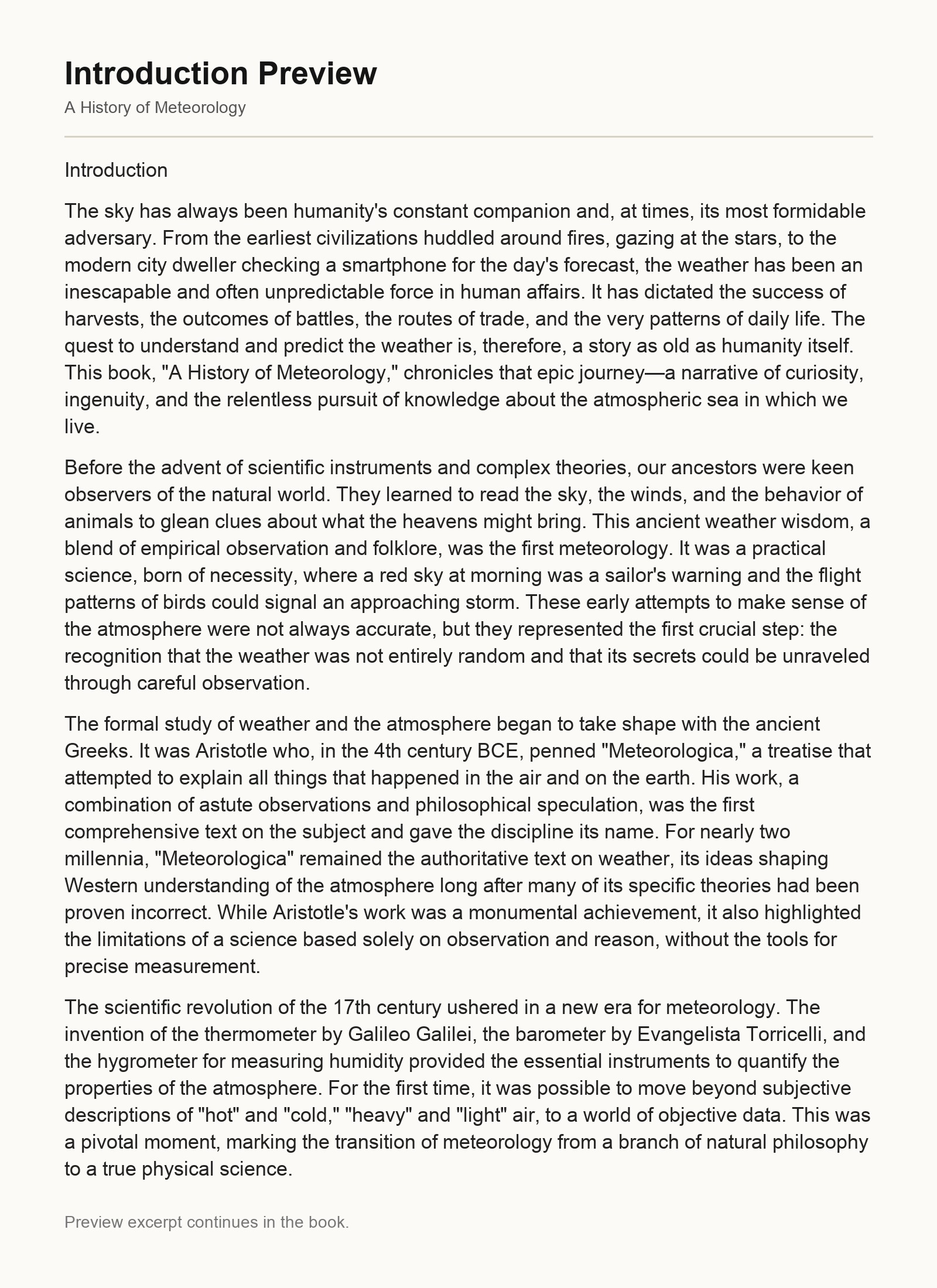
From the earliest stargazers who read the sky for omens of rain to the modern forecasters who consult satellite images on their smartphones, humanity’s relationship with the atmosphere has been one of constant curiosity and necessity. This book traces that enduring quest, beginning with the weather wisdom of ancient civilizations—from Babylonian oracle bones to Egyptian Nile forecasts and Polynesian wayfinding—showing how observation, folklore, and practical need laid the first foundations of meteorology.
Readers will then journey through the intellectual breakthroughs that transformed weather lore into a science. They will discover Aristotle’s early treatise that gave the field its name, the revolutionary instruments of the Scientific Revolution—thermometers, barometers, and hygrometers—that turned qualitative guesses into measurable data, and the daring experiments of figures like Benjamin Franklin, whose kite proved lightning’s electrical nature and gave us the lightning rod. The narrative continues with Luke Howard’s cloud classification, the birth of synoptic charts via the telegraph, and the formation of the first national weather services driven by maritime disasters and war.
The work delves into the pivotal moments that reshaped our understanding of the atmosphere itself. It explains how the Bergen School uncovered the concepts of air masses and fronts, how upper‑air soundings from kites and balloons revealed the layered structure of the troposphere and stratosphere, and how World War II’s need for accurate forecasts—most famously the D‑Day prediction—pushed meteorology into a global, data‑driven enterprise. Subsequent chapters illuminate the rise of numerical weather prediction, the dawn of weather satellites, the discovery of El Niño, and the growing fields of atmospheric chemistry and climate change that revealed humanity’s profound impact on the sky.
Beyond the science, the book explores how forecasts are made useful and trusted. Readers will learn about the Doppler radar revolution that lets us see inside storms, the ensemble forecasting methods that embrace chaos theory’s limits, and the vital role of social science in shaping warnings that prompt protective action. It also surveys the modern weather enterprise—where public agencies, private innovators, and academic researchers intersect—and looks ahead to the future of forecasting, where artificial intelligence, machine learning, and advanced remote sensing promise to reshape how we anticipate and respond to an ever‑changing atmosphere. By the end, readers will not only know the history of meteorology but also appreciate the complex, human‑centered process that turns data about the sky into decisions that protect lives and livelihoods.
What You'll Find Inside:
- Traces meteorology's evolution from ancient observational practices and Aristotle's theories to modern scientific understanding through technological innovation.
- Highlights pivotal inventions like the thermometer, barometer, telegraph, radiosonde, weather satellites, and Doppler radar that transformed forecasting capabilities.
- Explores key theoretical breakthroughs including the discovery of air masses and fronts, chaos theory's limits on predictability, and the science of climate change.
- Examines meteorology's critical role in historical events such as the D-Day invasion, the Dust Bowl, and both World Wars.
- Details the modern weather enterprise, covering public and private sectors, extreme weather attribution, and the future of forecasting with AI and machine learning.
Who's It For:
This book is ideal for students, researchers, and professionals in meteorology, atmospheric science, and climatology seeking a comprehensive historical foundation. It will also appeal to history of science enthusiasts and general readers interested in how weather forecasting has evolved and impacted human affairs throughout history. Anyone curious about the scientific journey to understand and predict our atmosphere will find this narrative both informative and engaging.
Table of Contents:
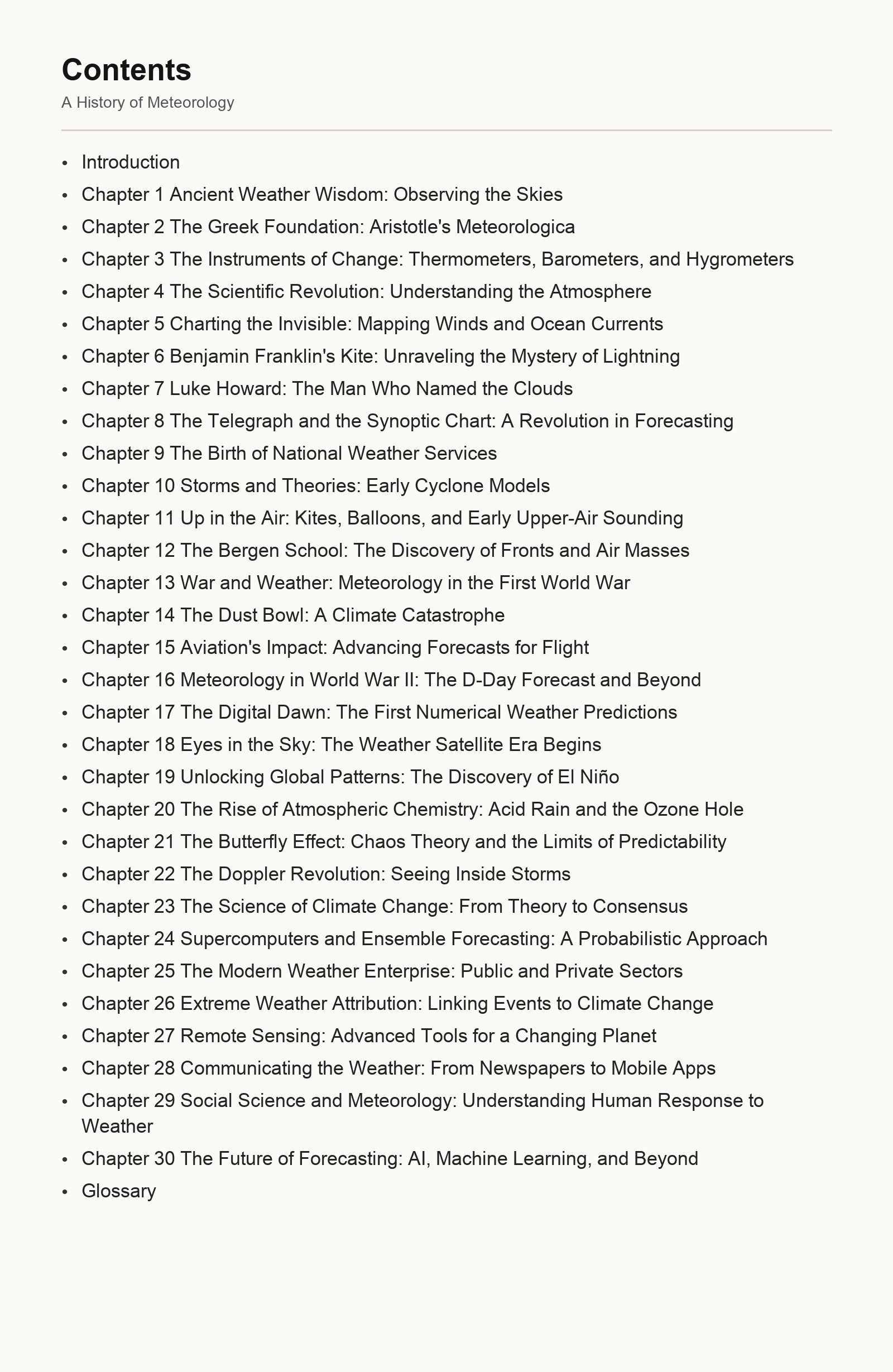
- Introduction
- Chapter 1 Ancient Weather Wisdom: Observing the Skies
- Chapter 2 The Greek Foundation: Aristotle's Meteorologica
- Chapter 3 The Instruments of Change: Thermometers, Barometers, and Hygrometers
- Chapter 4 The Scientific Revolution: Understanding the Atmosphere
- Chapter 5 Charting the Invisible: Mapping Winds and Ocean Currents
- Chapter 6 Benjamin Franklin's Kite: Unraveling the Mystery of Lightning
- Chapter 7 Luke Howard: The Man Who Named the Clouds
- Chapter 8 The Telegraph and the Synoptic Chart: A Revolution in Forecasting
- Chapter 9 The Birth of National Weather Services
- Chapter 10 Storms and Theories: Early Cyclone Models
- Chapter 11 Up in the Air: Kites, Balloons, and Early Upper-Air Sounding
- Chapter 12 The Bergen School: The Discovery of Fronts and Air Masses
- Chapter 13 War and Weather: Meteorology in the First World War
- Chapter 14 The Dust Bowl: A Climate Catastrophe
- Chapter 15 Aviation's Impact: Advancing Forecasts for Flight
- Chapter 16 Meteorology in World War II: The D-Day Forecast and Beyond
- Chapter 17 The Digital Dawn: The First Numerical Weather Predictions
- Chapter 18 Eyes in the Sky: The Weather Satellite Era Begins
- Chapter 19 Unlocking Global Patterns: The Discovery of El Niño
- Chapter 20 The Rise of Atmospheric Chemistry: Acid Rain and the Ozone Hole
- Chapter 21 The Butterfly Effect: Chaos Theory and the Limits of Predictability
- Chapter 22 The Doppler Revolution: Seeing Inside Storms
- Chapter 23 The Science of Climate Change: From Theory to Consensus
- Chapter 24 Supercomputers and Ensemble Forecasting: A Probabilistic Approach
- Chapter 25 The Modern Weather Enterprise: Public and Private Sectors
- Chapter 26 Extreme Weather Attribution: Linking Events to Climate Change
- Chapter 27 Remote Sensing: Advanced Tools for a Changing Planet
- Chapter 28 Communicating the Weather: From Newspapers to Mobile Apps
- Chapter 29 Social Science and Meteorology: Understanding Human Response to Weather
- Chapter 30 The Future of Forecasting: AI, Machine Learning, and Beyond
- Glossary
Author:
Published By:
Date Published:
May 19, 2026
Type:
Nonfiction
Language:
English
Also Available In:
Word Count:
70,211 words
Reading Time:
4 hours 55 minutes
Sample:
Order:
Buy the A History of Meteorology ebook on MixCache.com:
Buy NowThe full ebook will be available immediately to read instantly on any device.
$5 account credit for all new MixCache.com accounts, usable toward any ebook purchase!*





Ratings & Reviews
Ask Questions About This Book
Have a question about the content? Ask our AI assistant!
Start by asking a question about "A History of Meteorology"
Example: "Does this book mention William Shakespeare?"
Thinking...