
Browse by Category
Fiction
- Action & Adventure
- African American
- Anthologies
- Children's Fiction
- Classics
- Comics & Graphic Novels
- Coming of Age
- Contemporary
- Cultural & Regional
- Drama
- Erotica
- Fantasy
- General
- Historical Fiction
- Horror
- Humor & Satire
- Literary Fiction
- Mystery, Thriller & Suspense
- Poetry
- Religious & Inspirational
- Romance
- Science Fiction
- Short Stories
- War & Military
- Westerns
- Women's Fiction
- Young Adult
Non-Fiction
- Antiques & Collectibles
- Arts & Photography
- Biographies & Memoirs
- Business & Money
- Children's Non-Fiction
-
Computers & Technology
- Artificial Intelligence
- Computer Science
- Cybersecurity & Cryptography
- Data Science & Analytics
- Databases & Big Data
- Game Development & Design
- General
- Hardware & DIY
- Mobile App Development
- Networking & Cloud Computing
- Operating Systems
- Programming
- Robotics
- Software
- Software Engineering
- User Experience (UX) & Design
- Web Development & Design
- Cooking, Food & Wine
- Crafts, Hobbies & Home
- Education & Teaching
- Engineering
- General
- Health, Fitness & Dieting
-
History
- African History
- African History - North Africa
- African History - Sub-Saharan Africa
- American History
- American History - 20th Century
- American History - Civil War
- American History - Colonial Period
- Ancient History
- Asian History
- Asian History - China
- Asian History - India
- Asian History - Japan
- Asian History - Southeast Asia
- European History
- European History - Ancient Greece
- European History - Ancient Rome
- European History - Medieval
- European History - Modern
- European History - Renaissance
- General
- Middle Eastern History
- Military History
- Military History - Aviation
- Military History - Naval
- Social & Cultural History
- World History
- Humor & Entertainment
- Industrial Technology
- Language Learning
- Law
- LGBTQ+ Non-Fiction
- Literary Criticism
- Medical Books
- Parenting & Relationships
- Philosophy
- Politics & Social Sciences
- Reference
- Religion & Spirituality
-
Science & Math
- Agricultural Sciences
- Astronomy & Space Science
- Behavioral Sciences
- Biological Sciences
- Botany & Plant Science
- Chemistry
- Earth Sciences
- Engineering - Chemical
- Engineering - Civil
- Engineering - Electrical
- Engineering - Mechanical
- Environment
- General
- Geology
- Mathematics
- Nature & Ecology
- Oceanography
- Paleontology
- Physics
- Statistics
- Self-Help
- Sports & Outdoors
- Study Aids
- Sustainability & Green Living
- Textbooks
- Transportation
- Travel
- True Crime
- Urban Planning & Development
- Veterinary Medicine
- Writing & Publishing
Jump to Section
MixCache.com Total Access
Unlimited reading and audiobooks for every book published by MixCache.com.
Included titles carry the MTA badge.
Learn more →A History of Oceanography
About this book:
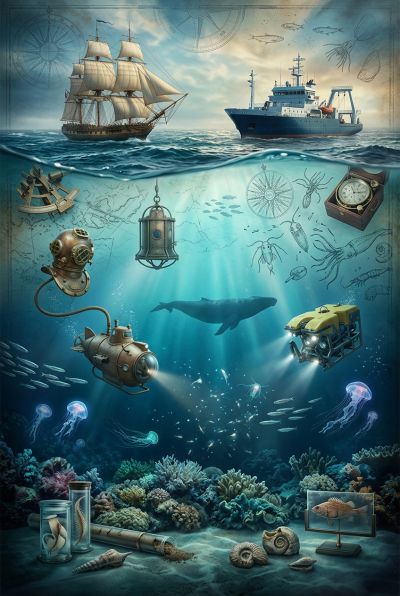
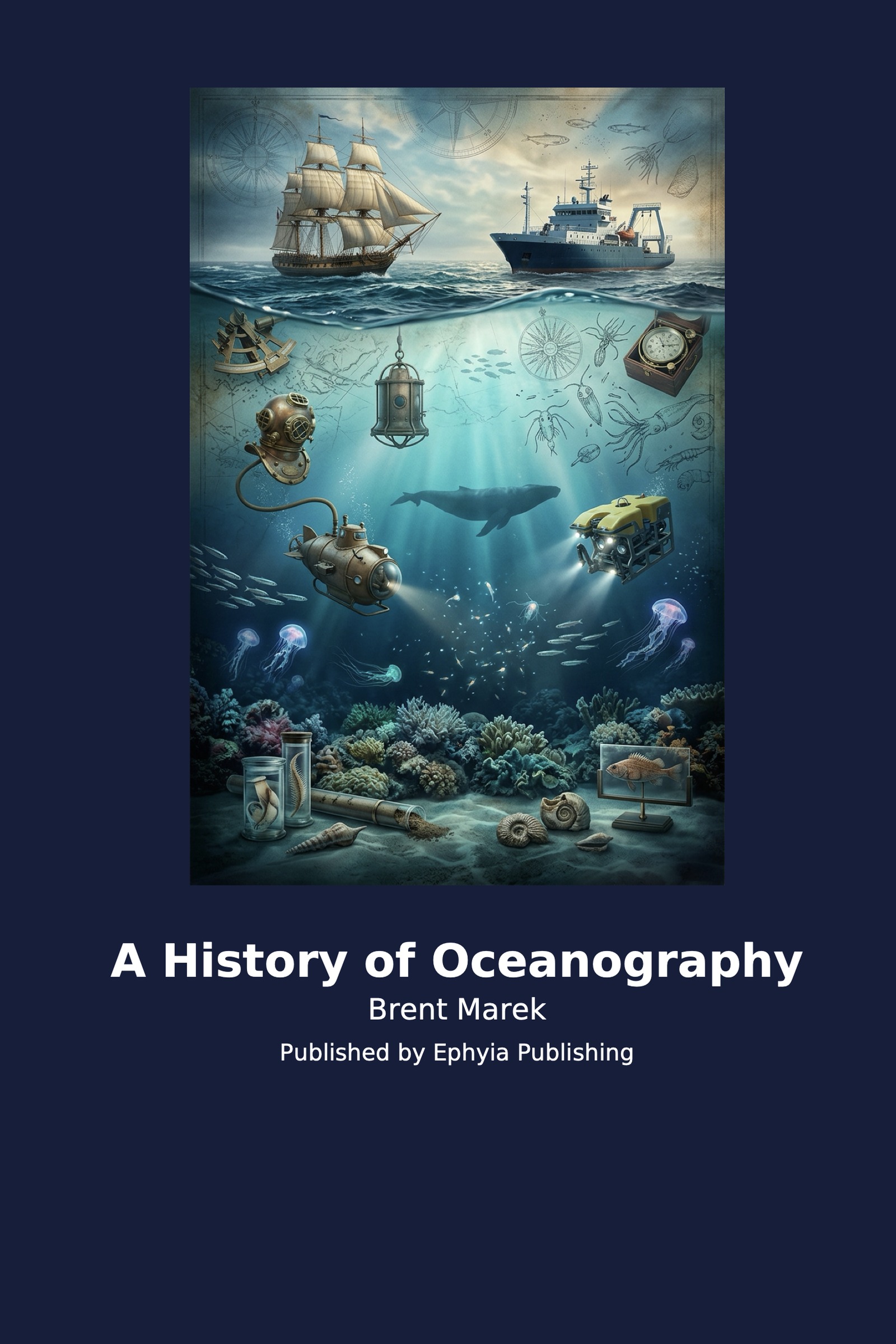
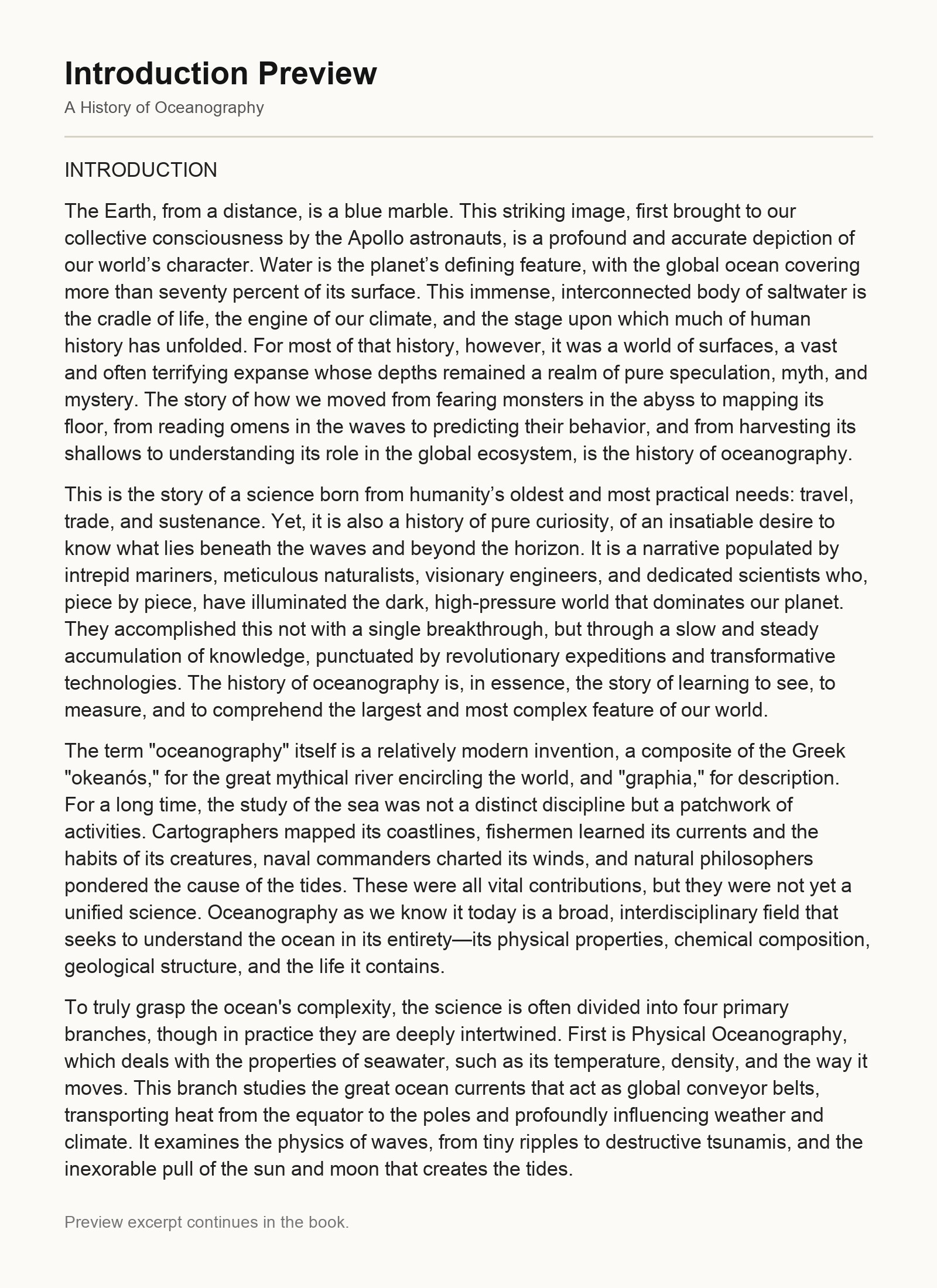
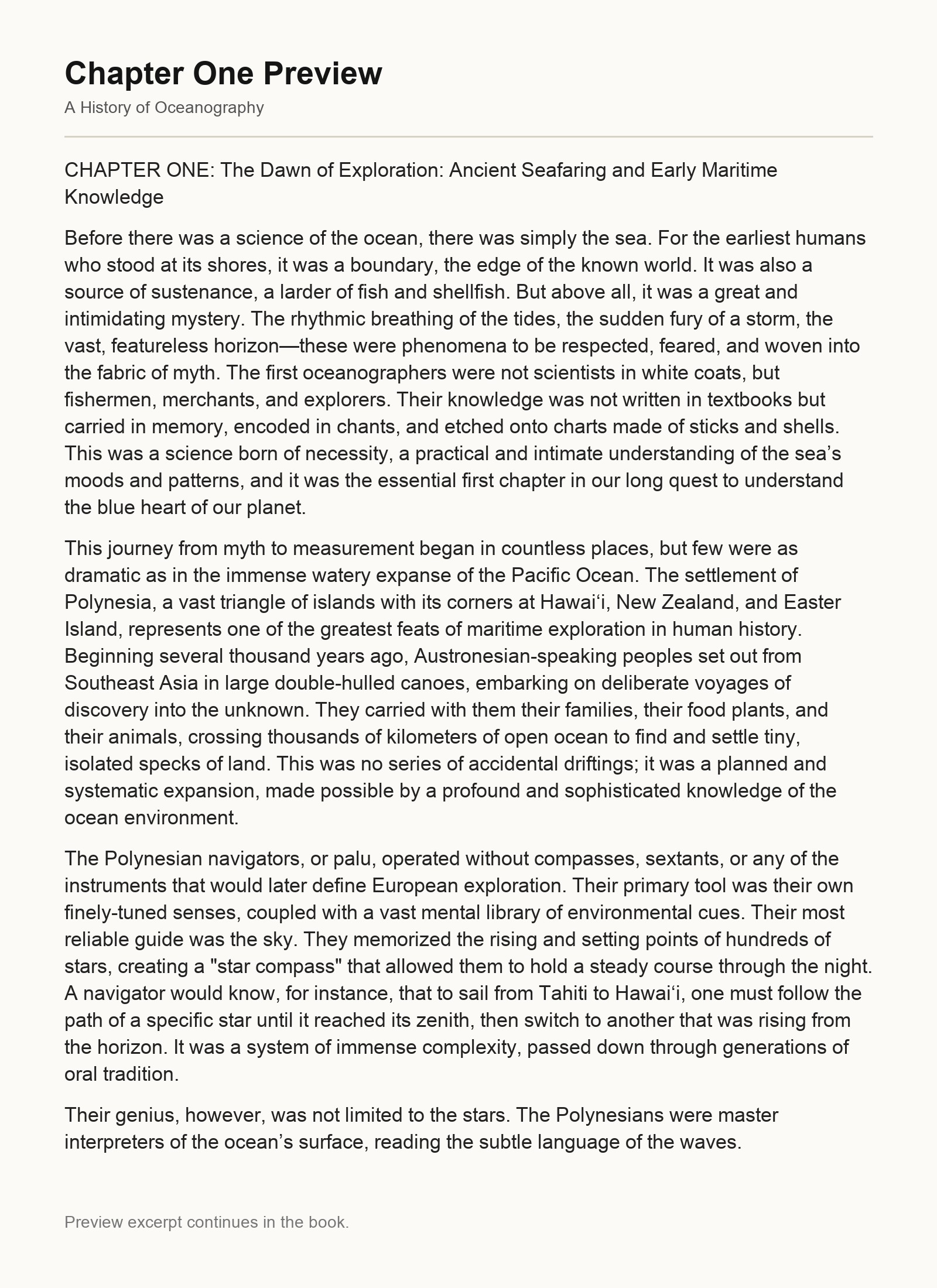
Dive into the sweeping saga of how humanity came to know the vast, mysterious ocean that covers our planet. From the daring star‑guided voyages of Polynesian navigators and the pragmatic wind‑charts of Phoenician traders to the bold circumnavigations of Magellan and the painstaking depth soundings of the HMS Challenger, this book traces every leap of curiosity and technology that turned myth into measurement. Readers will walk alongside ancient mariners who read swells and seabirds, witness the birth of modern science in the Challenger’s fifty‑volume report, and feel the excitement of discovering hydrothermal vents teeming with life in the sunless deep.
The narrative unfolds the scientific revolutions that reshaped our understanding of Earth itself. You will learn how early physicists unraveled the tides, how the invention of the marine chronometer solved the longitude problem, and how the painstaking work of mapping ocean currents revealed the great gyres that drive global climate. The book then carries you through the seismic breakthroughs of plate tectonics, showing how sonar, magnetic striping, and deep‑sea drilling turned the ocean floor into a dynamic, moving landscape that explains earthquakes, volcanoes, and the very shape of continents.
Beyond physics and geology, immerse yourself in the ocean’s living world. Explore the rise of marine biology from Aristotle’s observations to the discovery of chemosynthetic ecosystems at black smokers, and follow the intricate food webs that link microscopic phytoplankton to great whales. You will experience the triumphs and trials of fisheries science, the revelation of coral bleaching as a climate warning, and the startling insight that ocean acidification is silently dissolving the shells of plankton, oysters, and corals—forcing a reevaluation of what life in the sea can endure.
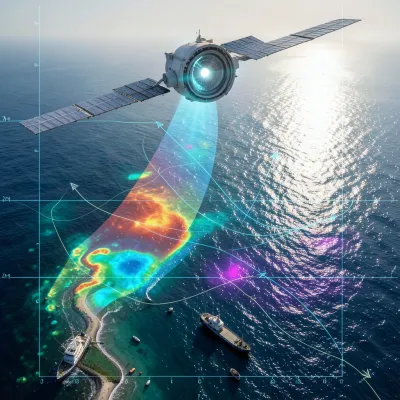
Finally, the book brings you to the cutting edge of twenty‑first‑century oceanography, where satellites, autonomous robots, and genomic sequencers create a continuous, real‑time view of the sea’s interior. You will see how data from Argo floats, cabled observatories, and environmental DNA are transforming our ability to predict El Niño, map the twilight zone, and monitor the health of polar ice shelves. By the end, readers will not only grasp the history of a science but also appreciate the ocean’s central role in Earth’s climate, biodiversity, and future—equipping them to understand the challenges and wonders that lie ahead in our interconnected blue planet.
What You'll Find Inside:
- The evolution from ancient Polynesian star navigation and Viking sunstone techniques to modern satellite and robotic ocean monitoring systems
- How the Challenger Expedition (1872-1876) established oceanography as a formal scientific discipline by disproving the azoic theory and collecting foundational data
- The plate tectonics revolution that emerged from seafloor spreading discoveries and magnetic striping patterns mapped by oceanographers
- The discovery of hydrothermal vents and chemosynthetic ecosystems that redefined our understanding of where life can exist on Earth
- How oceanography has evolved to address 21st-century challenges including climate change, ocean acidification, and marine pollution through integrated Earth system science
Who's It For:
This book is ideal for undergraduate and graduate students in oceanography, marine biology, earth sciences, and environmental studies seeking a comprehensive historical foundation for their field. It will also benefit researchers and professionals looking to contextualize their work within the broader evolution of oceanographic science. Educators will find it valuable for course development, while scientifically literate general readers interested in exploration, climate science, or Earth's systems will appreciate its engaging narrative of how humanity came to understand the ocean. The interdisciplinary nature of the content makes it relevant to anyone studying the connections between geology, chemistry, biology, and physics in marine environments.
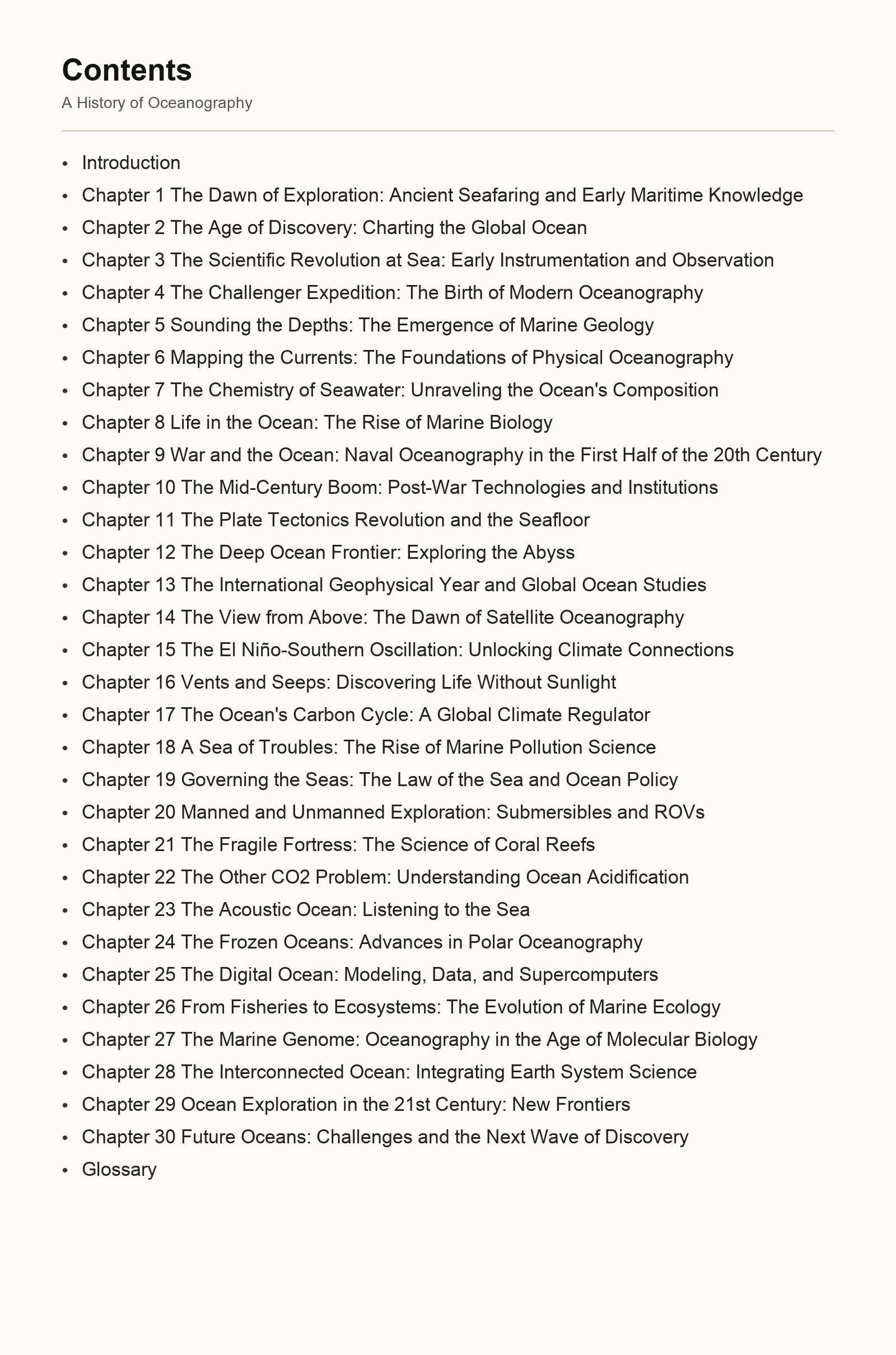
Table of Contents:
- Introduction
- Chapter 1 The Dawn of Exploration: Ancient Seafaring and Early Maritime Knowledge
- Chapter 2 The Age of Discovery: Charting the Global Ocean
- Chapter 3 The Scientific Revolution at Sea: Early Instrumentation and Observation
- Chapter 4 The Challenger Expedition: The Birth of Modern Oceanography
- Chapter 5 Sounding the Depths: The Emergence of Marine Geology
- Chapter 6 Mapping the Currents: The Foundations of Physical Oceanography
- Chapter 7 The Chemistry of Seawater: Unraveling the Ocean's Composition
- Chapter 8 Life in the Ocean: The Rise of Marine Biology
- Chapter 9 War and the Ocean: Naval Oceanography in the First Half of the 20th Century
- Chapter 10 The Mid-Century Boom: Post-War Technologies and Institutions
- Chapter 11 The Plate Tectonics Revolution and the Seafloor
- Chapter 12 The Deep Ocean Frontier: Exploring the Abyss
- Chapter 13 The International Geophysical Year and Global Ocean Studies
- Chapter 14 The View from Above: The Dawn of Satellite Oceanography
- Chapter 15 The El Niño-Southern Oscillation: Unlocking Climate Connections
- Chapter 16 Vents and Seeps: Discovering Life Without Sunlight
- Chapter 17 The Ocean's Carbon Cycle: A Global Climate Regulator
- Chapter 18 A Sea of Troubles: The Rise of Marine Pollution Science
- Chapter 19 Governing the Seas: The Law of the Sea and Ocean Policy
- Chapter 20 Manned and Unmanned Exploration: Submersibles and ROVs
- Chapter 21 The Fragile Fortress: The Science of Coral Reefs
- Chapter 22 The Other CO2 Problem: Understanding Ocean Acidification
- Chapter 23 The Acoustic Ocean: Listening to the Sea
- Chapter 24 The Frozen Oceans: Advances in Polar Oceanography
- Chapter 25 The Digital Ocean: Modeling, Data, and Supercomputers
- Chapter 26 From Fisheries to Ecosystems: The Evolution of Marine Ecology
- Chapter 27 The Marine Genome: Oceanography in the Age of Molecular Biology
- Chapter 28 The Interconnected Ocean: Integrating Earth System Science
- Chapter 29 Ocean Exploration in the 21st Century: New Frontiers
- Chapter 30 Future Oceans: Challenges and the Next Wave of Discovery
- Glossary
Author:
Published By:
Date Published:
May 19, 2026
Type:
Nonfiction
Language:
English
Also Available In:
Word Count:
71,540 words
Reading Time:
5 hours 1 minutes
Sample:
Order:
Buy the A History of Oceanography ebook on MixCache.com:
Buy NowThe full ebook will be available immediately to read instantly on any device.
$5 account credit for all new MixCache.com accounts, usable toward any ebook purchase!*




Ratings & Reviews
Ask Questions About This Book
Have a question about the content? Ask our AI assistant!
Start by asking a question about "A History of Oceanography"
Example: "Does this book mention William Shakespeare?"
Thinking...