Browse by Category
Fiction
- Action & Adventure
- African American
- Anthologies
- Children's Fiction
- Classics
- Comics & Graphic Novels
- Coming of Age
- Contemporary
- Cultural & Regional
- Drama
- Erotica
- Fantasy
- General
- Historical Fiction
- Horror
- Humor & Satire
- Literary Fiction
- Mystery, Thriller & Suspense
- Poetry
- Religious & Inspirational
- Romance
- Science Fiction
- Short Stories
- War & Military
- Westerns
- Women's Fiction
- Young Adult
Non-Fiction
- Antiques & Collectibles
- Arts & Photography
- Biographies & Memoirs
- Business & Money
- Children's Non-Fiction
-
Computers & Technology
- Artificial Intelligence
- Computer Science
- Cybersecurity & Cryptography
- Data Science & Analytics
- Databases & Big Data
- Game Development & Design
- General
- Hardware & DIY
- Mobile App Development
- Networking & Cloud Computing
- Operating Systems
- Programming
- Robotics
- Software
- Software Engineering
- User Experience (UX) & Design
- Web Development & Design
- Cooking, Food & Wine
- Crafts, Hobbies & Home
- Education & Teaching
- Engineering
- General
- Health, Fitness & Dieting
-
History
- African History
- African History - North Africa
- African History - Sub-Saharan Africa
- American History
- American History - 20th Century
- American History - Civil War
- American History - Colonial Period
- Ancient History
- Asian History
- Asian History - China
- Asian History - India
- Asian History - Japan
- Asian History - Southeast Asia
- European History
- European History - Ancient Greece
- European History - Ancient Rome
- European History - Medieval
- European History - Modern
- European History - Renaissance
- General
- Middle Eastern History
- Military History
- Military History - Aviation
- Military History - Naval
- Social & Cultural History
- World History
- Humor & Entertainment
- Industrial Technology
- Language Learning
- Law
- LGBTQ+ Non-Fiction
- Literary Criticism
- Medical Books
- Parenting & Relationships
- Philosophy
- Politics & Social Sciences
- Reference
- Religion & Spirituality
-
Science & Math
- Agricultural Sciences
- Astronomy & Space Science
- Behavioral Sciences
- Biological Sciences
- Botany & Plant Science
- Chemistry
- Earth Sciences
- Engineering - Chemical
- Engineering - Civil
- Engineering - Electrical
- Engineering - Mechanical
- Environment
- General
- Geology
- Mathematics
- Nature & Ecology
- Oceanography
- Paleontology
- Physics
- Statistics
- Self-Help
- Sports & Outdoors
- Study Aids
- Sustainability & Green Living
- Textbooks
- Transportation
- Travel
- True Crime
- Urban Planning & Development
- Veterinary Medicine
- Writing & Publishing
Jump to Section
MixCache.com Total Access
Unlimited reading and audiobooks for every book published by MixCache.com.
Included titles carry the MTA badge.
Learn more →
The Black Sea Bridge: Trade, Culture, and Conflict on Europe's Eastern Edge
MTA
An exploration of the Black Sea region's role in European history and geopolitical tensions
About this book:
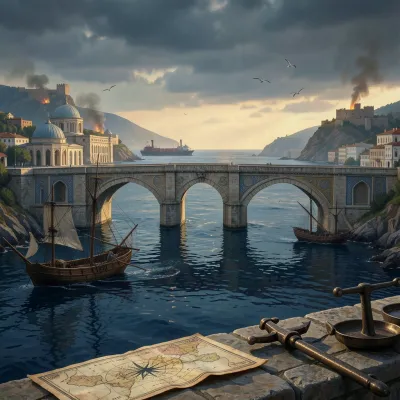
*The Black Sea Bridge* repositioned the Black Sea from a historical periphery to a central engine of European and Eurasian transformation. Moving chronologically from Bronze Age circuits to modern geopolitical flashpoints, the book explores how the region functioned as a vital conduit for trade, faith, and empire. It highlights the indispensable role of maritime nodes like Istanbul, Odesa, Varna, and Trabzon, which served as hinge points where local resources—grain, slaves, timber, and oil—met global demand.
A central pillar of the narrative is the resilience of trading diasporas, particularly Greeks, Armenians, Jews, and Tatars. These communities navigated the shifting boundaries of the Byzantine, Ottoman, Mongol, and Russian empires, creating durable networks of trust and credit that survived even as political flags changed. The book details how the sea oscillated between being an "imperial lake" and a contested commons, with the strategic control of the Turkish Straits remaining a constant obsession for regional powers from Rome to the Soviet Union.
The latter half of the book examines the radical shifts brought by modernity, including the industrialization of the grain trade, the medical and media revolutions of the Crimean War, and the arrival of steam and telegraph technologies. These advancements integrated the region into the global economy but also heightened the stakes of conflict. Twentieth-century upheavals, including the Holodomor, the Holocaust, and Cold War militarization, shattered the old cosmopolitan order, replacing it with rigid ideological and national borders.
In its concluding chapters, the work analyzes the post-Soviet landscape of privatization, energy corridors, and territorial disputes in Georgia and Ukraine. It emphasizes that while the commodities have shifted to hydrocarbons, the underlying logic of chokepoints and great-power competition remains unchanged. Ultimately, the book addresses the environmental crisis of the Anthropocene, arguing that the Black Sea’s future depends on reconciling its history of intense exploitation with the ecological limits of a fragile, enclosed sea.
What You'll Find Inside:
- The Black Sea served as a bridge connecting Europe, Asia, and the Middle East through millennia of trade, migration, and cultural exchange rather than merely acting as a regional boundary.
- Control of the Black Sea's strategic chokepoints—particularly the Turkish Straits and key ports—has consistently determined the balance of power among competing empires from ancient Greece to modern Russia.
- Diasporic communities including Armenians, Greeks, Jews, and Tatars created enduring commercial and cultural networks that functioned as vital intermediaries between rival empires and faiths.
- The region's commodities—from grain and slaves in antiquity to oil and gas in the modern era—have driven both economic integration and geopolitical conflict across centuries.
- From ancient trade routes to contemporary energy pipelines, the Black Sea's role as a conduit between continents has persisted through technological transformations, shaping East-West relations.
Who's It For:
This book is ideal for students and scholars of European, Eurasian, or Middle Eastern history seeking to understand the Black Sea's pivotal role in regional developments. It will particularly benefit those interested in maritime history, trade networks, and how geography influences geopolitical tensions, including contemporary conflicts involving Ukraine, Crimea, and Russia. Policy analysts and professionals working on Eastern European affairs will find valuable historical context for current events, while general readers fascinated by cultural exchange and empire-building will appreciate its comprehensive sweep from antiquity to the Anthropocene.
Table of Contents:
- Introduction
- Chapter 1 Shores and Crossroads: The Geography and Imaginary of the Black Sea
- Chapter 2 From Bronze Routes to Byzantium: Early Circuits of Exchange
- Chapter 3 Colonies of the Pontos: Greeks and the Making of a Maritime World
- Chapter 4 Rome and the Steppe: Frontiers in Flux
- Chapter 5 Byzantium and the Khazar Gate: Diplomacy and Tribute
- Chapter 6 Slavs, Bulgars, and New Polities on the Littoral
- Chapter 7 Rus’ to the Sea: Varangians, Vikings, and River Roads
- Chapter 8 Genoa, Venice, and the Merchant Republics
- Chapter 9 The Mongol Moment: Pax on the Plains, Trade on the Waves
- Chapter 10 The Ottoman Lake: Conquest, Law, and the Straits
- Chapter 11 Ports of Empire: Istanbul, Odesa, Varna, Trabzon
- Chapter 12 Commodities of Connection: Grain, Slaves, Timber, Oil
- Chapter 13 Diasporas in Motion: Armenians, Greeks, Jews, Tatars
- Chapter 14 Faiths and Borderlands: Orthodoxy, Islam, and Minority Worlds
- Chapter 15 The Eastern Question: Reform, Nationalism, Intervention
- Chapter 16 The Crimean War: Media, Medicine, and Modernity
- Chapter 17 Steam, Rail, and Telegraph: Technologies of Integration
- Chapter 18 Revolution, Hunger, and Hope: 1917–1933 Across the Littoral
- Chapter 19 War, Occupation, and Population Transfers: 1939–1947
- Chapter 20 The Cold War Rim: Bases, Spies, and Black Channels
- Chapter 21 After 1991: Ports, Privatization, and New Elites
- Chapter 22 Energy Corridors and Chokepoints: Pipelines, Straits, and Power
- Chapter 23 Contested Shores: Georgia, Crimea, and the Donbas
- Chapter 24 Culture on the Move: Music, Cuisine, Literature, Film
- Chapter 25 Sea in the Anthropocene: Fisheries, Pollution, and Futures
Author:
Published By:
Date Published:
May 14, 2026
Type:
Nonfiction
Language:
English
Word Count:
69,460 words
Reading Time:
4 hours 52 minutes
Sample:
Order:
Order The Black Sea Bridge: Trade, Culture, and Conflict on Europe's Eastern Edge (Hardcover) on MixCache.com:
Buy NowPrint copy is made to order and ships worldwide. Includes the ebook free, ready to read instantly.
$5 account credit for all new MixCache.com accounts, usable toward any ebook purchase!*