Browse by Category
Fiction
- Action & Adventure
- African American
- Anthologies
- Children's Fiction
- Classics
- Comics & Graphic Novels
- Coming of Age
- Contemporary
- Cultural & Regional
- Drama
- Erotica
- Fantasy
- General
- Historical Fiction
- Horror
- Humor & Satire
- Literary Fiction
- Mystery, Thriller & Suspense
- Poetry
- Religious & Inspirational
- Romance
- Science Fiction
- Short Stories
- War & Military
- Westerns
- Women's Fiction
- Young Adult
Non-Fiction
- Antiques & Collectibles
- Arts & Photography
- Biographies & Memoirs
- Business & Money
- Children's Non-Fiction
-
Computers & Technology
- Artificial Intelligence
- Computer Science
- Cybersecurity & Cryptography
- Data Science & Analytics
- Databases & Big Data
- Game Development & Design
- General
- Hardware & DIY
- Mobile App Development
- Networking & Cloud Computing
- Operating Systems
- Programming
- Robotics
- Software
- Software Engineering
- User Experience (UX) & Design
- Web Development & Design
- Cooking, Food & Wine
- Crafts, Hobbies & Home
- Education & Teaching
- Engineering
- General
- Health, Fitness & Dieting
-
History
- African History
- African History - North Africa
- African History - Sub-Saharan Africa
- American History
- American History - 20th Century
- American History - Civil War
- American History - Colonial Period
- Ancient History
- Asian History
- Asian History - China
- Asian History - India
- Asian History - Japan
- Asian History - Southeast Asia
- European History
- European History - Ancient Greece
- European History - Ancient Rome
- European History - Medieval
- European History - Modern
- European History - Renaissance
- General
- Middle Eastern History
- Military History
- Military History - Aviation
- Military History - Naval
- Social & Cultural History
- World History
- Humor & Entertainment
- Industrial Technology
- Language Learning
- Law
- LGBTQ+ Non-Fiction
- Literary Criticism
- Medical Books
- Parenting & Relationships
- Philosophy
- Politics & Social Sciences
- Reference
- Religion & Spirituality
-
Science & Math
- Agricultural Sciences
- Astronomy & Space Science
- Behavioral Sciences
- Biological Sciences
- Botany & Plant Science
- Chemistry
- Earth Sciences
- Engineering - Chemical
- Engineering - Civil
- Engineering - Electrical
- Engineering - Mechanical
- Environment
- General
- Geology
- Mathematics
- Nature & Ecology
- Oceanography
- Paleontology
- Physics
- Statistics
- Self-Help
- Sports & Outdoors
- Study Aids
- Sustainability & Green Living
- Textbooks
- Transportation
- Travel
- True Crime
- Urban Planning & Development
- Veterinary Medicine
- Writing & Publishing
Jump to Section
MixCache.com Total Access
Unlimited reading and audiobooks for every book published by MixCache.com.
Included titles carry the MTA badge.
Learn more →
Rivers of Trade: Commercial Networks that Built Europe
MTA
A study of inland and maritime trade routes, markets, and merchant cultures across European history
About this book:
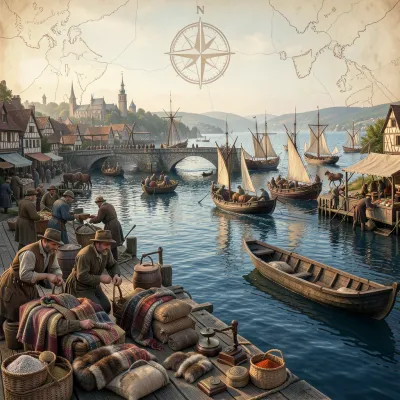
*Rivers of Trade: Commercial Networks that Built Europe* explores the historical evolution of European commerce through its maritime and riverine arteries. The book argues that the continent’s development was fundamentally shaped by its geography—specifically its vast drainage basins and coastal seas—which functioned as the original infrastructure for moving goods, people, and information. From Roman roads and monastic markets to the sophisticated financial hubs of the Hanseatic League and Italian maritime republics, these networks facilitated the growth of cities, the rise of powerful states, and the creation of a shared merchant culture rooted in trust and standardized legal practices.
The narrative details how specific commodities—such as grain, salt, wool, and wine—drove regional specialization and necessitated long-distance cooperation. The text highlights the pivotal roles played by entrepôts like Bruges, Antwerp, Amsterdam, and London, tracing the shift of economic gravity from the Mediterranean to the Atlantic. This transition was accelerated by technological innovations in shipbuilding and hydraulic engineering, as well as the development of financial instruments like bills of exchange, joint-stock companies, and marine insurance, which allowed capital to move more fluidly and securely across borders.
Beyond material exchange, the book examines the human dimension of trade, including the circulation of specialized craftsmen, the emergence of religious refugee networks like the Huguenots and Sephardic Jews, and the darker history of coerced labor and the transatlantic slave trade. It illustrates how states periodically collaborated with or exploited these networks through customs, monopolies, and warfare, eventually leading to the mercantilist systems that underpinned global empires. These historical interactions created a precedent for international governance and economic interdependence.
Ultimately, the study connects these pre-industrial roots to the modern era, showing how the arrival of steam, rail, and industrial canals further integrated the continent. The author concludes that the contemporary European Union is the culmination of these millennia of connectivity. The same rivers and corridors that once carried cogs and caravans now support the high-speed rails and digital bourses of a unified market, proving that the pursuit of commercial connection has been the most consistent force in the construction of European civilization.
What You'll Find Inside:
- How Europe's river systems and maritime routes served as the continent's original infrastructure, enabling the movement of goods that drove urban growth and state formation from Roman times through the industrial era.
- The development of key financial innovations like bills of exchange, banking houses, and early stock markets that facilitated long-distance trade without physical movement of coin.
- How merchant cultures built trust across linguistic and religious boundaries through diaspora networks, shared legal practices (lex mercatoria), and reputation systems that enabled pan-European commerce.
- The evolution of trade networks from localized fairs (like Champagne) and league systems (Hanseatic) to integrated Atlantic and global systems that reshaped Europe's economic geography.
- How extractive practices like the transatlantic slave trade and colonial exploitation were integral to Europe's commercial development, creating both wealth and enduring inequalities.
Who's It For:
This book is ideal for students and scholars of economic history, European studies, and globalization who seek to understand how trade networks shaped the continent's development. It will particularly benefit readers interested in the interplay between geography, technology, and cultural exchange in building commercial systems. General readers with a keen interest in how historical trade patterns influence modern Europe will also find valuable insights into the roots of European integration.
Table of Contents:
- Introduction
- Chapter 1 Rivers as Arteries: The Geography of European Exchange
- Chapter 2 Roman and Post‑Roman Networks across Land and Sea
- Chapter 3 Monastic Markets and the Medieval Commercial Revival
- Chapter 4 The Fairs of Champagne and Continental Corridors
- Chapter 5 The Hanseatic League: Baltic–North Sea Worlds
- Chapter 6 Rhine, Scheldt, and Meuse: Waterways of the Low Countries
- Chapter 7 The Danube Corridor: Central Europe to the Black Sea
- Chapter 8 Mediterranean Caravans and Sea Lanes
- Chapter 9 Venice and Genoa: Rival Maritime Republics
- Chapter 10 Iberian Gateways to the Atlantic
- Chapter 11 Nordic Trades: Timber, Tar, and Fish
- Chapter 12 The Black Sea and Steppe Routes
- Chapter 13 Technologies of Movement: Ships, Carts, Canals, and Locks
- Chapter 14 Merchant Cultures: Diasporas, Languages, and Trust
- Chapter 15 Money on the Move: Banking, Bills, and Bourses
- Chapter 16 Ports and Cities: Bruges, Antwerp, Amsterdam, London
- Chapter 17 States and Traders: Customs, Monopolies, and War
- Chapter 18 Peril and Protection: Piracy, Convoys, and Insurance
- Chapter 19 Markets and Materials: Grain, Salt, Wool, Wine
- Chapter 20 People in Circulation: Migration, Slavery, and Servitude
- Chapter 21 Knowledge at Sea: Navigation, Charts, and Information Flows
- Chapter 22 Faith and Commerce: Religious Conflict and Refugee Networks
- Chapter 23 Europe in a Wider World: Spices, Silver, and Empire
- Chapter 24 Steam, Rail, and Industrial Canals
- Chapter 25 Legacies of Connectivity: From Regional Nets to the European Union
Author:
Published By:
Date Published:
May 14, 2026
Type:
Nonfiction
Language:
English
Word Count:
70,676 words
Reading Time:
4 hours 57 minutes
Sample:
Order:
Order Rivers of Trade: Commercial Networks that Built Europe (Hardcover) on MixCache.com:
Buy NowPrint copy is made to order and ships worldwide. Includes the ebook free, ready to read instantly.
$5 account credit for all new MixCache.com accounts, usable toward any ebook purchase!*