
Browse by Category
Fiction
- Action & Adventure
- African American
- Anthologies
- Children's Fiction
- Classics
- Comics & Graphic Novels
- Coming of Age
- Contemporary
- Cultural & Regional
- Drama
- Erotica
- Fantasy
- General
- Historical Fiction
- Horror
- Humor & Satire
- Literary Fiction
- Mystery, Thriller & Suspense
- Poetry
- Religious & Inspirational
- Romance
- Science Fiction
- Short Stories
- War & Military
- Westerns
- Women's Fiction
- Young Adult
Non-Fiction
- Antiques & Collectibles
- Arts & Photography
- Biographies & Memoirs
- Business & Money
- Children's Non-Fiction
-
Computers & Technology
- Artificial Intelligence
- Computer Science
- Cybersecurity & Cryptography
- Data Science & Analytics
- Databases & Big Data
- Game Development & Design
- General
- Hardware & DIY
- Mobile App Development
- Networking & Cloud Computing
- Operating Systems
- Programming
- Robotics
- Software
- Software Engineering
- User Experience (UX) & Design
- Web Development & Design
- Cooking, Food & Wine
- Crafts, Hobbies & Home
- Education & Teaching
- Engineering
- General
- Health, Fitness & Dieting
-
History
- African History
- African History - North Africa
- African History - Sub-Saharan Africa
- American History
- American History - 20th Century
- American History - Civil War
- American History - Colonial Period
- Ancient History
- Asian History
- Asian History - China
- Asian History - India
- Asian History - Japan
- Asian History - Southeast Asia
- European History
- European History - Ancient Greece
- European History - Ancient Rome
- European History - Medieval
- European History - Modern
- European History - Renaissance
- General
- Middle Eastern History
- Military History
- Military History - Aviation
- Military History - Naval
- Social & Cultural History
- World History
- Humor & Entertainment
- Industrial Technology
- Language Learning
- Law
- LGBTQ+ Non-Fiction
- Literary Criticism
- Medical Books
- Parenting & Relationships
- Philosophy
- Politics & Social Sciences
- Reference
- Religion & Spirituality
-
Science & Math
- Agricultural Sciences
- Astronomy & Space Science
- Behavioral Sciences
- Biological Sciences
- Botany & Plant Science
- Chemistry
- Earth Sciences
- Engineering - Chemical
- Engineering - Civil
- Engineering - Electrical
- Engineering - Mechanical
- Environment
- General
- Geology
- Mathematics
- Nature & Ecology
- Oceanography
- Paleontology
- Physics
- Statistics
- Self-Help
- Sports & Outdoors
- Study Aids
- Sustainability & Green Living
- Textbooks
- Transportation
- Travel
- True Crime
- Urban Planning & Development
- Veterinary Medicine
- Writing & Publishing
Jump to Section
MixCache.com Total Access
Unlimited reading and audiobooks for every book published by MixCache.com.
Included titles carry the MTA badge.
Learn more →
Molded in Plastic
The Material That Changed the World
About this book:


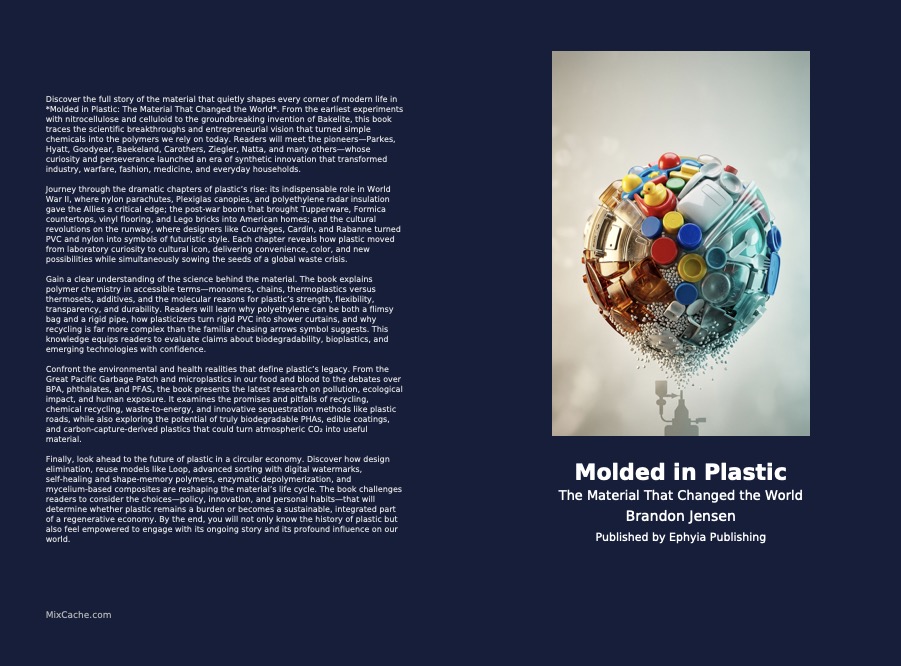
Discover the full story of the material that quietly shapes every corner of modern life in *Molded in Plastic: The Material That Changed the World*. From the earliest experiments with nitrocellulose and celluloid to the groundbreaking invention of Bakelite, this book traces the scientific breakthroughs and entrepreneurial vision that turned simple chemicals into the polymers we rely on today. Readers will meet the pioneers—Parkes, Hyatt, Goodyear, Baekeland, Carothers, Ziegler, Natta, and many others—whose curiosity and perseverance launched an era of synthetic innovation that transformed industry, warfare, fashion, medicine, and everyday households.
Journey through the dramatic chapters of plastic’s rise: its indispensable role in World War II, where nylon parachutes, Plexiglas canopies, and polyethylene radar insulation gave the Allies a critical edge; the post‑war boom that brought Tupperware, Formica countertops, vinyl flooring, and Lego bricks into American homes; and the cultural revolutions on the runway, where designers like Courrèges, Cardin, and Rabanne turned PVC and nylon into symbols of futuristic style. Each chapter reveals how plastic moved from laboratory curiosity to cultural icon, delivering convenience, color, and new possibilities while simultaneously sowing the seeds of a global waste crisis.
Gain a clear understanding of the science behind the material. The book explains polymer chemistry in accessible terms—monomers, chains, thermoplastics versus thermosets, additives, and the molecular reasons for plastic’s strength, flexibility, transparency, and durability. Readers will learn why polyethylene can be both a flimsy bag and a rigid pipe, how plasticizers turn rigid PVC into shower curtains, and why recycling is far more complex than the familiar chasing arrows symbol suggests. This knowledge equips readers to evaluate claims about biodegradability, bioplastics, and emerging technologies with confidence.
Confront the environmental and health realities that define plastic’s legacy. From the Great Pacific Garbage Patch and microplastics in our food and blood to the debates over BPA, phthalates, and PFAS, the book presents the latest research on pollution, ecological impact, and human exposure. It examines the promises and pitfalls of recycling, chemical recycling, waste‑to‑energy, and innovative sequestration methods like plastic roads, while also exploring the potential of truly biodegradable PHAs, edible coatings, and carbon‑capture‑derived plastics that could turn atmospheric CO₂ into useful material.
Finally, look ahead to the future of plastic in a circular economy. Discover how design elimination, reuse models like Loop, advanced sorting with digital watermarks, self‑healing and shape‑memory polymers, enzymatic depolymerization, and mycelium‑based composites are reshaping the material’s life cycle. The book challenges readers to consider the choices—policy, innovation, and personal habits—that will determine whether plastic remains a burden or becomes a sustainable, integrated part of a regenerative economy. By the end, you will not only know the history of plastic but also feel empowered to engage with its ongoing story and its profound influence on our world.
What You'll Find Inside:
- Traces the invention of fully synthetic plastic from Bakelite to modern polymers, highlighting key chemists and breakthroughs.
- Explores how World War II accelerated plastic production and innovation, turning it into a strategic material for the Allied war effort.
- Details plastic's pervasive integration into daily life—from household goods and fashion to medicine and technology—and its cultural impact.
- Examines the environmental and health consequences of plastic waste, including microplastics, chemical additives, and the limits of recycling.
- Discusses emerging solutions such as bioplastics, circular economy models, and cutting‑edge innovations like self‑healing and carbon‑capture plastics.
Who's It For:
This book is ideal for students and professionals in materials science, environmental studies, and public policy who seek a comprehensive understanding of plastic’s history, impact, and future. It also appeals to designers, engineers, and sustainability advocates looking for insights into alternatives and systemic change. General readers curious about how a single material shaped the modern world—and what to do about its legacy—will find the narrative both informative and compelling.
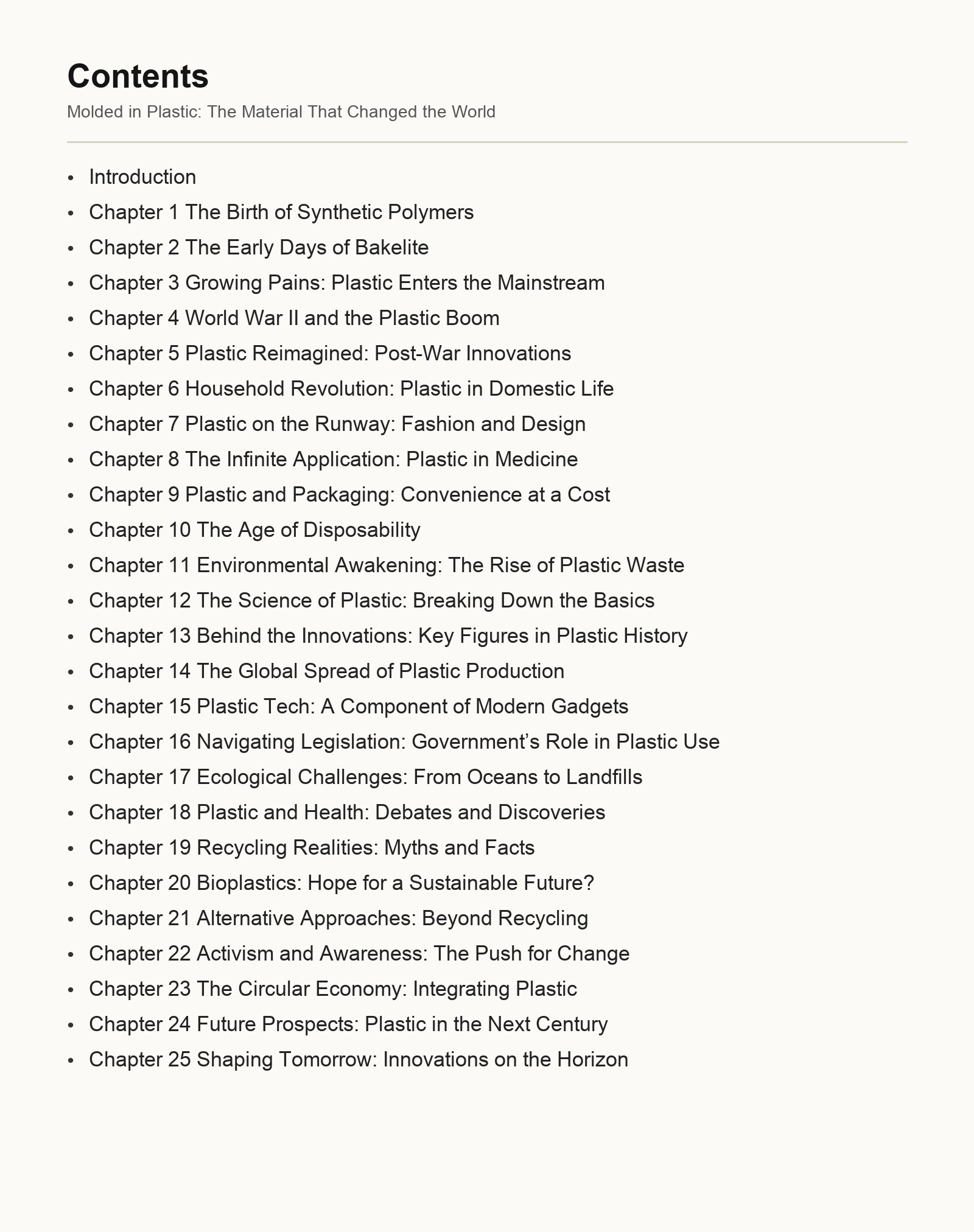
Table of Contents:
- Introduction
- Chapter 1 The Birth of Synthetic Polymers
- Chapter 2 The Early Days of Bakelite
- Chapter 3 Growing Pains: Plastic Enters the Mainstream
- Chapter 4 World War II and the Plastic Boom
- Chapter 5 Plastic Reimagined: Post-War Innovations
- Chapter 6 Household Revolution: Plastic in Domestic Life
- Chapter 7 Plastic on the Runway: Fashion and Design
- Chapter 8 The Infinite Application: Plastic in Medicine
- Chapter 9 Plastic and Packaging: Convenience at a Cost
- Chapter 10 The Age of Disposability
- Chapter 11 Environmental Awakening: The Rise of Plastic Waste
- Chapter 12 The Science of Plastic: Breaking Down the Basics
- Chapter 13 Behind the Innovations: Key Figures in Plastic History
- Chapter 14 The Global Spread of Plastic Production
- Chapter 15 Plastic Tech: A Component of Modern Gadgets
- Chapter 16 Navigating Legislation: Government’s Role in Plastic Use
- Chapter 17 Ecological Challenges: From Oceans to Landfills
- Chapter 18 Plastic and Health: Debates and Discoveries
- Chapter 19 Recycling Realities: Myths and Facts
- Chapter 20 Bioplastics: Hope for a Sustainable Future?
- Chapter 21 Alternative Approaches: Beyond Recycling
- Chapter 22 Activism and Awareness: The Push for Change
- Chapter 23 The Circular Economy: Integrating Plastic
- Chapter 24 Future Prospects: Plastic in the Next Century
- Chapter 25 Shaping Tomorrow: Innovations on the Horizon
Author:
Published By:
Date Published:
May 24, 2026
Type:
Nonfiction
Language:
English
Also Available In:
Word Count:
43,529 words
Reading Time:
3 hours 3 minutes
Sample:
Order:
Buy the Molded in Plastic ebook on MixCache.com:
Buy NowThe full ebook will be available immediately to read instantly on any device.
$5 account credit for all new MixCache.com accounts, usable toward any ebook purchase!*






Ratings & Reviews
Ask Questions About This Book
Have a question about the content? Ask our AI assistant!
Start by asking a question about "Molded in Plastic"
Example: "Does this book mention William Shakespeare?"
Thinking...