Browse by Category
Fiction
- Action & Adventure
- African American
- Anthologies
- Children's Fiction
- Classics
- Comics & Graphic Novels
- Coming of Age
- Contemporary
- Cultural & Regional
- Drama
- Erotica
- Fantasy
- General
- Historical Fiction
- Horror
- Humor & Satire
- Literary Fiction
- Mystery, Thriller & Suspense
- Poetry
- Religious & Inspirational
- Romance
- Science Fiction
- Short Stories
- War & Military
- Westerns
- Women's Fiction
- Young Adult
Non-Fiction
- Antiques & Collectibles
- Arts & Photography
- Biographies & Memoirs
- Business & Money
- Children's Non-Fiction
-
Computers & Technology
- Artificial Intelligence
- Computer Science
- Cybersecurity & Cryptography
- Data Science & Analytics
- Databases & Big Data
- Game Development & Design
- General
- Hardware & DIY
- Mobile App Development
- Networking & Cloud Computing
- Operating Systems
- Programming
- Robotics
- Software
- Software Engineering
- User Experience (UX) & Design
- Web Development & Design
- Cooking, Food & Wine
- Crafts, Hobbies & Home
- Education & Teaching
- Engineering
- General
- Health, Fitness & Dieting
-
History
- African History
- African History - North Africa
- African History - Sub-Saharan Africa
- American History
- American History - 20th Century
- American History - Civil War
- American History - Colonial Period
- Ancient History
- Asian History
- Asian History - China
- Asian History - India
- Asian History - Japan
- Asian History - Southeast Asia
- European History
- European History - Ancient Greece
- European History - Ancient Rome
- European History - Medieval
- European History - Modern
- European History - Renaissance
- General
- Middle Eastern History
- Military History
- Military History - Aviation
- Military History - Naval
- Social & Cultural History
- World History
- Humor & Entertainment
- Industrial Technology
- Language Learning
- Law
- LGBTQ+ Non-Fiction
- Literary Criticism
- Medical Books
- Parenting & Relationships
- Philosophy
- Politics & Social Sciences
- Reference
- Religion & Spirituality
-
Science & Math
- Agricultural Sciences
- Astronomy & Space Science
- Behavioral Sciences
- Biological Sciences
- Botany & Plant Science
- Chemistry
- Earth Sciences
- Engineering - Chemical
- Engineering - Civil
- Engineering - Electrical
- Engineering - Mechanical
- Environment
- General
- Geology
- Mathematics
- Nature & Ecology
- Oceanography
- Paleontology
- Physics
- Statistics
- Self-Help
- Sports & Outdoors
- Study Aids
- Sustainability & Green Living
- Textbooks
- Transportation
- Travel
- True Crime
- Urban Planning & Development
- Veterinary Medicine
- Writing & Publishing
Jump to Section
MixCache.com Total Access
Unlimited reading and audiobooks for every book published by MixCache.com.
Included titles carry the MTA badge.
Learn more →
Iron to Intel: The Technological Transformation of Europe
MTA
How innovations from the forge to the microchip reshaped European societies and economies
About this book:
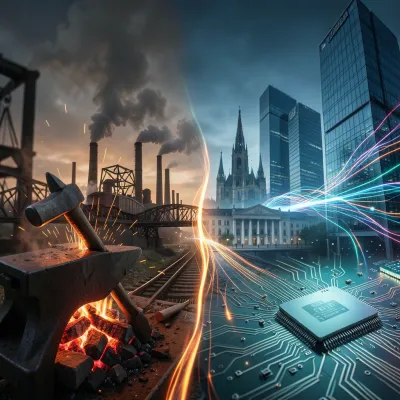
*Iron to Intel: The Technological Transformation of Europe* explores the profound impact of innovation on the continent's socioeconomic and political landscape, tracing a line from medieval metallurgy to the digital age. The narrative begins with the mastery of iron and water power, which laid the groundwork for industrialization, and follows the revolutionary influence of the printing press and early navigational instruments in reshaping European thought and global reach. It details how the "War by Workshop" and the Military Revolution consolidated the power of the centralized state, while the Scientific Revolution introduced a culture of measurement and empirical inquiry that redefined humanity’s relationship with nature.
The book transitions into the First Industrial Revolution, centered on coal, steam, and textiles, which sparked unprecedented urbanization and subsequent crises in public health. The 19th and early 20th centuries are characterized by the "shrinking" of the continent through railways and the telegraph, followed by the transformative arrival of electricity and synthetic chemistry. These advancements facilitated the rise of heavy industry and mass production, but also fueled the catastrophic "total war" of the world wars, where technological capacity became the primary metric of national survival and destruction.
In the postwar era, the focus shifts to reconstruction and the birth of the consumer society, driven by electronics, nuclear energy, and the dawn of computing. The narrative tracks Europe’s struggle for technological sovereignty in the face of American dominance, highlighting the development of the semiconductor industry and the unique European pathways of the internet and mobile communications. As the economy transitioned from factory-based manufacturing to digital platforms, the text examines the resulting disruptions to labor markets and the emergence of the "gig economy."
The final chapters address the contemporary challenges of living in a coded world, specifically the pervasive influence of smartphones and social media. It emphasizes Europe’s distinctive role as a global regulatory leader through frameworks like the GDPR and the AI Act, which seek to balance innovation with individual rights and privacy. The book concludes by looking toward the future, analyzing the green technology transition and the strategic importance of AI and quantum computing, arguing that Europe’s future will be defined by its ability to govern these powerful tools according to its historical values of democracy and human rights.
What You'll Find Inside:
- Traces Europe's technological evolution from medieval bloomery furnaces to modern semiconductors, showing how each innovation transformed work, borders, citizenship, and daily life expectations.
- Demonstrates that technological change was neither linear nor inevitable, advancing in pulses shaped by states, cities, guilds, entrepreneurs, engineers, artisans, and activists rather than rolling across the continent like a tide.
- Explores the dual nature of innovation—how technologies promising emancipation often created new dependencies, and machines raising productivity could entrench inequality, examining who benefited, who paid, and who was left out.
- Highlights Europe's distinctive setting as a dense mosaic of polities fostering competition and imitation, with cities and universities cultivating skilled labor while migration and markets circulated people, ideas, and capital across permeable borders.
- Argues that technological power is a social project where choices about standards, safety, ownership, training, and redistribution shape outcomes as profoundly as laboratory breakthroughs, featuring not just inventors but workers whose struggles mediated change on the ground.
Who's It For:
This book is ideal for students and scholars of history, technology, or European studies seeking an integrated analysis of how technological innovations reshaped European societies and economies from medieval times to the present. It will also benefit policymakers, technologists, and socially conscious readers interested in understanding the historical patterns of technological governance, the distribution of innovation's benefits and burdens, and the lessons from Europe's past transformations for addressing contemporary challenges in automation, digitalization, and sustainable development.
Table of Contents:
- Introduction
- Chapter 1 From Bloomery to Blast: Medieval Metallurgy and the Making of Europe
- Chapter 2 Gears, Mills, and Water: Mechanical Power Before Steam
- Chapter 3 The Press that Printed a World: Gutenberg and the Republic of Letters
- Chapter 4 Instruments of Discovery: Navigation, Cartography, and the Age of Exploration
- Chapter 5 War by Workshop: Gunpowder, Fortifications, and the Military Revolution
- Chapter 6 Measuring Nature: Scientific Instruments and the Birth of Experiment
- Chapter 7 Cotton, Coal, and Steam: The First Industrial Revolution
- Chapter 8 Iron Roads: Railways, Logistics, and the Shrinking Continent
- Chapter 9 Cities of Smoke: Urbanization, Sanitation, and Public Health Technologies
- Chapter 10 Telegraph to Telephone: Wiring Europe for Instant Communication
- Chapter 11 Powering Modernity: Electricity, Grids, and Household Life
- Chapter 12 Steel, Chemistry, and Scale: From Bessemer to BASF
- Chapter 13 Engines of Nations: Automobility, Aviation, and the Politics of Motion
- Chapter 14 War Machines: Total War, Industry, and the Technological State, 1914–1945
- Chapter 15 Rebuilding with Circuits: Postwar Reconstruction and Consumer Electronics
- Chapter 16 Atomic Europe: Nuclear Dreams, Fears, and Infrastructures
- Chapter 17 Silicon on the Rhine: Semiconductor Pioneers and European Computing
- Chapter 18 From Mainframes to Microcomputers: The Spread of Digital Work
- Chapter 19 Networks Without Borders: The Internet’s European Pathways
- Chapter 20 From Factory to Platform: Automation, Robotics, and New Labor Regimes
- Chapter 21 Living with Code: Smartphones, Social Media, and Everyday Life
- Chapter 22 Surveillance and Rights: Data, Privacy, and European Regulation
- Chapter 23 Green Tech Transition: Energy, Climate, and Industrial Strategy
- Chapter 24 Peripheries and Centers: Regional Divergence in a Technological Europe
- Chapter 25 Futures Made in Europe: Innovation, Policy, and the Next Transformation
Author:
Published By:
Date Published:
May 14, 2026
Type:
Nonfiction
Language:
English
Word Count:
80,436 words
Reading Time:
5 hours 38 minutes
Sample:
Order:
Order Iron to Intel: The Technological Transformation of Europe (Hardcover) on MixCache.com:
Buy NowPrint copy is made to order and ships worldwide. Includes the ebook free, ready to read instantly.
$5 account credit for all new MixCache.com accounts, usable toward any ebook purchase!*