
Browse by Category
Fiction
- Action & Adventure
- African American
- Anthologies
- Children's Fiction
- Classics
- Comics & Graphic Novels
- Coming of Age
- Contemporary
- Cultural & Regional
- Drama
- Erotica
- Fantasy
- General
- Historical Fiction
- Horror
- Humor & Satire
- Literary Fiction
- Mystery, Thriller & Suspense
- Poetry
- Religious & Inspirational
- Romance
- Science Fiction
- Short Stories
- War & Military
- Westerns
- Women's Fiction
- Young Adult
Non-Fiction
- Antiques & Collectibles
- Arts & Photography
- Biographies & Memoirs
- Business & Money
- Children's Non-Fiction
-
Computers & Technology
- Artificial Intelligence
- Computer Science
- Cybersecurity & Cryptography
- Data Science & Analytics
- Databases & Big Data
- Game Development & Design
- General
- Hardware & DIY
- Mobile App Development
- Networking & Cloud Computing
- Operating Systems
- Programming
- Robotics
- Software
- Software Engineering
- User Experience (UX) & Design
- Web Development & Design
- Cooking, Food & Wine
- Crafts, Hobbies & Home
- Education & Teaching
- Engineering
- General
- Health, Fitness & Dieting
-
History
- African History
- African History - North Africa
- African History - Sub-Saharan Africa
- American History
- American History - 20th Century
- American History - Civil War
- American History - Colonial Period
- Ancient History
- Asian History
- Asian History - China
- Asian History - India
- Asian History - Japan
- Asian History - Southeast Asia
- European History
- European History - Ancient Greece
- European History - Ancient Rome
- European History - Medieval
- European History - Modern
- European History - Renaissance
- General
- Middle Eastern History
- Military History
- Military History - Aviation
- Military History - Naval
- Social & Cultural History
- World History
- Humor & Entertainment
- Industrial Technology
- Language Learning
- Law
- LGBTQ+ Non-Fiction
- Literary Criticism
- Medical Books
- Parenting & Relationships
- Philosophy
- Politics & Social Sciences
- Reference
- Religion & Spirituality
-
Science & Math
- Agricultural Sciences
- Astronomy & Space Science
- Behavioral Sciences
- Biological Sciences
- Botany & Plant Science
- Chemistry
- Earth Sciences
- Engineering - Chemical
- Engineering - Civil
- Engineering - Electrical
- Engineering - Mechanical
- Environment
- General
- Geology
- Mathematics
- Nature & Ecology
- Oceanography
- Paleontology
- Physics
- Statistics
- Self-Help
- Sports & Outdoors
- Study Aids
- Sustainability & Green Living
- Textbooks
- Transportation
- Travel
- True Crime
- Urban Planning & Development
- Veterinary Medicine
- Writing & Publishing
Jump to Section

Want unlimited access to all books published by MixCache.com (plus their audiobooks)? Try MixCache.com Total Access. Look for the MTA badge on book covers to identify included titles.
Access to infinite ebooks: Don't see the book you want? Suggest it and we'll create it (free!) for you from scratch with our powerful AI book writer. Then read it with MTA - besides profiting from any sales it makes!
Habsburgs to Bourbons: European Dynastic Wars and the Making of Modern Borders
MTA
Diplomacy, inheritance, and conflict that redrew Europe between 1500 and 1850
About this book:
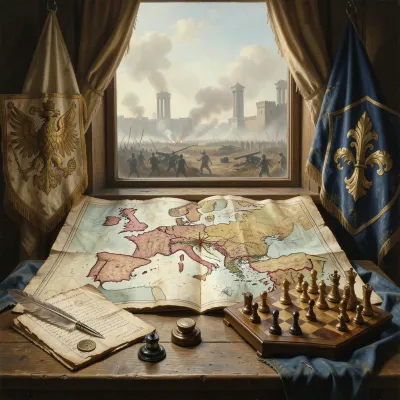
This book examines the evolution of European borders and statecraft between 1500 and 1850, tracing the transition from a continent governed by dynastic inheritance to one defined by centralized sovereign states. It begins with the Habsburg ascendancy under Maximilian I and Charles V, whose "composite monarchies" treated marriage and patrimony as primary tools of territorial expansion. The narrative details how religious schisms, such as the Reformation and the Thirty Years' War, complicated these family strategies, forcing dynasties to integrate confessional loyalty and bureaucratic reform into their claims of legitimacy.
The eighteenth-century shift from Habsburg to Bourbon influence marks a pivotal era of modernization. Through the War of the Spanish Succession and the subsequent Bourbon Reforms, rulers moved toward administrative centralization, professionalized militaries, and rationalized tax systems to sustain global imperial competition. This period also saw the rise of the "balance of power" doctrine, codified in treaties like Westphalia and Utrecht, where the preservation of European equilibrium began to supersede universal imperial ambitions. These diplomatic mechanisms were tested by the rise of Prussia and the eventual erasure of the Polish-Lithuanian Commonwealth, illustrating a cold, geopolitical calculus that treated territories as negotiable assets.
The final section explores the cataclysm of the French Revolution and the Napoleonic era, which shattered traditional notions of divine right. Napoleon’s attempt to impose a family empire across Europe accelerated the spread of uniform legal codes and mass conscription, inadvertently nurturing the seeds of nationalism. The book concludes with the Congress of Vienna and the mid-nineteenth-century "Eastern Question," where restored dynasties attempted to reconcile hereditary authority with a new world of fixed borders and rising national identities. Ultimately, the text argues that modern borders emerged not in spite of dynastic wars, but as their direct result, as the private law of royal families was slowly transformed into the public order of the modern nation-state.
What You'll Find Inside:
- How Habsburg matrimonial strategies transformed a south German family into Europe's dominant dynasty through calculated marriages that treated weddings as treaties and children as boundary commissions.
- The evolution of the balance of power principle from Westphalia to Vienna, showing how dynasties shifted from universal empire ambitions to negotiated territorial settlements that embedded sovereignty in international law.
- How religious conflicts like the Reformation and Thirty Years' War became intertwined with dynastic succession, forcing rulers to negotiate confessional coexistence while maintaining political authority.
- The globalization of dynastic conflict in the Seven Years' War, where European succession disputes played out across continents in India, North America, and the Caribbean, linking colonial wealth to European power struggles.
- How dynasties adapted to revolutionary challenges after 1789, using administrative innovations and constitutional concessions while maintaining dynastic legitimacy through strategic marriages and reforms.
Who's It For:
This book would be most valuable for students and scholars of early modern European history, particularly those interested in diplomatic history, state formation, and the intersection of dynastic politics with military and religious conflicts. It would also appeal to readers seeking to understand how modern European borders and state systems emerged from centuries of inheritance disputes, royal marriages, and great-power negotiations. The book's integration of military, diplomatic, and social history makes it suitable for advanced undergraduate and graduate courses in European history.
Author:
Published By:
Date Published:
May 2, 2026
Type:
Nonfiction
Language:
English
Word Count:
58,997 words
Reading Time:
4 hours 8 minutes
Sample:
MixCache.com Total Access
Get unlimited access to this book + all books published by MixCache.com for $11.99/month
Subscribe to MTAOr purchase this book individually below
Order:
Buy the Habsburgs to Bourbons: European Dynastic Wars and the Making of Modern Borders ebook on MixCache.com:
Buy Now
Full ebook will be available immediately
- read online or download as a PDF file.
$5 account credit for all new MixCache.com accounts, usable toward any ebook purchase!*


Ratings & Reviews
Ask Questions About This Book
Have a question about the content? Ask our AI assistant!
Start by asking a question about "Habsburgs to Bourbons: European Dynastic Wars and the Making of Modern Borders"
Example: "Does this book mention William Shakespeare?"
Thinking...