Browse by Category
Fiction
- Action & Adventure
- African American
- Anthologies
- Children's Fiction
- Classics
- Comics & Graphic Novels
- Coming of Age
- Contemporary
- Cultural & Regional
- Drama
- Erotica
- Fantasy
- General
- Historical Fiction
- Horror
- Humor & Satire
- Literary Fiction
- Mystery, Thriller & Suspense
- Poetry
- Religious & Inspirational
- Romance
- Science Fiction
- Short Stories
- War & Military
- Westerns
- Women's Fiction
- Young Adult
Non-Fiction
- Antiques & Collectibles
- Arts & Photography
- Biographies & Memoirs
- Business & Money
- Children's Non-Fiction
-
Computers & Technology
- Artificial Intelligence
- Computer Science
- Cybersecurity & Cryptography
- Data Science & Analytics
- Databases & Big Data
- Game Development & Design
- General
- Hardware & DIY
- Mobile App Development
- Networking & Cloud Computing
- Operating Systems
- Programming
- Robotics
- Software
- Software Engineering
- User Experience (UX) & Design
- Web Development & Design
- Cooking, Food & Wine
- Crafts, Hobbies & Home
- Education & Teaching
- Engineering
- General
- Health, Fitness & Dieting
-
History
- African History
- African History - North Africa
- African History - Sub-Saharan Africa
- American History
- American History - 20th Century
- American History - Civil War
- American History - Colonial Period
- Ancient History
- Asian History
- Asian History - China
- Asian History - India
- Asian History - Japan
- Asian History - Southeast Asia
- European History
- European History - Ancient Greece
- European History - Ancient Rome
- European History - Medieval
- European History - Modern
- European History - Renaissance
- General
- Middle Eastern History
- Military History
- Military History - Aviation
- Military History - Naval
- Social & Cultural History
- World History
- Humor & Entertainment
- Industrial Technology
- Language Learning
- Law
- LGBTQ+ Non-Fiction
- Literary Criticism
- Medical Books
- Parenting & Relationships
- Philosophy
- Politics & Social Sciences
- Reference
- Religion & Spirituality
-
Science & Math
- Agricultural Sciences
- Astronomy & Space Science
- Behavioral Sciences
- Biological Sciences
- Botany & Plant Science
- Chemistry
- Earth Sciences
- Engineering - Chemical
- Engineering - Civil
- Engineering - Electrical
- Engineering - Mechanical
- Environment
- General
- Geology
- Mathematics
- Nature & Ecology
- Oceanography
- Paleontology
- Physics
- Statistics
- Self-Help
- Sports & Outdoors
- Study Aids
- Sustainability & Green Living
- Textbooks
- Transportation
- Travel
- True Crime
- Urban Planning & Development
- Veterinary Medicine
- Writing & Publishing
Jump to Section
MixCache.com Total Access
Unlimited reading and audiobooks for every book published by MixCache.com.
Included titles carry the MTA badge.
Learn more →
Fermentation Nation: Global Traditions of Food and Wine Making
MTA
Ethnic fermentations, preservation techniques, and modern craft applications
About this book:
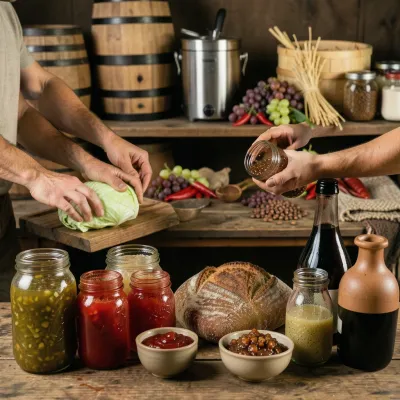
*Fermentation Nation: Global Traditions of Food and Wine Making* explores fermentation as both an ancient survival technology and a sophisticated culinary art. The book begins by grounding the reader in the essential science of "microbial alchemy," detailing how yeasts, bacteria, and molds interact with the core variables of salt, time, and temperature to preserve and transform food. By establishing these technical foundations, the text prepares the reader to understand how invisible microorganisms not only prevent spoilage but also unlock complex flavors, improve digestibility, and enhance nutritional profiles.
The heart of the book is a sprawling cultural atlas that traces unique fermentation lineages across five continents. It moves from the "jang" houses of Korea and the "koji" culture of Japan to the fiery "doubanjiang" of China and the diverse "idli" and "toddy" traditions of South Asia. The exploration continues through the fish sauces of Southeast Asia, the "labneh" and preserved lemons of the Levant, and the deep cabbage cultures of Europe. In the Americas, the book highlights indigenous traditions like nixtamalization, "chicha," and "pulque," alongside the critical role of microbial succession in Latin American cacao fermentation. This global survey illustrates how different climates and local ingredients have shaped distinct regional identities through shared microbial processes.
Beyond traditional food staples, the book examines the intersection of fermentation with the beverage world and modern artisanal movements. It delves into the "Natural Wine" movement, emphasizing vineyard microbiomes and ancient vessels like amphorae, and explores the rustic traditions of farmhouse brewing, ciders, and acetous ferments like kombucha and vinegar. This section bridges the gap between historical practice and contemporary craft, showing how ancient methods—such as the production of Roman-style "garum"—are being revived as "Garum 2.0" in modern professional kitchens to maximize umami and reduce food waste.
The final section serves as a practical guide for the modern practitioner, emphasizing safety, sanitation, and sensory diagnostics. Through artisan profiles and step-by-step home projects, the book moves from "Classics for Beginners," like sauerkraut and yogurt, to "Advanced Inoculations" involving wild yeast captures and koji cultivation. By blending cultural history with hands-on application, the book encourages a collaborative relationship with the microbial world, inviting readers to participate in a global tradition that measures time in bubbles, aromas, and the slow, living transformation of the larder.
What You'll Find Inside:
- Salt, time, and temperature are the foundational variables that guide microbial activity and determine fermentation outcomes across all traditions.
- Yeasts, bacteria, and molds each play distinct roles—producing alcohol, acids, and enzymes—that transform raw ingredients into preserved, flavorful, and nutritionally enhanced foods.
- The book surveys global fermentation practices, from Korean kimchi and jang to Japanese koji miso/shoyu/sake, Chinese pickles and doubanjiang, South Asian idli/dosa/curd, and many others, highlighting regional techniques and cultural significance.
- Step‑by‑step home projects range from beginner sauerkraut and yogurt to advanced wild yeast captures, koji cultivation, miso, and vinegar making, with safety, sanitation, and sensory guidance.
- Fermentation is presented as a living craft that blends tradition, terroir, and modern innovation, encouraging observation, patience, and responsible experimentation.
Who's It For:
This book is ideal for home cooks, fermentation hobbyists, and food artisans who want to deepen their understanding of both the science and cultural heritage of fermented foods. It also serves culinary students, professional chefs, and food science enthusiasts seeking practical, globally inspired techniques they can apply in the kitchen or small‑scale production. Readers will benefit from the clear instructions, safety guidelines, and sensory tips that make traditional and experimental fermentation accessible and rewarding.
Table of Contents:
- Introduction
- Chapter 1 The Living Larder: Why Fermentation Endures
- Chapter 2 Microbial Alchemy: Yeasts, Bacteria, and Molds
- Chapter 3 Salt, Time, and Temperature: The Core Variables
- Chapter 4 Korea’s Fermentory: Kimchi, Jang, and Jeotgal
- Chapter 5 Japan’s Koji Culture: Miso, Shoyu, and Sake Foundations
- Chapter 6 China’s Cellars: Pickles, Doubanjiang, Vinegars, and Huadiao Wines
- Chapter 7 South Asia: Idli, Dosa, Curd, and Toddy Traditions
- Chapter 8 Southeast Asia: Fish Sauce, Shrimp Paste, and Coconut Ferments
- Chapter 9 The Levant and North Africa: Labneh, Harissa, and Preserved Lemons
- Chapter 10 Europe’s Cabbage Culture: Sauerkraut, Kvass, and Beyond
- Chapter 11 Sourdough Across Continents: Grains, Starters, and Crumbs
- Chapter 12 Cultured Dairy and Cheeses: From Kefir to Raw-Milk Rinds
- Chapter 13 Indigenous Americas: Nixtamal, Chicha, and Pulque
- Chapter 14 Latin Ferments: Curtido, Aguardiente, and Cacao Fermentation
- Chapter 15 The Natural Wine Movement: Vineyard Microbiomes and Amphorae
- Chapter 16 Ciders, Perrys, and Country Wines: Orchard Fermentations
- Chapter 17 Farmhouse Beers and Ales: Kveik, Lambic, and Spontaneity
- Chapter 18 Kombucha, Jun, and Vinegars: Acetous Pathways
- Chapter 19 From Garum to Garum 2.0: Reviving Ocean Ferments
- Chapter 20 Safety, Sanitation, and Sensory: Doing No Harm
- Chapter 21 Tools of the Trade: Crocks, Airlocks, and Cellars
- Chapter 22 Flavor Design: Spices, Blends, and Fermentation Geometry
- Chapter 23 Artisans at Work: Profiles from Five Continents
- Chapter 24 Home Projects I: Step-by-Step Classics for Beginners
- Chapter 25 Home Projects II: Advanced Inoculations and Wild Captures
Author:
Published By:
Date Published:
May 9, 2026
Type:
Nonfiction
Language:
English
Word Count:
58,207 words
Reading Time:
4 hours 5 minutes
Sample:
Order:
Order Fermentation Nation: Global Traditions of Food and Wine Making (Paperback) on MixCache.com:
Buy NowPrint copy is made to order and ships worldwide. Includes the ebook free, ready to read instantly.
$5 account credit for all new MixCache.com accounts, usable toward any ebook purchase!*