
Browse by Category
Fiction
- Action & Adventure
- African American
- Anthologies
- Children's Fiction
- Classics
- Comics & Graphic Novels
- Coming of Age
- Contemporary
- Cultural & Regional
- Drama
- Erotica
- Fantasy
- General
- Historical Fiction
- Horror
- Humor & Satire
- Literary Fiction
- Mystery, Thriller & Suspense
- Poetry
- Religious & Inspirational
- Romance
- Science Fiction
- Short Stories
- War & Military
- Westerns
- Women's Fiction
- Young Adult
Non-Fiction
- Antiques & Collectibles
- Arts & Photography
- Biographies & Memoirs
- Business & Money
- Children's Non-Fiction
-
Computers & Technology
- Artificial Intelligence
- Computer Science
- Cybersecurity & Cryptography
- Data Science & Analytics
- Databases & Big Data
- Game Development & Design
- General
- Hardware & DIY
- Mobile App Development
- Networking & Cloud Computing
- Operating Systems
- Programming
- Robotics
- Software
- Software Engineering
- User Experience (UX) & Design
- Web Development & Design
- Cooking, Food & Wine
- Crafts, Hobbies & Home
- Education & Teaching
- Engineering
- General
- Health, Fitness & Dieting
-
History
- African History
- African History - North Africa
- African History - Sub-Saharan Africa
- American History
- American History - 20th Century
- American History - Civil War
- American History - Colonial Period
- Ancient History
- Asian History
- Asian History - China
- Asian History - India
- Asian History - Japan
- Asian History - Southeast Asia
- European History
- European History - Ancient Greece
- European History - Ancient Rome
- European History - Medieval
- European History - Modern
- European History - Renaissance
- General
- Middle Eastern History
- Military History
- Military History - Aviation
- Military History - Naval
- Social & Cultural History
- World History
- Humor & Entertainment
- Industrial Technology
- Language Learning
- Law
- LGBTQ+ Non-Fiction
- Literary Criticism
- Medical Books
- Parenting & Relationships
- Philosophy
- Politics & Social Sciences
- Reference
- Religion & Spirituality
-
Science & Math
- Agricultural Sciences
- Astronomy & Space Science
- Behavioral Sciences
- Biological Sciences
- Botany & Plant Science
- Chemistry
- Earth Sciences
- Engineering - Chemical
- Engineering - Civil
- Engineering - Electrical
- Engineering - Mechanical
- Environment
- General
- Geology
- Mathematics
- Nature & Ecology
- Oceanography
- Paleontology
- Physics
- Statistics
- Self-Help
- Sports & Outdoors
- Study Aids
- Sustainability & Green Living
- Textbooks
- Transportation
- Travel
- True Crime
- Urban Planning & Development
- Veterinary Medicine
- Writing & Publishing
Jump to Section
MixCache.com Total Access
Unlimited reading and audiobooks for every book published by MixCache.com.
Included titles carry the MTA badge.
Learn more →
The Evolution of Cooking
MTA
From Fire to Molecular Gastronomy
About this book:
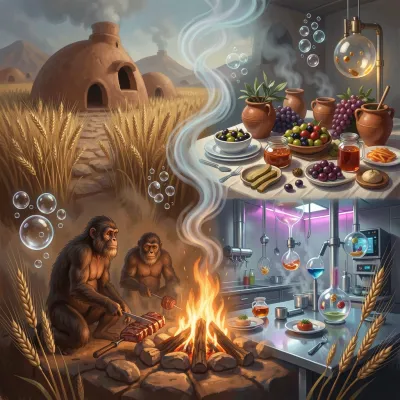
The evolution of cooking began with humanity's mastery of fire, transforming raw ingredients into more digestible and energy-dense foods that facilitated brain development and social cohesion. Early hominids utilized simple techniques like roasting over open flames and stone boiling, laying the groundwork for culinary practices. The Agricultural Revolution marked a pivotal shift, domesticating grains and animals, enabling settled communities, and introducing fermentation for bread, beer, and cheese. Ancient civilizations like Egypt refined these practices, elevating bread and beer to dietary staples while developing elaborate banquets for the elite, showcasing food's deep integration with religion, social hierarchy, and preservation methods such as drying and salting.
Classical Greece and Rome established foundational culinary traditions—the Mediterranean triad of olives, grapes, and grains in Greece, and Rome's imperial indulgence featuring exotic spices, garum, and lavish feasts documented in texts like Apicius's cookbook. The Silk Road then catalyzed a global exchange of spices, techniques, and ingredients (noodles, citrus, sugar), while medieval Europe developed distinct culinary identities shaped by feudalism and Church fasts, featuring pottages for peasants and spiced feasts for nobility, alongside the rise of professional cooks. The Islamic Golden Age advanced culinary sophistication through balanced flavors, irrigation innovations, distillation for rosewater, and detailed cookbooks emphasizing fresh ingredients and harmonious spice use, profoundly influencing global gastronomy.
The Age of Exploration triggered the Columbian Exchange, introducing New World staples like potatoes, tomatoes, and chilies to the Old World, revolutionizing diets worldwide and spurring colonial fusion cuisines. The Renaissance ushered in *haute cuisine* through artistic presentation, refined techniques, and lighter dishes, while the Enlightenment rationalized cooking with precise cookbooks, early restaurants, and scientific inquiry. The Industrial Revolution then transformed food via mass production, canning, refrigeration, and urban eating habits, making processed foods accessible but raising concerns about adulteration. The Victorian era elaborated domestic science and formal dining, setting standards for meal structure and household management.
The 20th century brought widespread refrigeration, processed foods, and convenience culture, culminating in post-war America's TV dinners and fast-food boom. Television sparked the celebrity chef phenomenon, elevating cooks to cultural icons. *Nouvelle Cuisine* revolutionized French gastronomy with lighter, fresher preparations and artistic plating, influencing global fine dining. Late 20th-century globalization fueled fusion cuisine, culinary tourism, and debates over authenticity, countered by the farm-to-table movement's emphasis on local, sustainable sourcing. The digital age democratized food knowledge through blogs, social media, and online communities, while molecular gastronomy applied scientific techniques like spherification and sous vide to redefine texture and sensation. Concurrently, the plant-based revolution gained momentum from health, ethical, and environmental concerns, and emerging technologies like lab-grown meat and personalized nutrition hint at a future where food is tailored to individual biology and produced sustainably, continuing cooking's endless evolution from necessity to art, science, and cultural expression.
What You'll Find Inside:
- Discover how controlling fire transformed early hominids' diets, enabling brain growth by making food more digestible and setting the foundation for all culinary innovation.
- Explore the Agricultural Revolution's impact: how grain cultivation, permanent settlements, and accidental fermentation discoveries created the staples that sustained early civilizations.
- Trace global culinary exchange through the Silk Road and Columbian Exchange, which introduced transformative ingredients like spices, potatoes, tomatoes, and chilies that reshaped worldwide cuisines.
- Learn about modern movements from Nouvelle Cuisine's focus on freshness and precision to molecular gastronomy's scientific techniques and the plant-based revolution's health and ethical dimensions.
- Understand 21st-century cooking trends including farm-to-table sustainability, digital food communities, and emerging technologies like lab-grown meat that are redefining food's future.
Who's It For:
This book is ideal for curious readers passionate about food history, anthropology, or cultural evolution—including home cooks seeking deeper context for their practices, culinary students exploring gastronomy's roots, food writers researching trends, and anyone interested in how cooking techniques, ingredient choices, and meal rituals have shaped human societies from prehistoric times to today's technological innovations.
Table of Contents:
- Introduction
- Chapter 1 The Dawn of Culinary Arts: Early Hominids and the Control of Fire
- Chapter 2 The Hunter-Gatherer's Feast: Simple Techniques and Wild Flavors
- Chapter 3 The Agricultural Revolution: Grains, Settlements, and Early Fermentation
- Chapter 4 Ancient Egypt: Bread, Beer, and Banquets of the Pharaohs
- Chapter 5 Classical Greece and Rome: From Humble Staples to Imperial Indulgence
- Chapter 6 The Silk Road's Culinary Exchange: Spices, Techniques, and New Ingredients
- Chapter 7 Medieval Europe: Feasts, Fasts, and the Rise of Professional Cooks
- Chapter 8 The Islamic Golden Age: Sophistication and Innovation in the Kitchen
- Chapter 9 The Age of Exploration: Global Ingredients and Columbian Exchange
- Chapter 10 The Renaissance Table: Art, Science, and the Birth of Haute Cuisine
- Chapter 11 Colonial Cuisines: Adaptation and Fusion in New Worlds
- Chapter 12 The Enlightenment and Culinary Rationalization: Early Cookbooks and Standardization
- Chapter 13 The Industrial Revolution: Mass Production, Canning, and Urban Eating
- Chapter 14 Victorian Era: Elaborate Dinners and the Rise of Domestic Science
- Chapter 15 The Twentieth Century's Early Innovations: Refrigeration and Processed Foods
- Chapter 16 Post-War America: Convenience, Fast Food, and the Suburban Kitchen
- Chapter 17 The Rise of Celebrity Chefs and Television Cooking
- Chapter 18 Nouvelle Cuisine: A Revolution in French Gastronomy
- Chapter 19 The Global Kitchen: Fusion, Authenticity, and Culinary Tourism
- Chapter 20 Farm-to-Table Movement: Reconnecting with Origins and Sustainability
- Chapter 21 The Digital Age: Food Blogs, Social Media, and Online Culinary Communities
- Chapter 22 Molecular Gastronomy: Science, Spherification, and Sensory Exploration
- Chapter 23 Plant-Based Revolution: Health, Ethics, and the Future of Food
- Chapter 24 The Future of Food: Lab-Grown Meats and Personalized Nutrition
- Chapter 25 Cooking in the 21st Century: Technology, Tradition, and Constant Evolution
Author:
Published By:
Date Published:
July 14, 2026
Type:
Nonfiction
Language:
English
Word Count:
39,122 words
Reading Time:
2 hours 44 minutes
Sample:
MixCache.com Total Access
Get unlimited access to this book + all books published by MixCache.com for $11.99/month
Subscribe to MTAOr purchase this book individually below
Order:
Buy the The Evolution of Cooking ebook on MixCache.com:
Buy Now
Full ebook will be available immediately
- read online or download as a PDF file.
$5 account credit for all new MixCache.com accounts, usable toward any ebook purchase!*


Ratings & Reviews
Ask Questions About This Book
Have a question about the content? Ask our AI assistant!
Start by asking a question about "The Evolution of Cooking"
Example: "Does this book mention William Shakespeare?"
Thinking...