Browse by Category
Fiction
- Action & Adventure
- African American
- Anthologies
- Children's Fiction
- Classics
- Comics & Graphic Novels
- Coming of Age
- Contemporary
- Cultural & Regional
- Drama
- Erotica
- Fantasy
- General
- Historical Fiction
- Horror
- Humor & Satire
- Literary Fiction
- Mystery, Thriller & Suspense
- Poetry
- Religious & Inspirational
- Romance
- Science Fiction
- Short Stories
- War & Military
- Westerns
- Women's Fiction
- Young Adult
Non-Fiction
- Antiques & Collectibles
- Arts & Photography
- Biographies & Memoirs
- Business & Money
- Children's Non-Fiction
-
Computers & Technology
- Artificial Intelligence
- Computer Science
- Cybersecurity & Cryptography
- Data Science & Analytics
- Databases & Big Data
- Game Development & Design
- General
- Hardware & DIY
- Mobile App Development
- Networking & Cloud Computing
- Operating Systems
- Programming
- Robotics
- Software
- Software Engineering
- User Experience (UX) & Design
- Web Development & Design
- Cooking, Food & Wine
- Crafts, Hobbies & Home
- Education & Teaching
- Engineering
- General
- Health, Fitness & Dieting
-
History
- African History
- African History - North Africa
- African History - Sub-Saharan Africa
- American History
- American History - 20th Century
- American History - Civil War
- American History - Colonial Period
- Ancient History
- Asian History
- Asian History - China
- Asian History - India
- Asian History - Japan
- Asian History - Southeast Asia
- European History
- European History - Ancient Greece
- European History - Ancient Rome
- European History - Medieval
- European History - Modern
- European History - Renaissance
- General
- Middle Eastern History
- Military History
- Military History - Aviation
- Military History - Naval
- Social & Cultural History
- World History
- Humor & Entertainment
- Industrial Technology
- Language Learning
- Law
- LGBTQ+ Non-Fiction
- Literary Criticism
- Medical Books
- Parenting & Relationships
- Philosophy
- Politics & Social Sciences
- Reference
- Religion & Spirituality
-
Science & Math
- Agricultural Sciences
- Astronomy & Space Science
- Behavioral Sciences
- Biological Sciences
- Botany & Plant Science
- Chemistry
- Earth Sciences
- Engineering - Chemical
- Engineering - Civil
- Engineering - Electrical
- Engineering - Mechanical
- Environment
- General
- Geology
- Mathematics
- Nature & Ecology
- Oceanography
- Paleontology
- Physics
- Statistics
- Self-Help
- Sports & Outdoors
- Study Aids
- Sustainability & Green Living
- Textbooks
- Transportation
- Travel
- True Crime
- Urban Planning & Development
- Veterinary Medicine
- Writing & Publishing
Jump to Section
MixCache.com Total Access
Unlimited reading and audiobooks for every book published by MixCache.com.
Included titles carry the MTA badge.
Learn more →
Bipolar Battles: Proxy Wars, Nuclear Strategy, and the Cold War
MTA
Deterrence theory, covert operations, and regional conflicts under superpower rivalry
About this book:
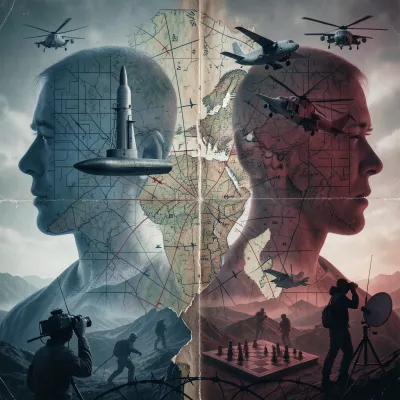
"Bipolar Battles: Proxy Wars, Nuclear Strategy, and the Cold War" comprehensively examines how the rivalry between the United States and the Soviet Union shaped global politics from the late 1940s to the early 1990s. The book argues that the existence of nuclear weapons created a paradox: total war became unthinkable, yet limited conflicts, often fought by proxies, became more likely as superpowers sought influence without triggering a catastrophic exchange. This dynamic led to the development of sophisticated deterrence theories, crisis management techniques, and a reliance on covert operations and propaganda, all designed to channel competition while preventing direct confrontation.
The book delves into the theoretical foundations of Cold War strategy, tracing the evolution of deterrence from "massive retaliation" to "flexible response" and explaining concepts like second-strike capability and mutually assured destruction (MAD). It details the development and deployment of the nuclear triad—land-based missiles, submarine-launched missiles, and strategic bombers—as the cornerstone of strategic stability. Arms races and efforts at arms control, including test bans, the SALT treaties, and the ABM debate, are explored as attempts to manage the inherent risks of nuclear proliferation and maintain a precarious balance.
Key case studies illustrate these strategic principles in action across various global theaters. The Korean War serves as an early example of limited war under a nuclear shadow, while the Vietnam War highlights the challenges of counterinsurgency and the limits of air power. The Sino-Soviet split is presented as a fundamental realignment that complicated bipolarity and created new diplomatic opportunities. Further chapters analyze superpower maneuvering in the Arab-Israeli wars, interventions in Latin America (Cuba, Chile, Nicaragua), and proxy conflicts in Africa (Congo, Angola, Horn of Africa). The book also examines the unique nuclear threshold in South Asia (India and Pakistan) and the Soviet intervention in Afghanistan as critical tests of imperial limits.
Beyond military and diplomatic strategies, the book explores the broader dimensions of the Cold War. It analyzes the role of intelligence and covert action by agencies like the CIA and KGB, political warfare, propaganda, and the construction of alliance architectures like NATO and the Warsaw Pact. The economic aspects of containment, including aid, sanctions, and the rise of the military-industrial complex, are detailed, as are the domestic political impacts of McCarthyism, the peace movement, and dissent. Finally, the "long 1970s" and the "late Cold War" periods of détente and renewed confrontation, including the Strategic Defense Initiative (SDI) and the INF Treaty, are examined as the endgame of this complex global struggle.
The conclusion reflects on the enduring legacies of the Cold War, arguing that many of the mechanisms perfected during the bipolar era—proxy wars, information operations, economic sanctions, and the dilemmas of escalation and credibility—continue to shape modern conflict, even in a post-superpower world. The book suggests that the Cold War did not end with a complete resolution of global tensions but with a set of adaptive practices that states still utilize, making its lessons crucial for understanding the complexities of contemporary international relations.
What You'll Find Inside:
- How nuclear deterrence theory evolved from massive retaliation to flexible response, shaping superpower behavior and preventing direct conflict while enabling proxy wars
- The mechanics of the nuclear triad (land-based missiles, submarine-launched missiles, bombers) and how second-strike capability created mutually assured destruction as a stabilizing framework
- Case studies of major proxy conflicts including Korea, Vietnam, Angola, and Afghanistan that demonstrate how superpower competition played out in peripheral regions
- The role of intelligence gathering, covert operations, propaganda, and political warfare as essential tools of statecraft that operated below the threshold of nuclear war
- How Cold War mechanisms of crisis management, arms control, alliance politics, and economic statecraft continue to influence contemporary conflict dynamics and great-power rivalry
Who's It For:
This book is designed for students and scholars of international relations, history, and political science who seek a comprehensive understanding of Cold War strategy and conflict. It will also benefit national security professionals, policymakers, and defense analysts looking to apply historical lessons about deterrence, escalation control, and proxy warfare to contemporary security challenges. General readers with an interest in 20th-century history and the origins of modern geopolitical tensions will find the detailed case studies and strategic analysis accessible and informative.
Table of Contents:
- Introduction
- Chapter 1 The Bipolar World: Origins of the Cold War
- Chapter 2 The Logic of Deterrence: From Massive Retaliation to Flexible Response
- Chapter 3 Nuclear Strategy and the Triad: Second-Strike and Mutually Assured Destruction
- Chapter 4 Crisis Management at the Brink: Berlin, Cuba, and Escalation Control
- Chapter 5 Arms Races and Arms Control: Test Bans, SALT, and the ABM Debate
- Chapter 6 Intelligence and Covert Action: CIA, KGB, and the Shadow Conflict
- Chapter 7 Political Warfare and Propaganda: Hearts, Minds, and Narratives
- Chapter 8 Alliance Architecture: NATO, the Warsaw Pact, and Extended Deterrence
- Chapter 9 Limited War Doctrine: Theory, Practice, and the Escalation Ladder
- Chapter 10 Korea: War on the Peninsula and the Limits of Victory
- Chapter 11 Vietnam: Insurgency, Counterinsurgency, and Air Power
- Chapter 12 The Sino–Soviet Split: Realignment in a Bipolar System
- Chapter 13 The Middle East Arena: Arab–Israeli Wars and Superpower Maneuvering
- Chapter 14 Latin America: Cuba, Chile, and Nicaragua in the Superpower Chessboard
- Chapter 15 Africa’s Battlegrounds: Congo, Angola, and the Horn of Africa
- Chapter 16 South Asia: India, Pakistan, and the Nuclear Threshold
- Chapter 17 Technology and Surveillance: Missiles, Satellites, and Reconnaissance
- Chapter 18 Maritime Strategy: Submarines, Sea Lanes, and Naval Diplomacy
- Chapter 19 Strategic Air Power and Air Defense: Bombers, SAMs, and Precision Strike
- Chapter 20 Afghanistan: The Soviet Intervention and the Limits of Empire
- Chapter 21 Economics of Containment: Aid, Sanctions, and the Military–Industrial Complex
- Chapter 22 Domestic Politics and Dissent: From McCarthyism to the Peace Movement
- Chapter 23 Détente and Its Discontents: The Long 1970s
- Chapter 24 The Late Cold War: SDI, INF, and the Endgame
- Chapter 25 Legacies and Lessons: Proxy Wars and the Shape of Modern Conflict
Author:
Published By:
Date Published:
May 7, 2026
Type:
Nonfiction
Language:
English
Word Count:
75,898 words
Reading Time:
5 hours 19 minutes
Sample:
Order:
Order Bipolar Battles: Proxy Wars, Nuclear Strategy, and the Cold War (Hardcover) on MixCache.com:
Buy NowPrint copy is made to order and ships worldwide. Includes the ebook free, ready to read instantly.
$5 account credit for all new MixCache.com accounts, usable toward any ebook purchase!*