Browse by Category
Fiction
- Action & Adventure
- African American
- Anthologies
- Children's Fiction
- Classics
- Comics & Graphic Novels
- Coming of Age
- Contemporary
- Cultural & Regional
- Drama
- Erotica
- Fantasy
- General
- Historical Fiction
- Horror
- Humor & Satire
- Literary Fiction
- Mystery, Thriller & Suspense
- Poetry
- Religious & Inspirational
- Romance
- Science Fiction
- Short Stories
- War & Military
- Westerns
- Women's Fiction
- Young Adult
Non-Fiction
- Antiques & Collectibles
- Arts & Photography
- Biographies & Memoirs
- Business & Money
- Children's Non-Fiction
-
Computers & Technology
- Artificial Intelligence
- Computer Science
- Cybersecurity & Cryptography
- Data Science & Analytics
- Databases & Big Data
- Game Development & Design
- General
- Hardware & DIY
- Mobile App Development
- Networking & Cloud Computing
- Operating Systems
- Programming
- Robotics
- Software
- Software Engineering
- User Experience (UX) & Design
- Web Development & Design
- Cooking, Food & Wine
- Crafts, Hobbies & Home
- Education & Teaching
- Engineering
- General
- Health, Fitness & Dieting
-
History
- African History
- African History - North Africa
- African History - Sub-Saharan Africa
- American History
- American History - 20th Century
- American History - Civil War
- American History - Colonial Period
- Ancient History
- Asian History
- Asian History - China
- Asian History - India
- Asian History - Japan
- Asian History - Southeast Asia
- European History
- European History - Ancient Greece
- European History - Ancient Rome
- European History - Medieval
- European History - Modern
- European History - Renaissance
- General
- Middle Eastern History
- Military History
- Military History - Aviation
- Military History - Naval
- Social & Cultural History
- World History
- Humor & Entertainment
- Industrial Technology
- Language Learning
- Law
- LGBTQ+ Non-Fiction
- Literary Criticism
- Medical Books
- Parenting & Relationships
- Philosophy
- Politics & Social Sciences
- Reference
- Religion & Spirituality
-
Science & Math
- Agricultural Sciences
- Astronomy & Space Science
- Behavioral Sciences
- Biological Sciences
- Botany & Plant Science
- Chemistry
- Earth Sciences
- Engineering - Chemical
- Engineering - Civil
- Engineering - Electrical
- Engineering - Mechanical
- Environment
- General
- Geology
- Mathematics
- Nature & Ecology
- Oceanography
- Paleontology
- Physics
- Statistics
- Self-Help
- Sports & Outdoors
- Study Aids
- Sustainability & Green Living
- Textbooks
- Transportation
- Travel
- True Crime
- Urban Planning & Development
- Veterinary Medicine
- Writing & Publishing
Jump to Section

Want unlimited access to all books published by MixCache.com (plus their audiobooks)? Try MixCache.com Total Access. Look for the MTA badge on book covers to identify included titles.
Access to infinite ebooks: Don't see the book you want? Suggest it and we'll create it (free!) for you from scratch with our powerful AI book writer. Then read it with MTA - besides profiting from any sales it makes!
Swords and Borderlands: Military Strategy and Fortification in Chinese History
MTA
Armies, generals, walls, and frontier policy from the Qin to the People's Republic
About this book:
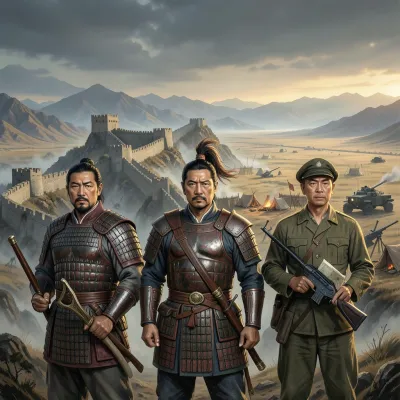
*Swords and Borderlands: Military Strategy and Fortification in Chinese History* offers a comprehensive analysis of the evolution of China’s frontier policies from the Qin dynasty to the modern era. The book argues that China’s borders were not static lines but dynamic systems of management, where military strategy was inextricably linked to infrastructure, logistics, and administrative innovation. By shifting the perspective from the imperial center to the geographic edges, the text illustrates how successive regimes negotiated the persistent tension between sedentary agrarian society and mobile steppe or maritime adversaries.
The narrative details the development of diverse defensive mechanisms, ranging from the standardized weaponry and road networks of the Qin to the sophisticated *tuntian* (military-agricultural colonies) of the Han and the riverine redoubts of the Three Kingdoms. It traces the maturation of fortification engineering through the Song’s city-fortress strategies and the iconic brick-and-beacon systems of the Ming Great Wall. The book also highlights the significant contributions of non-Han dynasties, such as the Liao, Jin, and Yuan, in refining hybrid governance models and imperial communication networks like the *örtöö* postal relay system.
In the later chapters, the book explores the transition into the modern age, marked by the Qing dynasty's massive territorial incorporation of Xinjiang and Tibet and the subsequent "self-strengthening" reforms in response to industrial-age threats. The 20th-century sections cover the impact of railways on warlord politics, the CCP’s revolutionary mobile strategies, and the consolidation of borders in the early People’s Republic. The study concludes with the shift from physical barriers to high-technology border security, such as sensors and satellites, emphasizing that while the tools of warfare have evolved, the fundamental challenge of securing an immense and varied frontier remains a core driver of Chinese statecraft.
What You'll Find Inside:
- How Chinese dynasties transformed frontier management from simple walls to integrated systems combining fortifications, logistics, granaries, and beacon networks for sustainable defense across two millennia.
- The evolution of key military institutions like the Han tuntian soldier-farmer colonies, Tang fubing garrison militia, and Ming coastal defense systems that blended military readiness with agricultural production and local administration.
- Technological adaptation across eras - from Qin standardization and crossbow innovations to Song artillery, Ming firearms, and finally modern sensor networks, drones, and digital surveillance systems.
- Case studies of specific frontier challenges: steppe nomad diplomacy (Han vs Xiongnu), riverine warfare (Three Kingdoms period), Himalayan high-altitude conflicts (1962 Sino-Indian War), and jungle militarization (Sino-Vietnamese border wars of 1979).
- The enduring concept of frontiers as managed zones of exchange and control rather than static barriers, revealing how states balanced coercion, trade, and diplomacy to secure margins while adapting to geography and local populations.
Who's It For:
This book is essential reading for students and scholars of Chinese history, military strategy, and Asian studies, particularly those interested in the long-term evolution of frontier defense and state-building. It will also benefit defense analysts, policymakers, and professionals in border security seeking historical precedents for managing complex territorial margins. Readers fascinated by the intersection of geography, technology, and administration in sustaining imperial power across diverse environments will find valuable insights into how Chinese regimes adapted their strategies from antiquity to the modern era.
Author:
Published By:
Date Published:
May 4, 2026
Type:
Nonfiction
Language:
English
Word Count:
62,766 words
Reading Time:
4 hours 24 minutes
Sample:
Order:
Order Swords and Borderlands: Military Strategy and Fortification in Chinese History (Paperback) on MixCache.com:
Buy NowPrint copy is made to order and ships worldwide. Includes the ebook free, ready to read instantly.
$5 account credit for all new MixCache.com accounts, usable toward any ebook purchase!*