
Browse by Category
Fiction
- Action & Adventure
- African American
- Anthologies
- Children's Fiction
- Classics
- Comics & Graphic Novels
- Coming of Age
- Contemporary
- Cultural & Regional
- Drama
- Erotica
- Fantasy
- General
- Historical Fiction
- Horror
- Humor & Satire
- Literary Fiction
- Mystery, Thriller & Suspense
- Poetry
- Religious & Inspirational
- Romance
- Science Fiction
- Short Stories
- War & Military
- Westerns
- Women's Fiction
- Young Adult
Non-Fiction
- Antiques & Collectibles
- Arts & Photography
- Biographies & Memoirs
- Business & Money
- Children's Non-Fiction
-
Computers & Technology
- Artificial Intelligence
- Computer Science
- Cybersecurity & Cryptography
- Data Science & Analytics
- Databases & Big Data
- Game Development & Design
- General
- Hardware & DIY
- Mobile App Development
- Networking & Cloud Computing
- Operating Systems
- Programming
- Robotics
- Software
- Software Engineering
- User Experience (UX) & Design
- Web Development & Design
- Cooking, Food & Wine
- Crafts, Hobbies & Home
- Education & Teaching
- Engineering
- General
- Health, Fitness & Dieting
-
History
- African History
- African History - North Africa
- African History - Sub-Saharan Africa
- American History
- American History - 20th Century
- American History - Civil War
- American History - Colonial Period
- Ancient History
- Asian History
- Asian History - China
- Asian History - India
- Asian History - Japan
- Asian History - Southeast Asia
- European History
- European History - Ancient Greece
- European History - Ancient Rome
- European History - Medieval
- European History - Modern
- European History - Renaissance
- General
- Middle Eastern History
- Military History
- Military History - Aviation
- Military History - Naval
- Social & Cultural History
- World History
- Humor & Entertainment
- Industrial Technology
- Language Learning
- Law
- LGBTQ+ Non-Fiction
- Literary Criticism
- Medical Books
- Parenting & Relationships
- Philosophy
- Politics & Social Sciences
- Reference
- Religion & Spirituality
-
Science & Math
- Agricultural Sciences
- Astronomy & Space Science
- Behavioral Sciences
- Biological Sciences
- Botany & Plant Science
- Chemistry
- Earth Sciences
- Engineering - Chemical
- Engineering - Civil
- Engineering - Electrical
- Engineering - Mechanical
- Environment
- General
- Geology
- Mathematics
- Nature & Ecology
- Oceanography
- Paleontology
- Physics
- Statistics
- Self-Help
- Sports & Outdoors
- Study Aids
- Sustainability & Green Living
- Textbooks
- Transportation
- Travel
- True Crime
- Urban Planning & Development
- Veterinary Medicine
- Writing & Publishing
Jump to Section
MixCache.com Total Access
Unlimited reading and audiobooks for every book published by MixCache.com.
Included titles carry the MTA badge.
Learn more →
Backyard to Launchpad: Amateur Observing and Launch Watching
MTA
A practical guide for hobbyists to observe planets, track satellites, and attend or stream launches
About this book:
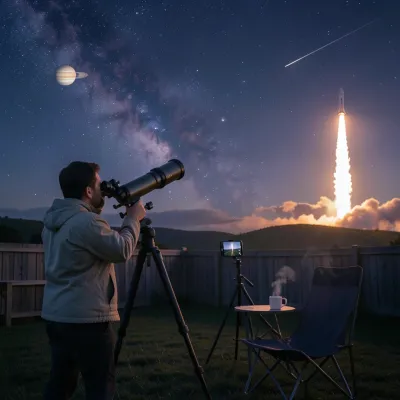
"Backyard to Launchpad: Amateur Observing and Launch Watching" serves as a comprehensive guide for individuals interested in bridging the gap between passive skygazing and active participation in astronomical observation and spaceflight tracking. The book begins by equipping the novice with foundational skills, from selecting appropriate optics like binoculars and beginner telescopes to understanding celestial mechanics such as coordinates, time, and seasonal patterns. It emphasizes the importance of site selection, mitigating light pollution, and mastering observing techniques like dark adaptation, averted vision, and sketching to enhance visual perception and record observations effectively for both lunar and planetary targets, including the sun (with stringent safety protocols).
Beyond traditional astronomy, the guide delves into the dynamic world of artificial objects. It provides a detailed primer on satellites, explaining orbital mechanics, Two-Line Elements (TLEs), and pass predictions, along with the software and apps used for tracking. The book also introduces amateur radio techniques for receiving weather satellite images and listening to beacons. For the spaceflight enthusiast, it demystifies launch vehicles, staging, and trajectories, offering advice on how to interpret mission briefings, webcasts, and telemetry. Crucially, it provides extensive guidance on planning to watch launches in person, covering logistics, on-site safety, etiquette, and advanced techniques for capturing launches through photography and audio recording.
A significant portion of the book focuses on moving from passive consumption to active contribution through citizen science. It outlines various pathways for amateurs to contribute valuable data to scientific research, including observing variable stars, timing occultations, and conducting meteor counts, emphasizing the importance of accurate record-keeping and data sharing. The text stresses the critical role of observation journals, detailing how checklists, logs, and sketches build skill and preserve invaluable personal and scientific data.
Finally, the book highlights the power of community and collaboration, encouraging readers to engage with local astronomy clubs, star parties, and online networks for mentorship, shared learning, and collective projects. It frames the journey from hobbyist to contributor as a continuous cycle of learning, adapting, and sharing, reminding readers that every observation, however small, adds to humanity's collective understanding of the cosmos. The overarching message is that with proper preparation, respect for the sky, and a spirit of inquiry, anyone can meaningfully participate in exploring both the natural wonders and human achievements above us.
What You'll Find Inside:
- Guidance on selecting and using binoculars and beginner telescopes, including types, magnification, aperture, and essential accessories.
- How to choose, set up, and maintain mounts and tripods for stable pointing and smooth tracking of celestial and moving objects.
- Fundamentals of celestial coordinates, time systems, and seasonal sky patterns to locate and predict when objects will be visible.
- Core observing techniques such as dark adaptation, averted vision, sketching, and effective record‑keeping to maximize what you can see.
- From planetary, lunar, and solar observing to satellite tracking, launch watching (in person or via streams), and pathways to contribute to citizen science.
Who's It For:
This book is aimed at beginner to intermediate amateur astronomers and space enthusiasts who want a practical, hands‑on guide to observing the night sky, tracking satellites, and following rocket launches. It assumes no advanced math or expensive gear, focusing instead on clear instructions, tool selection, and techniques that let hobbyists quickly become confident observers and informed launch watchers. Readers who wish to contribute to citizen science projects or join local astronomy clubs will also find useful advice on how to share their observations and collaborate with others.
Table of Contents:
- Introduction
- Chapter 1 Choosing Your First Optics: Binoculars and Beginner Telescopes
- Chapter 2 Mounts, Tripods, and Tracking: Stability and Smooth Motions
- Chapter 3 The Night Sky Basics: Coordinates, Time, and Seasonal Patterns
- Chapter 4 Site Selection and Light Pollution: Making the Most of Your Sky
- Chapter 5 Observing Techniques: Dark Adaptation, Averted Vision, and Sketching
- Chapter 6 Planetary Observing: From Mercury to Neptune
- Chapter 7 The Moon Up Close: Phases, Features, and Libration
- Chapter 8 Solar Observing Safely: Filters, Sunspots, and Eclipses
- Chapter 9 Cameras and Eyepieces: Smartphone to DSLR Imaging
- Chapter 10 Keeping Gear Tuned: Collimation, Cleaning, and Power Management
- Chapter 11 Satellites 101: Orbits, TLEs, and Pass Predictions
- Chapter 12 Satellite Tracking Tools: Apps, Websites, and Planetarium Software
- Chapter 13 Radio from the Backyard: Weather Images, Beacons, and Amateur Bands
- Chapter 14 Spaceflight Primer: Launch Vehicles, Stages, and Trajectories
- Chapter 15 Reading Mission Briefings: Press Kits, Timelines, and Callouts
- Chapter 16 Telemetry and Webcasts: Decoding Overlays and Jargon
- Chapter 17 Planning to Watch a Launch In Person: Windows, Weather, and Logistics
- Chapter 18 On‑Site Safety and Etiquette: Distances, Hearing, and Photo Spots
- Chapter 19 Capturing Launches: Cameras, Audio, and Exposure Settings
- Chapter 20 Streaming Like a Pro: Curating Feeds and Avoiding Pitfalls
- Chapter 21 Following Missions After Liftoff: Deployments, Burns, and Anomalies
- Chapter 22 Citizen Science Pathways: Variable Stars, Occultations, and Meteor Counts
- Chapter 23 Building Your Observation Journal: Checklists, Logs, and Data Sharing
- Chapter 24 Community and Collaboration: Clubs, Star Parties, and Online Networks
- Chapter 25 Roadmaps and Next Steps: From Hobbyist to Contributor
Author:
Published By:
Date Published:
May 3, 2026
Type:
Nonfiction
Language:
English
Word Count:
69,229 words
Reading Time:
4 hours 51 minutes
Sample:
MixCache.com Total Access
Get unlimited access to this book + all books published by MixCache.com for $11.99/month
Subscribe to MTAOr purchase this book individually below
Order:
Buy the Backyard to Launchpad: Amateur Observing and Launch Watching ebook on MixCache.com:
Buy Now
Full ebook will be available immediately
- read online or download as a PDF file.
$5 account credit for all new MixCache.com accounts, usable toward any ebook purchase!*



Ratings & Reviews
Ask Questions About This Book
Have a question about the content? Ask our AI assistant!
Start by asking a question about "Backyard to Launchpad: Amateur Observing and Launch Watching"
Example: "Does this book mention William Shakespeare?"
Thinking...