Browse by Category
Fiction
- Action & Adventure
- African American
- Anthologies
- Children's Fiction
- Classics
- Comics & Graphic Novels
- Coming of Age
- Contemporary
- Cultural & Regional
- Drama
- Erotica
- Fantasy
- General
- Historical Fiction
- Horror
- Humor & Satire
- Literary Fiction
- Mystery, Thriller & Suspense
- Poetry
- Religious & Inspirational
- Romance
- Science Fiction
- Short Stories
- War & Military
- Westerns
- Women's Fiction
- Young Adult
Non-Fiction
- Antiques & Collectibles
- Arts & Photography
- Biographies & Memoirs
- Business & Money
- Children's Non-Fiction
-
Computers & Technology
- Artificial Intelligence
- Computer Science
- Cybersecurity & Cryptography
- Data Science & Analytics
- Databases & Big Data
- Game Development & Design
- General
- Hardware & DIY
- Mobile App Development
- Networking & Cloud Computing
- Operating Systems
- Programming
- Robotics
- Software
- Software Engineering
- User Experience (UX) & Design
- Web Development & Design
- Cooking, Food & Wine
- Crafts, Hobbies & Home
- Education & Teaching
- Engineering
- General
- Health, Fitness & Dieting
-
History
- African History
- African History - North Africa
- African History - Sub-Saharan Africa
- American History
- American History - 20th Century
- American History - Civil War
- American History - Colonial Period
- Ancient History
- Asian History
- Asian History - China
- Asian History - India
- Asian History - Japan
- Asian History - Southeast Asia
- European History
- European History - Ancient Greece
- European History - Ancient Rome
- European History - Medieval
- European History - Modern
- European History - Renaissance
- General
- Middle Eastern History
- Military History
- Military History - Aviation
- Military History - Naval
- Social & Cultural History
- World History
- Humor & Entertainment
- Industrial Technology
- Language Learning
- Law
- LGBTQ+ Non-Fiction
- Literary Criticism
- Medical Books
- Parenting & Relationships
- Philosophy
- Politics & Social Sciences
- Reference
- Religion & Spirituality
-
Science & Math
- Agricultural Sciences
- Astronomy & Space Science
- Behavioral Sciences
- Biological Sciences
- Botany & Plant Science
- Chemistry
- Earth Sciences
- Engineering - Chemical
- Engineering - Civil
- Engineering - Electrical
- Engineering - Mechanical
- Environment
- General
- Geology
- Mathematics
- Nature & Ecology
- Oceanography
- Paleontology
- Physics
- Statistics
- Self-Help
- Sports & Outdoors
- Study Aids
- Sustainability & Green Living
- Textbooks
- Transportation
- Travel
- True Crime
- Urban Planning & Development
- Veterinary Medicine
- Writing & Publishing
Jump to Section
MixCache.com Total Access
Unlimited reading and audiobooks for every book published by MixCache.com.
Included titles carry the MTA badge.
Learn more →
Putin's Russia and the Soviet Inheritance
MTA
Historical Roots of Contemporary Governance, Propaganda, and Foreign Policy
About this book:
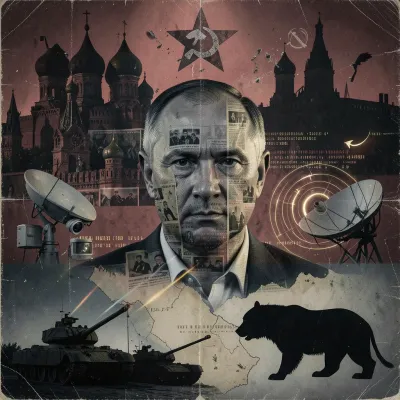
The book, "Putin's Russia and the Soviet Inheritance," argues that understanding contemporary Russia requires acknowledging its deep roots in the Soviet past. It contends that the current governing system is a blend of Soviet legacies—like the primacy of security, instrumental use of law, and state control over institutions—with modern market mechanisms, new media, and global interdependence. This framework emphasizes "path dependence" and strategic improvisation, where post-Soviet chaos provided the opportunity to reconstruct an order that feels familiar yet utilizes 21st-century tools to project stability domestically and influence internationally.
The book traces the evolution of Putin's Russia through several key areas. It details the reconstruction of the state into a centralized "power vertical," drawing heavily on the KGB legacy and a security-state mindset that prioritizes control and loyalty. This includes the managed nature of democracy, where elections are rituals validating the status quo; the marginalization of opposition parties; and the instrumental use of courts and law to serve state interests. Furthermore, it examines how federalism has been "rewired" to centralize control over regions and governors, and how state capitalism, with its state-owned enterprises and loyal oligarchs, commands the strategic heights of the economy. Media capture and advanced propaganda, including digital disinformation, are analyzed as sophisticated tools for narrative management, while memory politics and the Russian Orthodox Church are shown to reinforce national identity and state legitimacy.
In foreign policy, the book asserts that inherited instincts, such as the belief in Russia as a great power with a sphere of influence in the "near abroad," are refracted through new conditions. Chapters explore Russia's complex relations with Europe and the United States, marked by cycles of conflict and accommodation, and its escalating involvement in Ukraine from the Orange Revolution to full-scale war. The text also covers Russia's power projection beyond its immediate neighborhood, specifically in Syria and Africa, utilizing hybrid tactics and leveraging energy, pipelines, and cyber operations as instruments of statecraft. The final sections address economic adaptation through import substitution in response to sanctions and delve into the complexities of elite politics, succession scenarios, and the regime's overall durability.
Ultimately, "Putin's Russia and the Soviet Inheritance" offers a comprehensive analytical framework for interpreting the continuities and changes in the Russian state. It highlights how Soviet legacies structure incentives and repertoires, influencing actors' choices within those constraints. The book concludes that the system is resilient, adapting old tools to new challenges and prioritizing control and credibility. It suggests that Russia's future will be shaped by these deep continuities and contingent decisions, with the state constantly striving to preserve its core functions—sovereignty, order, and legitimacy—in a volatile world.
What You'll Find Inside:
- The Soviet inheritance persists in adapted forms - institutions don't vanish when flags change but mutate and continue to shape contemporary Russian governance, propaganda, and foreign policy through path dependence and strategic improvisation.
- The KGB legacy created an enduring security-state mindset that prioritizes threat assessment, information control, and hierarchical coordination, permeating all levels of Russian governance and elite formation.
- Putin's power vertical system centralizes authority through managed democracy, media capture, and legal instrumentation, creating a system that rewards loyalty while maintaining controlled pluralism.
- State capitalism concentrates strategic economic assets in loyal hands, enabling the state to direct investment, cushion shocks, and mobilize resources for geopolitical objectives while maintaining market mechanisms.
- Historical memory, particularly the Great Patriotic War victory, is systematically instrumentalized as a tool of rule to legitimize current policies, foster national unity, and frame dissent as unpatriotic or treasonous.
Who's It For:
This book is written for analysts, students, and general readers who seek a historically grounded framework for understanding contemporary Russia rather than a catalogue of headlines. It will particularly benefit political scientists, historians, international relations specialists, and policy professionals looking to understand how Soviet legacies shape Putin's Russia. General readers interested in gaining deeper insight beyond daily news coverage will also find value in its analytical approach to Russia's governance, propaganda, and foreign policy.
Table of Contents:
- Introduction
- Chapter 1 From Late Soviet Stagnation to Post-Soviet Flux
- Chapter 2 The KGB Legacy and the Security-State Mindset
- Chapter 3 Building the Power Vertical: Centralization as Strategy
- Chapter 4 Managed Democracy: Elections as Ritual
- Chapter 5 Parties of Power and the Marginalization of Opposition
- Chapter 6 Courts, Law, and the Instrumental State
- Chapter 7 Federalism Rewired: Regions, Governors, and Control
- Chapter 8 Oligarchs, State Capitalism, and the Commanding Heights
- Chapter 9 Media Capture: From Oligarchic TV to State Narratives
- Chapter 10 Propaganda 2.0: Digital Ecosystems and Disinformation
- Chapter 11 Memory Politics: History as a Tool of Rule
- Chapter 12 Church and State: Orthodoxy and National Identity
- Chapter 13 Security Services Ascendant: Siloviki in Governance
- Chapter 14 The Social Contract: Stability, Paternalism, and Fear
- Chapter 15 Repression by Law: NGOs, “Foreign Agents,” and Civil Society
- Chapter 16 Military Reform and the New Way of War
- Chapter 17 Energy, Pipelines, and the Geopolitics of Leverage
- Chapter 18 The Near Abroad: Post-Soviet Space as Sphere of Influence
- Chapter 19 Europe and the United States: Cycles of Conflict and Accommodation
- Chapter 20 Ukraine: From Orange Revolution to Full-Scale War
- Chapter 21 Syria, Africa, and Power Projection Beyond the Neighborhood
- Chapter 22 Cyber Operations and the Information Battlespace
- Chapter 23 Sanctions, Substitution, and Economic Adaptation
- Chapter 24 Elite Politics, Succession Scenarios, and Regime Durability
- Chapter 25 Futures of the Russian State: Continuities, Contingencies, and Change
Author:
Published By:
Date Published:
May 2, 2026
Type:
Nonfiction
Language:
English
Word Count:
72,646 words
Reading Time:
5 hours 5 minutes
Sample:
Order:
Order Putin's Russia and the Soviet Inheritance (Paperback) on MixCache.com:
Buy NowPrint copy is made to order and ships worldwide. Includes the ebook free, ready to read instantly.
$5 account credit for all new MixCache.com accounts, usable toward any ebook purchase!*