Browse by Category
Fiction
- Action & Adventure
- African American
- Anthologies
- Children's Fiction
- Classics
- Comics & Graphic Novels
- Coming of Age
- Contemporary
- Cultural & Regional
- Drama
- Erotica
- Fantasy
- General
- Historical Fiction
- Horror
- Humor & Satire
- Literary Fiction
- Mystery, Thriller & Suspense
- Poetry
- Religious & Inspirational
- Romance
- Science Fiction
- Short Stories
- War & Military
- Westerns
- Women's Fiction
- Young Adult
Non-Fiction
- Antiques & Collectibles
- Arts & Photography
- Biographies & Memoirs
- Business & Money
- Children's Non-Fiction
-
Computers & Technology
- Artificial Intelligence
- Computer Science
- Cybersecurity & Cryptography
- Data Science & Analytics
- Databases & Big Data
- Game Development & Design
- General
- Hardware & DIY
- Mobile App Development
- Networking & Cloud Computing
- Operating Systems
- Programming
- Robotics
- Software
- Software Engineering
- User Experience (UX) & Design
- Web Development & Design
- Cooking, Food & Wine
- Crafts, Hobbies & Home
- Education & Teaching
- Engineering
- General
- Health, Fitness & Dieting
-
History
- African History
- African History - North Africa
- African History - Sub-Saharan Africa
- American History
- American History - 20th Century
- American History - Civil War
- American History - Colonial Period
- Ancient History
- Asian History
- Asian History - China
- Asian History - India
- Asian History - Japan
- Asian History - Southeast Asia
- European History
- European History - Ancient Greece
- European History - Ancient Rome
- European History - Medieval
- European History - Modern
- European History - Renaissance
- General
- Middle Eastern History
- Military History
- Military History - Aviation
- Military History - Naval
- Social & Cultural History
- World History
- Humor & Entertainment
- Industrial Technology
- Language Learning
- Law
- LGBTQ+ Non-Fiction
- Literary Criticism
- Medical Books
- Parenting & Relationships
- Philosophy
- Politics & Social Sciences
- Reference
- Religion & Spirituality
-
Science & Math
- Agricultural Sciences
- Astronomy & Space Science
- Behavioral Sciences
- Biological Sciences
- Botany & Plant Science
- Chemistry
- Earth Sciences
- Engineering - Chemical
- Engineering - Civil
- Engineering - Electrical
- Engineering - Mechanical
- Environment
- General
- Geology
- Mathematics
- Nature & Ecology
- Oceanography
- Paleontology
- Physics
- Statistics
- Self-Help
- Sports & Outdoors
- Study Aids
- Sustainability & Green Living
- Textbooks
- Transportation
- Travel
- True Crime
- Urban Planning & Development
- Veterinary Medicine
- Writing & Publishing
Jump to Section
MixCache.com Total Access
Unlimited reading and audiobooks for every book published by MixCache.com.
Included titles carry the MTA badge.
Learn more →
Revolutionary Lawyers
MTA
Law, Courts, and Legal Reform in Soviet Political Transformation
About this book:
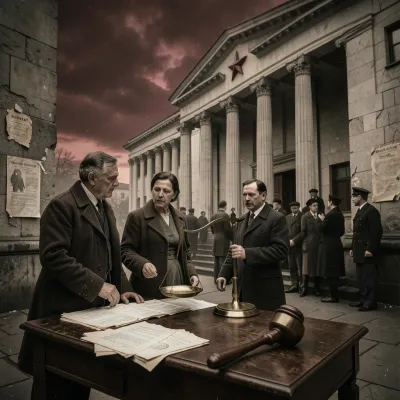
*Revolutionary Lawyers* provides a comprehensive institutional and social history of the Soviet legal system, tracing its evolution from the improvised "people's justice" of the 1917 October Revolution to its collapse during the 1991 transition. The book challenges the traditional view of Soviet law as a mere façade for state violence, arguing instead that the legal order was a sophisticated instrument of state-building. It illustrates how the regime balanced the "extraordinary justice" of security organs like the Cheka and KGB with a professionalized, bureaucratic court system that sought to provide predictability and legitimacy for a developing socialist society.
The narrative details the cyclical relationship between reform and repression, highlighting pivotal moments such as the New Economic Policy (NEP) compromise, the 1930s recasting of legal norms, and the postwar reconstruction. It examines the central roles played by the Narkomjust (Commissariat of Justice) and the Procuracy, the latter of which became a dominant force for surveillance and administrative oversight. The book also focuses on the professionalization of jurists—judges, prosecutors, and the *advokatura* (defense bar)—showing how these "revolutionary lawyers" navigated a system that demanded both technical competence and absolute political loyalty.
A recurring theme is the "theatrical" or performative nature of Soviet legality. The book explores how the state used legal forms, from the drafting of grand constitutions (1936 and 1977) to the staging of high-profile show trials, to perform accountability and moral authority for both domestic and international audiences. Even in periods of intense repression, the regime felt compelled to dress its actions in the language of statutes and procedures, creating a durable legal culture that could absorb dissent and manage the complexities of a planned economy while maintaining the party’s ultimate supremacy.
The final section analyzes the "Helsinki effect" on human rights talk in the 1970s and the subsequent transformation of law during Gorbachev’s *perestroika*, where legal reform was used as a tool to dismantle the very system it once protected. By comparing the Soviet experience with other socialist states and examining its legacies in post-Soviet legal orders, the book concludes that Soviet law was a flexible political resource. It remains a foundational study on how authoritarian regimes use legality to civilize power without fully surrendering it, leaving an institutional and psychological imprint that persists in Eurasia today.
What You'll Find Inside:
- Soviet law functioned as both a reform instrument (standardizing rules, professionalizing justice) and repression tool (policing dissent, staging consensus) - a central paradox explored throughout the book.
- The evolution from improvised revolutionary tribunals to routinized Soviet courts demonstrates how legality developed as a state-building project balancing expediency with procedural regularity.
- Trials served as performative theaters where narratives of guilt, reform, and redemption were staged to align public sentiment with policy objectives.
- Legal professionals (judges, procurators, advocates) developed professional identities that allowed them to navigate shifting political winds while maintaining commitments to procedure.
- The book offers comparative insights into revolutionary legality and speaks to contemporary debates about law in post-authoritarian and post-conflict settings.
Who's It For:
This book will be valuable for scholars and students of Soviet/Russian history, legal historians, political scientists studying law and state power, and professionals working on legal reform in post-authoritarian or post-conflict settings. Readers interested in comparative legal systems, transitional justice, and how law functions as both instrument of state power and site of negotiation will find particular relevance in the book's analysis of Soviet legal evolution and its contemporary implications.
Table of Contents:
- Introduction
- Chapter 1 From Uprising to Tribunal: Law in the October Aftermath
- Chapter 2 Commissars of Justice: Building the Narkomjust
- Chapter 3 Extraordinary Justice: Cheka, GPU, and the Elastic Boundaries of Law
- Chapter 4 People’s Courts and Revolutionary Legality
- Chapter 5 Codifying the Revolution: Early Decrees and Legal Pluralism
- Chapter 6 The NEP Compromise: Markets, Property, and Procedure
- Chapter 7 Socialist Legality Emerges: The 1930s Recasting of Norms
- Chapter 8 Procuracy Ascendant: Surveillance through Law
- Chapter 9 The Advokatura: Defense in a System of Discipline
- Chapter 10 Show Trials and Spectacle: Performing Guilt
- Chapter 11 Labor, Discipline, and the Law: Factories and Collectives
- Chapter 12 Nationalities and Law: Federalism, Autonomy, and Control
- Chapter 13 War and Emergency Justice: 1941–1945
- Chapter 14 Postwar Reconstruction: Restoring and Expanding Legal Order
- Chapter 15 The Thaw: Khrushchev’s Reforms and Their Limits
- Chapter 16 Everyday Law under Brezhnev: Stagnation and Stability
- Chapter 17 Legal Education and the Making of Soviet Jurists
- Chapter 18 Constitutionalism without Courts? The 1936 and 1977 Constitutions
- Chapter 19 Dissent, Rights Talk, and the Helsinki Effect
- Chapter 20 Perestroika and Glasnost: Law as a Vehicle of Change
- Chapter 21 The 1989–1991 Transition: Courts in Collapse and Creation
- Chapter 22 Legitimacy and Coercion: Theoretical Perspectives on Soviet Law
- Chapter 23 Comparative Lessons: Revolutionary Law in Other Socialist States
- Chapter 24 Legacies in Post-Soviet Legal Orders
- Chapter 25 Rethinking Reform and Repression: A Synthesis
Author:
Published By:
Date Published:
May 2, 2026
Type:
Nonfiction
Language:
English
Word Count:
78,224 words
Reading Time:
5 hours 29 minutes
Sample:
Order:
Order Revolutionary Lawyers (Paperback) on MixCache.com:
Buy NowPrint copy is made to order and ships worldwide. Includes the ebook free, ready to read instantly.
$5 account credit for all new MixCache.com accounts, usable toward any ebook purchase!*