
Browse by Category
Fiction
- Action & Adventure
- African American
- Anthologies
- Children's Fiction
- Classics
- Comics & Graphic Novels
- Coming of Age
- Contemporary
- Cultural & Regional
- Drama
- Erotica
- Fantasy
- General
- Historical Fiction
- Horror
- Humor & Satire
- Literary Fiction
- Mystery, Thriller & Suspense
- Poetry
- Religious & Inspirational
- Romance
- Science Fiction
- Short Stories
- War & Military
- Westerns
- Women's Fiction
- Young Adult
Non-Fiction
- Antiques & Collectibles
- Arts & Photography
- Biographies & Memoirs
- Business & Money
- Children's Non-Fiction
-
Computers & Technology
- Artificial Intelligence
- Computer Science
- Cybersecurity & Cryptography
- Data Science & Analytics
- Databases & Big Data
- Game Development & Design
- General
- Hardware & DIY
- Mobile App Development
- Networking & Cloud Computing
- Operating Systems
- Programming
- Robotics
- Software
- Software Engineering
- User Experience (UX) & Design
- Web Development & Design
- Cooking, Food & Wine
- Crafts, Hobbies & Home
- Education & Teaching
- Engineering
- General
- Health, Fitness & Dieting
-
History
- African History
- African History - North Africa
- African History - Sub-Saharan Africa
- American History
- American History - 20th Century
- American History - Civil War
- American History - Colonial Period
- Ancient History
- Asian History
- Asian History - China
- Asian History - India
- Asian History - Japan
- Asian History - Southeast Asia
- European History
- European History - Ancient Greece
- European History - Ancient Rome
- European History - Medieval
- European History - Modern
- European History - Renaissance
- General
- Middle Eastern History
- Military History
- Military History - Aviation
- Military History - Naval
- Social & Cultural History
- World History
- Humor & Entertainment
- Industrial Technology
- Language Learning
- Law
- LGBTQ+ Non-Fiction
- Literary Criticism
- Medical Books
- Parenting & Relationships
- Philosophy
- Politics & Social Sciences
- Reference
- Religion & Spirituality
-
Science & Math
- Agricultural Sciences
- Astronomy & Space Science
- Behavioral Sciences
- Biological Sciences
- Botany & Plant Science
- Chemistry
- Earth Sciences
- Engineering - Chemical
- Engineering - Civil
- Engineering - Electrical
- Engineering - Mechanical
- Environment
- General
- Geology
- Mathematics
- Nature & Ecology
- Oceanography
- Paleontology
- Physics
- Statistics
- Self-Help
- Sports & Outdoors
- Study Aids
- Sustainability & Green Living
- Textbooks
- Transportation
- Travel
- True Crime
- Urban Planning & Development
- Veterinary Medicine
- Writing & Publishing
Jump to Section
MixCache.com Total Access
Unlimited reading and audiobooks for every book published by MixCache.com.
Included titles carry the MTA badge.
Learn more →The Economy of Iran
About this book:
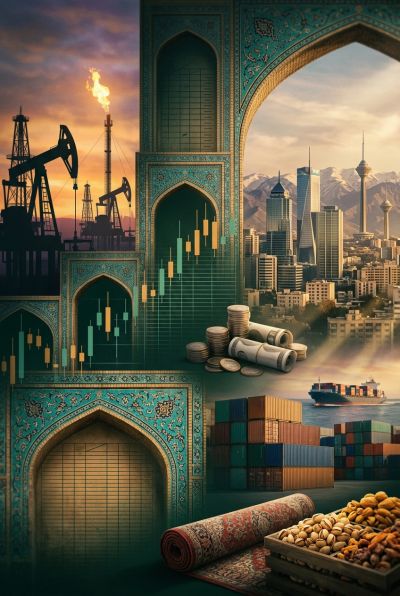
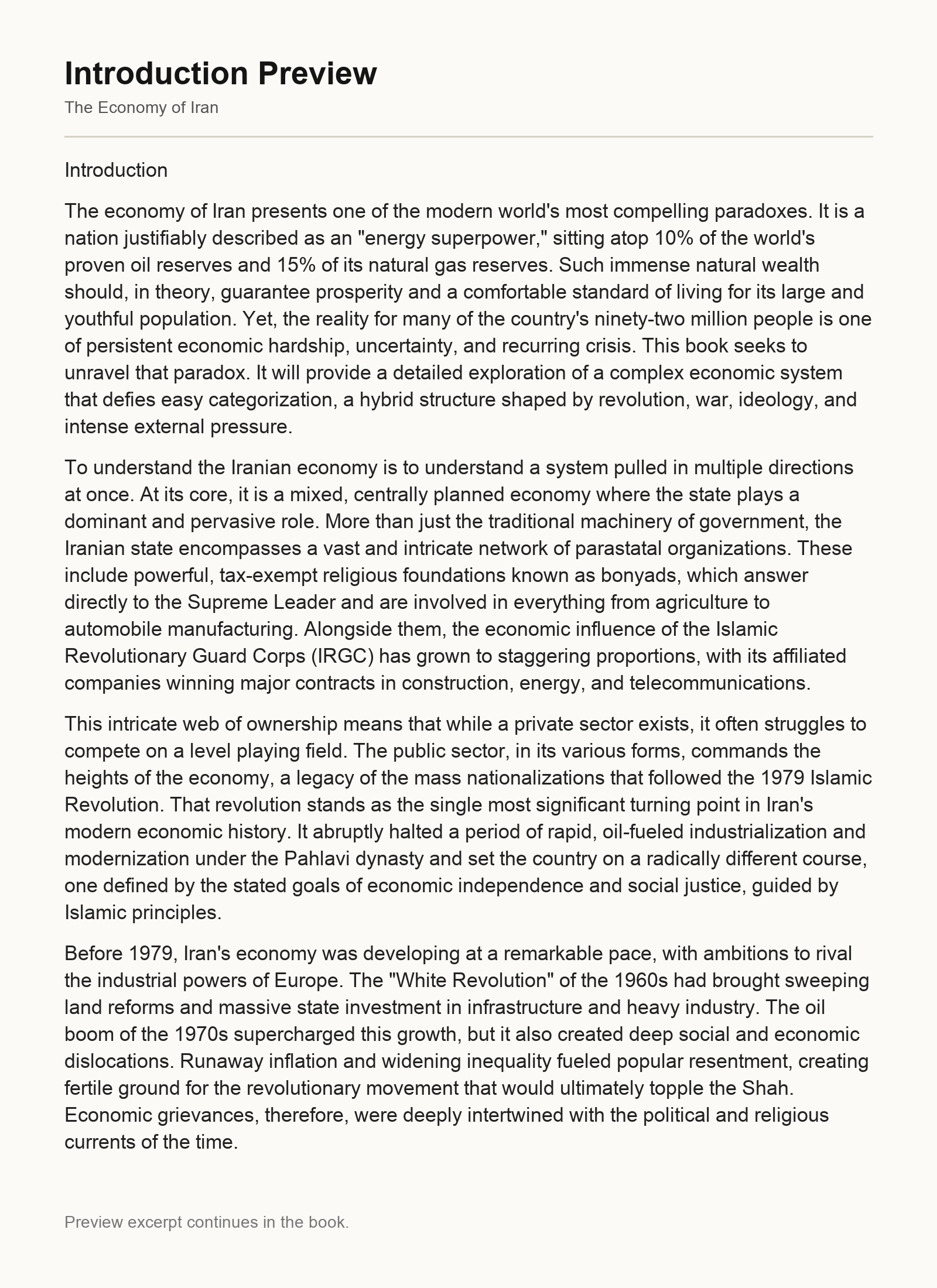
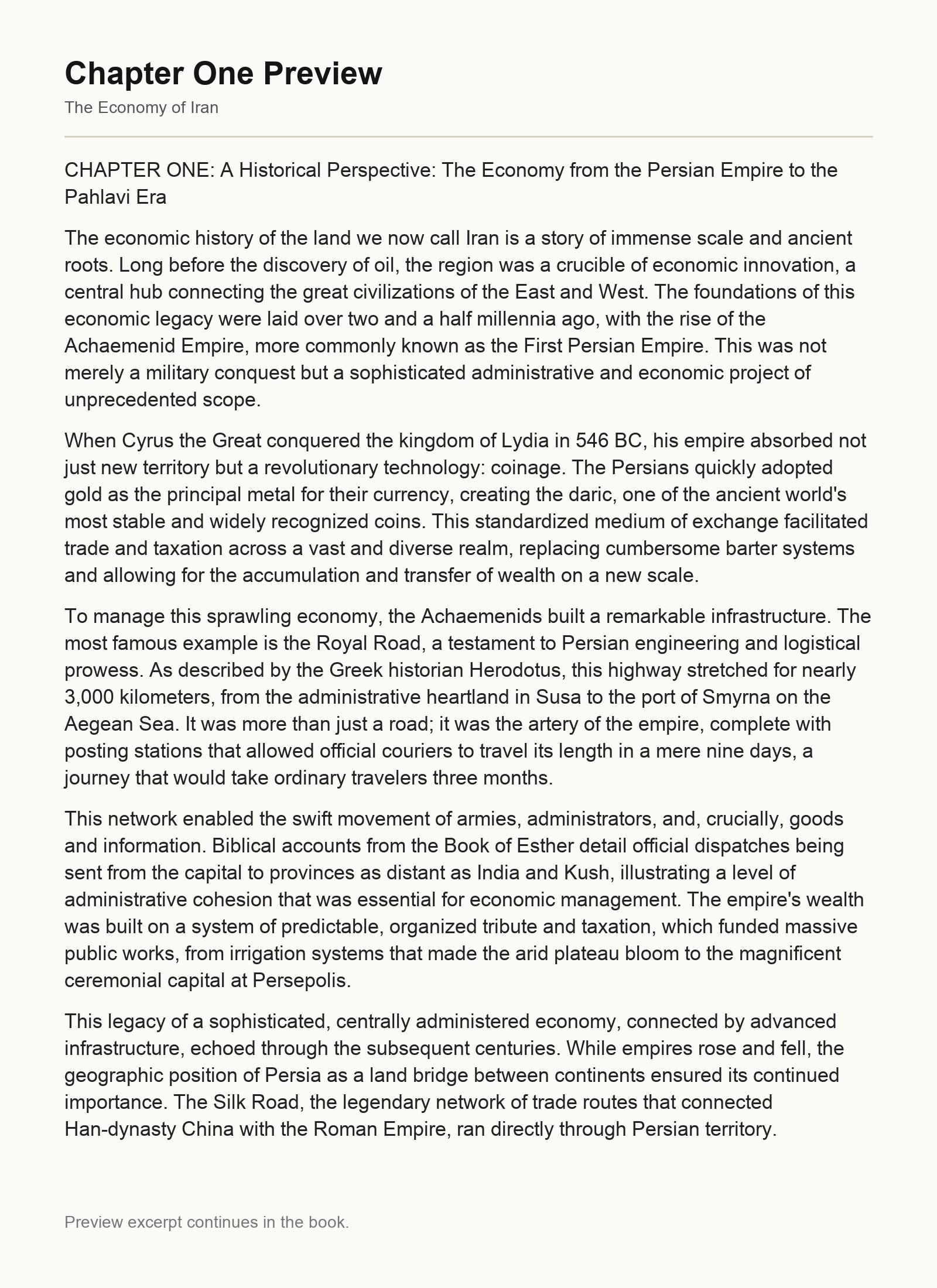
The Economy of Iran offers a deep, chapter‑by‑chapter exploration of one of the world’s most intriguing economic paradoxes: a nation blessed with vast oil and gas reserves yet plagued by chronic inflation, currency collapse, and persistent hardship. Readers will trace Iran’s economic journey from the ancient trade networks of the Achaemenid Empire through the Pahlavi modernization drive, the seismic rupture of the 1979 Islamic Revolution, and the devastating eight‑year war with Iraq that forged a command‑and‑control economy. This historical foundation sets the stage for understanding how ideology, war, and international pressure have shaped the country’s unique hybrid system.
The book dissects the structure of ownership that defines modern Iran, revealing the dominant role of the state, the cooperative sector, and the private sector, while exposing the powerful parastatal economy built around religious foundations (bonyads) and the Islamic Revolutionary Guard Corps (IRGC). Readers will learn how these entities enjoy tax exemptions, preferential contracts, and direct allegiance to the Supreme Leader, creating a parallel economic network that often crowds out genuine private initiative and distorts competition across industries ranging from energy and petrochemicals to construction and telecommunications.
Each major sector receives detailed scrutiny: the oil and gas industry that underpins the budget, the petrochemical complexes that turn cheap feedstock into export earnings, the mining and metals wealth that remains largely untapped, the manufacturing base that includes automobile production and defense industries, and the service sector where banking, finance, and a volatile stock exchange operate under heavy state influence. Chapters on agriculture, water, and electricity crises illustrate how environmental mismanagement compounds economic strain, while sections on labor, unemployment, brain drain, living standards, poverty, and inequality reveal the human cost of systemic inefficiencies and sanctions.
The work also equips readers with a clear picture of Iran’s macroeconomic challenges—persistent hyperinflation, the rial’s dramatic devaluation, fiscal dependence on hydrocarbon revenues, and the ineffective subsidy reform attempts—as well as the difficult business climate marked by corruption, bureaucratic hurdles, and the ever‑present shadow of international sanctions. Readers will understand how sanctions have repeatedly choked off oil exports, deterred foreign investment, and forced the economy into cycles of boom and bust, from the brief relief of the JCPOA to the renewed isolation after the 2025 war with Israel.
Finally, the book looks ahead, presenting two divergent futures: a continuation of the resistance‑economy model that risks deeper stagnation, or a pragmatic pivot toward genuine reform and re‑engagement with the global market that could unleash massive investment, stabilize the currency, and revive growth. By the end, readers will have gained a comprehensive, nuanced understanding of Iran’s economic strengths, vulnerabilities, and the profound choices that will determine whether the nation can harness its vast potential or remain trapped in a cycle of crisis.
What You'll Find Inside:
- Iran's paradox as an 'energy superworld' with 10% of global oil reserves and 15% of natural gas reserves yet persistent economic hardship for its 92 million citizens
- The unique tripartite ownership structure established by Article 44 of Iran's Constitution, dominated in practice by parastatal organizations like bonyads and the IRGC's economic empire
- The comprehensive impact of nearly five decades of international sanctions on Iran's access to global finance, technology, and investment markets
- Chronic macroeconomic challenges including hyperinflation (consistently 30-50% annually) and catastrophic currency devaluation (from 70 rials/$1 pre-revolution to over 1 million rials/$1 by 2025)
- Structural economic issues like youth unemployment, brain drain, water/electricity crises, and the struggle to diversify beyond hydrocarbon dependence despite industrial achievements
Who's It For:
This book is essential reading for economics students, researchers, and policy makers seeking to understand Iran's complex economic system. It provides valuable insights for professionals working in international finance, sanctions compliance, or Middle East business environments. Academics studying political economy, development studies, or resource-rich economies will find this comprehensive analysis particularly useful for understanding how revolution, ideology, war, and international pressure shape economic outcomes.
Table of Contents:
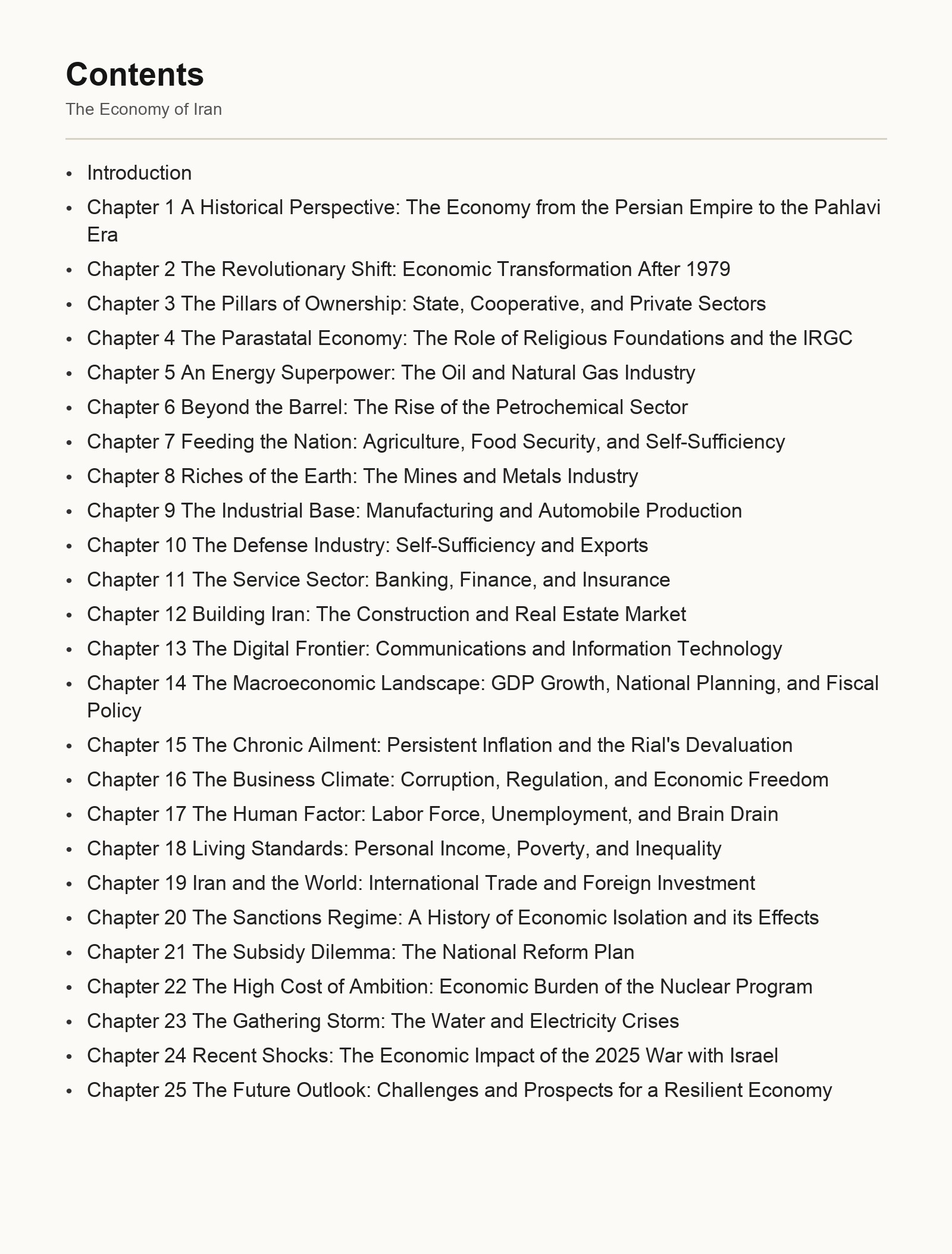
- Introduction
- Chapter 1 A Historical Perspective: The Economy from the Persian Empire to the Pahlavi Era
- Chapter 2 The Revolutionary Shift: Economic Transformation After 1979
- Chapter 3 The Pillars of Ownership: State, Cooperative, and Private Sectors
- Chapter 4 The Parastatal Economy: The Role of Religious Foundations and the IRGC
- Chapter 5 An Energy Superpower: The Oil and Natural Gas Industry
- Chapter 6 Beyond the Barrel: The Rise of the Petrochemical Sector
- Chapter 7 Feeding the Nation: Agriculture, Food Security, and Self-Sufficiency
- Chapter 8 Riches of the Earth: The Mines and Metals Industry
- Chapter 9 The Industrial Base: Manufacturing and Automobile Production
- Chapter 10 The Defense Industry: Self-Sufficiency and Exports
- Chapter 11 The Service Sector: Banking, Finance, and Insurance
- Chapter 12 Building Iran: The Construction and Real Estate Market
- Chapter 13 The Digital Frontier: Communications and Information Technology
- Chapter 14 The Macroeconomic Landscape: GDP Growth, National Planning, and Fiscal Policy
- Chapter 15 The Chronic Ailment: Persistent Inflation and the Rial's Devaluation
- Chapter 16 The Business Climate: Corruption, Regulation, and Economic Freedom
- Chapter 17 The Human Factor: Labor Force, Unemployment, and Brain Drain
- Chapter 18 Living Standards: Personal Income, Poverty, and Inequality
- Chapter 19 Iran and the World: International Trade and Foreign Investment
- Chapter 20 The Sanctions Regime: A History of Economic Isolation and its Effects
- Chapter 21 The Subsidy Dilemma: The National Reform Plan
- Chapter 22 The High Cost of Ambition: Economic Burden of the Nuclear Program
- Chapter 23 The Gathering Storm: The Water and Electricity Crises
- Chapter 24 Recent Shocks: The Economic Impact of the 2025 War with Israel
- Chapter 25 The Future Outlook: Challenges and Prospects for a Resilient Economy
Author:
Published By:
Date Published:
May 24, 2026
Type:
Nonfiction
Language:
English
Also Available In:
German, Spanish, French, Italian, Portuguese
Word Count:
45,570 words
Reading Time:
3 hours 11 minutes
Sample:
Order:
Buy the The Economy of Iran ebook on MixCache.com:
Buy NowThe full ebook will be available immediately to read instantly on any device.
$5 account credit for all new MixCache.com accounts, usable toward any ebook purchase!*




Ratings & Reviews
Ask Questions About This Book
Have a question about the content? Ask our AI assistant!
Start by asking a question about "The Economy of Iran"
Example: "Does this book mention William Shakespeare?"
Thinking...