Browse by Category
Fiction
- Action & Adventure
- African American
- Anthologies
- Children's Fiction
- Classics
- Comics & Graphic Novels
- Coming of Age
- Contemporary
- Cultural & Regional
- Drama
- Erotica
- Fantasy
- General
- Historical Fiction
- Horror
- Humor & Satire
- Literary Fiction
- Mystery, Thriller & Suspense
- Poetry
- Religious & Inspirational
- Romance
- Science Fiction
- Short Stories
- War & Military
- Westerns
- Women's Fiction
- Young Adult
Non-Fiction
- Antiques & Collectibles
- Arts & Photography
- Biographies & Memoirs
- Business & Money
- Children's Non-Fiction
-
Computers & Technology
- Artificial Intelligence
- Computer Science
- Cybersecurity & Cryptography
- Data Science & Analytics
- Databases & Big Data
- Game Development & Design
- General
- Hardware & DIY
- Mobile App Development
- Networking & Cloud Computing
- Operating Systems
- Programming
- Robotics
- Software
- Software Engineering
- User Experience (UX) & Design
- Web Development & Design
- Cooking, Food & Wine
- Crafts, Hobbies & Home
- Education & Teaching
- Engineering
- General
- Health, Fitness & Dieting
-
History
- African History
- African History - North Africa
- African History - Sub-Saharan Africa
- American History
- American History - 20th Century
- American History - Civil War
- American History - Colonial Period
- Ancient History
- Asian History
- Asian History - China
- Asian History - India
- Asian History - Japan
- Asian History - Southeast Asia
- European History
- European History - Ancient Greece
- European History - Ancient Rome
- European History - Medieval
- European History - Modern
- European History - Renaissance
- General
- Middle Eastern History
- Military History
- Military History - Aviation
- Military History - Naval
- Social & Cultural History
- World History
- Humor & Entertainment
- Industrial Technology
- Language Learning
- Law
- LGBTQ+ Non-Fiction
- Literary Criticism
- Medical Books
- Parenting & Relationships
- Philosophy
- Politics & Social Sciences
- Reference
- Religion & Spirituality
-
Science & Math
- Agricultural Sciences
- Astronomy & Space Science
- Behavioral Sciences
- Biological Sciences
- Botany & Plant Science
- Chemistry
- Earth Sciences
- Engineering - Chemical
- Engineering - Civil
- Engineering - Electrical
- Engineering - Mechanical
- Environment
- General
- Geology
- Mathematics
- Nature & Ecology
- Oceanography
- Paleontology
- Physics
- Statistics
- Self-Help
- Sports & Outdoors
- Study Aids
- Sustainability & Green Living
- Textbooks
- Transportation
- Travel
- True Crime
- Urban Planning & Development
- Veterinary Medicine
- Writing & Publishing
Jump to Section
MixCache.com Total Access
Unlimited reading and audiobooks for every book published by MixCache.com.
Included titles carry the MTA badge.
Learn more →
The Art of Propaganda
MTA
Visual Culture, Film, and Rhetoric in Soviet Political Communication
About this book:
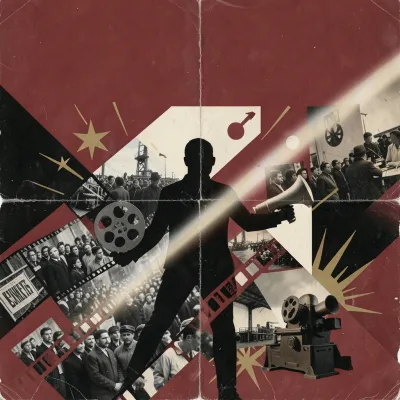
*The Art of Propaganda: Visual Culture, Film, and Rhetoric in Soviet Political Communication* provides a comprehensive historical and theoretical analysis of how the Soviet state utilized diverse media to institutionalize its ideology and govern its citizenry. The book argues that aesthetics and form were not merely decorative but were fundamental methods of rule, used to translate abstract political doctrines into the sensory rhythms of everyday life. By examining the evolution of propaganda from the revolutionary fervor of the 1920s through the rigid codification of Socialist Realism under Stalin and the managed optimism of the "Thaw," the text maps how the state saturated public and private spaces with coordinated messages.
The study explores a wide array of media, including the bold graphics of Bolshevik posters, the rhythmic innovations of montage in early Soviet cinema, and the intimate reach of national radio networks. It details how the state staged its power through monumental architecture, urban planning, and mass spectacles like parades, which transformed citizens into both participants and spectators of a choreographed political ritual. The book also highlights specific thematic imaginaries—such as the "technological sublime" of the space race and the heroic depictions of industrial and agrarian labor—that were used to foster a sense of collective progress and national identity across a vast, multinational union.
Beyond the mechanics of production, the book treats Soviet citizens as active interpreters rather than passive recipients. It investigates the spectrum of audience reception, noting how individuals navigated the omnipresent propaganda through layers of irony, apathy, and quiet dissent. By analyzing the "reading against the grain" that occurred in kitchens and workplaces, the text illustrates the limits of state persuasion and the resilience of private memory. This focus on reception provides a balanced view of how a "total sound-image environment" functioned in practice, acknowledging the gap between intended ideological impact and lived reality.
The final chapters trace the "afterlives" of this propaganda apparatus, examining how Soviet techniques were exported globally and how they persist in the post-Soviet landscape. The book concludes that while the Soviet Union collapsed, its communicative strategies—simplification, repetition, and the management of affect—have migrated into the modern global playbook of advertising, public relations, and digital disinformation. By reconstructing the grammar of Soviet persuasion, the work offers a critical toolkit for understanding the enduring relationship between visual culture and political power in the twentieth century and beyond.
What You'll Find Inside:
- Explores how Soviet state used posters, film, radio, and public spectacles as coordinated tools of governance across different historical periods
- Traces the evolution of Soviet visual culture from revolutionary urgency through Socialist Realism to stagnation-era repetition
- Analyzes how propaganda simplified complex ideology into recognizable visual and auditory patterns that shaped everyday perception
- Examines how citizens actively interpreted, negotiated, and sometimes resisted official messages through humor, apathy, and subtle dissent
- Demonstrates how Soviet propaganda techniques continue to influence modern political communication and visual culture
Who's It For:
This book is for students and scholars of history, media studies, political science, and visual culture who want to understand how propaganda functions as a system of governance. It will particularly benefit those interested in the intersection of aesthetics and political power, Soviet history, and the ways media shapes collective consciousness. Researchers studying contemporary propaganda techniques will find valuable historical parallels in the Soviet case study.
Table of Contents:
- Introduction
- Chapter 1 Theories of Propaganda and Visual Rhetoric
- Chapter 2 Revolution on Paper: Bolshevik Posters, 1917–1921
- Chapter 3 Constructivism and the Birth of Soviet Design
- Chapter 4 Agitprop on Wheels: Trains, Boats, and Street Theater
- Chapter 5 The NEP’s Hybrids: Commerce, Advertising, and the Party Line
- Chapter 6 Montage and the Revolutionary Eye: Vertov, Eisenstein, Kuleshov
- Chapter 7 Sounding the State: Radio Networks, Voices, and Songs
- Chapter 8 Staging Power: Parades, Mass Spectacles, and Political Ritual
- Chapter 9 From Avant-Garde to Doctrine: Codifying Socialist Realism
- Chapter 10 Icons of Authority: Leader Imagery and the Cult of Personality
- Chapter 11 Steel, Wheat, and Shock Work: Industrial and Agrarian Imaginaries
- Chapter 12 Educating the Future: Pioneers, Komsomol, and Pedagogy
- Chapter 13 Bodies of the Collective: Gender, Health, and Sport
- Chapter 14 War of Images: The Great Patriotic War
- Chapter 15 Reconstruction and Vigilance: Postwar Campaigns and Enemies Within
- Chapter 16 The Thaw’s Promise: Optimism, Satire, and the Consumer Gaze
- Chapter 17 Airwaves of Everyday Life: Radio News, Advice, and Drama
- Chapter 18 Screens for the Masses: Newsreels, Documentary, and Feature Film
- Chapter 19 The Technological Sublime: Space, Science, and Modernity
- Chapter 20 Many Nations, One Union? Nationalities and Peripheral Visualities
- Chapter 21 Monumental Persuasion: Urban Plans, Architecture, and Memory
- Chapter 22 Reception, Apathy, and Dissent: Reading Against the Grain
- Chapter 23 Exporting the Revolution: Festivals, Solidarity, and Translation Abroad
- Chapter 24 Stagnation and Style: Repetition, Nostalgia, and Cynicism
- Chapter 25 Afterlives: Post-Soviet Memory and the Global Propaganda Playbook
Author:
Published By:
Date Published:
May 2, 2026
Type:
Nonfiction
Language:
English
Word Count:
69,205 words
Reading Time:
4 hours 51 minutes
Sample:
Order:
Order The Art of Propaganda (Hardcover) on MixCache.com:
Buy NowPrint copy is made to order and ships worldwide. Includes the ebook free, ready to read instantly.
$5 account credit for all new MixCache.com accounts, usable toward any ebook purchase!*